Why is astronomy interesting? Chandra likes Wigner’s answer

The questions “Why is astronomy interesting; and what is the case for astronomy?” have intrigued me; I have often discussed these questions with my friends and associates. Granted that physical science, as a whole, is worth pursuing, the question is what the particular case for astronomy is? My own answer has been this: Physical science deals with the entire range of natural phenomena; and nature exhibits different patterns at different levels; and the patterns of the largest scales are those of astronomy. (Thus Jeans’ criterion of gravitational instability is something which we cannot experience except when the scale is astronomical.) Of the many other answers to my questions, I find the following of Wigner most profound: “The study of laboratory physics can only tell us what the basic laws of nature are; only astronomy can tell us what the initial conditions for those laws are.”

from A Scientific Autobiography: S. Chandrasekhar (2011) by edited by Kameshwar C. Wali 

3 Questions for the AI age

3 Questions to Ponder in the Age of Artificial Intelligence (AI).

  1. What will you do with the time you gain from the utility of AI?
  2. How will you utilize your individual short-term and long-term memory?
  3. What is your definition of intelligence in humans?

I think it is worth thinking about.

Writing in the age of AI

A contemporary question of interest: How can artificial intelligence (AI) influence writing?

Writing has two consequences – 1) a writer processing information and communicating it to an audience; 2) a reader processing the author’s information.

The first part has an element of personal touch, just like any art or craft (for example, pottery). One does write (or create a pot) partly because it gives some pleasure and helps one to understand something in the process. There is a gain of knowledge in writing. This pleasure and wisdom through writing cannot be replaced by an external agency like AI. This is because external tools like AI are assistants of thought, not internal replacements of thought. In that sense, no external tool can replace any amateur activity because something is done for the sake of the process. Writing as a tool of self-reflection cannot be replaced by something external.

So, where is the threat? Actually, it is professional writing which is under partial threat from AI. Wherever the end product is more important than the process of writing, AI can gain prominence, provided it is accurate. It is still a partial threat because a professional writer can create questions and combinations that may arise out of individual experiences. Those lived experiences are derived from “life“, and AI cannot be a substitute for such an internal experience.

Writing, like many human endeavors, is both internal and external. The former makes us human, and that is hard to replace. After all, the A in AI stands for artificial.

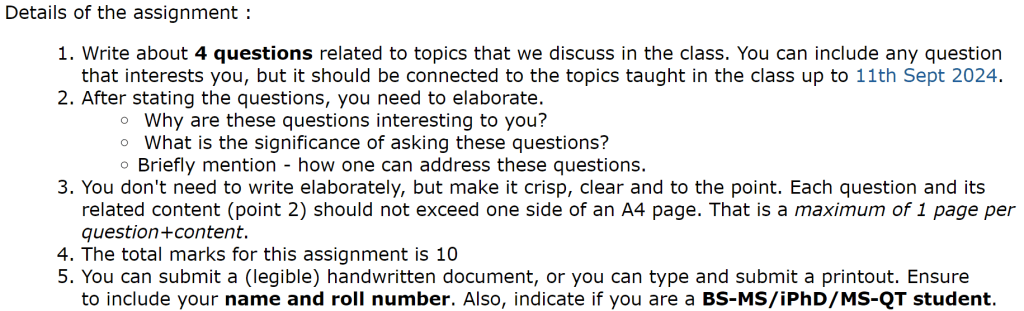
Questions as a class assignment

Over the years, I have been giving student assignments to write about their questions (rather than answers to my Qs).

Snapshot of email to my class below.

I have found some gems in the process and importantly reduces the ‘burden’ of single right answers. Student feedback on this process has been positive.

Even in the ChatGPT era, it is the quality of Qs that determines the answer, and in this assignment, students are free to choose their Qs as per their interest and experience connected to what I teach…something harder for ChatGPT to grasp (as of now).

Interesting times ahead.

Meditation on Questioning

Why do humans ask questions?

This question fascinates me.

Here is what I have been learning from my observations :

1) Children tend to ask questions that are driven by curiosity. If these questions are refined, they turn out to be philosophical. Eg: Why do we live?

2) Adults tend to ask questions that are generally connected to economics. On average, their questions are more on ‘how’ than on ‘why’.

3) A dialogue is actually a volley of questions and answers. We somehow tend to under-appreciate this. What we generally ascribe to Socrates is something present in all cultures. It is worth exploring this questioning tradition in all cultures. Eg.: Tarka shastra.

4) A great way to engage with a book is to read it as a series of answers to implicit questions. I am amazed to see how interesting and active reading becomes. This also works for research papers and sometimes even on fiction.

5) A collection of questions is a sub-set of knowledge. The answers derived from these questions can lead to further questions. Following this process will give you a ‘body of knowledge’. There is some fractal nature to this.

6) Scientific thinking is essentially a systematic way of asking questions. The operational word here is ‘systematic’. The structure of these questions is such that it fosters further enquiry, but it is also open-ended. That way, it gives us room for creative thinking.

7) Creative thinking, in essence, is a question of effective combination. It becomes ‘creative’ when the sum of parts creates something new AND relevant. The conjunction is its vitality.

8) Finding an error in our thinking also originates in questioning. In fact, error analysis is a form of questioning from a different viewpoint. It requires us to shift our perspective, and the central question is where and when to shift?

9) Questioning is an inherent human quality. Fostering this is not only existential but also very useful. Etymologically “systematic treatment of an art, craft, or technique” means technology. If you observe, its roots are connected to scientific thinking (see 6).

10) Questioning is generally considered a part of the means to an end. If you observe, it is a means that never ends. Worth asking – Why?