Renny Thomas is an Assistant Professor of Sociology and Social Anthropology at IISER Bhopal. An anthropologist of science, his research explores the intersection of science, religion, and culture in India. He is the author of Science and Religion in India: Beyond Disenchantment (2021) and co-editor of books: Mapping Scientific Method: Disciplinary Narrations (2022) and Decolonial Keywords: South Asian Thoughts and Attitudes (2026). Thomas, recently, was also the Taki Visiting Global Professor at New York University.
In this episode, we explore the sociology of science from an Indian perspective.
Anderson, Robert S. ‘Science and Religion in India: Beyond Disenchantment: By Renny Thomas, New York, Routledge, 2022, 203 Pp., $128CAD (Hardback), ISBN 9781032073194’. Tapuya: Latin American Science, Technology and Society 5, no. 1 (2022): 2141013. https://doi.org/10.1080/25729861.2022.2141013.
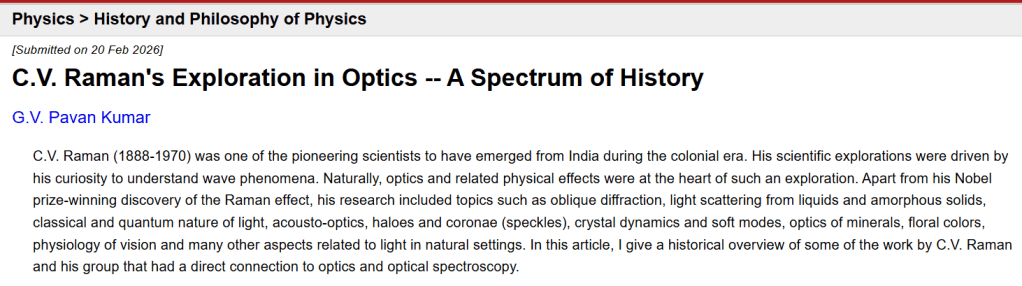
Journal of the Optical Society of America is coming up with a special issue on Optics in South Asia. I was invited to write a historical overview of Raman’s work on optics. Below is the snapshot of the pre-print. It should also appear in the axriv in the coming week. Meanwhile, you can access the preprint PDF below.
Also, look out for a research article from my group on multipolar optical binding submitted to the same issue. I will post a link when it appears as a pre-print.
Acknowledgements:
Professor Anurag Sharma, IIT, Delhi, for inviting me to write about Raman;
Other editors of this issue for taking the initiative.
Digital Archive Depository of Raman Research Institute
Debarati Chatterjee is a Professor of theoretical astrophysicist at IUCAA and the Chair of Education and Public Outreach for the LIGO-India project. An avid science communicator, she founded the Indian branch of the Pint of Science festival and regularly holds outreach events in multiple languages to make science accessible to all.
In this episode, we explore her intellectual journey so far.
12.Sharma, Kanika. ‘I Encourage Women to Claim Their Space in Astrophysics and Beyond’. Nature, ahead of print, 21 November 2025. https://doi.org/10.1038/d41586-025-03400-1.
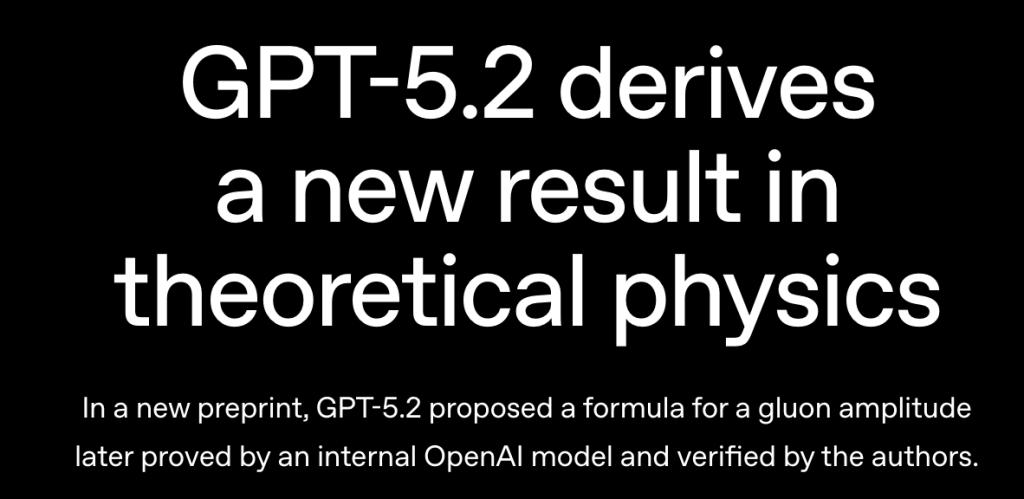
The above snapshot is from OpenAI, which has claimed to have derived a new result in theoretical physics. What is it about, and how good are the claims? Below, I discuss them.
Let me start with some background. Except for the hydrogen atom, the nucleus of all elements in the periodic table consists of neutrons and protons. Neutrons and protons are made of quarks. Quarks interact through gluons. How do these gluons interact? This is a contemporary question.
In this particular case, the authors of the study say: “We’ve published a new preprint showing that a type of particle interaction many physicists expected would not occur can, in fact, arise under specific conditions. The work focuses on gluons, the particles that carry the strong nuclear force.”[1]
The interaction can be computed in terms of probabilities[2], and these probabilities depend on quantum mechanical amplitudes (also called scattering amplitudes). Finding these amplitudes requires a deeper knowledge of strong nuclear forces. Computing such amplitudes is expensive and requires a lot of effort. Physicists, under physical constraints, take a guess on which interaction is more probable and which is not. This study shows that one of the interactions that physicists thought was not probable turns out to be probable, but under specific conditions. “The preprint studies a central concept in particle physics called a scattering amplitude. A scattering amplitude is the quantity physicists use to compute the probability that particles interact in a particular way. …….One case, however, has generally been treated as absent (having zero amplitude)……..As a result, this configuration has largely been set aside. The preprint shows that this conclusion is too strong.”[1]
Of course, this has been possible using the brute force computational capability of the GPT 5.2 model, and it has come up with a particular formula that shows the amplitude to be probable and has further validated it with a formal proof. It is a methodological breakthrough, and the authors claim, “An internal scaffolded version of GPT‑5.2 then spent roughly 12 hours reasoning through the problem, coming up with the same formula and producing a formal proof of its validity.” [1]
I think it is a good development in computational physics and helps in calculating parameters that have relevance in finding probabilities of interaction in particle physics. Overall, my hunch is that it is an important step in computational physics.
Notes:
[1] OpenAI has put out an excellent summary of this problem (without jargon), and it needs basic physics, and the flow of text is good.
Siddhesh Kamat is Professor of Biology at IISER Pune. His research explores lipid signaling, chemical biology, metabolomics, and serine hydrolases in neurodegeneration and immunity. In 2024, he was awarded the Infosys Prize (Life Sciences). He has also played under-14 cricket for Mumbai.
In this episode, we explore his intellectual journey and how sports played a vital role in his thinking.
Below are a couple of paragraphs that caught my attention:
“Scientific understanding and scientific discovery are both important aims in science. The two are distinct in the sense that scientific discovery is possible without new scientific understanding….
…..to design new efficient molecules for organic laser diodes, a search space of 1.6 million was explored using ML and quantum chemistry insights. The top candidate was experimentally synthesized and investigated. Thereby, the authors of this study discovered new molecules with very high quantum efficiency. Whereas these discoveries could have important technological consequences, the results do not provide new scientific understanding.”
The authors provide two more examples of a similar kind, from different branches of science.
The authors conclude:
“Undoubtedly, advanced computational methods in general and in AI specifically will further revolutionize how scientists investigate the secrets of our world. We outline how these new methods can directly contribute to acquiring new scientific understanding. We suspect that significant future progress in the use of AI to acquire scientific understanding will require multidisciplinary collaborations between natural scientists, computer scientists and philosophers of science. Thus, we firmly believe that these research efforts can — within our lifetimes — transform AI into true agents of understanding that will directly contribute to one of the main goals of science, namely, scientific understanding.”
Nice.. thanks for sharing, will go through it. Although a lot of brute force seems to be passed off as understanding these days (brawn = brain?) I wonder if AI and ML of the varieties we have today are advancements in computing or intelligence?
My reply:
The computational capability is undoubtedly great, and probably the coding/software domain has been conquered, but there is a tendency to extrapolate the immediate impact of AI to every domain of human life, where even basic tech has not made an impact. That needs deeper knowledge of interfacing AI with other domains of engineering. Embedding AI in the virtual domain is one thing, but to put it in the real world with noise is a different game altogether. That needs interfacing with the physical world, and there is also an energy expense that doesn’t get factored into the discussion. It has great potential, and I’m eager to see its impact on the physical infrastructure. Parallelly, it is interesting to see how it has been sold in the public domain.
A gentle reminder: Digital infrastructure is not equal to physical infrastructure.
The former is a smaller set of the four-dimensional space-time world we live in.
AI-based tech is fantastic for an upgrade in digital infrastructure and has already made tremendous progress. But the real deal is in the physical domain.
This also indicates where the future action is, and will be influenced by our understanding of physical sciences, including engineering domains beyond computer science.
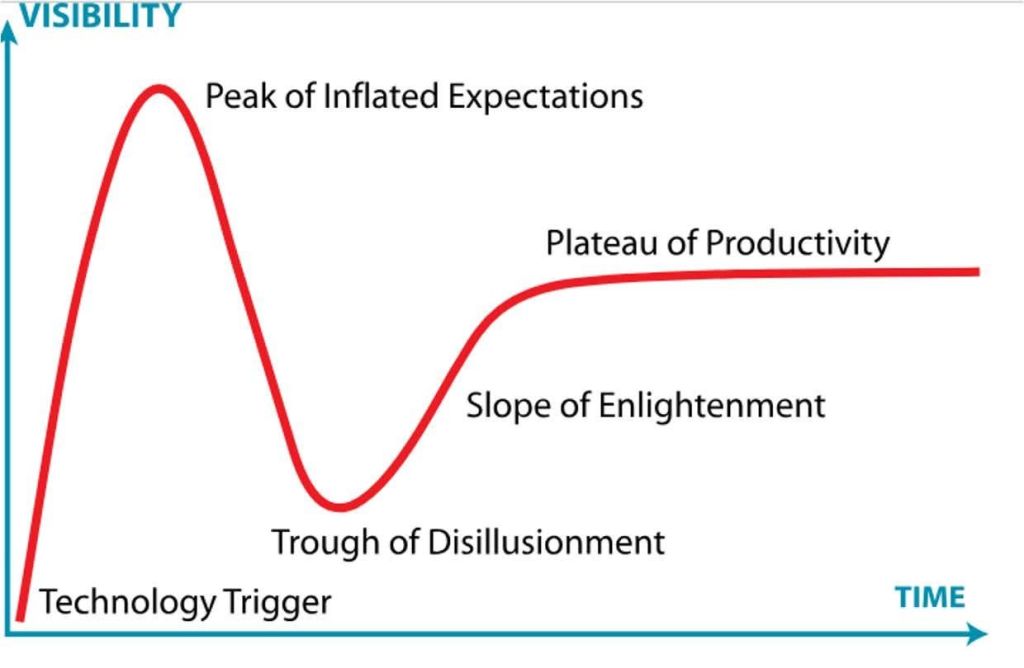
What we are witnessing in AI is probably the peak of Gartner’s hype cycle.
If you need to admire complex analysis for its elegance and visual utility, try quantum optics. Specifically, the description of quantum states. Thanks to creation and annihilation operators, the position and momentum states of a quantum optical field can be represented as quadratures. These entities can now be represented on the orthogonal axes of a complex plane. The representation of Argand diagrams starting with a classical electromagnetic field and then extrapolating them to quantum theory is a tribute to its geometrical representation. The fact that two axes can be utilized to represent real and imaginary parts of the defined state is itself an interesting thing. By certain operations within the plane, one can realize the vacuum state, the coherent state, and the squeezed state of quantum optics.
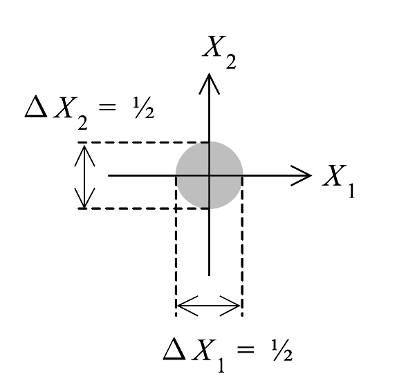
The Vacuum Spread – One of the major consequences of quantum theory, and especially the second quantization, is the realization of the vacuum states. Even when there are zero photons, there is a residual energy in the system that manifests as vacuum states. How to define the presence or absence of a photon is a different proposition because vacuum states are also associated with something called virtual photons. That needs a separate discussion. Anyway, in a complex plane of quadrature, a vacuum state is represented by a circular blob and not a point (see fig. 1). It is the spread of the blob that indicates the uncertainty. In a way, it is an elegant representation of the uncertainty principle itself because the spread in the plane indicates the error in its measurement. Importantly, it emphasizes the point that no matter how low the energy of the system is, there is an inherent uncertainty in the quadrature of the field. This also forms the fundamental difference between a classical and a quantum state. The measurement of the vacuum fluctuation is a challenging task, but one of the most prevalent consequences of vacuum fluctuation is the oblivious spontaneous emission. If one looks at the emission process in terms of stimulated and spontaneous pathways, then the logical consequence of the vacuum state becomes evident in some literature on quantum optics. Spontaneous emission is also defined as stimulated emission triggered by vacuum state fluctuations. It is an interesting viewpoint and helps us to create a picture of the emission process vis-à-vis the stimulated emission.
Figure 1. Vacuum state representation. Note that their centre is at the origin and has a finite spread across all the quadrants. Figure adapted from ref. 2.
Another manifestation of the vacuum state is the Casimir effect, where an attractive force is induced as you bring two parallel plates close to each other. The distance being of the order of the wavelength or below this triggers a fascinating phenomenon which has deep implications not only in understanding the fundamentals of quantum optics and electrodynamics, but also in the design and development of quantum nanomechanical devices.
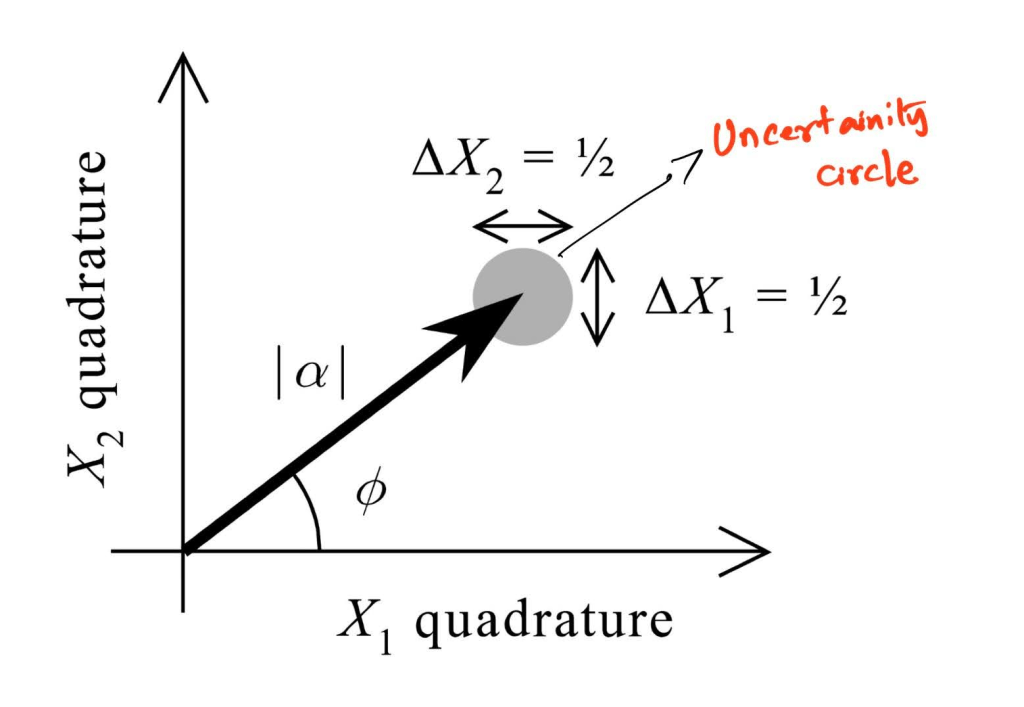
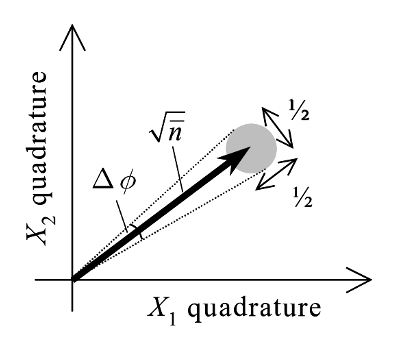
A shift in the plane – Coherent states are also described as displaced vacuum states, and this displacement is evident in the Argand diagrams. The quadrature can now help us visualize the uncertainty in the phase and the number of photons in the optical field. One of the logical consequences of the coherent state is the number-phase uncertainty. This gets clear if one observes the spread in the angle of the vector and the radius of the blob represented (see Fig. 2). Notice that the blob still exists. The only difference is that the location of the blob has shifted. The consequence of this spread has a deeper connection to the uncertainty in the average number of photons and the phase of the optical field. The connection to the number of photons is through the mod alpha, which essentially represents the square root of the average number of photons. Taken together, the blob in the Argand diagram represents the number-phase uncertainty.
Figure 2. Coherent state representation. Note that their centre is displaced. Figure adapted from ref. 2.
Lasers are the prototypical examples of coherent states. The fact that they obey Poissonian statistics is the direct consequence of the variance in the photon number, which is equivalent to the square root of the average number of photons. This means one can use photon statistics to discriminate between sources that are sub-Poissonian, Poissonian, or super-Poissonian in nature. The super-Poissonian case is the thermal light, and the sub-Poissonian state represents photon states whose number can reach up to 1 or 0. The coherent states sit in the middle, obeying the Poissonian statistics.
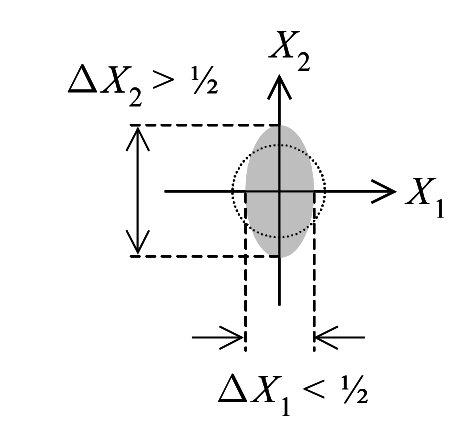
Everything has a cost – Once you have a circle with a defined area, it will be interesting to ask: Can you ‘squeeze’ this circle without changing its area? The answer is yes, and that is what manifests as a squeezed state. In this special state, one can squeeze the blob along one of the axes at the cost of a spread in the orthogonal direction. This converts the circle into an ellipse (see Fig. 3).
Figure 3. Squeezed State. Note the circle has been squeezed into an ellipse. Figure adapted from ref. 2.
Note that the area must be conserved, which means that the uncertainty principle still holds good; just that the reduction in the uncertainty along one axis is compensated by the increment in another. This geometrical trick has a deep connection to the behaviour of an optical field. If one squeezes the axis along the average number of photons, it means that you are able to create an amplitude-squeezed state. This means the uncertainty in the counting of photons in that state has reduced, albeit at the cost of the uncertainty in the measurement of phase. Similarly, if one squeezes the blob along the axis of the phase, then we end up with a lowering of the uncertainty for the optical phase. Of course, this comes at the cost of counting of number of photons. I should mention that the concept of optical phase itself is not clearly defined in quantum optics. This is because an ill-defined phase can have a value of 2π, which creates the problem. An interesting application of the phase-squeezed quantum states is in interferometric measurements. By reducing the uncertainty in the phase, one can create highly accurate measurements of phase shifts. So much so that this can have direct implications on high-precision measurements, including gravitational wave detection. The anticipation is also that such tiny shifts can be helpful in observing feeble fluctuations in macroscopic quantum systems.
Pictures can lead to more than 1,000 words. And if you add them to a quantum optical description, as in the case of the states that I have defined, they create a quantum tapestry. Perhaps this is the beauty of physics, where there is a coherence between mathematical language, geometrical representation, and physical reality. Feynman semi-jokingly may have said, “Nobody understands quantum mechanics,” but he forgot to add that there is great joy in the process of understanding through mathematical pictures. After all, he knew the power of diagrams.
References:
Ficek, Zbigniew, and Mohamed Ridza Wahiddin. Quantum Optics for Beginners. 1st edition. Jenny Stanford Publishing, 2014.
Fox, Mark. Quantum Optics: An Introduction. Oxford Master Series in Physics 15. Oxford University Press, 2006.
Gerry, Christopher C., and Peter L. Knight. Introductory Quantum Optics. Cambridge, United Kingdom ; New York, NY, 2024.
Saleh, B. E. A., and M. C. Teich. Fundamentals of Photonics. 2nd edition. Wiley India Pvt Ltd, 2012.
 VISMAYA - History & Philosophy of Physics