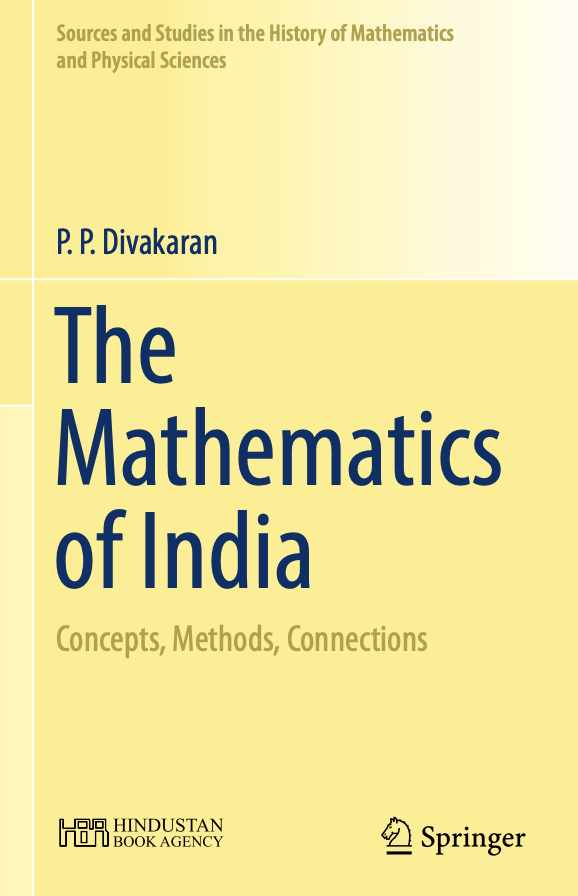
In recent years, this has been one of the best books on the history of mathematics in India. The late Prof. Divakaran was a theoretical physicist and a scholar.
This book is also an excellent example of how a scientist can present historical facts and analyse them with rigour and nuance. Particularly, it puts the Indian contribution in the global context and shows how ideas are exchanged across the geography. The writing is jargon-free and can be understood by anyone interested in mathematics.
Unfortunately, the cost of the book ranges from Rs 8800 to Rs 14,000 (depending on the version), which is a shame. Part of the reason why scholarly books, particularly in India, don’t get the traction is because of such high cost. This needs to change for the betterment and penetration of knowledge in a vast society such as India.
There is a nice video by numberphile on Prof. Divakaran and his book:
I have been teaching polarization of light in my optics class. In there, I introduced them to matrix representation of polarization states. One of the standard references that I use for explanation is a 1954 paper in American J. Physics, by McMaster titled: “Polarization and the Stokes Parameters.”
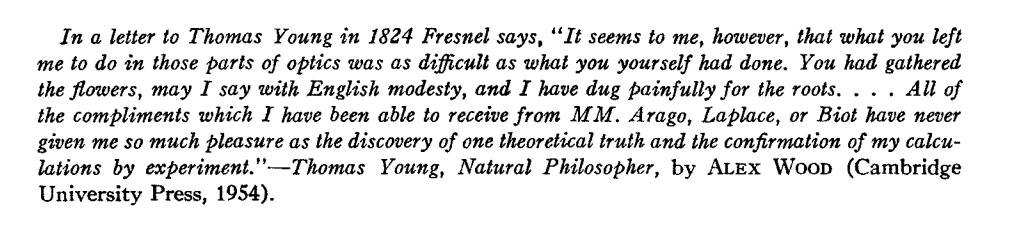
While skimming through the pdf of the journal paper, I found an excerpt from a 1954 book, which quotes Fresnel writing to Thomas Young:
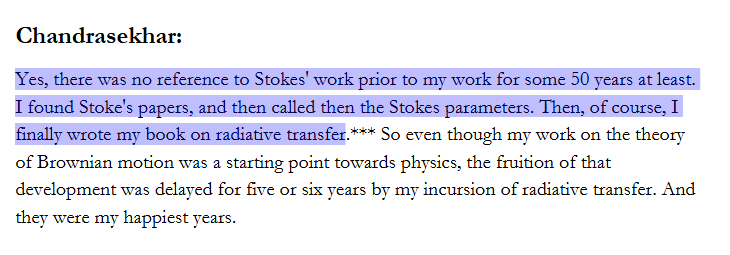
Further, I knew from the past that S. Chandrasekhar (astrophysicist) had a role in rejuvenating Stokes vector formalism in radiative transfer. Below is his description from AIP oral history archives (May 1977):
” I started the sequence of papers, and almost at the time I started it, I read the paper by Wick in which he had used the method of discrete coordinates,* and I realized at once that that method can be used in a large scale way for solving all problems. So that went on. I have always said and felt that the five years inwhich I worked on radiative transfer [1944 – 49] is the happiest period of my scientific life. I started on it with no idea that one paper would lead to another, which would lead to another, which would lead to another and soon for some 24 papers — and the wholesubject moved with its own momentum.” (emphasis added)
He further states how he rediscovered Stokes polarization vector formalism:
“All this had a momentum of it own. Then suddenly I realized one had to put polarization in;the problems of characterizing polarized light — my rediscovery of Stokes originalpaper, writing on Stokes parameters and calling them Stokes parameters for the first time“
Chandra further adds that the Stokes formalism was almost forgotten for 50 years, and he had a role in resurrecting it.
Next, there was some noise on social media where some one questioned the utility of matrix multiplication. For them, below is a wonderful review article by McMaster (again), to explore from polarization viewpoint, and realize the power of non-commutative matrix algebra:
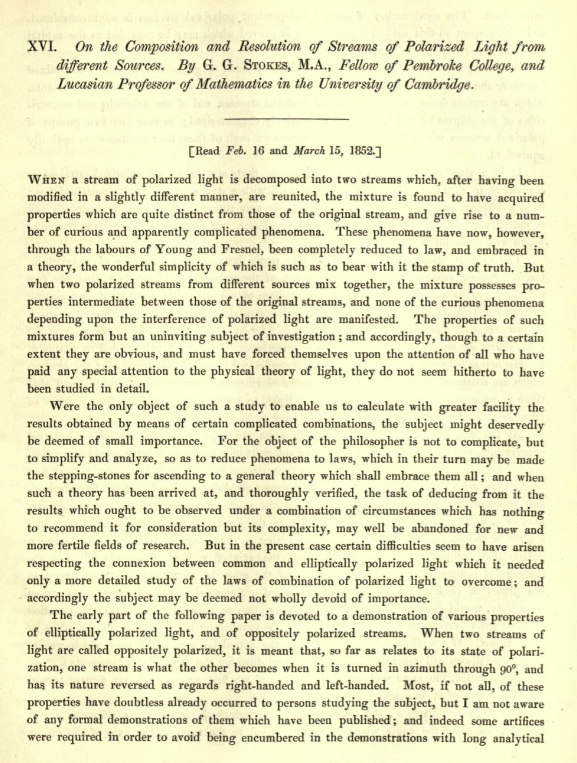
Finally, the original paper by Stokes on his formalism, which is hard to find (thanks to paywall). But, classic papers are hard to suppress, and I found the full paper on internet archives.
‘There is a story about two friends, who were classmates in high school, talking about their jobs. One of them became a statistician and was working on population trends. He showed a reprint to his former classmate, The reprint started, as usual, with the Gaussian distribution and the statistician explained to his former classmate the meaning of the symbols for the actual population, for the average population, and so on. His classmate was a bit incredulous and was not quite sure whether the statistician was pulling his leg. “How can you know that?” was his query. “And what is this symbol here?” “Oh,” said the statistician, “this is π.” “What is that?” “The ratio of the circumference of the circle to its diameter.” “Well, now you are pushing your joke too far,” said the classmate, “surely the population has nothing to do with the circumference of the circle.”’
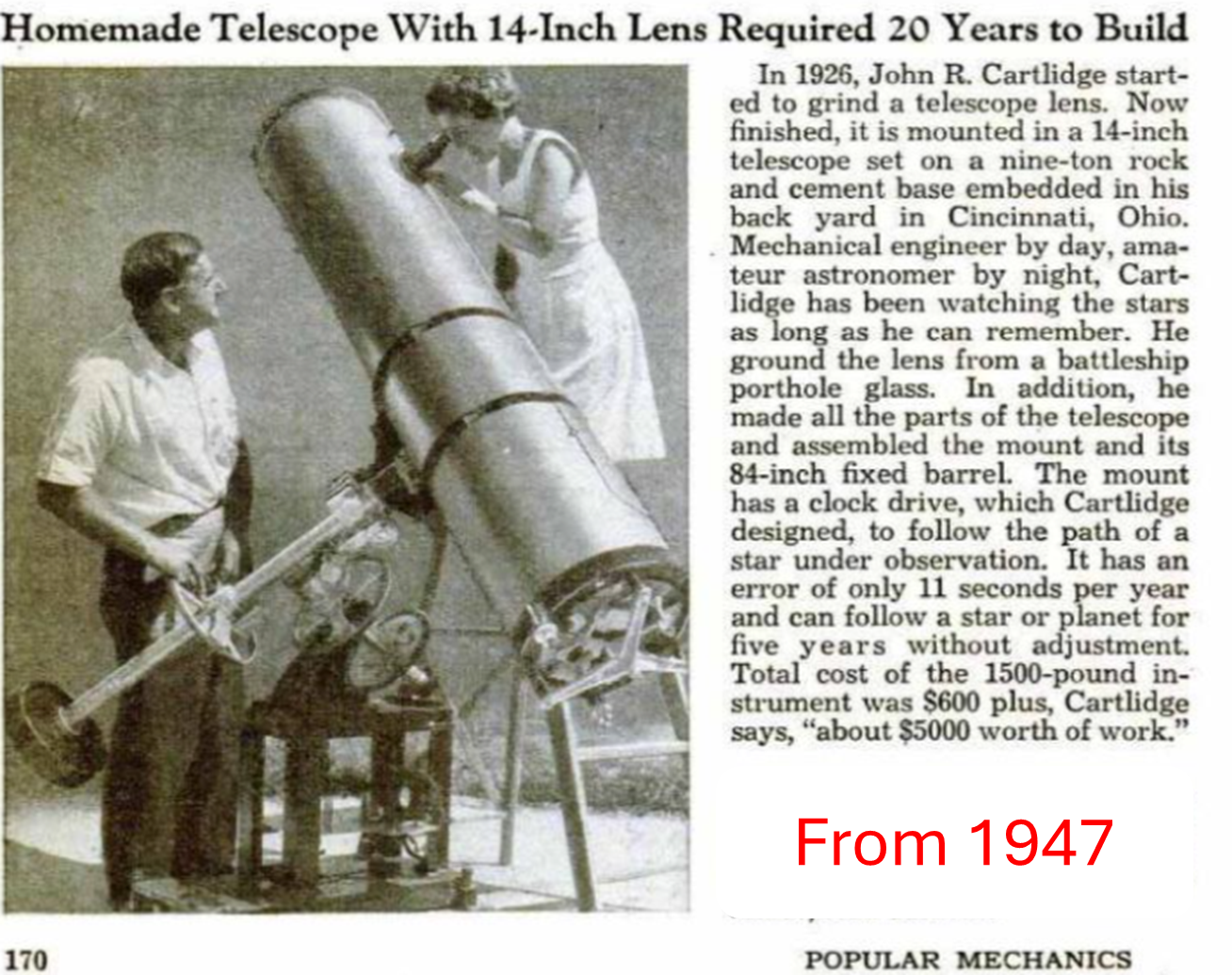
For ages, human beings have been curious about stars. Telescopes as observational tools have changed how human beings have studied and understood astronomical objects. Below is a snapshot from a 1947 edition of popular mechanics that features someone named John Cartlidge from USA. He was a mechanical engineer and an amateur astronomer. The story reveals that he took 20 years to build the telescope, and the description text from the magazine is an interesting read. An amount of $600 plus, for that era, sounds expensive. But what is astonishing is the 20-year effort to build a telescope.
This instance of human effort to pursue curiosity connects well to a wonderful poem: ‘Curiosity’ by David Jilk, and below I reproduce a stanza from it:
“Your greatest teacher is the world itself and glory comes to those who find her codes; for she is coy, no book upon a shelf, and must be queried via crab-walk modes: your question is, which questions make inroads? Instruction thus proceeds aesthetically with obverse strokes of creativity.“
Amateur astronomy fosters that strokes of creativity. After all, sky is the only limit !
Today, in my optics class, I discussed optical forces due to momentum in electromagnetic waves. Towards the late 1800s, it was realized that light can impart momentum. This manifested as radiation pressure in the electromagnetic theory proposed by James Maxwell.
Pyotr Nikolaevich Lebedev (24 February 1866 – 1 March 1912) was one of the earliest to experimentally measure (~1899) the radiation pressure on a surface (link to his 1900 paper in German). In 1991, the Soviet Union released a 1 ruble coin (pictured above) to commemorate Lebedev’s scientific achievement.
The formula expresses the total momentum transferred per unit time ( radiation pressure, P) by a beam of N photons, each of energy hν, that is incident on a surface with a coefficient of reflectivity ρ. The constant, c, is the speed of light.
Some writing advice (mainly physics) I shared with my undergraduate class. This may be useful to others.
Equations, data and figures make meaning when you include a context. This context is expressed using words. Symbols and data by themselves cannot complete the meaning of an argument, unless one knows the context. A common mistake undergraduates make in an exam is to answer questions using only symbols and figures and assume the reader can understand the context.
One way to treat writing in physics (in this case, an exam paper or an assignment) is to imagine you are talking to a fellow physics student who is not part of the course you are writing about. This means you can assume some knowledge, but not the context. Anticipate their questions and address them in the text you are writing. This model also works while writing research papers with some caveats.
While you refer to equations, data and figures in your assignment, make sure you cite the reference at the location of the content you are discussing. Merely listing the references at the end of the document does not make the connection. Remember, while talking, you never do this kind of referencing.
It is useful to structure your arguments with headings, sub-headings and a numbered list. This gives a visual representation of your arguments. You may not find this kind of structured writing in novels, other forms of fictional writing and also in some literature related to social sciences, but in natural sciences with dense information, this will be very useful. Always remember, while writing science (or any form of nonfiction writing), clarity comes before aesthetics.
Also, below is another blog related to written assignments.
“For me, there are two implications of doing science. One is that science is extremely useful to society, and the second is that it is a good, thoughtful way of living one’s life. Communicating the second implication is important to me, and I do this by researching, writing, and podcasting about the history and philosophy of science (physics in particular). This path helps people understand the human element of doing science and reveals a context. Some of my blogs (filtered here) discuss why I do science and how I do it. More than ‘influencing’ the audience, I am interested in inviting them to explore science by themselves via their own curiosity. That is one reason why my blog is called VISMAYA.”
Images from: Leslie, Stuart W., and Indira Chowdhury. ‘Homi Bhabha Master Builder of Nuclear India’. Physics Today 71, no. 9 (2018): 48–55. https://doi.org/10.1063/PT.3.4021.
When we remember and talk about building modern, scientific India, we must acknowledge past scientists who played a critical role in taking ideas and turning them into reality. Homi Bhabha (image on left) was one of the pioneers. But we must also remember many unknown people of India who literally built modern scientific facilities, such as the CIRUS nuclear reactor (image on right is from 1958). Although their faces are invisible, their contributions should not be.
The 2025 Nobel Prize in physics has been awarded to John Clarke, Michel H. Devoret and John M. Martinis “for the discovery of macroscopic quantum mechanical tunnelling and energy quantisation in an electric circuit.“
The Nobel Prize webpage has an excellent summary of the work at popular and technical levels.
In this blog, I want to draw attention to an interesting review article from 1984 by Anthony Leggett that pre-empts the awarded work. Leggett himself was a Nobel laureate (2003), and his work on the theory of superconductors and superfluids forms one of the conceptual foundations for this year’s Nobel prize. Four of his papers have been cited by the Nobel committee as part of the scientific description of the award, and one of them is a review article I wish to emphasize.
The title of Leggett’s review is “Schrödinger’s cat and her laboratory cousins“. It discusses the detection and implication of macroscopic quantum mechanical entities, and has a description of the so-called Schrödinger’s cat, which is essentially a thought experiment describing quantum superposition and the bizarre consequence of such a formulation. Leggett utilizes this conceptual picture of the cat (in alive and dead states) and extends this to possible scenarios in which the macroscopic quantum superposition can be detected and verified under laboratory conditions. The text below from his review captures the essence of the concept and connects it to experimental verification :
“It is probably true to say that most physicists who are even conscious of the existence of the Cat paradox are inclined to dismiss it somewhat impatiently as a typical philosophers’ problem which no practising scientist need worry about. The reason why such an attitude can be maintained is that close examination of the paradox has seemed to lead to the conclusion that, worrying or not at the metaphysical level, it has at any rate no observable consequences: that is, the experimental consequences of the above apparently bizarre description are quite undetectable. Since physicists, by virtue of their profession, tend to be impatient of questions to which they know a priori no experiment can conceivably be relevant, they have tended to shrug off the paradox and leave the philosophers to worry about it.
Over the last few years, thanks to rapid advances in cryogenics, noise control and microfabrication technologies, it has become clear that the above conclusion may be over-optimistic (or pessimistic, depending on one’s point of view!). To be sure, it is unlikely that in the foreseeable future we will be able to exhibit the experimental consequences of a cat being in a linear superposition of states corresponding to life and death. However, at a more modest level it is possible to ask whether it would be possible to exhibit any macroscopic object in a superposition of states which by a reasonable common-sense criterion could be called macroscopically different. The answer which seems to be emerging is that it is almost certainly possible to obtain circumstantial evidence of such a state of affairs, and not out of the question that one might be able to set up a more spectacular, direct demonstration. This is the subject of this article.“
Cut to 2025, this is also the subject of the Nobel Prize in Physics today.