How to Build Atomic LEGOs?

In ~8min, I try to explain how and why to build atomic Legos and their potential applications.

The video is for non-experts.

Reference for further reading:

Geim, A. K., and I. V. Grigorieva. ‘Van Der Waals Heterostructures’. Nature 499, no. 7459 (2013): 419–25. https://doi.org/10.1038/nature12385.

Humanizing Science – A Conversation with a Student

Recently, I was talking to a college student who had read some of my blogs. He was interested in knowing what it means to humanize science. I told him that there are at least three aspects to it.

First is to bring out the wonder and curiosity in a human being in the pursuit of science. The second was to emphasize human qualities such as compassion, effort, mistakes, wrong directions, greed, competition and humour in the pursuit of science. The third thing was to bring out the utilitarian perspective.

The student was able to understand the first two points but wondered why utility was important in the pursuit of humanizing science. I mentioned that the origins of curiosity and various human tendencies can also be intertwined with the ability to use ideas. Some of the great discoveries and inventions, including those in the so-called “pure science” categories, have happened in the process of addressing a question that had its origin in some form of an application.

Some of the remarkable ideas in science have emerged in the process of applying another idea. Two great examples came into my mind: the invention of LASERs, and pasteurization.

I mentioned that economics has had a major role in influencing human ideas – directly or indirectly. As we conversed, I told the student that there is sometimes a tendency among young people who are motivated to do science to look down upon ideas that may have application and utility. I said that this needs a change in the mindset, and one way to do so is to study the history, philosophy and economics of science. I said that there are umpteen examples in history where applications have led to great ideas, both experimental and theoretical in nature, including mathematics.

Further, the student asked me for a few references, and I suggested a few sources. Specifically, I quoted to him what Einstein had said:

 “….So many people today—and even professional scientists—seem to me like someone who has seen thousands of trees but has never seen a forest. A knowledge of the historic and philosophical background gives that kind of independence from prejudices of his generation from which most scientists are suffering. This independence created by philosophical insight is—in my opinion—the mark of distinction between a mere artisan or specialist and a real seeker after truth..”

The student was pleasantly surprised and asked me how this is connected to economics. I mentioned that physicists like Marie Curie, Einstein and Feynman did think of applications and referred to the famous lecture by Feynman titled “There is Plenty of Room at the Bottom(1959).

To give a gist of his thinking, I showed what Feynman had to say on miniaturization:

There may even be an economic point to this business of making things very small. Let me remind you of some of the problems of computing machines. In computers we have to store an enormous amount of information. The kind of writing that I was mentioning before, in which I had everything down as a distribution of metal, is permanent. Much more interesting to a computer is a way of writing, erasing, and writing something else. (This is usually because we don’t want to waste the material on which we have just written. Yet if we could write it in a very small space, it wouldn’t make any difference; it could just be thrown away after it was read. It doesn’t cost very much for the material).”

I mentioned that this line of thinking on minaturization is now a major area of physics and has reached the quantum limit. The student was excited and left after noting the references.

On reflecting on the conversation, now I think that there is plenty of room to humanize science.

A quantum survery – 3 thoughts

One of the joys of studying quantum mechanics, at any stage of a career, is to be aware of the fact that there is more scope for interpretations and understanding. This notion has not changed for several decades. A recent survey reinforces this thought.

There are at least 3 interesting points that I infer from the situation:

1) The interpretation of reality at the quantum scale is probabilistic. This has served us well in experiments and has led to the founding of quantum technologies. We are in a situation in the history of science where the philosophical foundations are uncertain, but the technological implications are profound.

2) Having more data is always good, but for a new leap of thought, we may have to pay attention to new connections among the data. Can AI play a role in this?

3) There is more room for exploration in the foundations of quantum physics. Philosophy of physics has a role to play in this exploration. Physics students and researchers with (analytical) philosophical inclination have an opportunity to contribution. This needs a grounding in understanding mathematics and experiments related to quantum physics. I see this as a great opportunity for someone to enter the field.

Conclusion: Good time to explore the foundations of physics*

*subject to support from society

Tony Tyson and a giant CCD camera

Recently, I came across an interview with Tony Tyson, one of the main scientists related to the Rubin telescope. He says:

“We can do better than this. We can build a larger telescope by making larger mosaics of larger CCDs.”
— Tony Tyson

On a day when India lost a test match, the first sentence rings loud…anyway, the topic of this post is a fascinating development happening in observational cosmology.

Tony’s suggestion above is a great, ambitious way to explore the Universe….by building effective observational tools that can image and comprehend the observable…and perhaps unobservable too…

For students: Observational cosmology is a great place to explore cutting-edge science: physics (experiments + theory), maths, engineering & computation…all come together..

Check out the interview of Tony Tyson…one of the brains behind the cameras of Rubin Observatory…plenty to learn…

Just like test cricket, observational cosmology needs patience…perhaps a good lesson for life too…

Sanskrit subhashita – don’t waste

Here is a Sanskrit subhashita that I like.

वृथा वृष्टि: समुद्रेषु वृथा तृप्तेषु भोजनम्।

वृथा दानम् धनाढ्येषु वृथा दीपो दिवाऽपि च॥

LLMs are getting better at translations.

Below is a comparison of translations on 2 platforms

English Translation from perplexity AI:

Rain over the ocean is wasted, food for those who are already full is wasted; Charity to the wealthy is wasted, and a lamp during the daytime is wasted.

English translation from ChatGPT:

Rain over the ocean is in vain, food for one who is already full is in vain; Charity to the wealthy is in vain, and a lamp during the day is also in vain.

Optothermally induced active & chiral motion – a new paper

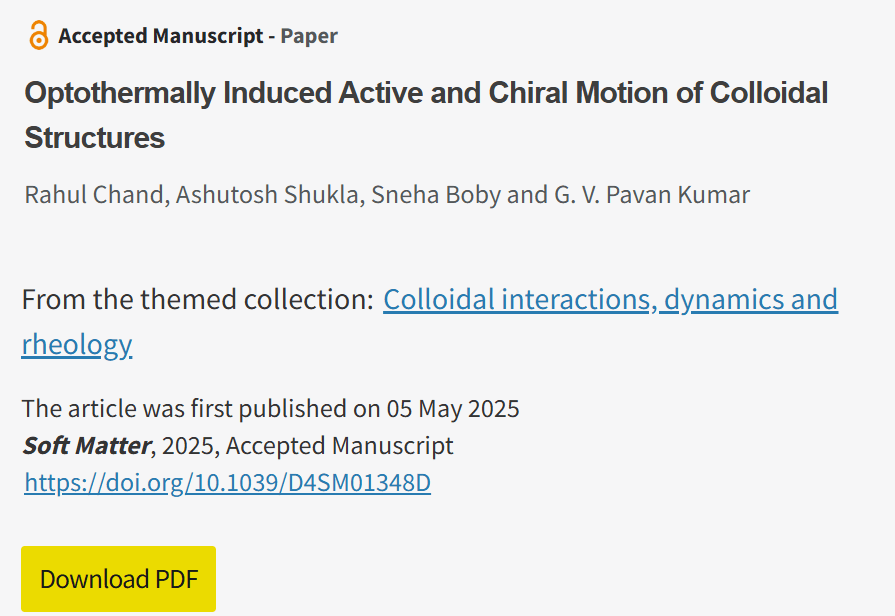
We have a new paper in Soft Matter

link to the paper (free to access, thanks to IISER Pune library)

We use optical illumination to generate thermal fields, creating non-reciprocal interactions between passive and active colloids. Active colloids absorb light and produce thermal gradients, driving thermo-osmotic forces that induce propulsion and chiral motion. Our Langevin simulations, backed by experimental observation, reveal how to control colloidal behavior. May have implications in light-driven chiral motion and nonlinear dynamics.

Super effort by Rahul, Ashutosh & Sneha from our group, who combined numerical simulations, analytical theory, with experimental observations.

The 2 anonymous reviewers made us think and work hard, and we thank them!

Also, the paper is part of the journal’s themed collection on “Colloidal interactions, dynamics and rheology”

Optical computing – review link and a few thoughts..

“How might optical computers beat electronic computers? …….. There are three main metrics of computing performance for which we might aim to achieve an advantage: latency, throughput and energy efficiency…”

A very readable review by Peter MacMahon of Cornell.

In the immediate future, designing energy-efficient computational platforms will be a necessity. Electronic transport is noisy and dissipative. Optical alternatives can be important, but challenges remain…

Given that the speed of light is the upper limit of information transport and processing, optics will be a vital ingredient in computation. In hindsight, it has already been. But there is more to it than just the speed, as the review article explains elaborately..

Interesting times ahead…