We have a new preprint: https://arxiv.org/abs/2411.15512


We have a new preprint: https://arxiv.org/abs/2411.15512
We have an arxiv preprint :
We explore some dynamic regimes of optical matter driven by heat+light…
https://arxiv.org/abs/2411.12488

Aninda Sinha is a theoretical physicist and a professor at Indian Institute of Science, Bengaluru: https://chep.iisc.ac.in/Personnel/asinha.html
He works at the interface of quantum field theory, superstrings and mathematical physics. In this episode, we explore his intellectual journey and discuss his recent work that led to a new series on pi, generalizing Madava’s series.
References:
References:
Pavan Kumar, G. V. “Gerhard Herzberg (1904–1999): A Pioneer in Molecular Spectroscopy.” Resonance 29 (2024): 1339. https://www.ias.ac.in/describe/article/reso/029/10/1339-1345.
Stoicheff, Boris. Gerhard Herzberg: An Illustrious Life in Science. Ottawa : Montréal ; Ithaca N.Y.: Canadian Forest Service,Canada, 2002.
Stoicheff, Boris P. “Gerhard Herzberg PC CC. 25 December 1904 – 3 March 1999.” Biographical Memoirs of Fellows of the Royal Society 49 (December 2003): 179–95. https://doi.org/10.1098/rsbm.2003.0011.
Gautam is a theoretical physicist who is driven by curiosity. His explorations include superconductivity, biophysics, active matter, public health, art, music etc.
He is a Professor & Dean at Ashoka University: https://www.ashoka.edu.in/profile/gautam-menon-2/.
In this episode, we discuss his intellectual journey until now.
References:
The Nobel Prize in Physics 2024 was awarded to John J. Hopfield and Geoffrey E. Hinton “for foundational discoveries and inventions that enable machine learning with artificial neural networks“. There has been much buzz surrounding this prize, especially in the context of whether these discoveries are indeed in the realm of mainstream physics. Many science commentators have questioned the choice and have provocatively dismissed it as ‘not part of mainstream physics’.
This has also brought into focus an important question: What is physics?
This question does not have a simple answer, given the rich history of the subject and its applicability over centuries. What we now call engineering is essentially an extrapolation of thinking in physics. New avenues have branched out from physics that cannot be readily identified as mainstream physics; a case in point is artificial intelligence and machine learning.
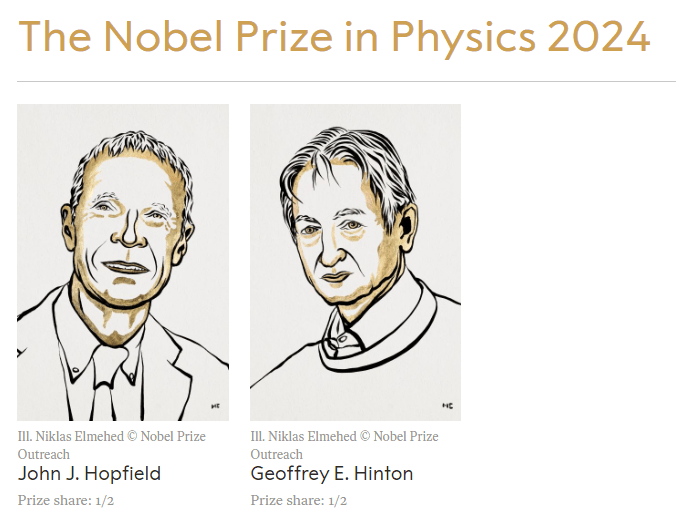
One of the aspects of mainstream physics is that the intellectual investment in the contemporary scenario is mainly driven by discoveries happening in the realm of quantum mechanics and general relativity. One of the mainstream problems in physics is to combine quantum mechanics and gravitation, which remains an unresolved task. Therefore, significant attention is paid to understanding these theories and verifying them through experimentation. Other areas and sub-disciplines in physics have become loosely connected to these two important theories.
There is another dimension to physics that is equally important and has vast applications: statistical physics. In statistical physics, the motivation comes from multi-particle systems and their applicability as models to understand our world, including biological systems. One utilizes knowledge from mathematics and statistics, combining them with physical laws to predict, invent and understand new forms and assemblies of matter. This thinking has been extrapolated to abstract assemblies and hence applied to a variety of situations. This approach has led to a revolution in how we can understand the realistic world because a statistical viewpoint is very useful for studying complex systems, such as many-body quantum mechanical aggregates (such as groups of electrons), dynamics of molecules inside a cell and the evolution of the stock market. Statistical physics plays a dominant role in all these situations. It has become a ubiquitous tool, making it difficult to directly connect it to basic principles of physics as taught in college textbooks and classrooms. It reminds me of a saying: if you are everywhere, then you are from nowhere.
This situation leads us back to the question: What is physics? John Hopfield himself offers an interesting definition related to this question, emphasizing that viewpoint is a crucial element. This perspective allows for greater freedom in using physics beyond conventional definitions. Among scientific disciplines, physics is always associated with its depth of understanding. This is a good opportunity to emphasize the breadth of physics, which is equally noteworthy.
In that light, the 2024 Nobel Prize in Physics should be welcomed as an expansion of the horizon of what constitutes physics. In a day and age where basic science has been questioned regarding its applicability to modern-day life and technology, this prize serves as a welcome change to showcase that basic science has played a fundamental role in establishing a contemporary tool of primary importance to society.
This point is particularly important because policymakers and politicians tend to focus on immediate issues and ask how they can influence them by using modern-day technology. Utility is central to this form of thinking. Given that basic sciences are often viewed as ‘not immediately useful’, this viewpoint diminishes the prominence of foundational disciplines: physics, chemistry, biology, and mathematics. In contrast, this prize reinforces the idea that building cutting-edge technology, which holds contemporary relevance and societal impact, has its roots in these foundational disciplines. In that sense, this prize is an important message because, like it or not, the Nobel Prize captures the attention not only of the scientific world but also of the public and, hence, of interest to politicians and policymakers.
Issac Asimov is attributed to have said: “There is a single light of science, and to brighten it anywhere is to brighten it everywhere.” The Nobel Prize in Physics 2024 fits that bill.
 VISMAYA - History & Philosophy of Physics