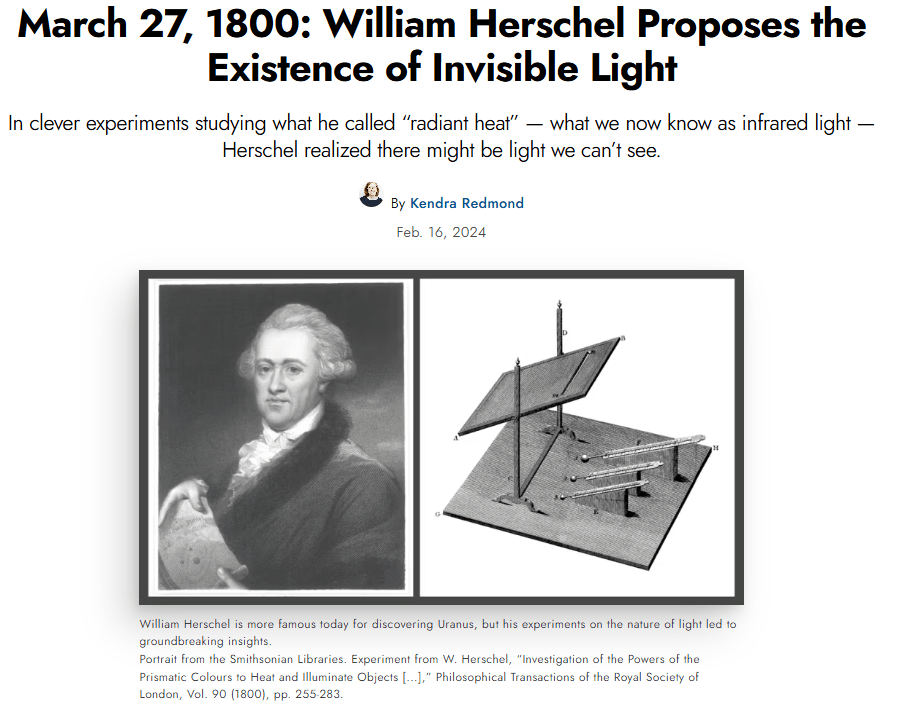
I came across a nice article on the discovery of Infra-red (IR) radiation by William Herschel. It has some information on how he detected the IR part of the electromagnetic spectrum.
It was interesting to note that Herschel’s viewpoint after writing a few papers on this topic was to conclude with uncertainty on the interpretation of his own result.
One may argue that he was not confident in his work, but to truly discover something new, one will have to be at the boundary of the unknown. At such an inflection point, uncertainty and self-criticism are so important, and I don’t blame Herschel for being circumspect.
Nevertheless, his work received attention in spite of his doubts and motivated other researchers, such as Ritter and Röntgen, to explore the extended spectrum of electromagnetic radiation.
Scientific progress is two steps forward and one step backward. The backward step (as in questioning new findings, verification, clarification and debate) is one of the hallmarks of scientific thinking, without which we may take many forward steps, albeit in a totally wrong direction.
Welcome to essays in A Global History of Physics, where I discuss people, ideas, philosophy and technology involved in the development of physics across the world
Some aspects of the essays are published in journals and magazines, and some are written as part of my podcast. The intention is to eventually collate them into book(s). You are free to use it for educational and non-commercial purposes with attribution.
Welcome to essays in the global history of physics, where we discuss people, ideas and technology connected to physics in the historical context. Let me explain why the global history of physics is important. Physics, as you know, is one of the central disciplines of natural sciences from which various branches of science and technology have emanated.
Understanding the evolution of such an important output of human thought is imperative. It not only gives us a glimpse of how people over the ages have thought about ideas but also reveals how those ideas are connected to philosophical and technological questions that were of interest to people in the past. In fact, it is that dual connection of physics to philosophy and technology that makes it interesting, important and intellectually rich.
This series of essays aims to capture the historical evolution of physics by paying attention to the global evolution of the subject. In doing so, we will visit the people from the past and learn about their ideas and technologies that eventually led to the topics within physics.
Here, I need to emphasize the global aspect of history. Conventionally, the history of science as a discipline has been criticized for being Eurocentric in nature. In recent years, as highlighted by James Poskett’s excellent book Horizons (1), there has been an emerging scholarship in the history of science to reveal a decentralized evolution of science and that includes some developments in physics itself. In these essays, I will give credit to people, ideas and technology irrespective of their origin and emphasize curiosity as a basic human instinct prevalent across space and time.
This thought reinforces science, specifically physics, as a global intellectual pursuit over many ages and times. The way I will do this is to take on a particular branch of physics and discuss its evolution in chronological order. Of course, my aim is not to cover everything that is known but to highlight some interesting developments in that field with attention to some interesting people, ideas, tools and technologies at the relevant place and time.
Such an exercise cannot be done in one single essay. So, I intend to cover the chronological evolution with a series of essays spanning all the branches of physics. Yes, it will be a long journey, and I hope you will accompany me in this one endeavor.
2. How a physical phenomenon is explained.
One starts with a concrete situation of a particular problem. Associated with this situation is a general law. One applies the general law to the situation in a logical manner and utilizes mathematical descriptions where precision is needed. This logical and mathematical description leads to an explanation witha concrete prediction. Observations must test this prediction. The ability to predict a future observation is one of the remarkable traits of science in general and physics in particular (2). It is through this ability to predict that one can envisage the utility of a physical concept. That utility forms the seed of development towards technology.
As you may observe, there is a nice connection between scientific inquiry and the eventual realization of technology. This connection is what makes science and technology go hand in hand. Importantly, this is one of the outstanding features of physics and historical explanation, as we intend to do in these essays, which will justify the claim.
This connection between science and technology is not a one-way coupling. In fact, many interesting questions in physics have emerged out of technological development across various eras of human history. This recognition of jugalbandhi between science and technology is at the heart of the essay series.
Physics has played a critical role in engineering civilization over the centuries. This role has been explicit in recent times, say around the last 300 years or so. But what is interesting is that inquiries in physical sciences have implicitly influenced the growth of a civilization.
This growth is not only materialistic but also intellectual in nature. Therefore, understanding the evolution of physics gives us a glimpse of the evolution of humankind. Of course, it may not be the complete picture, but at least we learn about people, ideas and technology that gave rise to the world that we identify as a physical, real entity.
3. Engineering Civilizations
Let us start with some ancient civilizations. The oldest tools used by humans were stones. In fact, the ‘Stone Age’ gets its name from this. According to archeological explorations, the earliest stone tools found in Lomekwi, Kenya, date back to 3.3 million years ago (3). This is the Paleolithic age, in which hunting and gathering were the main occupations of human beings. The stone tools found within India at Attirampakkam, a village close to Chennai in Tamil Nadu, date back to around 300 thousand years ago (4). From such archeological evidence, humans were acquainted with toolmaking long ago. Towards the Neolithic age, we also have evidence of pottery in civilizations, indicating a gradual change to farming and agricultural occupations that were assisted by toolmaking based on clay and fire. I need to emphasize that knowledge of these tools was handed over from one generation to another without a formal writing process. The oldest written record dates to around 3500 BCE in the form of a cuneiform script from Mesopotamian civilization, which is somewhere around present-day Iraq (2). Such writing itself needs small tools, such as a stylus and a platform, such as clay, to imprint the written text. Well before any form of writing became part of any civilization, tools and structures had to be invented.
An interesting element of the Indus Valley Civilization was that they used measurement scales (5). In the Harappan museum, one can find a linear scale made of a shell that has nine divisions with a small circle engraved on it. A periodically divided scale indicates a quantitative measure of length and indicates the sophistication of thought, both from device and utility viewpoints.
A remarkable aspect of this scale is the utility of the shell as the material. Given that shells are robust and can sustain large temperature fluctuations, they make for an excellent choice as a material for scale. One must really marvel at how humans came to the point where such a design was implemented without modern tools, scientific knowledge or a written script.
To emphasize this fact, one of the earliest texts from the Indus Valley civilization dates to around 3000 BCE. Of course, in this case, the script is yet to be deciphered completely. What is interesting is that ancient civilizations achieved remarkable engineering feats even before any formalization of scientific disciplines, including physics, came into the picture.
This is because for civilization to survive, grow and sustain, they had to manage their natural resources and construct structures. These tasks would not have been feasible without an intricate understanding of how things work and how they can be used to construct physical structures. This can be achieved only through certain tools and techniques.
The civilizations would not have evolved without this engineering and, therefore, deserve credit as a human achievement. These tools and techniques have implicit physics in them. Of course, there was no formal discipline called physics until around 300 BCE, but the empirical knowledge about tools and techniques for construction was already present long before physics became a formal discipline of science.
4. The role of philosophy
As human beings cultivated crops, their mobility was confined to a smaller region compared to the hunter-gatherer era. This settlement at a place gave humans leisure to think and wonder about nature. As a consequence of this thinking, philosophical thoughts emerged (6).
Questions pertaining to philosophy, such as what life is and how humans live and interact with nature, occupied human minds. This exploratory era also gave rise to the need to understand the world, explore nature and harness it. Inquiries pertaining to the motion of celestial objects and that of common living and non-living things captured the attention.
To understand the intellectual foundations of physics, one needs to understand its connection to philosophy in general and philosophy of science in particular. The connection between reality and physical law is through an abstract formulation (2). Reality has its own complications, and a physical law retains only a small set of the complications that are evident in reality.
Although this connection between reality and a physical law looks to be straightforward, historically, there has been a large intellectual struggle to come to this point. It has not been an obvious task to connect reality to physical laws. And by studying the history of physics, it is evident that the route has been anything but smooth.
Another important aspect I need to emphasize is how reality becomes a raw material for scientific investigation. In essence, reality provides a kind of formless raw material on which physical laws can be formulated. These physical laws are drawn from a simplified structure of reality, and there is a process of encoding reality in a language that is amenable to scientific investigation.
This process of going from a multi-faceted reality to a slightly more precise physical law is done through assumptions, and these assumptions play a critical role. The pathway from reality to general laws has been through inductive methods, at least in the historical context. In the inductive method, there is an extrapolation from the finite to the general principles.
Based on certain observations in a concrete situation, one derives a general law. Now, the question is, how does one derive such a general law? This generalization is based on a logical process, and one of the best tools to implement logical analysis is mathematics. This is where the role of mathematics becomes so important in physics. If one needs to go from a concrete, realistic situation to an abstract principle, one will have to utilize mathematical tools such as geometry to convert the reality into an abstract formulation. An important aspect of physics and science, in general, is that once this abstract formulation has been postulated, the physical law can be tested going forward. The results can be checked by performing observations, and these observations can confirm or reject the induced hypothesis.
When it comes to the observation, there are two elements. The first is the observed object, and the second is the observer themselves. The demarcation between the observer and the observed object seems trivial; historically, it has not been the case. Because the observed object can interact with the observer, the physical laws that are derived from such observations must ensure that the observers themselves are not perturbing the physical reality.
Also, the judgment of objectivity itself is a complex process because the criteria of truth have a social connection. This means what we call a factor of truth is closely connected to the social realities in which the observation is performed. This social connection brings in another layer of complication, and one must understand the philosophy behind these processes.
As you can see, formulating science and, in our case, physics has not been a trivial task, given that these philosophical questions must be addressed to get a satisfactory answer. Understanding and discriminating science from other forms of human activity has not been a trivial exercise either, but it is with the help of philosophy that progress has been made.
This also highlights the intricate connection between philosophy, physics, experimental observation and technological developments as a network of events that interact with each other. Each part of this network plays a critical role and, many times, feeds back important information in the process. Therefore, to understand physics, we need to not only appreciate the philosophical questions but also be aware of technological developments.
Because many of the developments in the realm of scientific philosophy were motivated by technology and vice versa, this is also the reason why the history of physics is so interesting. It brings together all these epistemological components into one single platform and creates an intellectual magic that has played a critical role in understanding nature and the universe, that which can be observed and, in some cases, that which cannot be observed.
So, how did ancient people think about a subject called physics? What were the initiating thoughts of philosophers that led to physics? If we want to address these questions, we need to pay attention to some of the philosophers who thought and wrote about science. Among them, one of the earliest to do so was Aristotle. In the next essay, we will discuss his physics.
References:
[1] J. Poskett, Horizons: A Global History of Science. Penguin UK, 2022.
[2] K. Simonyi, A Cultural History of Physics, 1st edition. Boca Raton, Fla: A K Peters/CRC Press, 2012.
[4] S. Pappu, Y. Gunnell, M. Taieb, J. Brugal, and Y. Touchard, “Excavations at the Palaeolithic Site of Attirampakkam, South India: Preliminary Findings,” Curr. Anthropol., vol. 44, no. 4, pp. 591–598, 2003, doi: 10.1086/377652.
[5] S. Guha, A History of India through 75 Objects. Hachette UK, 2022.
[6] P. Adamson, Classical Philosophy: A history of philosophy without any gaps, Volume 1. in A History of Philosophy. Oxford, New York: Oxford University Press, 2014.
Writing in 1976, Weinberg made an interesting observation [1]:
A number of years ago, when I was an in- structor at Columbia University, I heard a rumor that Werner Heisenberg and Wolfgang Pauli, two of the great figures in physics in this century, had developed a new theory which would unify the physics of elementary particles. Thus, you can imagine my excitement when I received an invitation to attend what was de- scribed as a secret seminar to be conducted by Heisenberg and Pauli. On the appointed day, I was somewhat disconcerted to find some 500 distinguished theoretical physicists attempting to crowd into the room; however, my enthusiasm returned when I saw Niels Bohr seated in the front row. (I had been a graduate student at Copenhagen and had learned to look on Bohr as an oracle.) After Heisenberg and Pauli dis- cussed their theory, Bohr commented on it, con- cluding that he doubted the theory would be the great new revolution in physics because it was not sufficiently “crazy.”
He further adds :
This remark reflects an opinion, very common among physicists for the past forty years, that the next significant advance in theoretical physics would appear as another revolution – a break with the concepts of the past as radical as the great revo- lutions of the first third of the twentieth century: the theory of relativity and the development of quantum mechanics. That opinion may yet be proved true, but what has been developing in the last few years is, in fact, a different sort of synthesis. There is now a feeling that the pieces of physics are falling into place, not because of any single revolutionary idea or because of the efforts of any one physicist, but because of a flowering of many seeds of theory, most of them planted long ago
I like this way of thinking in terms of synthesis. It is closer to how science is done today than giving all the credit to an individual. Weinberg was a fine thinker who deeply thought about physics and its history. This is evident in his writing and talks.
Reference:
[1] S. Weinberg, “The Forces of Nature,” Bulletin of the American Academy of Arts and Sciences, vol. 29, no. 4, pp. 13–29, 1976, doi: 10.2307/3823787.
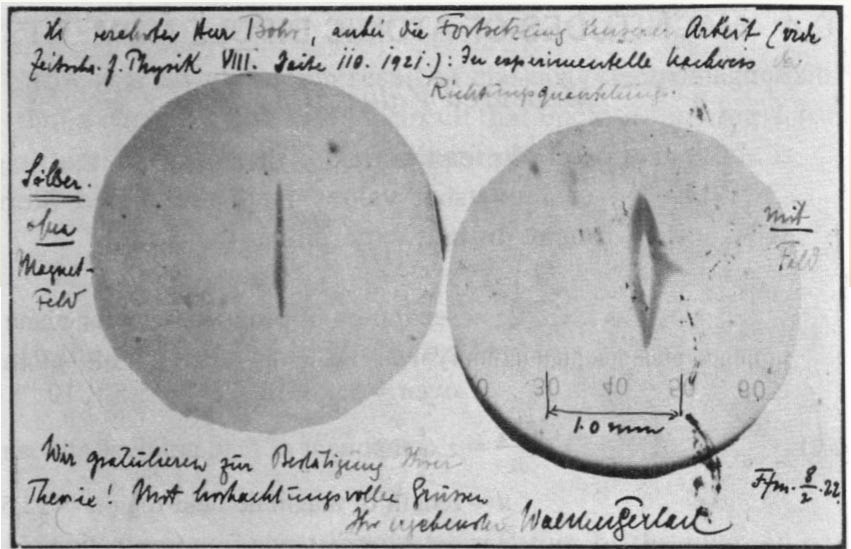
The above picture is from Friedrich, Bretislav, and Dudley Herschbach. “Stern and Gerlach: How a Bad Cigar Helped Reorient Atomic Physics.” Physics Today 56, no. 12 (December 1, 2003): 53–59. https://doi.org/10.1063/1.1650229.
During the formative years of quantum mechanics (early 1900s), the spin and orbital angular momentum of atoms were found to be quantized by theoretical arguments. Experimental proof was lacking.
Stern-Gerlach experiment provided the first experimental proof in 1922. They took a beam of neutral silver atoms and deflected them through an inhomogeneous magnetic field.
Silver atoms have an unpaired electron in their outermost orbit. If they were to obey quantum mechanics, they should exhibit a spin of +1/2 or -1/2. When subjected to an external magnetic field, the electrons with +1/2 or -1/2 should spatially split into two. That is exactly what Stern and Gerlach observed, and below is the first picture of the same.
To quote the authors:
Gerlach’s postcard, dated 8 February 1922, to Niels Bohr. It shows a photograph of the beam splitting, with the message, in translation: “Attached [is] the experimental proof of directional quantization. We congratulate [you] on the confirmation of your theory.” (Courtesy AIP Emilio Segrè Visual Archives.)
This experiment was one of the most important observations in quantum mechanics and further confirmed the quantization of spins, which is now common knowledge in physics.
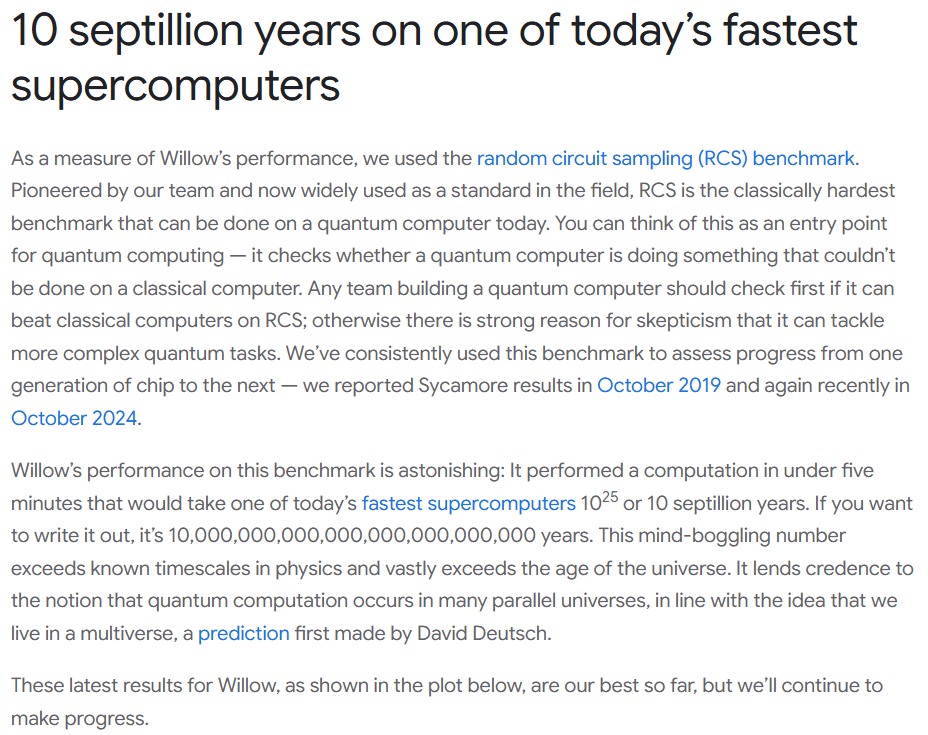
In scientific research, comparative analysis is an excellent way to objectively quantify two measurable entities. The recent Google quantum chip (named Willow) does that efficiently as it compares its capability with today’s fastest supercomputers. The comparison note on Google’s blog is worth reading.
In scientific analysis, such comparison teaches us three things:
a) how a scientific boundary is claimed to be pushed?
b) how a benchmark problem is used to achieve comparison?
c) what is the current state-of-the-art in that research area?
Some further observations on the work:
The theme of the Nature paper reporting this breakthrough is mainly on error correction. Technically, it shows how error tolerance is measured for a quantum device. This device is based on superconducting circuits, which were tested first on a 72-qubit processor and then on a 105-qubit processor.
Interestingly, as the authors mention in the paper, the origins of the errors are not understood well.
The paper is quite technical to read, and, to my limited understanding as an outsider, it makes a good case for the claim. The introduction and the outlook of the paper are written well, and give more technical information that can be appreciated by a general scientific audience.
There is more to come ! It looks like Google has further plans to expand on this work, and it will be interesting to see in which direction they will take the capability. The Google blog shows a roadmap and mentions their ambition as follows: “The next challenge for the field is to demonstrate a first “useful, beyond-classical” computation on today’s quantum chips that is relevant to a real-world application. We’re optimistic that the Willow generation of chips can help us achieve this goal.”
In the past 12 months or so, there has been a lot of buzz related to AI tools (thanks to GPTs, Nobels and perplexities :-), which are mainly in the realm of software theoretical development. This breakthrough in the realm of ‘hardware’ tells us how the physical world is still important!
More to learn and explore…interesting times ahead..
Gupta, Subhasish Dutta, Nirmalya Ghosh, and Ayan Banerjee. Wave Optics: Basic Concepts and Contemporary Trends. CRC Press, 2015.
Haldar, Arijit, Sambit Bikas Pal, Basudev Roy, S. Dutta Gupta, and Ayan Banerjee. “Self-Assembly of Microparticles in Stable Ring Structures in an Optical Trap.” Physical Review A 85, no. 3 (March 27, 2012): 033832. https://doi.org/10.1103/PhysRevA.85.033832.
“Self-Assembly of Mesoscopic Materials To Form Controlled and Continuous Patterns by Thermo-Optically Manipulated Laser Induced Microbubbles | Langmuir.” Accessed December 2, 2024. https://pubs.acs.org/doi/full/10.1021/la402777e.
X (formerly Twitter). “Ayan Banerjee (@ayanban7) / X,” November 26, 2024. https://x.com/ayanban7.
Muralidharan, B., A. W. Ghosh, and S. Datta. “Probing Electronic Excitations in Molecular Conduction.” Physical Review B 73, no. 15 (April 10, 2006): 155410. https://doi.org/10.1103/PhysRevB.73.155410.



 VISMAYA - History & Philosophy of Physics