Today, in my optics class, I discussed optical forces due to momentum in electromagnetic waves. Towards the late 1800s, it was realized that light can impart momentum. This manifested as radiation pressure in the electromagnetic theory proposed by James Maxwell.
Pyotr Nikolaevich Lebedev (24 February 1866 – 1 March 1912) was one of the earliest to experimentally measure (~1899) the radiation pressure on a surface (link to his 1900 paper in German). In 1991, the Soviet Union released a 1 ruble coin (pictured above) to commemorate Lebedev’s scientific achievement.
The formula expresses the total momentum transferred per unit time ( radiation pressure, P) by a beam of N photons, each of energy hν, that is incident on a surface with a coefficient of reflectivity ρ. The constant, c, is the speed of light.
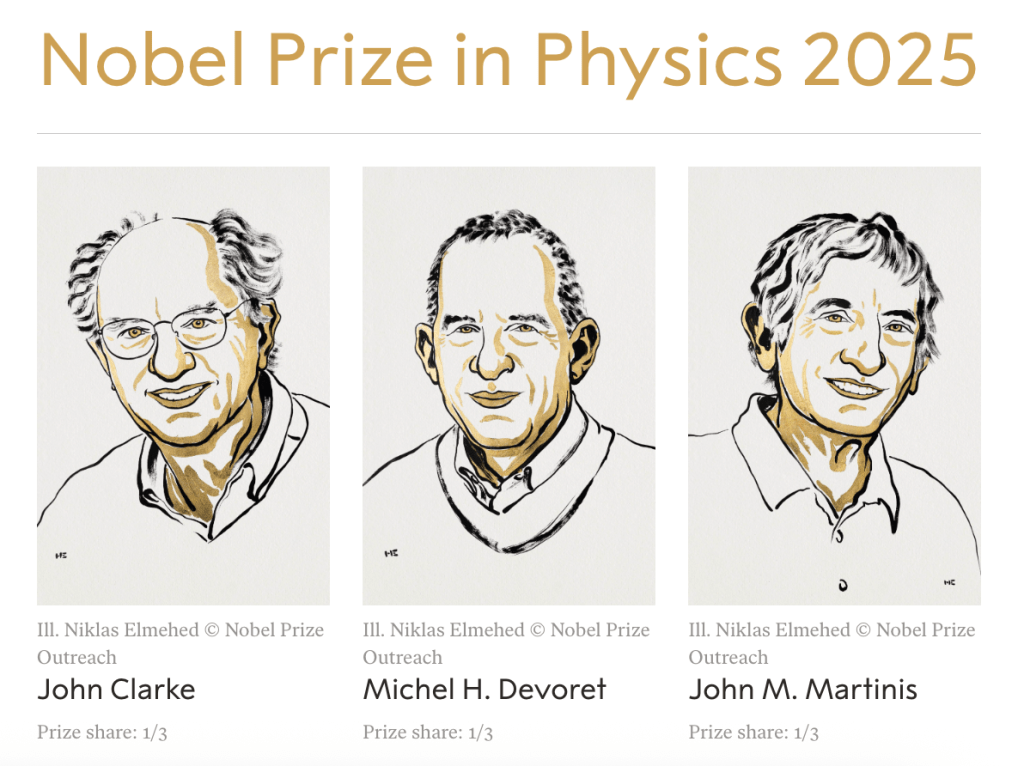
The 2025 Nobel Prize in physics has been awarded to John Clarke, Michel H. Devoret and John M. Martinis “for the discovery of macroscopic quantum mechanical tunnelling and energy quantisation in an electric circuit.“
The Nobel Prize webpage has an excellent summary of the work at popular and technical levels.
In this blog, I want to draw attention to an interesting review article from 1984 by Anthony Leggett that pre-empts the awarded work. Leggett himself was a Nobel laureate (2003), and his work on the theory of superconductors and superfluids forms one of the conceptual foundations for this year’s Nobel prize. Four of his papers have been cited by the Nobel committee as part of the scientific description of the award, and one of them is a review article I wish to emphasize.
The title of Leggett’s review is “Schrödinger’s cat and her laboratory cousins“. It discusses the detection and implication of macroscopic quantum mechanical entities, and has a description of the so-called Schrödinger’s cat, which is essentially a thought experiment describing quantum superposition and the bizarre consequence of such a formulation. Leggett utilizes this conceptual picture of the cat (in alive and dead states) and extends this to possible scenarios in which the macroscopic quantum superposition can be detected and verified under laboratory conditions. The text below from his review captures the essence of the concept and connects it to experimental verification :
“It is probably true to say that most physicists who are even conscious of the existence of the Cat paradox are inclined to dismiss it somewhat impatiently as a typical philosophers’ problem which no practising scientist need worry about. The reason why such an attitude can be maintained is that close examination of the paradox has seemed to lead to the conclusion that, worrying or not at the metaphysical level, it has at any rate no observable consequences: that is, the experimental consequences of the above apparently bizarre description are quite undetectable. Since physicists, by virtue of their profession, tend to be impatient of questions to which they know a priori no experiment can conceivably be relevant, they have tended to shrug off the paradox and leave the philosophers to worry about it.
Over the last few years, thanks to rapid advances in cryogenics, noise control and microfabrication technologies, it has become clear that the above conclusion may be over-optimistic (or pessimistic, depending on one’s point of view!). To be sure, it is unlikely that in the foreseeable future we will be able to exhibit the experimental consequences of a cat being in a linear superposition of states corresponding to life and death. However, at a more modest level it is possible to ask whether it would be possible to exhibit any macroscopic object in a superposition of states which by a reasonable common-sense criterion could be called macroscopically different. The answer which seems to be emerging is that it is almost certainly possible to obtain circumstantial evidence of such a state of affairs, and not out of the question that one might be able to set up a more spectacular, direct demonstration. This is the subject of this article.“
Cut to 2025, this is also the subject of the Nobel Prize in Physics today.
15th Aug also happens to be birthday of Louis de Broglie, the famous French physicist who played a critical role in understanding wave-particle duality in quantum physics, and laid an important foundation through his formula
λ = h / p ;
where, λ is the wavelength of quantum particle with momentum p and h is the Planck constant.
de Broglie studied and discovered the wave nature of electron, for which he received the Nobel prize in physics in the year 1929. In 1920s, understanding light from a quantum mechanical viewpoint was a challenge. Reconciling light, both as a particle and a wave, was counterintuitive and required a leap of thought that was provided by de Broglie. On 12th Dec 1928, delivered his Nobel lecture and mentions:
“I thus arrived at the following overall concept which guided my studies: for both matter and radiations, light in particular, it is necessary to introduce the corpuscle concept and the wave concept at the same time. In other words the existence of corpuscles accompanied by waves has to be assumed in all cases. However, since corpuscles and waves cannot be independent because, according to Bohr’s expression, they constitute two complementary forces of reality, it must be possible to establish a certain parallelism between the motion of a corpuscle and the propagation of the associated wave.“
This duality still remains, as we try understand the nature of light and harness it for information processing.
Interestingly, de Broglie was one of persons who nominated CV Raman for the Nobel prize in 1930 ! Below snapshot is from the Nobel prize nomination archives.



 VISMAYA - History & Philosophy of Physics