Blog highlighted by SciRio

A nice article by @RutujaUgale in @Sci_Rio that discusses public engagement by scientists as influencers of scientific thought.

Thanks, Rutuja, for profiling my blog, ‘Vismaya’.

Here is my quote from the article:

For me, there are two implications of doing science. One is that science is extremely useful to society, and the second is that it is a good, thoughtful way of living one’s life. Communicating the second implication is important to me, and I do this by researching, writing, and podcasting about the history and philosophy of science (physics in particular). This path helps people understand the human element of doing science and reveals a context. Some of my blogs (filtered here) discuss why I do science and how I do it. More than ‘influencing’ the audience, I am interested in inviting them to explore science by themselves via their own curiosity. That is one reason why my blog is called VISMAYA.”

Link to the full article.

Builders of Modern Scientific India

Images from: Leslie, Stuart W., and Indira Chowdhury. ‘Homi Bhabha Master Builder of Nuclear India’. Physics Today 71, no. 9 (2018): 48–55. https://doi.org/10.1063/PT.3.4021.

When we remember and talk about building modern, scientific India, we must acknowledge past scientists who played a critical role in taking ideas and turning them into reality. Homi Bhabha (image on left) was one of the pioneers. But we must also remember many unknown people of India who literally built modern scientific facilities, such as the CIRUS nuclear reactor (image on right is from 1958). Although their faces are invisible, their contributions should not be.

Meghnad Saha – lest we forget

Meghnad Saha (6 October 1893 – 16 February 1956), of the fame of Saha’s ionization formula, was born this day. In 1993, a postage stamp in India was released commemorating his birth centenary.

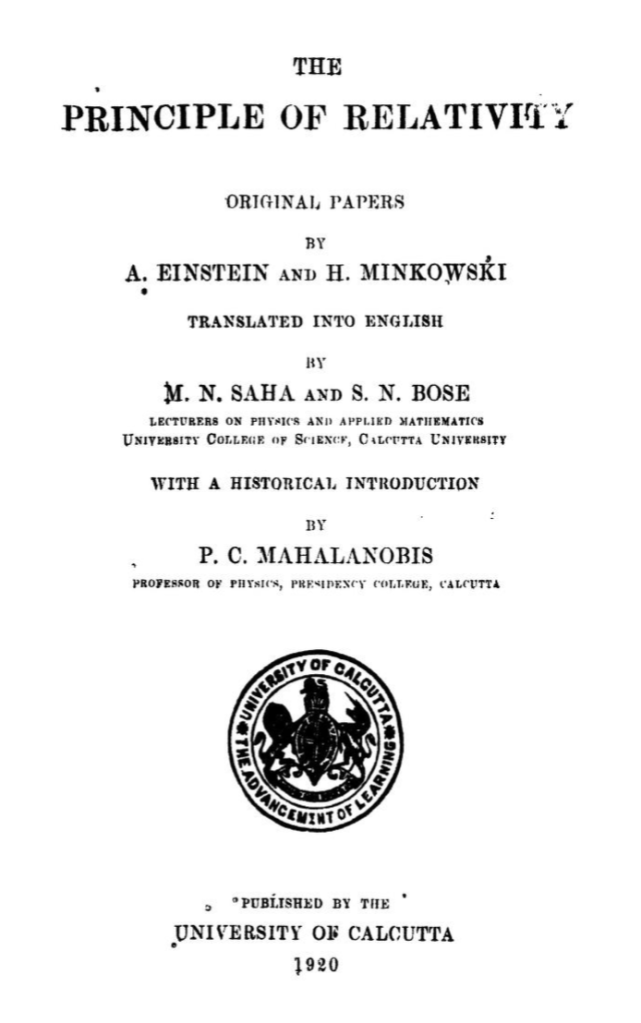
Saha was an astrophysicist with a broad knowledge and appreciation of various branches of physics. One of the earliest English translations (1920) of the papers on relativity by Einstein and Minkowski was written by Meghnad Saha and S.N.Bose.

At the beginning of the book, Mahalanobis introduces the topic with a historical introduction. He begins with a thoughtful discussion on experiments that eventually ruled out the presence of ether, and it sets the stage as follows:

Lord Kelvin writing in 1893 in hig preface to the English edition of Hertz’s Researches on Electric Waves, says many workers and many thinkers have helped to build up the nineteenth century school of plenum, one ether for light, heat, electricity, magnetism; and the German and English volumes containing Hertz’s electrical papers, given to the world in the last decade of the century, will be a permanent monument of the splendid consummation now realised.”

Ten years later, in 1905, we find Einstein declaring that “the ether will be proved to be superflous”. At first sight the revolution in scientific thought brought about in the course of a single decade appears to be almost too violent. A more careful even though a rapid review of the subject will, however, show how the Theory of Relativity gradually became a historical necessity.

Towards the beginning of the nineteenth century, the luminiferous ether came into prominence as a result of the brilliant successes of the wave theory in the hands of Young and Fresnel. In its stationary aspect, the elastic solid ether was the outcome of the search for a medium in which the light waves may “undulate.” This stationary ether, as shown by Young, also afforded a satisfactory explanation of astronomical aberration. But its very success gave rise to a host of new questions all bearing on the central problem of relative motion of ether and matter.

Saha, in various capacities, took a stance against British colonialism. Although it affected some opportunities, he continued to do science and was recognized for his outstanding contributions. As Rajesh Kochhar mentions:

Saha had wanted to join the government service, but was refused permission because of his pronounced anti-British stance. For the same reason, the British government would have liked The Royal Society to exclude Saha. It goes to the credit of the Society that it ignored the pressures and the hints, and elected him a fellow, in 1927. This recognition brought him an annual research grant of £300 from the Indian government followed by the Royal Society’s grant of £250 in 1929 (DeVorkin 1994, p. 164).

Saha led a tough life. He not only had to face suppressive British colonial rule but also academic politics and battles (versus Raman, no less). His knowledge of physics, his contributions to Indian science, and his commitment to people (he was a politician too) were significant. Let me end the blog with a few lines from Arnab Rai Choudhuri’s article, which nicely summarizes Saha’s work (specifically his ionization formula), and his scientific life:

Saha’s tale of extraordinary scientific achievements is simultaneously a tale of triumph and defeat, a tale both uplifting and tragic. Saha showed what a man coming from a humble background in an impoverished colony far from the active centres of science could achieve by the sheer intellectual power of his mind. But his inability to follow the trail which he himself had blazed makes it clear that there are limits to what even an exceptionally brilliant person could achieve in science under very adverse circumstances.

India and Indian science should remember Meghnad Saha.

Gandhi, Tagore and Celebration of Ideas

One of the books that I have enjoyed reading over the years is  The Mahatma and The Poet – Letters and Debates between Gandhi and Tagore 1915-1941’ compiled and edited by Sabyasachi Bhattacharya. The theme of the book is centered around the intellectual exchanges between M.K. Gandhi and Rabindranath Tagore on a variety of topics, including education, scientific outlook, philosophy and human dignity. Sabyasachi introduces the book with an overview of letters and debates and emphasizes that ‘The intellectual quality of the dialogue between Mahatma Gandhi and Rabindranath Tagore is such that it possesses an enduring interest. In these pages, I have tried to situate their debates, in private letters and in public statements, in the historical context of India’s national life and the cultural and political discourse of those times.’(page 20)

The book has a rich intellectual texture and showcases two minds that are open to ideas and not hesitant to express them. As Sabyasachi mentions that:‘…. the differences between them were real and at the same time they shared a common highground above the terrain of differences. Despite their differences on many crucial questions, they were willing to learn from each other.’(page 34) It shows what two engaging minds can reveal not only about themselves, but also about the place and time in which they live and operate. In there, we learn something that was a hallmark of Gandhi’s life: he was open to criticism and changed his mind in the light of evolving times and thoughts, as Sabyasachi indicates with an example:

‘Gandhi was equally open to candid criticism. It is possible that in some respects his outlook evolved, in response to the debates with Tagore. Consider, for instance, his: approach in Hind Swaraj: “I believe that the civilization India has evolved is not to be beaten in the world. Nothing can equal the seeds sown by our ancestors…. India remains immovable and that is her glory…. India has nothing to learn from anybody else and this is as it should be.” One can compare that with his later pronouncements, most notably his reply to Tagore in 1921, a truly memorable statement: “I do not want my house to be walled in all sides and my windows to be stuffed. I want the culture of all the lands to be blown about my house as freely as possible. But I refuse to be blown off my feet by any.’ (page 36)

A snapshot from the book: The Mahatma And The Poet.

Gandhi is many things to many people, some positive and some negative. For me, what stands out is his ability to utilize philosophical ideas such as ahimsa (non-violence) and satyagraha (pursuit of truth) for a political goal and effectively communicate it to a large population in that era. He may well have failed in this era, but he remains an excellent benchmark for human dignity across the world, even today. In that sense, he represents ‘the swadeshi’ in all of us and yet appeals to the whole world, just as Tagore does.

The book (freely available online) is a great read; it is a visit not only to the past, but also into the depths of two human minds, and perhaps into the depths of oneself. After all, ideas too need celebration.  

Satish Dhawan – truly a man for all seasons

Image credit: Current Science 119, no. 9 (2020): 1427–32

Today is the birth anniversary of Satish Dhawan (25 September 1920 – 3 January 2002). He was probably India’s best scientist-administrator who headed institutions such as the Indian Institute of Science and the Indian Space Research Organization. With a PhD from Caltech, he came back to India and set up a marvellous research enterprise on fluid mechanics, including aerospace science and engineering. He mentored some of the outstanding scientists of India and led scientific institutions with vision, openness and informality, which is still a great benchmark to emulate1.

Below are a couple of historical documents related to Dhawan:

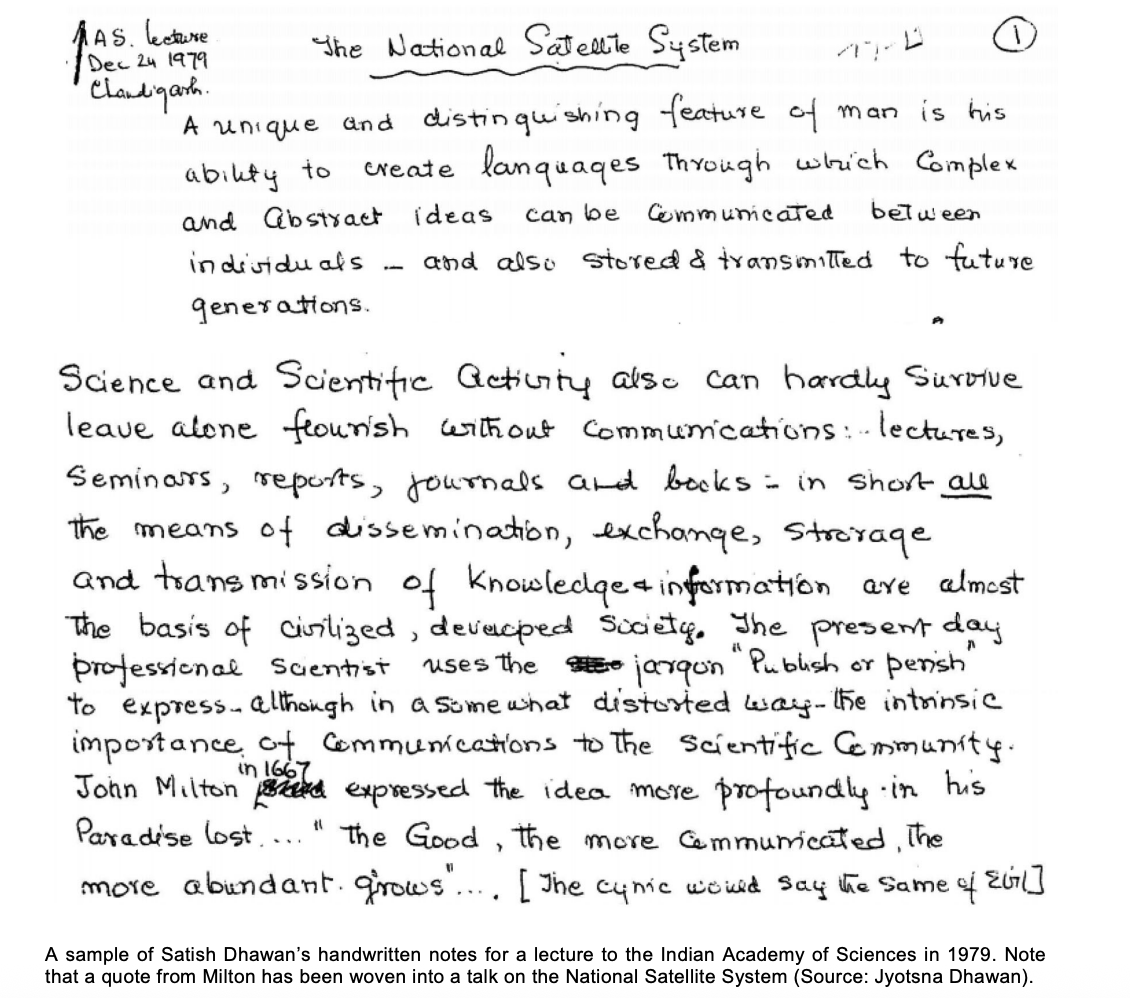
The first one is a lecture note from 1979, on making a case for a national satellite system and how it influences science and scientific activity (a copy of this note has been reproduced in a wonderful tribute to Satish Dhawan written by P. Balaram on his birth centenary2).

The next one is a beautiful perspective article written by Dhawan on ‘Bird Flight’ from an aerodynamics perspective3. It is a detailed overview of the dynamics of bird flight and shows Dhawan’s interest and ability to bridge two facets of science. It is a prototypical example of interdisciplinary research.

Finally, let me end the blog with a quote from P. Balaram on Satish Dhawan4:

“Dhawan mentored some remarkable students and built the discipline of aeronautical engineering at the Institute. He influenced aeronautical research and industry in India in a major way. He shepherded the Indian space programme following Vikram Sarabhai’s untimely death. He served the Indian scientific community in many ways. His stewardship transformed IISc. How then do we describe such a man? Dhawan studied English literature obtaining a Master’s degree in his youth. It may therefore be appropriate for me to borrow a 16th century description of Sir Thomas More:


‘[Sir Thomas] More is a man of an angel’s wit and
singular learning. I know not his fellow. For where is
the man of that gentleness, lowliness and affability?
And, as time requireth, a man of marvelous mirth and
pastimes, and sometime of as sad gravity. A man for
all seasons.’

Satish Dhawan was truly a man for all seasons.”

Happy Birthday to Prof. Satish Dhawan!

References:

  1. Current Science, in 2020, had a section of a volume dedicated to the birth centenary of Satish Dhawan, and has a foreword by his daughter and articles by many of his students and co-workers. https://www.jstor.org/stable/e27139029 ↩︎
  2. P. Balaram, “Satish Dhawan: The Transformation of the Indian Institute of Science, Bangalore,” Current Science 119, no. 9 (2020): 1427–32. This reference has many interesting references, including a handwritten obituary of CV Raman written by Dhawan https://www.jstor.org/stable/27139041. ↩︎
  3. S. Dhawan, “Bird Flight,” Sadhana 16, no. 4 (1991): 275–352, https://doi.org/10.1007/BF02745345. ↩︎
  4. P. Balaram, Current Science 119, no. 9 (2020), page 1432. https://www.jstor.org/stable/27139041. ↩︎

Sir MV on Education

In India, “National Engineers’ Day is celebrated every year on September 15 to honor the birth anniversary of Sir Mokshagundam Visvesvaraya, one of India’s greatest engineers”. Sir MV, as he was known, is one of the 20th-century Indians I admire. He was a forward-looking statesman who contributed immensely to building India (literally and figuratively). MV was a well-read and well-travelled person for his era, and wrote a few books and memos that are still pertinent to the current developments in India and the world.

Reconstructing India (1920)

One of his books, Reconstructing India (1920), reveals his thoughts on how and why India needs to reconstruct itself based on knowledge in science, technology and humanities. The title page is shown below, and the book is free to read online, thanks to the Internet Archive.

The book, as mentioned by MV in the preface, was written just after the First World War, and contemplates problems faced by India in light of geopolitical developments. In the 17 chapters of the book, divided into 4 parts, MV discusses specific issues faced by India, and proposes that political and administrative reforms can help India become a progressive society.

The largest part of the book is on economic reconstruction, in which he proposes contemporary methods (for the 1920s) to improve various sectors of manufacturing, including agricultural technology and communication media.

The third part of the book is on social reforms, and in there, he has a dedicated chapter on Education, which caught my attention, and I found it relevant even for today’s India.

Education, Humanities, and STEM

It is important that students of science and technology have a good exposure to some aspects of the humanities, including economics, history and philosophy. The pursuit and ability to choose good problems in science and technology critically depend on the social and economic structure in which they are practiced in universities and research institutions. MV anticipated this and highlights it as:

“Secondary and university education, though producing many able recruits for subordinate positions in the Civil Service, does not provide the men needed to carry on the work of agriculture, engineering, commerce and technology. The provision for training in economics and history is inadequate, and the study of those subjects is even discouraged. An attempt is actually made to teach economics in such a way as to render India’s emergence from a state of dependency difficult.”

Even in 2025, I would suggest that STEM students pay attention to economics, as it anchors them to understand the need and functions of a society, and therefore, their work can be calibrated accordingly. This is not to discourage open-ended research, but to understand how natural sciences are connected to the societal thoughts and needs. It gives us a broader understanding of the context, which is so important while understanding the evolution of ideas.

Comparative Education Systems

There is always a lot to learn from various societies and cultures. In order to do so, one needs comparative analysis. This helps one to choose some good elements from a society that can be emulated elsewhere. MV compares and comments on the 1900s British educational system in contrast to the German and Japanese counterparts. Note that India in the 1920s was still a British colony, and in a way, MV is critical of the system in which he himself was educated and trained. As he notes:

“Britain herself has had to pay a heavy price for her hand-to-mouth policy in regard to education. The educational chaos still existing there compares unfavourably with the great yet orderly progress made by Germany and Japan, both of which countries, after weighing and testing the educational systems of the world, absorbed the best of all.”

These were words written long before the Second World War, and give us a glimpse of how German and Japanese systems were functioning in the 1920s and had a lot to offer to the world. Of course, history took its own path, and German and Japanese society had other ideas.

Incidentally, I am writing this piece sitting in Leipzig (eastern Germany), and I am amazed by its architectural marvels that date back centuries. Indeed, German society had (and has) a lot to offer to the world. As MV indicates above, we need to absorb the best that is on offer. In doing so, we also need to reject that which is not good for any society.

Liberal Education and Financial Support

He further adds how liberal education adds value to a society, and calls not only the government but also the people to recognize the importance of financial support for education.

“Both the Government and the people must recognize that only by pursuing a liberal educational policy, and making generous financial provision for schools and colleges can they lift India out of her present low condition and ensure rapid progress.”

These words still hold good, and as a society, India has to re-emphasize modern education that helps us become not only better doctors and engineers, but also better human characters that can add value to the “modern” world.

Call to Action

In the final part of the book, MV makes a passionate appeal to the people of India, calling them to take action and move towards becoming a progressive nation:

“Do the people of India propose to profit by the lessons which world experience has to teach them, or will they be content to allow matters to drift and themselves grow weaker and poorer year by year?
This is the problem of the hour. They have to choose whether they will be educated or remain ignorant; whether they will come into closer touch with the outer world and become responsive to its influences, or remain secluded and indifferent; whether they will be organized or disunited, bold or timid, enterprising or passive ; an industrial or an agricultural nation ; rich or poor ; strong and respected, or weak and dominated by forward nations. The future is in their own hands.”

Indeed, the future is in our hands, and these words written more than 100 years ago still resonate loudly. We need more engineers like Sir MV. The reason he was so effective was that he combined thinking and doing. Importantly, the lesson we can learn from MV’s life and by reading this book, is that an open mind can grasp good ideas at any time and anywhere. Implementing those ideas is an equally important challenge, and MV was up to this in his own way. Are we, as Indians, open to this prospect and engineer our future?

Conversation with Arka Banerjee

Welcome to the podcast Pratidhavani – Humanizing Science

Arka Banerjee is a cosmologist and an Assistant Professor of Physics at IISER Pune. His research focuses on exploring the connections between fundamental physics at microscopic scales and the formation and evolution of large-scale structures in the Universe, such as galaxies and cosmic voids. To pursue these questions, he develops new simulation methods, constructs summary statistics for cosmological data, and generates forecasts for upcoming observational surveys.

In this episode, we explore his intellectual journey and research.

Spotify link

References:

“Arka Banerjee – Home.” n.d. Accessed August 23, 2025. https://arkabanerjee.github.io/.

“‪Arka Banerjee‬ – ‪Google Scholar‬.” n.d. Accessed August 23, 2025. https://scholar.google.com/citations?user=kLde9gcAAAAJ&hl=en.

“Arka Banerjee – IISER Pune.” n.d. Accessed August 23, 2025. https://www.iiserpune.ac.in/research/department/physics/people/faculty/regular-faculty/arka-banerjee/381.

“Arka Banerjee – INSPIRE.” n.d. Accessed August 23, 2025. https://inspirehep.net/authors/1671323.

Some Optical and IR observatories in India

Below are ‘locations of some of the optical and infrared observatories marked on the Indian map’.

from: Narendranath, Shyama, Shashikiran Ganesh, Dipen Sahu, et al. 2025. “Solar System Research Prospects for the Decade and Beyond.” Journal of Astrophysics and Astronomy 46 (2): 34. https://doi.org/10.1007/s12036-025-10060-0.

Happy Independence Day & de Broglie’s birthday

Happy Independence Day to my fellow Indians !

15th Aug also happens to be birthday of Louis de Broglie, the famous French physicist who played a critical role in understanding wave-particle duality in quantum physics, and laid an important foundation through his formula

λ = h / p ;

where, λ is the wavelength of quantum particle with momentum p and h is the Planck constant.

See here for more details.

de Broglie studied and discovered the wave nature of electron, for which he received the Nobel prize in physics in the year 1929. In 1920s, understanding light from a quantum mechanical viewpoint was a challenge. Reconciling light, both as a particle and a wave, was counterintuitive and required a leap of thought that was provided by de Broglie. On 12th Dec 1928, delivered his Nobel lecture and mentions:

“I thus arrived at the following overall concept which guided my studies:
for both matter and radiations, light in particular, it is necessary to introduce
the corpuscle concept and the wave concept at the same time. In other words
the existence of corpuscles accompanied by waves has to be assumed in all
cases. However, since corpuscles and waves cannot be independent because,
according to Bohr’s expression, they constitute two complementary forces
of reality, it must be possible to establish a certain parallelism between the
motion of a corpuscle and the propagation of the associated wave.

This duality still remains, as we try understand the nature of light and harness it for information processing.

Interestingly, de Broglie was one of persons who nominated CV Raman for the Nobel prize in 1930 ! Below snapshot is from the Nobel prize nomination archives.