Here I discuss the paper that announced the Raman effect to the world…
Tag: India
26 Jan – Indian Republic Day…and a few more
Happy Republic Day to all my fellow Indians !
26th Jan is also an important day in the history of physics/engineering –
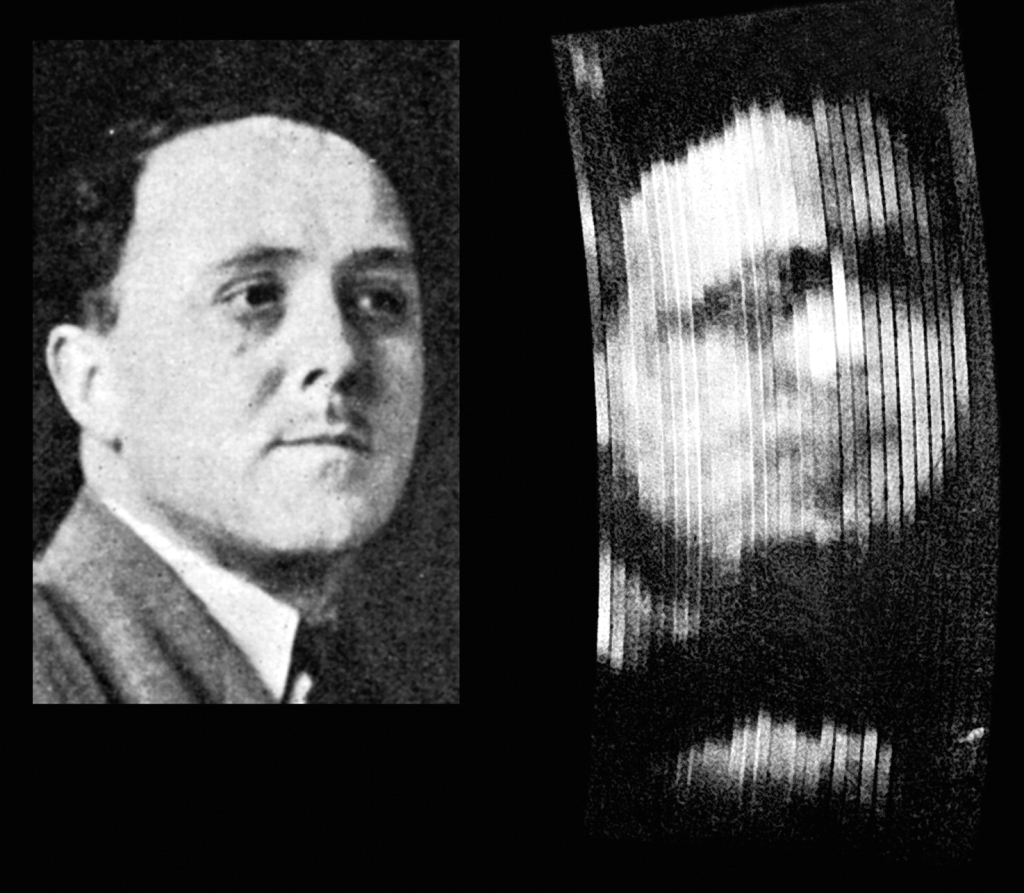
26th Jan 1926 – J.L. Baird “demonstrated television at his premises in Frith Street, London, to about forty people including members of the Royal Institution…..The Times was the only newspaper invited, and its reporter published the story on 28 January”. This exactly a 100 years today !
26th Jan 1939 – Niels Bohr publicly announced nuclear fission, specifically the splitting of the uranium atom.
26th Jan 1954 – Morris Tanenbaum et al. at Bell Laboratories showed a working silicon transistor.
References for further reading:
McLean, Donald F. 2014. “The Achievement of Television: The Quality and Features of John Logie Baird’s System in 1926.” The International Journal for the History of Engineering & Technology 84 (2): 227–47. https://doi.org/10.1179/1758120614Z.00000000048.
“Niels Bohr Announces the Discovery of Fission – Nuclear Museum.” n.d. Https://Ahf.Nuclearmuseum.Org/. Accessed January 26, 2026. https://ahf.nuclearmuseum.org/niels-bohr-announces-discovery-fission/.
“The Lost History of the Transistor.” 2004. IEEE Spectrum 41 (5): 44–49. https://doi.org/10.1109/MSPEC.2004.1296014.
Wikipedia. 2025. “History of the transistor.” December 22. https://en.wikipedia.org/w/index.php?title=History_of_the_transistor&oldid=1328866801.
C V Raman and long term thinking
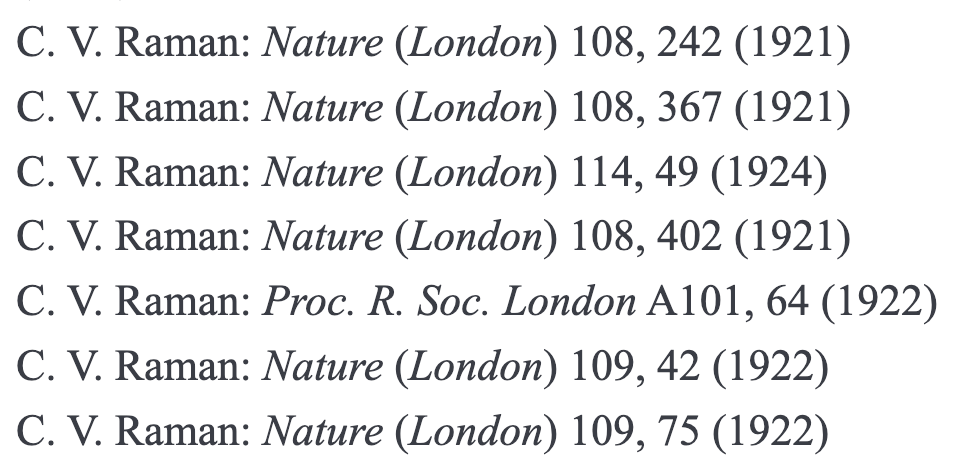
A small sampling of Raman’s publication. These papers are related to light scattering and form the foundation on which he made his famous discovery. Raman wrote more than 400 research papers in his lifetime (apart from monographs, lectures and public talks). Writing such a series of papers on a particular topic can be observed throughout his career.
A note to young scholars: intellectual monuments are built this way: thought after thought, day after day, paper after paper. Never underestimate what can be achieved with consistent, honest effort.
Some random thoughts..
Conversation with Srubabati Goswami
Srubabati Goswami is a pioneering Indian physicist specializing in high-energy physics, particularly neutrino physics. She is probably the first Indian woman to earn a PhD in neutrino oscillations from the University of Calcutta. She advanced research at Physical Research Laboratory, Ahmedabad (PRL), Saha Institute of Nuclear Physics, and Harish-Chandra Research Institute before becoming Senior Professor at PRL. A fellow of India’s three science academies, she unravels neutrino mysteries and champions women in science.
In this episode, we explored her intellectual history and her remarkable journey as a physicist.
References:
- Srubabati Goswami | LinkedIn’. Accessed 16 January 2026. https://www.linkedin.com/in/srubabati-goswami-9b5ab520/?originalSubdomain=in.
- Dogra, Aashima. A Trailblazer Looks for the Keys to the Next Generation of Physics Research – The Wire Science. 7 September 2017. https://science.thewire.in/science/srubabati-goswami-neutrino-ino-dino-kamiokande-prl/.
- Godbole, Edited Rohini, and Ram Ramaswamy. LILAVATI’S DAUGHTERS. n.d.
- ‘Indian Academy of Sciences’. Accessed 16 January 2026. https://fellows.ias.ac.in/profile/v/FL2017008.
- Sciences (TWAS), The World Academy of. ‘Goswami, Srubabati | TWAS’. Accessed 16 January 2026. https://twas.org/directory/goswami-srubabati.
- ‘Srubabati Detangles Weird Phenomena’. The Life of Science, 6 September 2017. https://thelifeofscience.com/2017/09/06/srubabati-detangles-weird-phenomena/.
- ‘Srubabati Goswami – Google Scholar’. Accessed 16 January 2026. https://scholar.google.co.in/citations?user=YbhShAcAAAAJ&hl=en.
- ‘The Neutrino Story: From Impossible Dreams to Unreachable Stars (ONLINE) by Srubabati Goswami – YouTube’. Accessed 16 January 2026. https://www.youtube.com/watch?v=XZKadiBqhrA.
- ‘Women Shaping Scientific Frontiers: From Lab Coats to Leadership (27 Stories of Women Leaders in Physics and Engineering) | Exotic India Art’. Accessed 16 January 2026. https://www.exoticindiaart.com/book/details/women-shaping-scientific-frontiers-from-lab-coats-to-leadership-27-stories-of-women-leaders-in-physics-and-engineering-hba517/.
- X (Formerly Twitter). ‘(1) Srubabati Goswami (@srubabati) / X’. 29 December 2025. https://x.com/srubabati.
Five Aspects of the Fifth Pillar – A Philosophical Perspective

In reference to a recent article on higher education in the Economic Times, a well-known tech entrepreneur and philanthropist wrote the following on X/Twitter: “75% of Indian higher education institutions still not industry-ready. Lot of work left to transform. But the 21st century requires education, research, innovation, and startups as four pillars of a university.”
This is a thought I do support, but I think there is one more important meta-pillar, perhaps a ‘foundation’ on which all these pillars are standing, and that is called ethics. Below are five aspects of ethics that I think need further attention.
- If one observes some of the major contemporary and pressing problems in our world, they can be connected to the ethical aspects of how humans function. A vital part of our educational system should re-emphasize this connection and make it central to everything that is done in a society.
- Ethics has two important elements to it: first, it has a philosophical grounding and connects to how humans function in a society. Second, it has an important connection to how trust in a society can be developed. Most of the discussions on ethics generally focus on the first element from a morality perspective, whereas the second point has an equally important utility and an economic connection.
- Ethical principles have great utility. It is important that we never keep it as an implicit aspect of human endeavour. Instead, we should start everything on the ethical grounds and build it up from there, including businesses, because a strong ethical foundation probably would be the best thing to happen for economic progress in any society, because trust is so important among human beings, and it is one thing that probably brings humans together. In the long run, the meaning of ‘prosper’ critically depends on the meaning of ethics. Being prosperous without being ethical is detrimental to any human pursuit. Zero-sum games are exciting, but in the limit of many games, the number of people who lose will be far more than the people who win. Instead, cooperative games have much larger dividends to all players and are inherently connected to a concept called as double thank you moment.
- The philosophy of ethics is something which the world has to revisit in greater detail, especially in an era where technological implications are driving human life in directions which we have not anticipated. One may think that raising ethical issues might hinder progress, but my argument here is that, instead of hindrance, one should look at it as an important requisite for human societies to not only survive but also to flourish. Large human endeavours cannot sustain without trust, and that trust is reinforced through ethical behaviour.
- Without ethical implications being factored in, it would be hard to really design anything related to technology. A case in point is the social media restrictions in countries such as Australia. Technology has the amazing capability to move fast before the philosophical debates can come in, but it does not mean that philosophy has to be completely ignored. The downstream of a scientific idea can become a product in a market, and positively impact society, but this evolution has a fellow-traveller, and that is ethics. The feedback loop is incomplete without the ethical considerations, and therefore, it should be looked at as an important ingredient in any human design.
There is an inherent connection between cooperation and trust, and that is founded on an ethical principle. The world requires an ethical recap, and it should be part of individuals, institutions, and governments. There is a rich history of ethics in all the cultures across the world, and it is worth revisiting them in a new light. Perhaps it is high time that we “Make Ethics Great Again.”
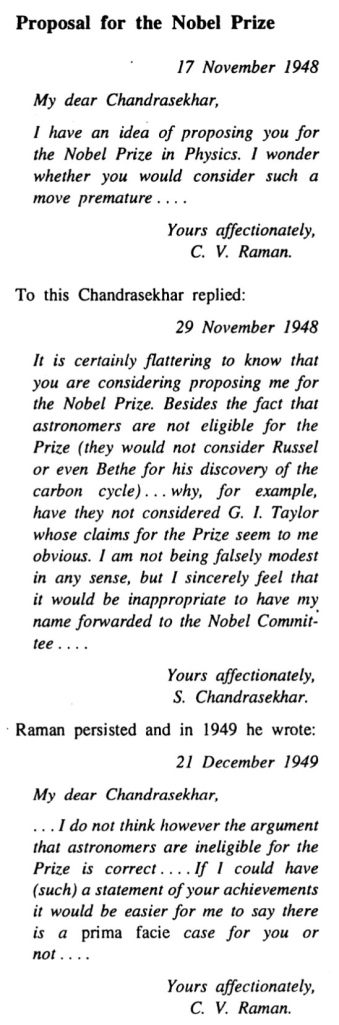
Raman-Chandra Letters
Saha and Bose translate Einstein
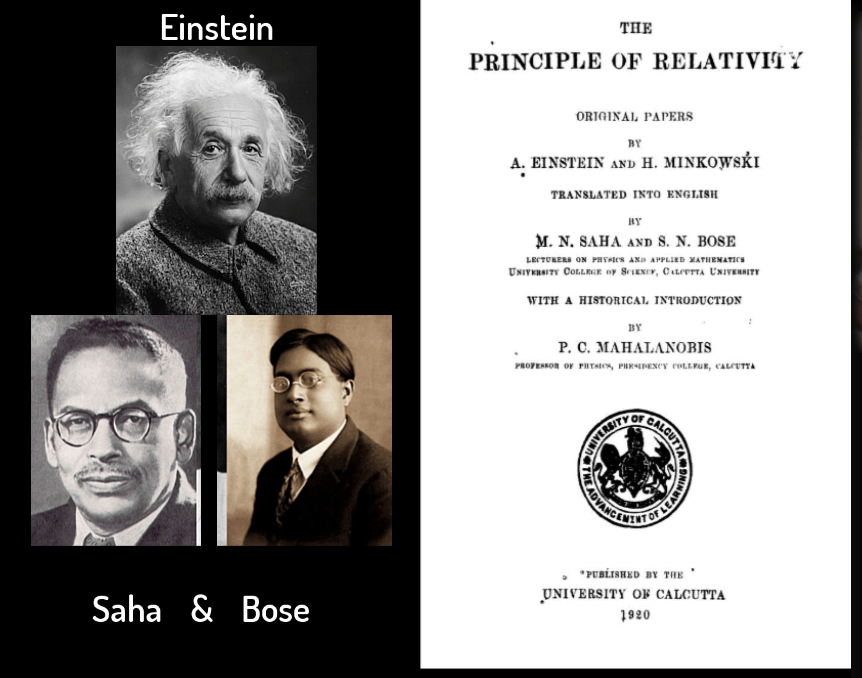
In physics, the general theory of relativity is one of the most remarkable achievements. It has turned out to be one of the most profound theories in the history of physics. In 1916, Albert Einstein proposed this theory, and it was confirmed in 1919.
Right after this confirmation, around 1920, two Indian gentlemen named Satyendranath Bose and Meghnad Saha translated Einstein’s German work into English. What you are seeing as an image is the remarkable book Principles of Relativity, containing the original papers by Einstein and Minkowski. This translation was done by M.N. Saha and S. N. Bose, who were then at the University College of Science, Calcutta University. It was published in 1920 by the University of Calcutta.
The book also contains a historical introduction by Mahalanobis, the celebrated statistician, although he was originally trained as a physicist himself. This historical introduction is itself quite remarkable.
If you look at the table of contents of this book, you will find the following:
- A historical introduction.
- The Electrodynamics of Moving Bodies, which is an important paper and is necessary for understanding what follows.
- A short biographical note on Albert Einstein was written by Saha.
- The Principle of Relativity, mainly the Minkowski papers, translated by Saha, along with an appendix.
- The General Principles of Relativity, Einstein’s epoch-making 1916 paper, translated by S. N. Bose, followed by notes by these gentlemen.
The historical introduction discusses the evolution of ideas that led to the fruition of the general theory of relativity. This turned out to be one of the most important expositions of the general theory of relativity, soon after the emergence of the theory and its subsequent confirmation by Eddington through his famous solar eclipse expedition. This is a remarkable document, and it is available on the Internet Archive.
Icons of Science in India – some thoughts
based on my blog.
ShuX in IISER Pune
Yesterday evening (10th Jan 2026), Shubhanshu Shukla, the recent Indian astronaut, was at IISER Pune as part of the ‘India Science Festival’. There was a huge crowd gathered to see and listen to him. Within IISER, it is rare to see such a massive gathering for a science event, and it was heartening to witness this on a Saturday evening. Thanks to schools and colleges in Pune, science and science-related activities get traction from the people of Pune (especially younger people). They enthusiastically participate in many events related to science.
Such a gathering is very important for at least three reasons:
- It connects a scientifically oriented person to the public and thereby connects them to science.
- It showcases that there is some science-related activity happening within the Indian scene.
- It sends out a message to people that icons can be created out of people who do science funded by the public.
I would want to emphasize four other points:
- Scientific icons are as good as the science they represent. A major part of the credit should go to the organizations that supported and trained him, and this includes ISRO, NASA and the Indian Air Force.
- To put an astronaut in space, it takes a lot of effort at various levels of society. Public support is vital for such an effort. Public icons such as Shubhanshu Shukla are a good representation of what investment in science can do to the morale of the public, especially for young people.
- The created momentum should not be lost, given that recognizable people, such as astronaut Shubhanshu Shukla, have made an imprint on young people. This should be followed up with measures to recruit them for science and technology.
- Space science and technology, astronomy and astrophysics have always been among the most fascinating domains to attract people into science. Many Indian scientists and a past astronaut, Rakesh Sharma, have played an important role in this pursuit. One should not forget them.
Let me conclude with a word of appreciation for Pune city. It is not a capital city, but its enthusiasm for intellectual pursuits is high, and it attracts a lot of enterprising people (recently, there was a public policy conference that had some amazing people). If it can get a lift in its public infrastructure, it can create its own path in the landscape of science and technology.
 VISMAYA - History & Philosophy of Physics