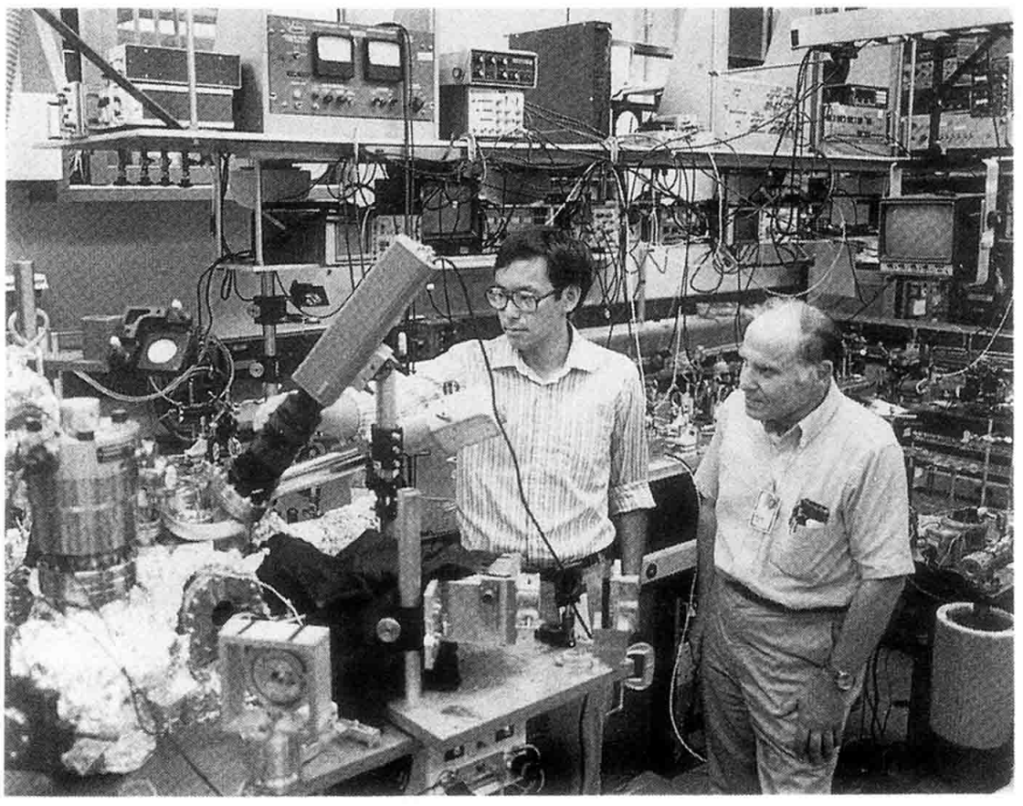
Steven Chu’s Nobel lecture has some gems. Below, he shares his experience of working with Arthur Ashkin.
“In 1986, the world was excited about atom trapping. During this time, Art Ashkin began to use optical tweezers to trap micron sized particles. While experimenting with colloidal tobacco mosaic viruses, he noticed tiny, translucent objects in his sample. Rushing into my lab, he excitedly proclaimed that he had ‘discovered Life’. I went into his lab, half thinking that the excitement of the last few years had finally gotten the better of him. In his lab was a microscope objective focusing an argon laser beam into a petri dish of water. Off to the side was an old Edmund Scientific microscope. Squinting into the microscope, I saw my eye lashes. Squinting harder, I occasionally saw some translucent objects. Many of these objects were ‘floaters’, debris in my vitreous humor that could be moved by blinking my eyes. Art assured me that there were other objects there that would not move when I blinked my eyes. Sure enough, there were objects in the water that could be trapped and would swim away if the light were turned off. Art had discovered bugs in his apparatus, but these were real bugs, bacteria that had eventually grown in his sample beads and water.”
Chu won the physics Nobel in 1997, and Ashkin won the same in 2018. Ashkin was the pioneer of optical trapping and tweezers, and applied it to a variety of problems, including the manipulation of biological matter. Chu harnessed the momentum of light to trap and cool atoms. Both started their work and collaborated at Bell Labs. Chu moved to Stanford, whereas Ashkin stayed back. Bell Labs was a remarkable place in the 1980s, as Chu describes in his lecture :
“Bell Labs was a researcher’s paradise. Our management supplied us with funding, shielded us from bureaucracy, and urged us to do the best science possible. The cramped labs and office cubicles forced us to rub shoulders with each other. Animated discussions frequently interrupted seminars and casual conversations in the cafeteria would sometimes mark the beginning of a new collaboration.”
Can the world afford to have another Bell Labs in 2025? Can it recreate the magic?
 VISMAYA - History & Philosophy of Physics