Why is astronomy interesting? Chandra likes Wigner’s answer

The questions “Why is astronomy interesting; and what is the case for astronomy?” have intrigued me; I have often discussed these questions with my friends and associates. Granted that physical science, as a whole, is worth pursuing, the question is what the particular case for astronomy is? My own answer has been this: Physical science deals with the entire range of natural phenomena; and nature exhibits different patterns at different levels; and the patterns of the largest scales are those of astronomy. (Thus Jeans’ criterion of gravitational instability is something which we cannot experience except when the scale is astronomical.) Of the many other answers to my questions, I find the following of Wigner most profound: “The study of laboratory physics can only tell us what the basic laws of nature are; only astronomy can tell us what the initial conditions for those laws are.”

from A Scientific Autobiography: S. Chandrasekhar (2011) by edited by Kameshwar C. Wali 
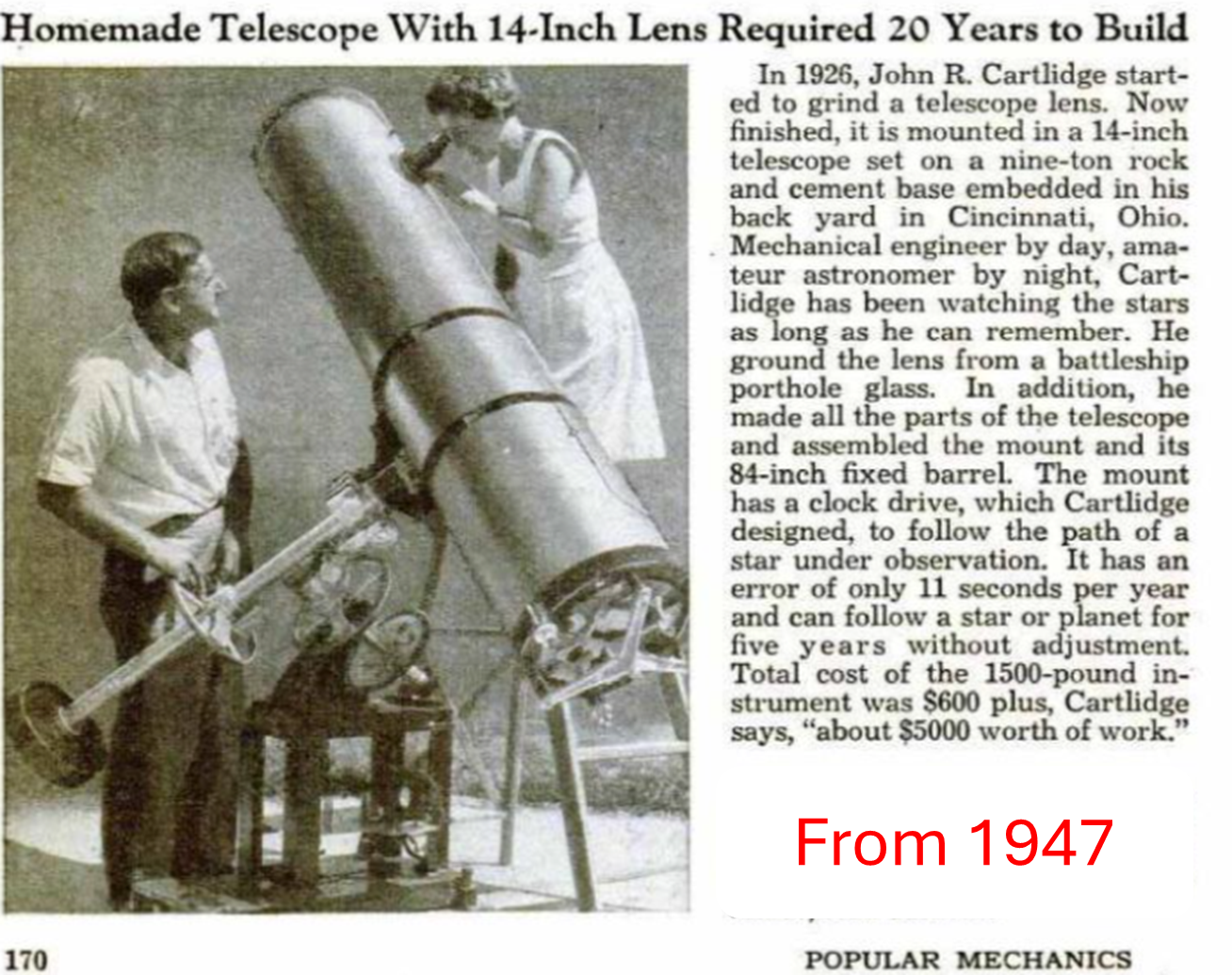
A telescope built over 20 years

For ages, human beings have been curious about stars. Telescopes as observational tools have changed how human beings have studied and understood astronomical objects. Below is a snapshot from a 1947 edition of popular mechanics that features someone named John Cartlidge from USA. He was a mechanical engineer and an amateur astronomer. The story reveals that he took 20 years to build the telescope, and the description text from the magazine is an interesting read. An amount of $600 plus, for that era, sounds expensive. But what is astonishing is the 20-year effort to build a telescope.

This instance of human effort to pursue curiosity connects well to a wonderful poem: ‘Curiosity’ by David Jilk, and below I reproduce a stanza from it:

Your greatest teacher is the world itself
and glory comes to those who find her codes;
for she is coy, no book upon a shelf,
and must be queried via crab-walk modes:
your question is, which questions make inroads?
Instruction thus proceeds aesthetically
with obverse strokes of creativity.

Amateur astronomy fosters that strokes of creativity. After all, sky is the only limit !