circa 1609..Spectacular drawing of the moon as seen in a telescope developed by Gallileo….he was truly a pioneer
— G V Pavan Kumar (@Pavan_KumarGV) June 7, 2023
His book "Sidereus Nuncius" had some of the early observations of astronomical objects including some stars in the milky wayhttps://t.co/Cujvj6tms8
1/2 https://t.co/ZvwBbr1qiC
New Episode : Ashkin’s Story – no prize to Nobel prize
References :
- “The Idea Factory: Bell Labs and the Great Age of Americ….” Accessed May 31, 2023. https://www.goodreads.com/book/show/11797471-the-idea-factory.
- Ashkin, Arthur. Optical Trapping And Manipulation Of Neutral Particles Using Lasers: A Reprint Volume With Commentaries. World Scientific, 2006.
- NobelPrize.org. “The Nobel Prize in Physics 2018.” Accessed June 2, 2023. https://www.nobelprize.org/prizes/physics/2018/ashkin/biographical/.
- Kumar, G. V. Pavan. “Trapping Questions and Evolving Answers.” Scatterings (blog), August 12, 2018. https://backscattering.wordpress.com/2018/08/12/trapping-questions-and-evolving-answers/.
- “Bell Labs (18 Books).” Accessed May 31, 2023. https://www.goodreads.com/list/show/136522.Bell_Labs.
- “Understanding Comets.” Accessed June 2, 2023. http://www.ianridpath.com/halley/halley2.html.
- IUCAA Science Day Events Webcast, 2019. https://www.youtube.com/watch?v=W4tIbxTwasM.
- NobelPrize.org. “The Nobel Prize in Physics 1997.” Accessed May 31, 2023. https://www.nobelprize.org/prizes/physics/1997/summary/.
- “Steven Chu – Nobel Lecture: The Manipulation of Neutral Particles.” Accessed June 3, 2023. https://www.nobelprize.org/prizes/physics/1997/chu/lecture/.
- NobelPrize.org. “The Nobel Prize in Physics 2018.” Accessed May 31, 2023. https://www.nobelprize.org/prizes/physics/2018/summary/.
- Nokia Bell Labs. “Nokia Bell Labs Awards,” July 3, 2020. https://www.bell-labs.com/about/awards/.
New Episode : Science, Rationality and Compassion
Watson, Peter. “Ideas: A History from Fire to Freud.” Accessed May 26, 2023. https://peterwatsonauthor.com/books/ideas-a-history-from-fire-to-freud/.
Pinker, Steven. “Rationality.” Accessed May 26, 2023. https://www.google.co.in/books/edition/Rationality/HT0NEAAAQBAJ?hl=en&gbpv=1&printsec=frontcover.
“Tarka Sastra.” In Wikipedia, July 8, 2022. https://en.wikipedia.org/w/index.php?title=Tarka_sastra&oldid=1097005247.
Adam Grant [@AdamMGrant]. “Compassion Is Kinder and Healthier than Empathy. Evidence: When We Feel Others’ Pain, We Often Get Overwhelmed and Withdraw. When We Feel Concern for Their Pain, We Reach out and Help. The Point of Compassion Isn’t to Share Their Feelings. It’s to Care about Their Feelings. Https://T.Co/EHDwUxHUJd.” Tweet. Twitter, May 24, 2023. https://twitter.com/AdamMGrant/status/1661377095736389640.
In Defense of Science & Scientific Method, 2023. https://www.youtube.com/watch?v=ng9ifSod7_k.
Kumar, G. V. Pavan. “51. A Case for Science + Philosophy.” Scatterings (blog), October 13, 2021. https://backscattering.wordpress.com/2021/10/13/51-a-case-for-science-philosophy/.
Kumar, G. V. Pavan. “Connection between Science and Empathy.” Scatterings (blog), March 5, 2022. https://backscattering.wordpress.com/2022/03/05/connection-between-science-and-empathy/.
New episode : Six Jugalbandis of Scientific Research
- References from the podcast :
- “Jugalbandi.” In Wikipedia, March 14, 2022. https://en.wikipedia.org/w/index.php?title=Jugalbandi&oldid=1077148368.
- Dyson, Freeman J. “Is Science Mostly Driven by Ideas or by Tools?” Science 338, no. 6113 (December 14, 2012): 1426–27. https://doi.org/10.1126/science.1232773.
- “The Structure of Scientific Revolutions.” In Wikipedia, May 2, 2023. https://en.wikipedia.org/w/index.php?title=The_Structure_of_Scientific_Revolutions&oldid=1152843404.
- Galison, Peter. Image and Logic: A Material Culture of Microphysics. Chicago, IL: University of Chicago Press, 1997. https://press.uchicago.edu/ucp/books/book/chicago/I/bo3710110.html.
- “The Hedgehog and the Fox.” In Wikipedia, April 21, 2023. https://en.wikipedia.org/w/index.php?title=The_Hedgehog_and_the_Fox&oldid=1150956564.
- “You and Your Research.” Accessed May 20, 2023. https://www.cs.virginia.edu/~robins/YouAndYourResearch.html.
- Alon, Uri. “How To Choose a Good Scientific Problem.” Molecular Cell 35, no. 6 (September 24, 2009): 726–28. https://doi.org/10.1016/j.molcel.2009.09.013.
- Weinberg, Steven. “Four Golden Lessons.” Nature 426, no. 6965 (November 2003): 389–389. https://doi.org/10.1038/426389a.
- Whitesides, George M., and John Deutch. “Let’s Get Practical.” Nature 469, no. 7328 (January 2011): 21–22. https://doi.org/10.1038/469021a.
Namaste, Hola, Welcome!
I am G.V. Pavan Kumar, the author of this blog.
My research interests are :
- Optics and Soft Matter Physics
- History of Science
In my research group, we study the interaction of light with soft-matter from a photonics viewpoint.
Until now, I have supervised 11 PhD theses, 11 MS theses, a few post-docs and several undergraduate students at IISER Pune (see my group members – past and present). I continue to learn a lot from them.
See our publications sorted by : topics / chronology.
Another strand of my research is the history of science. I am interested in the historical evolution of ideas in physical sciences and technology. I research the life and work of past scientists, innovators, and people driven by curiosity, and I write about them from an Indian and Asian perspective. My motivation is to humanize science.
Writing has been an integral part of my life since my childhood (1980s), and I have been in the process since the ‘pre-internet’ era. I have been blogging since 2008 or so. You can access my old blog site here.
Also connected to my blog are:
YouTube channel – Science meets History,
podcast – Pratidhvani: Humanizing Science.
My blog integrates all of the above.
You can access and listen to my audio podcast – Pratidhvani – Humanizing Science, on -Spotify, YouTube (audio), Google Podcast or Apple podcast (all links below).
Podcast Pratidhvani -Google podcast
Podcast Pratidhvani -Apple podcast
You can give your feedback here.
Note: My blogs/podcasts/videos are motivated by my research, teaching and learning. I create them in my personal capacity.
Inspirations from Japan
(G. V. Pavan Kumar, “OMC 2023,” Scatterings, April 21, 2023, https://backscattering.wordpress.com/2023/04/21/omc-2023/)
(G. V. Pavan Kumar, “Halina Rubinsztein-Dunlop – History of Optical Manipulation,” Scatterings, April 19, 2023, https://backscattering.wordpress.com/2023/04/19/halina-rubinsztein-dunlop-history-of-optical-manipulation/)
(G. V. Pavan Kumar, “3 Axis Pendulum at Yokohama City : An Introduction,” Scatterings, April 17, 2023, https://backscattering.wordpress.com/2023/04/17/3-axis-pendulum-at-yokohama-city-an-introduction/)
(G. V. Pavan Kumar, “Cup Noodles Museum – Food + Science + Technology + Inspiration,” Scatterings, April 22, 2023, https://backscattering.wordpress.com/2023/04/22/cup-noodles-museum-food-science-technology-inspiration/)
(G. V. Pavan Kumar, “Two Talks in Tokyo,” Scatterings, April 25, 2023, https://backscattering.wordpress.com/2023/04/25/two-talks-in-tokyo/)
(G. V. Pavan Kumar, “Ocean, Okinawa and OIST…,” Scatterings, April 29, 2023, https://backscattering.wordpress.com/2023/04/29/ocean-okinawa-and-oist/)
(G. V. Pavan Kumar, “Osaka and Optical Manipulation,” Scatterings, May 2, 2023, https://backscattering.wordpress.com/2023/05/02/osaka-and-optical-manipulation/)
(“Super-Kamiokande,” Wikipedia, April 18, 2023, https://en.wikipedia.org/w/index.php?title=Super-Kamiokande&oldid=1150512078)
(“The University of Tokyo,” The University of Tokyo, n.d., https://www.u-tokyo.ac.jp/en/about/museums.html)
(James Poskett, Horizons: A Global History of Science [Penguin UK, 2022])
(“It Matters Who Does Science,” n.d., https://www.science.org/content/blog-post/it-matters-who-does-science)
(Hideki Fujiwara et al., “Optical Selection and Sorting of Nanoparticles According to Quantum Mechanical Properties,” Science Advances 7, no. 3 [January 13, 2021]: eabd9551, https://www.science.org/doi/10.1126/sciadv.abd9551)
(Yohei Zushi and Kazumasa A. Takeuchi, “Scaling and Spontaneous Symmetry Restoring of Topological Defect Dynamics in Liquid Crystal,” Proceedings of the National Academy of Sciences 119, no. 41 [October 11, 2022]: e2207349119, https://www.pnas.org/doi/10.1073/pnas.2207349119)
(Yosuke Minowa et al., “Optical Trapping of Nanoparticles in Superfluid Helium,” Optica 9, no. 1 [January 20, 2022]: 139–144, https://opg.optica.org/optica/abstract.cfm?uri=optica-9-1-139)
(Takuya Iida and Hajime Ishihara, “Theoretical Study of the Optical Manipulation of Semiconductor Nanoparticles under an Excitonic Resonance Condition,” Physical Review Letters 90, no. 5 [February 5, 2003]: 057403, https://link.aps.org/doi/10.1103/PhysRevLett.90.057403)
Pratidhvani-Humanizing Science: podcast on reflections of Academic Scientist
As an extension of my blog, I am starting a podcast in my individual capacity :
Pratidhvani – Humanizing Science
In several Indian languages, including Kannada, Marathi, Sanskrit, Hindi and many more, the word – Pratidhvani (ಪ್ರತಿಧ್ವನಿ/प्रतिध्वनि) – means resonance, reflection (of sound). Through my podcast, I intend to reflect on my thoughts as an academic scientist on some topics related to science, technology, history and philosophy of science. Listen to my first podcast, and let me know what you think.
References :
Kumar, G.V.P., 2023. Science + History —> better Science. Scatterings. URL https://backscattering.wordpress.com/2023/04/01/science-history-better-science/ (accessed 5.11.23).
Kumar, G.V.P., 2022. 12 Years as a faculty member in India – 12 lessons. Scatterings. URL https://backscattering.wordpress.com/2022/05/25/12-years-as-a-faculty-in-india-12-lessons/ (accessed 5.11.23).
Weinberg, S., 2003. Four golden lessons. Nature 426, 389–389. https://doi.org/10.1038/426389a
Mankutimma’s Aphorisms!!: 789, n.d. . Mankutimma’s Aphorisms!! URL http://mankutimma-aphor.blogspot.com/2012/12/789.html (accessed 5.11.23).
Osaka and Optical Manipulation
Thanks to the invitation of Prof. Hajime Ishihara, I visited Osaka from 29th April to 2nd May 2023.
I arrived in Osaka on Saturday (29th Apr). On 30th Apr (Sunday) I headed out to visit the famous Kiyomizudera Temple in Kyoto with 2 PhD students from Ishihara’s group : Hideki Arahari and Takao Horai

Apart from the temple, we had a wonderful time exploring the Nishiki Market and Kamo river.
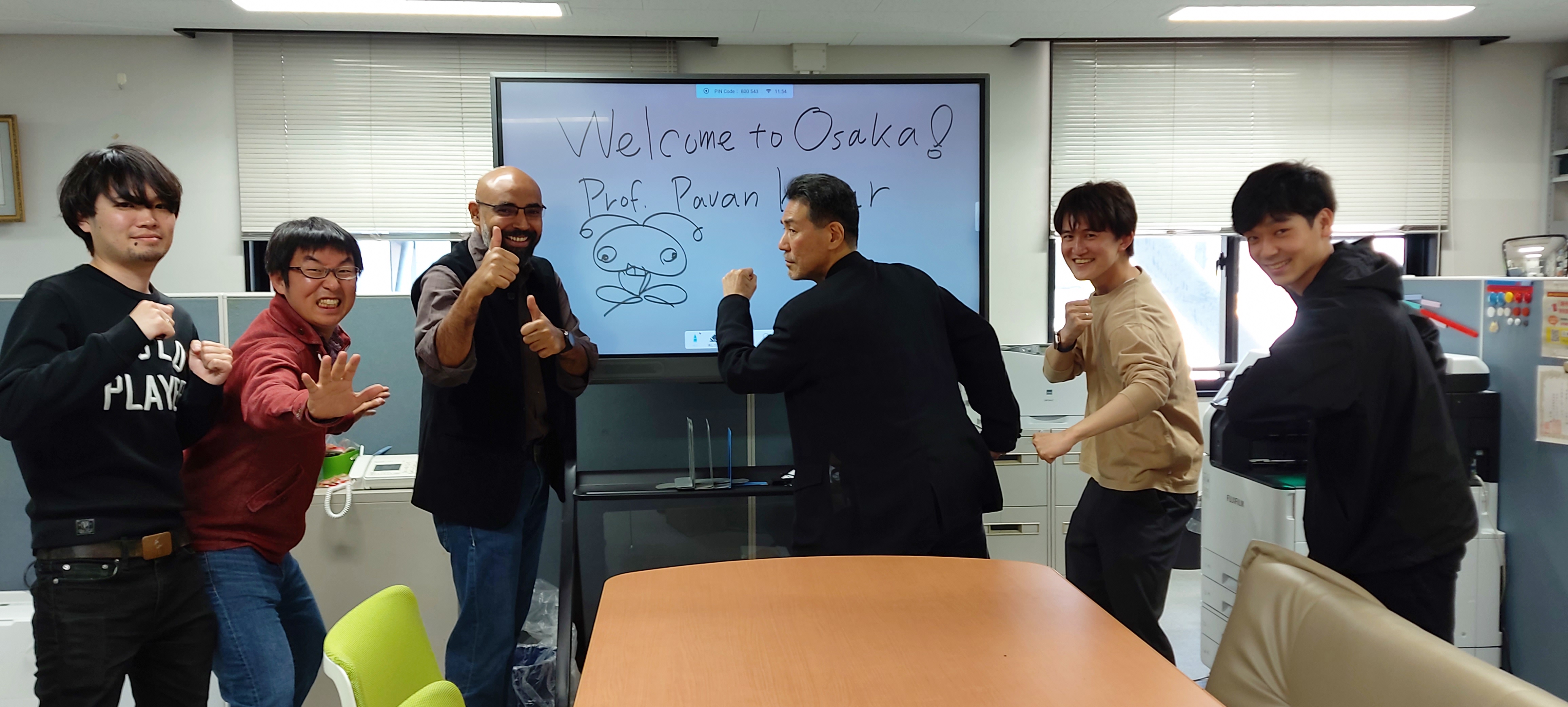
On 1st May, I visited Osaka University to officially meet Prof Ishihara, his group and other research groups in the university. We had a wonderful discussion on optical manipulation and major projects related to it especially in Japan, and undoubtedly Osaka has emerged as a major center in optical manipulation.
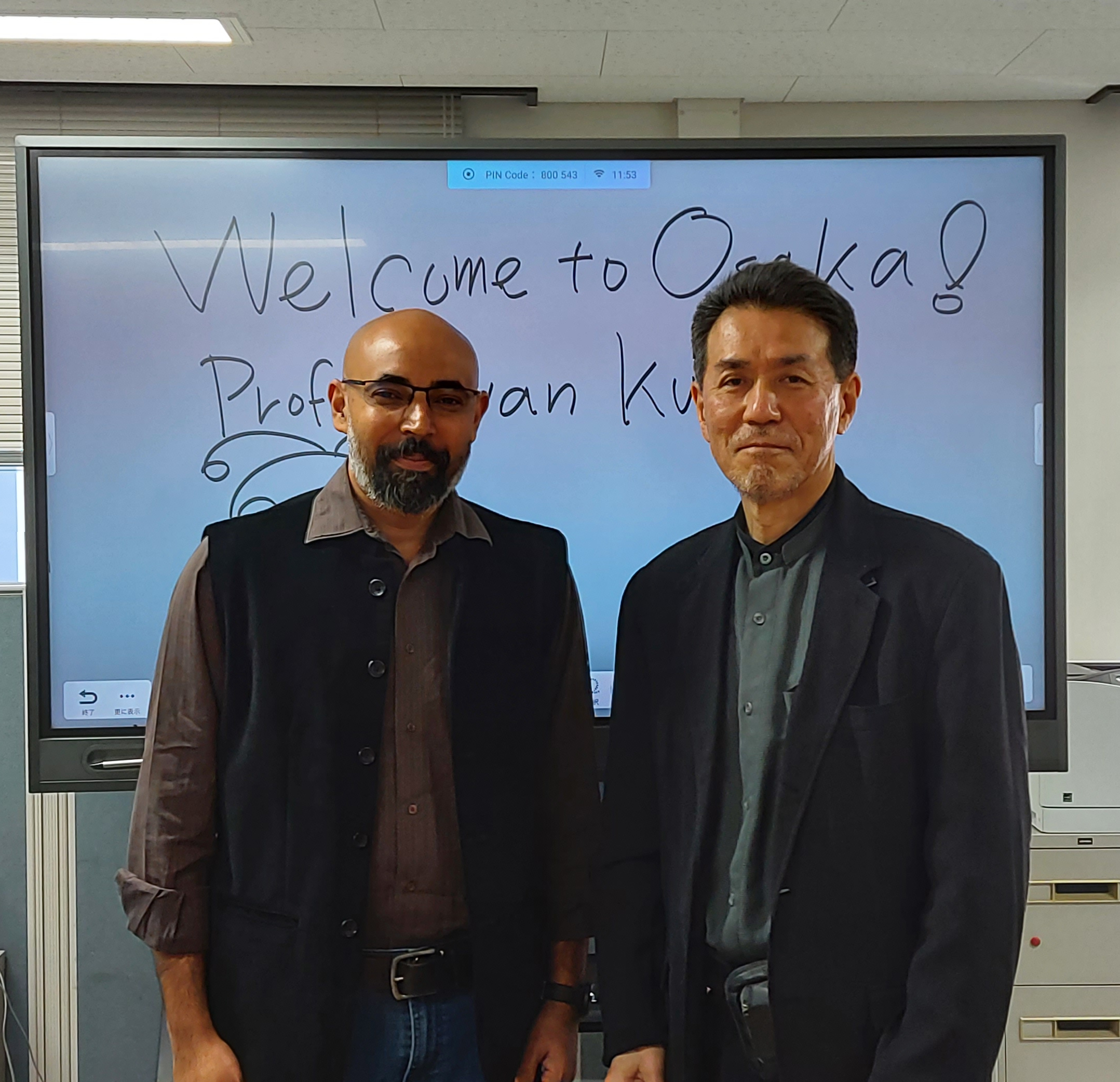
I was delighted to see so many students and research groups interested in optical trapping/manipulation and related science and technology. I learnt about some very interesting applications of optical manipulation. Also, it was great to see such a great sense of humor in this group of researchers. It was truly amazing.
I also visited labs of Prof. Ashida and Prof Ito, and got a very nice overview of their work including optical manipulation in liquid helium and photochemical reactions in an optical trap.
At 4pm, I gave my talk on “Optical Manipulation based on Opto-Thermal Gradients“. I elaborated on the role of absorption and related thermal gradient in optical manipulation. I presented some of our ongoing work on optical manipulation with structured light. The talk was attended by at least 30 to 40 people, and I was informed that students from various groups in Osaka were present (there are a few universities). The quality of questions and the follow up discussion was very good, and really enjoyed it.
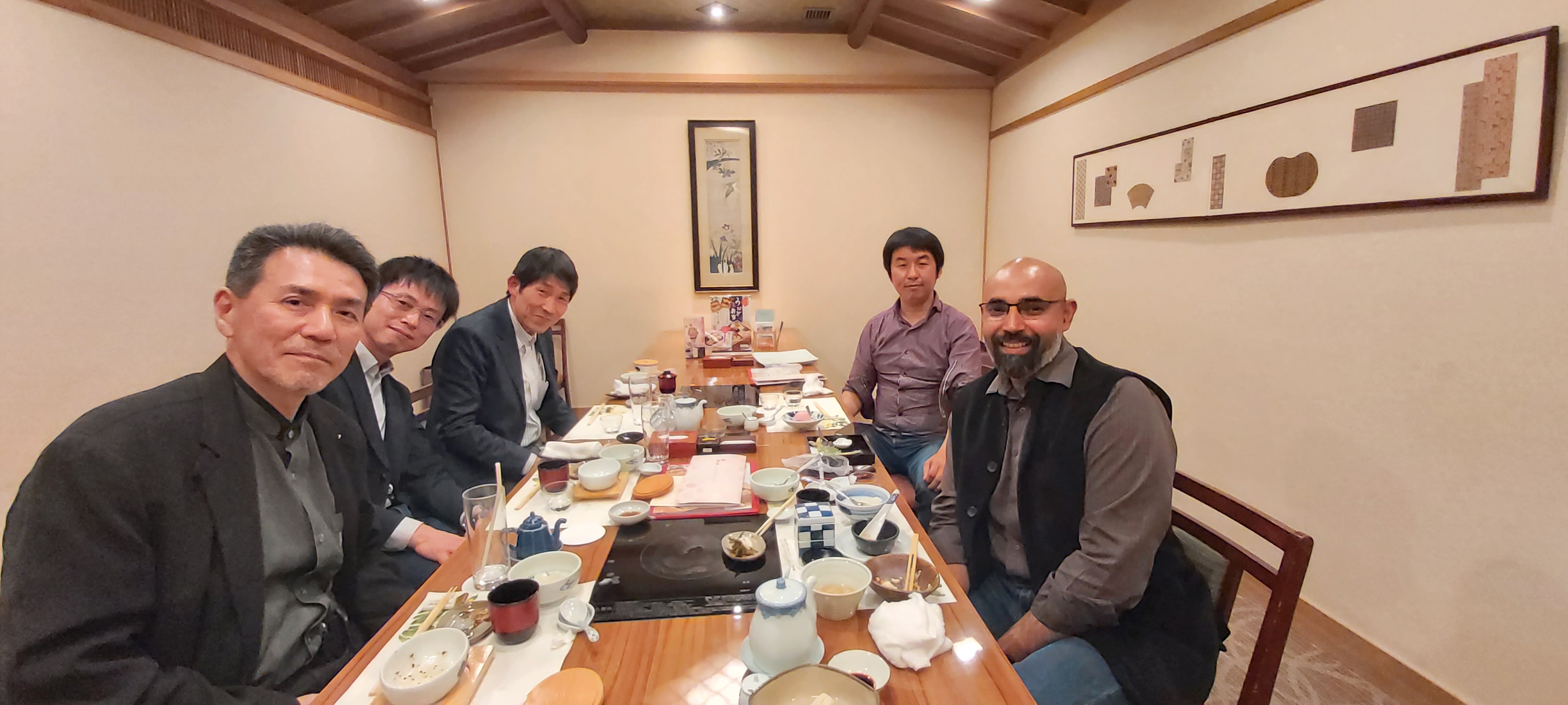
Finally, the day ended with a wonderful dinner at a tofu-themed Japanese restaurant. We had wonderful discussion on history and philosophy in our countries, and was very interesting.
My trajectory in Japan has been Yokohama –> Tokyo –> Okinawa –> Osaka. After 16 days, one conference talk and 4 research seminar across Japan, I am now heading back from Osaka to Tokyo (and writing this blog) on Shinkansen – the bullet train. Tomorrow, I will be leaving to India.
In Japanese, the word ‘Osaka’ also means ‘a large hill’. Japan’s geography has many large hills (see a picture of Mt. Fuji I took from the moving Shinkansen), and metaphorically speaking Japanese like to scale complex landscapes of life by bringing culture with science and technology. There is a lot to learn from this approach to life.
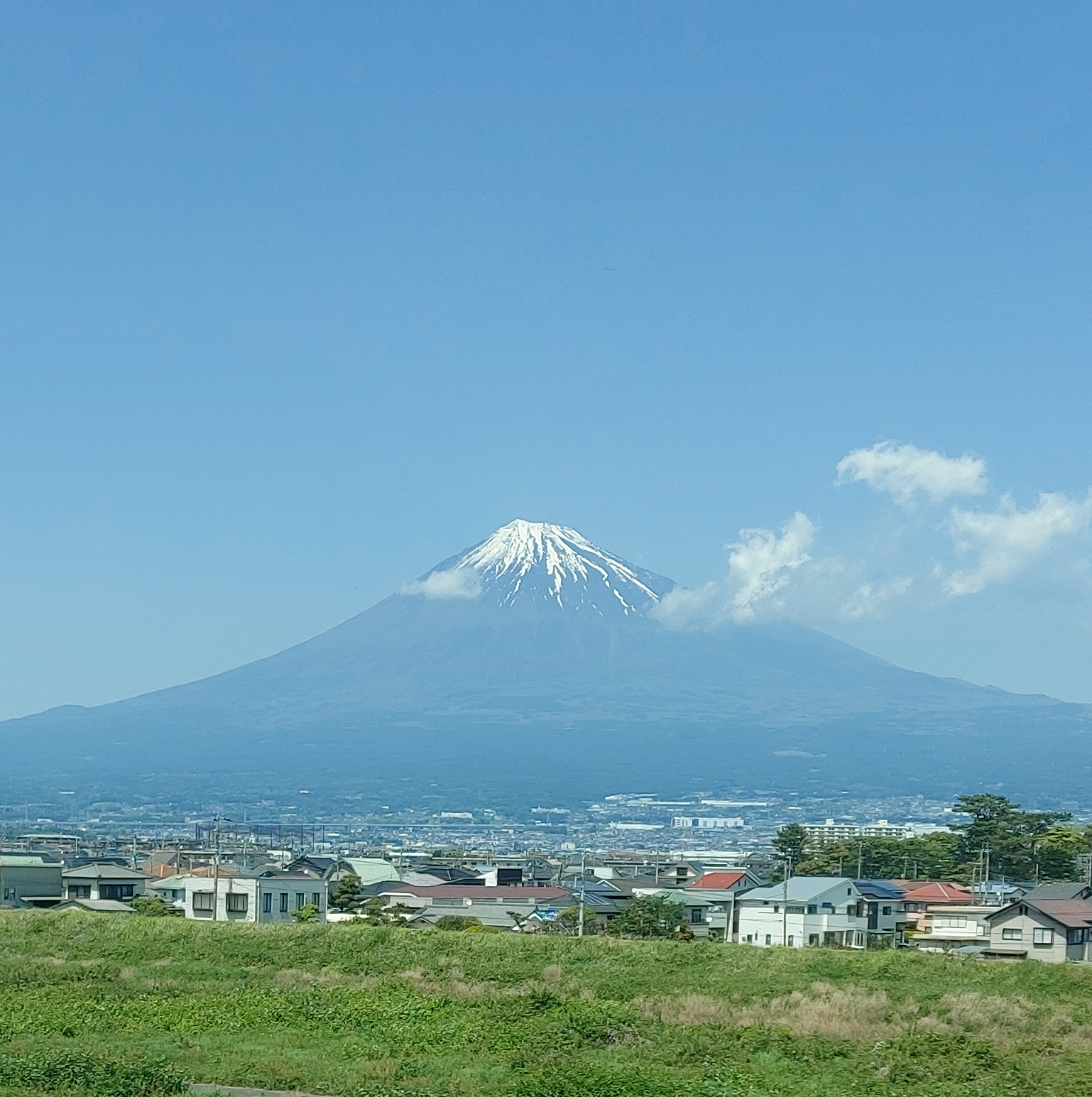
Osaka, optical manipulation and the perennial ascent towards knowledge. What a memorable trip this has been.
To Japan and to all the people I met here – Doumo Arigatou Gozaimasu !
Ocean, Okinawa and OIST…
I had a memorable visit to Okinawa Institute of Science and Technology – OIST (27th and 28th April 2023). Prof. Mahesh Bandi was my host, I had a fabulous time interacting with him and a few other groups. Below are some (of many) highlights.
First, the geography : located in the midst of the ocean(s), away from the mainland Japan, Okinawa is the southern most part of Japan. I took a 2.5 hrs. flight from Tokyo and reached the destination when it was dark.

In the morning, I woke up and opened the window to be pleasantly surprised to see the beautiful ocean in my field of view. Below is a photo I took from the balcony of the room.
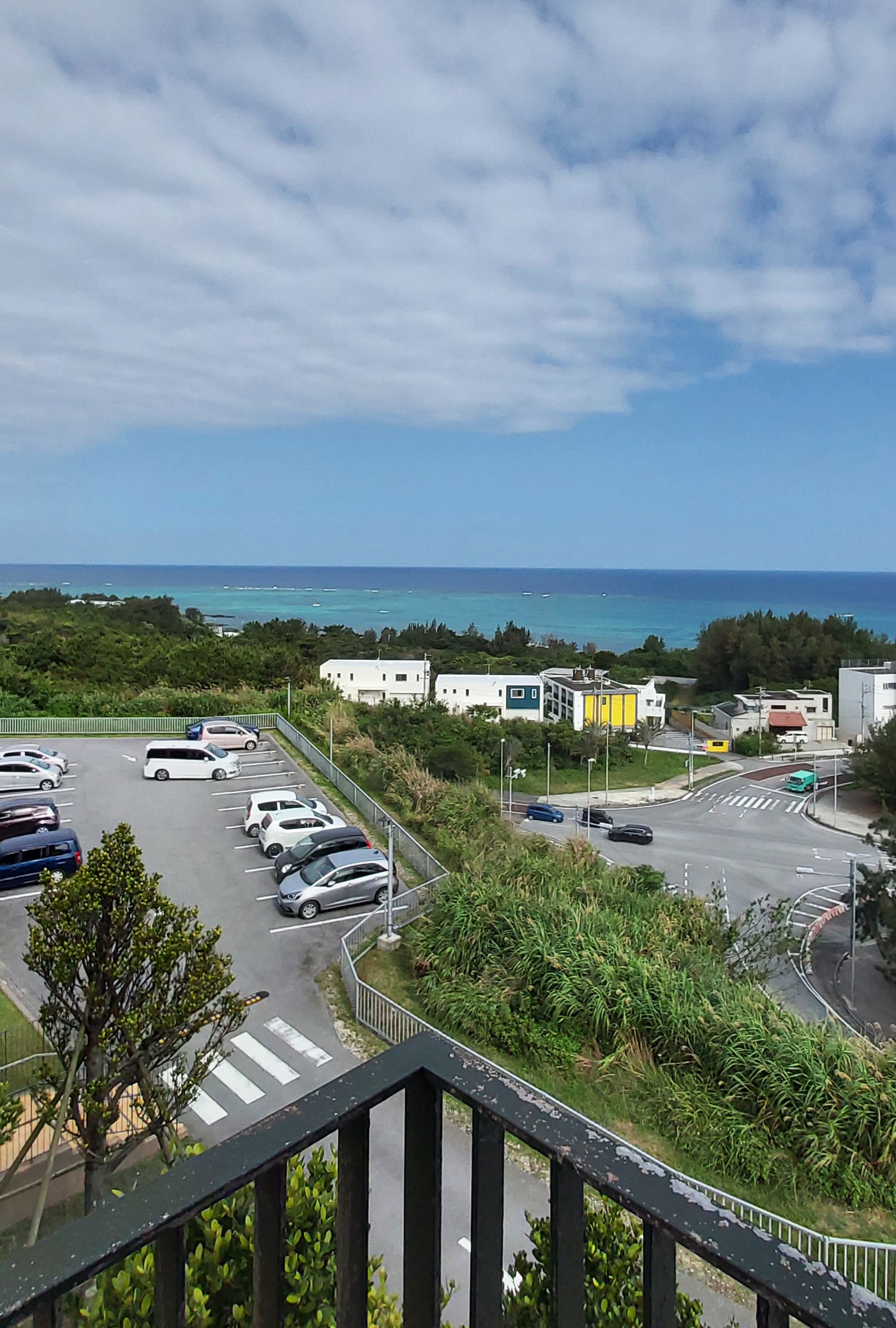
At the outset, I had a fabulous discussion. Mahesh and I had a excellent free-wheeling discussion on various topics including science, arts and history. Also, I visited his lab to see very creative experiments on non-equilibrium physics including some fascinating experimental designs to probe dynamics at liquid-air interface. He has a fabulous set of students working on interesting problems. It was both refreshing and stimulating.

In the afternoon, I gave my seminar and below is an interesting announcement (because it spells out my full name :-)). I discussed about some non-equilibrium aspects of our work, and towards the end emphasized some interesting prospects of statistical optics in an optothermal-assembly.

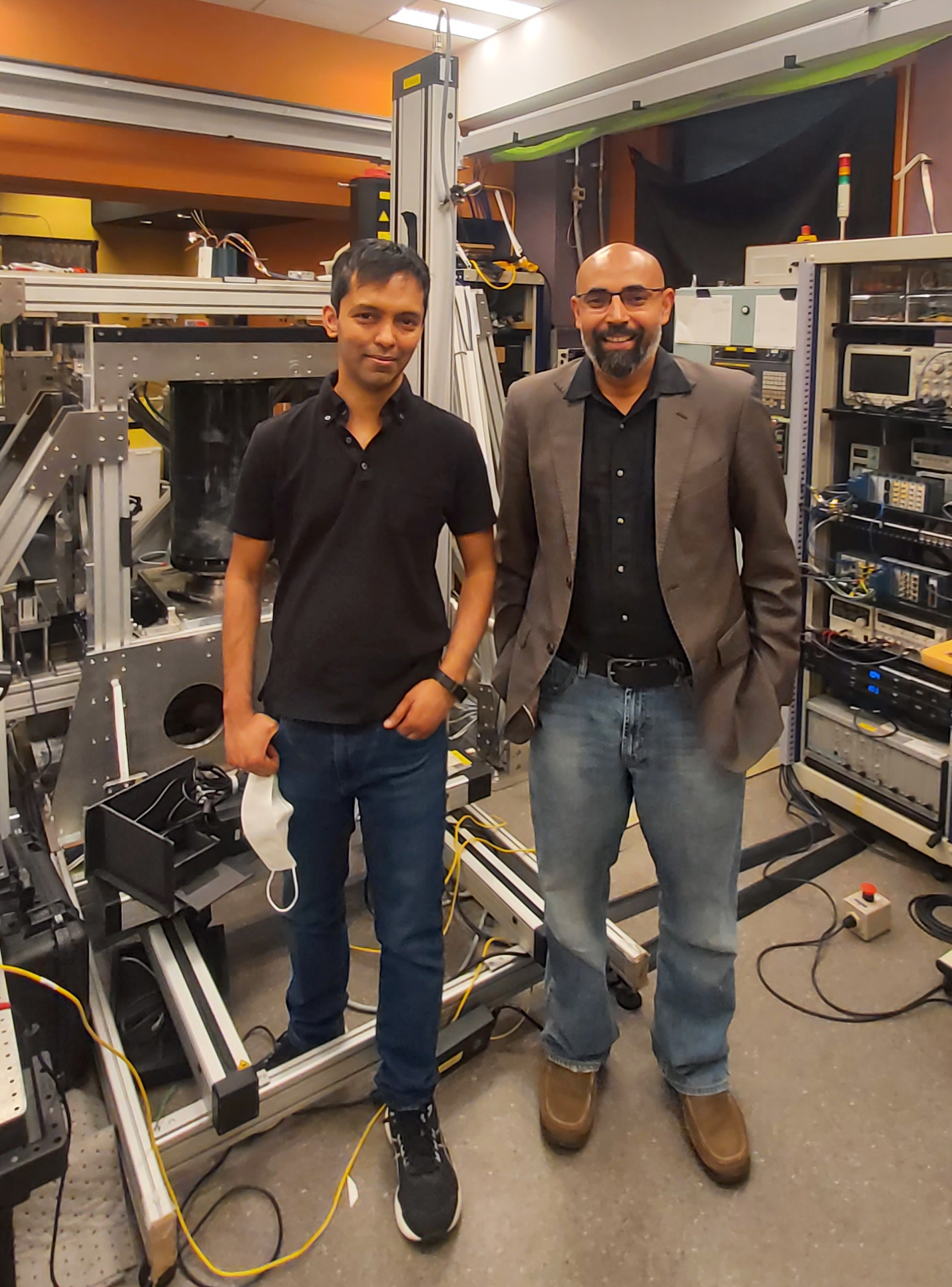
After my talk, I had illuminating discussion with Prof. Pinaki Chakraborty on thermal diffusion, fluid dynamics and history of science. I enjoyed visiting his lab, in which they have built one of the biggest Taylor-Couette flow set up I have ever seen (see the frame behind Pinaki in the picture below).
Next day, I had an elaborate lab tour of Prof. Sile Nic Chormaic, who is an expert in various topics related to optics/photonics including optical trapping. As she was travelling, her post-doc Dr. Souvik Sil, hosted me and took me around to show various aspects of their lab. It was a great learning experience.
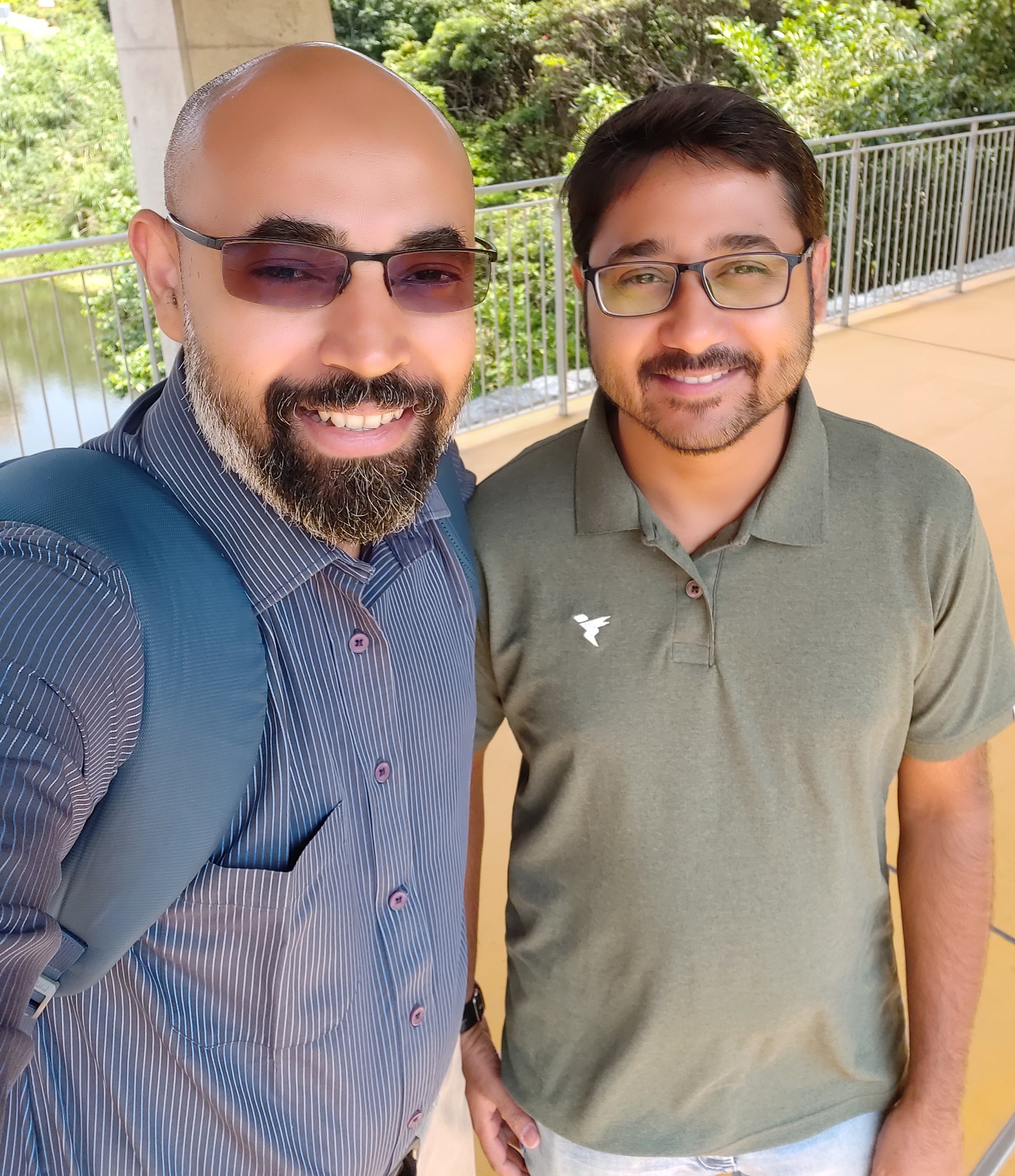
On the same day, I visited the cutting-edge lab of Prof. Keshav Dani. Since he was travelling, his team members gave me a brief tour and I was amazed by some of their experiments.
Another major highlight of my trip was to meet many IISER students. Specifically, I met Amit Bhunia (post-doc) and Saurav Raj (PhD student) who are IISER Pune alumnus. I also met many IISER Kolkata students (Souvik being one of them).
Overall, I was mighty impressed by the research infrastructure at OIST and the people working there. It is quite remarkable how they have been able to build such a great facility in such a short time (their campus started around 2010).

Today, I have reached Osaka, and on Monday will be giving a talk and visiting a few groups at Osaka Unviersity. Prof. Hajime Ishihara is my host, and I look forward to plenty of interaction on optical manipulation.
New paper : Optothermoelectric trapping of single nano-diamonds
We have a new paper appearing in Optics Letters on optical manipulation of fluorescent nano-diamonds. This experimental work (with some simulations) was performed by our group member Ashutosh Shukla in collaboration with the group of Prof. Kasturi Saha (IIT-Bombay). Our alumni, Sunny Tiwari, gave vital inputs to perform the experiments.
Fluorescent nano-diamonds have emerged as important (quantum) imaging agents in biological applications. It remains a challenge to manipulate them in complex fluidic environments.
Herein, we have come up with an optical trapping method based on opto-thermoelectric effect (see Fluorescence imaging video above). By using opto-thermal potentials created by a single gold nanoparticle (~200nm) on a glass surface, we have been able to trap individual nano-diamonds, and capture their spectral signatures. The Brownian motion in the trap can be tracked, and this leads to the measurement of effective trap stiffness. Furthermore, we extrapolate this thermo-plasmonic trapping method to trap and track individual nano-diamonds on silver nanowires.
As mentioned in the abstract of the manuscript, we envisage that our drop-casting platform can be extrapolated to perform targeted, low-power trapping, manipulation, and multimodal imaging of FNDs inside biological systems such as cells.
arxiv link to the paper : https://arxiv.org/abs/2210.02874
below is the snapshot of the abstract of the paper from journal’s early posting :

 VISMAYA - History & Philosophy of Physics