Conversation with Biman Nath

Biman Nath is a cosmologist and a Professor at Raman Research Institute, Bengaluru

His webpage : https://wwws.rri.res.in/~biman/

He is also bi-lingual author (non-fiction+fiction)

We discuss

  • his bio, growing up in Assam, career trajectory in India & US, his research, books, writing process ++
  • his current research interest in cosmology especially related to diffuse gases and deliberated on some contemporary questions.
  • on a variety of books he has authored and what motivated him to write in Bengali and English. What has been his experience in communicating science in two different languages.
  • many other topics including a segment in Bengali

Listen, as we humanize science…

Youtube audio :

spotify :

google podcast : https://podcasts.google.com/feed/aHR0cHM6Ly9hbmNob3IuZm0vcy9lMTcyMGUwYy9wb2RjYXN0L3Jzcw/episode/N2VjMWUxNWEtYWY5NS00ZjUwLWI1MWEtZGJkYmNlZmY1Y2Q3?sa=X&ved=0CAUQkfYCahcKEwjo4tnWgbiBAxUAAAAAHQAAAAAQAQ

apple podcast : https://podcasts.apple.com/us/podcast/ep-21-conversation-with-biman-nath-cosmologist-bi/id1687861465?i=1000628507584

References :

  1. “Biman B. Nath.” Accessed September 9, 2023. https://wwws.rri.res.in/~biman/.
  2. “Biman B. Nath | Raman Research Institute.” Accessed September 9, 2023. https://www.rri.res.in/people/faculty/biman-b-nath.
  3. “‪Biman B. Nath‬ – ‪Google Scholar‬.” Accessed September 9, 2023. https://scholar.google.co.in/citations?user=yQa01BoAAAAJ&hl=en.
  4. Amazon.In.” Accessed September 9, 2023. https://www.amazon.in/Books-Biman-Nath/s?rh=n%3A976389031%2Cp_27%3ABiman+Nath.
  5. “International Astronomical Union | IAU.” Accessed September 9, 2023. https://www.iau.org/administration/membership/individual/427/.
  6. Nath, Biman. Homi J Bhabha: A Renaissance Man among Scientists. Niyogi Books Pvt. Ltd., 2022.
  7. Nath, Biman. Solar System in Verse. Niyogi Books India Private Limited, 2023.
  8. Nath, Biman B. The Dawn of the Universe. Universities Press, 2005.
  9. Nath, Biman. The Story of Helium and the Birth of Astrophysics. 2013th edition. Springer, 2012.
  10. Similarities Between Sanskrit and Lithuanian, 2023. https://www.youtube.com/watch?v=bzRxSVK7qIU.
  11. “Ibn Al-Haytham.” In Wikipedia, September 6, 2023. https://en.wikipedia.org/w/index.php?title=Ibn_al-Haytham&oldid=1174142032.
Austin Kleon – inspirations

Austin Kleon on Writing, Creativity and The Importance of Idleness, 2020. https://open.spotify.com/episode/33TUAo3iWBbSolsf08q3FJ.

I found the discussion in this podcast interesting. Austin Kleon is charting out some interesting intellectual territory, and his work and thoughts are worth following. I have read most of his books and seen his talks, and it resonates with combinatoric creativity that Maria Popova often writes about.

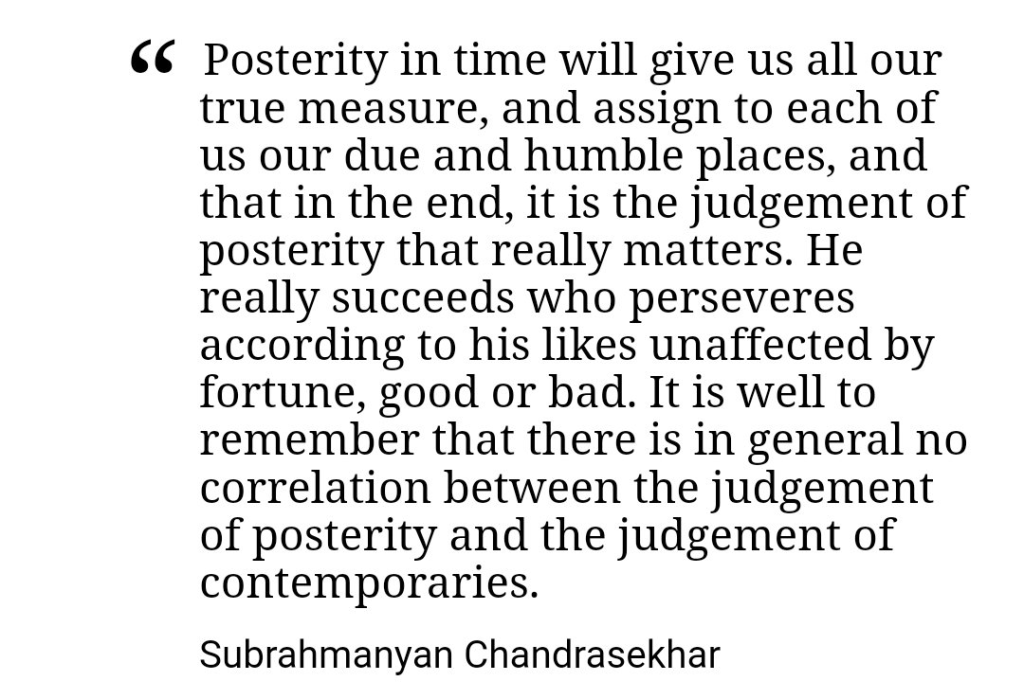
Will Durant is quoted to have said – “nothing is new, except the arrangement”

Chandra quoting Milne..

One of my all time fav. quotes. Chandra got it from Milne. Chandra had great temperament for scholarly work, & one can learn a lot from his style of working. His biographer, KC Wali, was a particle physicist, & his article linked is worth reading: https://jstor.org/stable/24100199

If interested, you can listen to a podcast I did on Chandra (one of the two of the similar name)…

Link to essays on Oppenheimer

Linked below is a fantastic, well researched & authentic biographical sketch of Oppenheimer – through a series of essays by Ashutosh Jogalekar

The movie has created a hype, and in India, people have taken interest for various reasons.

At the core – Oppenheimer was a scientist, in true spirit.

Crepuscular rays in Pune and a surprise from Western Ghats

What you see in this image (observed on 6th April 2023, 7.13am, Pune, India) is the emergence of sunlight from clouds in a peculiar expanding beam of rays. Such rays are called crepuscular rays.

The etymology of the word –

crepuscular (adj.)

figurative use, “dim, indistinct,” is attested from 1660s; literal use, “pertaining to or resembling twilight,” from 1755, from Latin crepusculum “twilight, dusk,” related to creper “obscure, uncertain,”

source : “Crepuscular | Search Online Etymology Dictionary.” Accessed April 7, 2023. https://www.etymonline.com/search?q=crepuscular&ref=searchbar_searchhint.

These rays are generally observed during the twilight and persist for a short time. The location of observation is close to the horizon, although I sighted it at a reasonable angle above the horizon (on Dr. Homi Bhabha road, in front of IISER-Pune Pashan gate). 

There is a large class of optical phenomena including sunbeams and moonshines, which are exclusively observed at twilight. For more details read this article by Shields, Janet. “Sunbeams and Moonshine.” Optics and Photonics News 5, no. 7 (July 1, 1994): 57. https://doi.org/10.1364/OPN.5.7.000057.

One may think this phenomenon is related to some kind of diffraction, but it is not. It mainly arises due to the linear perspective of how we visualize this optical effect in an open sky. Of course light scattering has some interesting role in this observation. A very nice discussion on this can be found in an article by Bohren, Craig, and Mark L. Sowers. “Simple Experiments in Atmospheric Physics.” Weatherwise 45, no. 2 (May 1, 1992): 34–38. https://doi.org/10.1080/00431672.1992.9925919.

A Surprise in Western Ghats

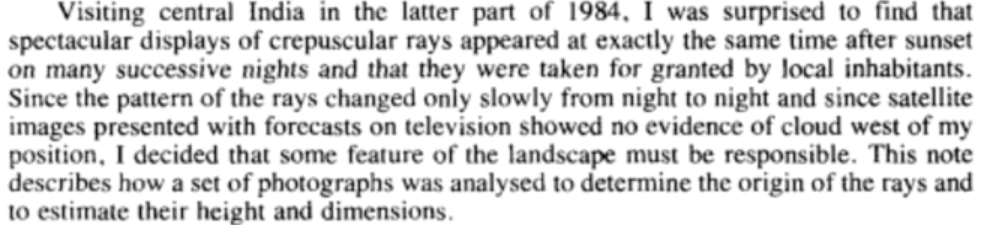
Western ghats are known to show this optical effect. In the year 1984, J. L. Monteith, a researcher who was visiting India from Goddard space center, USA (which is part of NASA) made an interesting and surprising observation. Below I reproduce his text –

For more details on this observation, read this paper by Monteith, J. L. “Crepuscular Rays Formed by the Western Ghats.” Weather 41, no. 9 (September 1986): 292–99. https://doi.org/10.1002/j.1477-8696.1986.tb03862.x.

Interestingly, such rays have also been periodically found in China and was reported as early as 1888 ! See this remarkable observation by Doberck, W. “Crepuscular Rays in China.” Nature 37, no. 959 (March 1888): 464–464. https://doi.org/10.1038/037464b0. Doberck also makes a connection to a historical text by Homer, in which Greek mariners describe the beautiful skies with peculiar rays. 

Around 2011, the crepuscular rays were simulated in a laboratory and further corroborated using numerical simulations. In order to mimic the behavior of clouds, “artificial fogs and milk–water solutions” were used and interesting quantitative observations were made.  For more details read : Gedzelman, Stanley David, and Michael Vollmer. “Crepuscular Rays: Laboratory Experiments and Simulations.” Applied Optics 50, no. 28 (October 1, 2011): F142–51. https://doi.org/10.1364/AO.50.00F142.

Atmospheric and meteorological optics are fascinating topics with some historical connections. For interested readers I highly recommend the following (fascinating and readable) books : 

  • Bohren, Craig F. Clouds in a Glass of Beer: Simple Experiments in Atmospheric Physics. Courier Corporation, 2001.
  •  What Light Through Yonder Window Breaks?: More Experiments in Atmospheric Physics. Courier Corporation, 2006.
  •        Minnaert, M. The Nature of Light and Colour in the Open Air. Revised ed. edition. New York,       N.Y: Dover Publications, 1954.
  • Minnaert, Marcel. Light and Color in the Outdoors. Translated by L. Seymour. Corrected edition. New York: Springer, 1993.

Science + History —> better Science

I recently read an interview of Lorraine Daston, a reputed historian of science on “Does Science Need History?”
She was interviewed by the philosopher Samuel Loncar

The long-form discussion is about history of science and how and why it is relevant not only to the public but also to the practicing scientists.

In the later part of the interview , I found an interesting and important observation made by Lorraine :

“One of the greatest achievements of science, contrary to what anyone would have thought not just circa 1700 but circa 1800, is the creation of the only effective international governance system that we have. In the face of two planetary crises—climate change and a global pandemic—it has not been the UN, it has not been the G8, that got together to diagnose the problem and suggest a solution. It has been the international community of scientists, and I would be extremely loath in any way to undermine the only example of semi-effective international governance we have.”

This is probably one of the important comments on science I have come across in recent times. In an age where nation-states are still fighting (big and small) wars, this is indeed a profound reminder on what truly is the instrument of effective (inter)national governance.

Do check out the whole interview. It has many interesting strands, branches and discussion including philosophy of science, publishing and some great references to explore.
As I have mentioned previously in my blogs, part of the reason why I blog is to bring out the human side of doing science. Interviews like these reinforces this thought, and encourages me as scientist to look into the history of science as not something decoupled from the science itself, but as a part of ones research in understanding why we, as human beings, are interested in science. In my opinion, our science education (and research) will be vastly enriched by including and emphasizing history of science as integral part of science. Frequently, I have also found that some of the best commentaries and criticism on science as human endeavor emnating from historians of science.

After all, it was history of science which opened our eyes towards understanding the structure of scientific revolutions. Hence Science + History —> better Science, and perhaps better human beings !

Chomsky et al., on Chatgpt

Chomsky et al., have some very interesting linguistic and philosophical points on chatGPT/AI and their variants (see NYT link).

To quote


“The human mind is not, like ChatGPT and its ilk, a lumbering statistical engine for pattern matching, gorging on hundreds of terabytes of data and extrapolating the most likely conversational response or most probable answer to a scientific question. On the contrary, the human mind is a surprisingly efficient and even elegant system that operates with small amounts of information; it seeks not to infer brute correlations among data points but to create explanations.”

The philosophical and ethical viewpoints expressed in this article are indeed noteworthy. What probably is even more important is the linguistic viewpoint which amalgamates language with human thought process, and that is what makes this article more interesting and unique.

My own take on Chatgpt has been ambivalent because I do see tremendous potential, but also some obvious faults in it. About a couple of months ago, I did try to play around with it, especially in the context of some obvious questions I had on optical forces, and the answers I got were far from satisfactory. At that time, I assumed that the algorithm had some work to do, and it was probably in the process of learning and getting better. The situation has not changed for better, and I do see some major flaws even now. Chomsky’s article highlighted the linguistic aspects which I had not come across in any other arguments against artificial intelligence-based answer generators, and there is some more food for thought here.

This is indeed an exciting time for machine learning-based approaches to train artificial thought process, but the question remains whether that process of thought can somehow emulate the capabilities of a human mind. 

As humans, a part of us want to see this achievement, and a part of us do not want this to happen. Can an artificial intelligence system have such a dilemma?