VISMAYA: History & Philosophy of Physics

Category: Writers

  • Crepuscular rays in Pune and a surprise from Western Ghats

    What you see in this image (observed on 6th April 2023, 7.13am, Pune, India) is the emergence of sunlight from clouds in a peculiar expanding beam of rays. Such rays are called crepuscular rays.

    The etymology of the word –

    crepuscular (adj.)

    figurative use, “dim, indistinct,” is attested from 1660s; literal use, “pertaining to or resembling twilight,” from 1755, from Latin crepusculum “twilight, dusk,” related to creper “obscure, uncertain,”

    source : “Crepuscular | Search Online Etymology Dictionary.” Accessed April 7, 2023. https://www.etymonline.com/search?q=crepuscular&ref=searchbar_searchhint.

    These rays are generally observed during the twilight and persist for a short time. The location of observation is close to the horizon, although I sighted it at a reasonable angle above the horizon (on Dr. Homi Bhabha road, in front of IISER-Pune Pashan gate). 

    There is a large class of optical phenomena including sunbeams and moonshines, which are exclusively observed at twilight. For more details read this article by Shields, Janet. “Sunbeams and Moonshine.” Optics and Photonics News 5, no. 7 (July 1, 1994): 57. https://doi.org/10.1364/OPN.5.7.000057.

    One may think this phenomenon is related to some kind of diffraction, but it is not. It mainly arises due to the linear perspective of how we visualize this optical effect in an open sky. Of course light scattering has some interesting role in this observation. A very nice discussion on this can be found in an article by Bohren, Craig, and Mark L. Sowers. “Simple Experiments in Atmospheric Physics.” Weatherwise 45, no. 2 (May 1, 1992): 34–38. https://doi.org/10.1080/00431672.1992.9925919.

    A Surprise in Western Ghats

    Western ghats are known to show this optical effect. In the year 1984, J. L. Monteith, a researcher who was visiting India from Goddard space center, USA (which is part of NASA) made an interesting and surprising observation. Below I reproduce his text –
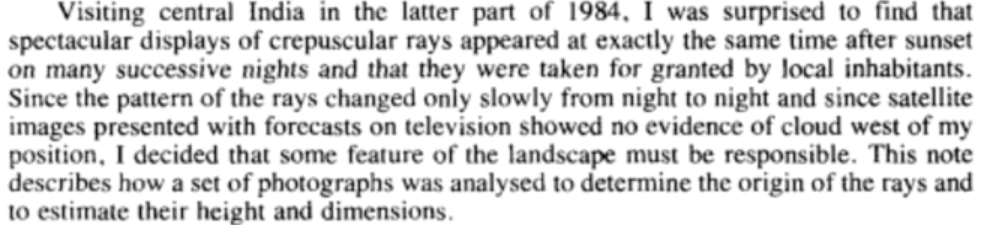
    For more details on this observation, read this paper by Monteith, J. L. “Crepuscular Rays Formed by the Western Ghats.” Weather 41, no. 9 (September 1986): 292–99. https://doi.org/10.1002/j.1477-8696.1986.tb03862.x.

    Interestingly, such rays have also been periodically found in China and was reported as early as 1888 ! See this remarkable observation by Doberck, W. “Crepuscular Rays in China.” Nature 37, no. 959 (March 1888): 464–464. https://doi.org/10.1038/037464b0. Doberck also makes a connection to a historical text by Homer, in which Greek mariners describe the beautiful skies with peculiar rays. 

    Around 2011, the crepuscular rays were simulated in a laboratory and further corroborated using numerical simulations. In order to mimic the behavior of clouds, “artificial fogs and milk–water solutions” were used and interesting quantitative observations were made.  For more details read : Gedzelman, Stanley David, and Michael Vollmer. “Crepuscular Rays: Laboratory Experiments and Simulations.” Applied Optics 50, no. 28 (October 1, 2011): F142–51. https://doi.org/10.1364/AO.50.00F142.

    Atmospheric and meteorological optics are fascinating topics with some historical connections. For interested readers I highly recommend the following (fascinating and readable) books : 

    • Bohren, Craig F. Clouds in a Glass of Beer: Simple Experiments in Atmospheric Physics. Courier Corporation, 2001.
    •  What Light Through Yonder Window Breaks?: More Experiments in Atmospheric Physics. Courier Corporation, 2006.
    •        Minnaert, M. The Nature of Light and Colour in the Open Air. Revised ed. edition. New York,       N.Y: Dover Publications, 1954.
    • Minnaert, Marcel. Light and Color in the Outdoors. Translated by L. Seymour. Corrected edition. New York: Springer, 1993.
  • Science + History —> better Science

    I recently read an interview of Lorraine Daston, a reputed historian of science on “Does Science Need History?”
    She was interviewed by the philosopher Samuel Loncar

    The long-form discussion is about history of science and how and why it is relevant not only to the public but also to the practicing scientists.

    In the later part of the interview , I found an interesting and important observation made by Lorraine :

    “One of the greatest achievements of science, contrary to what anyone would have thought not just circa 1700 but circa 1800, is the creation of the only effective international governance system that we have. In the face of two planetary crises—climate change and a global pandemic—it has not been the UN, it has not been the G8, that got together to diagnose the problem and suggest a solution. It has been the international community of scientists, and I would be extremely loath in any way to undermine the only example of semi-effective international governance we have.”

    This is probably one of the important comments on science I have come across in recent times. In an age where nation-states are still fighting (big and small) wars, this is indeed a profound reminder on what truly is the instrument of effective (inter)national governance.

    Do check out the whole interview. It has many interesting strands, branches and discussion including philosophy of science, publishing and some great references to explore.
    As I have mentioned previously in my blogs, part of the reason why I blog is to bring out the human side of doing science. Interviews like these reinforces this thought, and encourages me as scientist to look into the history of science as not something decoupled from the science itself, but as a part of ones research in understanding why we, as human beings, are interested in science. In my opinion, our science education (and research) will be vastly enriched by including and emphasizing history of science as integral part of science. Frequently, I have also found that some of the best commentaries and criticism on science as human endeavor emnating from historians of science.

    After all, it was history of science which opened our eyes towards understanding the structure of scientific revolutions. Hence Science + History —> better Science, and perhaps better human beings !

  • Chomsky et al., on Chatgpt

    Chomsky et al., have some very interesting linguistic and philosophical points on chatGPT/AI and their variants (see NYT link).

    To quote


    “The human mind is not, like ChatGPT and its ilk, a lumbering statistical engine for pattern matching, gorging on hundreds of terabytes of data and extrapolating the most likely conversational response or most probable answer to a scientific question. On the contrary, the human mind is a surprisingly efficient and even elegant system that operates with small amounts of information; it seeks not to infer brute correlations among data points but to create explanations.”

    The philosophical and ethical viewpoints expressed in this article are indeed noteworthy. What probably is even more important is the linguistic viewpoint which amalgamates language with human thought process, and that is what makes this article more interesting and unique.

    My own take on Chatgpt has been ambivalent because I do see tremendous potential, but also some obvious faults in it. About a couple of months ago, I did try to play around with it, especially in the context of some obvious questions I had on optical forces, and the answers I got were far from satisfactory. At that time, I assumed that the algorithm had some work to do, and it was probably in the process of learning and getting better. The situation has not changed for better, and I do see some major flaws even now. Chomsky’s article highlighted the linguistic aspects which I had not come across in any other arguments against artificial intelligence-based answer generators, and there is some more food for thought here.

    This is indeed an exciting time for machine learning-based approaches to train artificial thought process, but the question remains whether that process of thought can somehow emulate the capabilities of a human mind. 

    As humans, a part of us want to see this achievement, and a part of us do not want this to happen. Can an artificial intelligence system have such a dilemma?

  • M. Visvesvaraya’s professional autobiography

    M. Visvesvaraya was a legend and an inspiration… he was truly one of the makers of modern India…below is the link to his professional autobiography, available online for free

    Memoirs of my working life. by Visvesvaraya, M (1951)

    https://archive.org/details/VisvesvarayaAutobiography

  • Basic advice to undergrads: written assignments

    Below is some basic advice I shared with my undergraduate class (Physics majors/Optics). This may be useful to other students here.

    • Do not copy a text verbatim, unless you are quoting the text as it is, with reference at that location.  If you use a source, then write a summary in your own words and cite the original source at the location of your text.
    • In the absence of primary data (which you generate originally), you will be using secondary sources such as research papers, books and internet content. For scholarly purposes (including assignments), it is better to use journal articles and books as references. Wikipedia is essentially a tertiary reference. Although some entries are good, wikipedia content is generally taken from a book or a research paper. Identify that source and use it for your assignment and reference. Directly citing wikipedia (which is usually not peer reviewed by experts) is not a general practice in scientific literature. 
    • When you take a figure or equation from a secondary resource (paper, book, internet), it is important that you cite the source in figure caption/equation location.
    • In an assignment, I am mainly interested in reading what you think about the topic under consideration. Feel free to put down your thoughts and compare and contrast it to the literature you use. This is where the thinking + learning happens.
    • For some general advice on referencing, especially for online communication, have a look at my blogpost.
    • To appreciate importance of written communication in learning, have a look at another blogpost.
  • A relevant book and its review

    A book review has appeared an important and timely book on a topic which is subject to misinformation:

    Are Electromagnetic Fields Making Me Ill? How Electricity and Magnetism Affect our Health, by Bradley J. Roth

    reviewed by Robert G. Olsen in the most recent issue of the American Journal of Physics. https://aapt.scitation.org/doi/full/10.1119/5.0107970

    As the reviewer says:


    “While the focus is on the specific controversies listed in the table of contents, an even more valuable contribution of the book is the description of Roth’s methodology. In describing his approach to evaluating the science (or lack thereof) behind each claim, you will learn some of the thought processes needed to evaluate any new technology. Anyone who adopts these approaches will become a better investigator of new claims”

    I have been following book-reviews of American Journal of Physics
    There are some really good recommendations and assessments.

  • Indian Philosophy and Independent thought

    Today we mark the 75th anniversary of Indian independence from the British colonial rule. For a country of our population and size, it is indeed a great achievement that we have sustained to be a democratic nation. We continue to be a work in progress and there is a lot to learn and look forward to.

    India today is awash in the tri-colour flag, which marks a symbol of our identity.

    This symbol has a deeper philosophical meaning, and it has been wonderfully described by one of the great Indian philosopher Sarvepalli Radhakrishnan (also first vice-president of India, and subsequently President of India) as follows :

    “Bhagwa or the saffron colour denotes renunciation of disinterestedness. Our leaders must be indifferent to material gains and dedicate themselves to their work. The white in the centre is light, the path of truth to guide our conduct. The green shows our relation to soil, our relation to the plant life here on which all other life depends. The Ashoka Wheel in the center of the white is the wheel of the law of dharma. Truth or satya, dharma or virtue ought to be the controlling principles of those who work under this flag. Again, the wheel denotes motion. There is death in stagnation. There is life in movement. India should no more resist change, it must move and go forward. The wheel represents the dynamism of a peaceful change.”

    Dr. S. Radhakrishnan, Constituent Assembly of Independent India

    The metaphor of wheel to go forward is noteworthy. It essentially states that we as a society should be forward-looking and evolve our thoughts as we make progress. Such a call for evolution of thought and progress is not alien to our civilization.

    Lest we forget – Indian philosophy is not just a spiritual literature, it has immense depth and discussion on rationality and logic, and places emphasis on debates and arguments. So much so, that even our great, ancients poets such as Kalidasa uphold this rational spirit in their writings. To quote from his famous Malavikaagnimitram :

    पुराणमित्येव न साधु सर्वंन चाऽपि काव्यं नवमित्यवद्यम्।

    सन्तः परीक्ष्यान्यतरत् भजन्तेमूढ्ः परप्रत्ययनेयबुद्धिः ॥

    -मालविकाग्निमित्रम् (महाकवि कालिदास)

    The translation (source) from Sanskrit means :

    All poems are not good only because they are old. All poems are not bad because they are new. Good and wise people examine both and decide whether a poem is good or bad. Only a fool will be blindly led by what others say.

    -Malavikaagnimitram (Great Poet Kaalidaas)

    My hope is that we as a society get inspired by these calls for rationality, and adapt empathy, humility, logical and scientific thinking as some of the core principles our lives. This is not only for a better India, but also for a better world.

    After all, as one of ancient Indian philosophical text (Maha Upanishad, 6.71–75) says :

    अयं निजः परो वेति गणना लघुचेतसाम्!!

    उदारचरितानां तु वसुधैव कुटुम्बकम् !!

    which is transliterated as :

    This is mine, that is his, say the small minded,

    The wise believe that the entire world is a family.

    Dear Indian people….Happy 75th Independence Day !

  • 12 Years as a faculty member in India – 12 lessons

    Today I complete 12 years as a faculty member at IISER-Pune. I have attempted to put together a list of some lessons that I have learnt so far. A disclaimer to note is that this list is by no means a comprehensive one, but a text of self-reflection from my viewpoint on Indian academia. Of course, I write this in my personal capacity. So here is it..

    1. People first, infrastructure next – As an experimental physicist, people and infrastructure at working place are of paramount importance. When I am forced to prioritize between them, I have chosen people over infrastructure. I am extremely fortunate to have worked with and continue to work with excellent students, faculty colleagues, and admin staff members. I think a good work place is mainly defined by the people who occupy it. I am no way neglecting the role of infrastructure in academia, especially in a country like India, but people have a greater impact in academic life than infrastructure.
    2. Create internal standards – In academia, whether you like it or not, there will be evaluations and judgments on your research and teaching. Generally, every academic ecosystem has its own standards for evaluating people. These standards are generalized principles and are not customized to an individual. Therefore, it was important for me to realize what good work meant and how to judge myself. As long as internal standards are high, and are properly met with consistency, the external evaluation becomes secondary. This attitude totally frees up the mind, and helps me to get better compared to my previous self. This also means I can appreciate others work without having to compare myself to them.
    3. Constancy and Moderation – When it comes to any work, it is important to be consistent over a long period of time. An equally important aspect is to moderate the amount of work done for a period. Most of the important work in research happens in units of months if not years. Therefore, constant effort with moderation keeps the motivation high, and makes the work enjoyable. Binge-working is attractive, but for intellectual work it is ineffective.
    4. Writing is a great tool to think – One of the most underestimated tools of thinking is writing. Not just formal writing, but the process of external articulation of thought on paper does wonders. Countless times, I have obtained, clarified and developed my thoughts only after I started writing about it. Writing is integral part of research and not just a communication tool.
    5. Importance of philosophy – Ever since I was an undergrad, I have been interested in philosophy of science. I had never taken a formal course on philosophy, but I have gradually started appreciating the role of philosophy of science. Specifically, it has catered to my question on ‘why I do what I do?’
    6. Teaching as social responsibility – In the Indian academia, scientific social responsibility is a buzz word. For me, the greatest social responsibility as an academic comes in the form of teaching. In larger scheme of things, some how we tend to neglect the impact of conventional teaching on students. Also, this impact is not easily measured. But the joy one obtains seeing a student do well is priceless. This local impact is what I value more because the feedback is there to see, right in front of you.
    7. Science, sports and arts : a trinity – I love outdoor sports including running, swimming, cricket etc. Equally, I enjoy listening to music, reading poetry and appreciating any form of art from any culture. I have found that it has not only made me a better person, but also has positively impacted my work. Taken as a trinity, these human endeavours continue to enrich our lives.
    8. Emphasis on mental and physical health – The most important policy that I have set in my research group is this: To do effective and enjoyable work, your mental and physical health should be good. There is no point in doing good work at the expense of your health. Therefore the priority will always be good health followed by good work.
    9. Social media : effective if used properly – Social media has a unique reach. If you are in India, and you want to connect to the scientific world, social media is an excellent platform. Given the size and diversity of India, social media can also reach people from various backgrounds and languages. If used responsibly, social media can have great impact on how science is communicated within India and how India connects to the scientific world.
    10. Renewed interest in applied mathematics and coding – During my BSc (Maths, Physics, Electronics) and MSc (Physics), I had excellent training and exposure in mathematics. During the lock-down period, I rejuvenated my interest in applied mathematics (especially nonlinear dynamics) and have started coding too. This has added a new impetus to my research and should reflect in the coming years.
    11. Professor as a post-doc – A research strategy I found useful in my work is to treat myself as a post-doc in the lab. Given that, in India retaining a long-term post-doc is difficult, many of the skills and thought processes cannot be effectively transferred in lab. A long term research problem needs sustained effort in the lab. As an experimental faculty it is easy to get caught up in activities outside the lab and lose touch with the (optical) bench work. Thanks to the lock-down period, I was the only one in the lab for almost 6 months,and I restarted my experimental work. I value that time and I see great benefit in this approach.
    12. Self-mentoring – A lot of academic advice is written by people working in the west. A few of them are general and applicable to Indian academia, but many of them are not. In such a situation, as an academic I try to derive inspiration by reading, especially about people who have done great work in India. I have been deeply influenced by people such as M. Visvesvaraya and Ashoke Sen. 
  • Sagan’s quote

    Keynote address at CSICOP conference in 1987. “Do Science and the Bible Conflict?” Book by Judson Poling, p. 30, 2003

    Even before the age of social media, Carl Sagan played a prominent role in communicating science to the public. His book ‘Cosmos’ is a classic, and his public lectures (a few are on YouTube) are certainly worth watching.

    For me what is very impressive about Sagan’s communication is that he is not condescending by any means. This attitude is probably one the most important aspect in communicating science to society. The moment the public feels that scientific thinking is an elitist’s endeavour, they tend to repel.

    Not only was Sagan an excellent scientist, but also a person who articulated the role of science in society, especially by contrasting it to religion and politics. A very famous quote of his is reproduced here, that highlights the value of scientific thinking, and how it elevates the human mind.

    Quote reference: Keynote address at CSICOP conference in 1987. “Do Science and the Bible Conflict?” Book by Judson Poling, p. 30, 2003

  • 60. An old message.. for the new year

    Something I created about 12 years ago :http://pavan-astitva.blogspot.com/2010/02/click-to-read-1.html?m=1

    Years have changed, but the message has not……