‘We’gnana !

Recently, I saw the following tweet from the well-known historian William Dalrymple.

Congrats to the listed authors, who deserve rewards (and the money) for their effort.

I have 3 adjacent points to make:

1) India badly needs to read (and write) more on science and technology. Here, I am not referring to textbooks, but some popular-level science books (at least). Generally, educated Indians are exposed to science only through their textbooks, which are mostly dull, or, in this era, YouTube videos, which have a low signal-to-noise ratio. Good quality science & tech books at a popular level can add intellectual value, excitement, and expand scientific thinking via reading, not just in students, but also in adults.

2) In India, most of the non-fiction literature is dominated by the social sciences, particularly history (as seen in the best-seller list). I have no problem with that, but non-fiction as a genre is a broad tree. Indian readers (and publishers) can and should broaden this scope and explore other branches of the tree. Modern science books (authentic ones), especially written in the Indian context, are badly in need. I hope trade publishers are reading this!

3) Most of the public and social media discourse in India does not emphasize (or underplays) the scientific viewpoint. Scientific literature and scientific discourse should become a central part of our culture. Good books have a major role to play. Remember what Sagan’s Cosmos did to American scientific outlook, and indirectly to its economic progress. The recent Nobel in economics, especially through the work of Joel Mokyr, further reinforces the connection between science, economics and human progress. This realization should be bottom-up, down to individual families and public places.

One of the great scientists, James Maxwell, is attributed to have said: “Happy is the man who can recognise in the work of today a connected portion of the work of life and an embodiment of the work of Eternity.

Science, with its rich, global history and philosophy, in the form of good books, can connect India (and the world) to the ‘work of eternity’, and make us look forward.

Embedding science within culture, in a humane way, can lead to progress. Science books have a central role to play in this.

विज्ञान (Vignana) should transform to ‘We’gnana !

Have You Seen the Bird Flying? by D. R. Bendre

ಕನ್ನಡ ರಾಜ್ಯೋತ್ಸವದ ಶುಭಾಶಯಗಳು

Reproducing one of Da. Ra. Bendre’s Kannada poems titled “ಹಕ್ಕಿ ಹಾರುತಿದೆ ನೋಡಿದಿರಾ?” which translates to Have You Seen the Bird Flying?

A comment on the poem: In my reading, this poem is a metaphor for the exploration of the universe through the exploration of a bird. The poet periodically asks: “Have you seen the bird flying?”, thereby motivating the reader to observe what the bird may be seeing and doing. It is a poem read by school children, but there is a deeper philosophical meaning in asking humans to look up at the sky and realize the flight of a bird in themselves. YouTube also has the original audio of Bendre reciting the first few lines of the poem, and it is worth listening to.

Below is the poem, followed by a decent translation.

“ಹಕ್ಕಿ ಹಾರುತಿದೆ ನೋಡಿದಿರಾ?”

ಇರುಳಿರುಳಳಿದು ದಿನದಿನ ಬೆಳಗೆ
ಸುತ್ತಮುತ್ತಲೂ ಮೇಲಕೆ ಕೆಳಗೆ
ಗಾವುದ ಗಾವುದ ಗಾವುದ ಮುಂದಕೆ
ಎವೆ ತೆರೆದಿಕ್ಕುವ ಹೊತ್ತಿನ ಒಳಗೆ
ಹಕ್ಕಿ ಹಾರುತಿದೆ ನೋಡಿದಿರಾ?

ಕರಿನೆರೆ ಬಣ್ಣದ ಪುಚ್ಚಗಳುಂಟು
ಬಿಳಿ-ಹೊಳೆ ಬಣ್ಣದ ಗರಿ-ಗರಿಯುಂಟು
ಕೆನ್ನನ ಹೊನ್ನನ ಬಣ್ಣಬಣ್ಣಗಳ ರೆಕ್ಕೆಗಳೆರಡೂ ಪಕ್ಕದಲುಂಟು
ಹಕ್ಕಿ ಹಾರುತಿದೆ ನೋಡಿದಿರಾ?

ತಿಂಗಳಿನೂರಿನ ನೀರನು ಹೀರಿ
ಆಡಲು ಹಾಡಲು ತಾ ಹಾರಾಡಲು
ಮಂಗಳಲೋಕದ ಅಂಗಳ ಕೇರಿ
ಹಕ್ಕಿ ಹಾರುತಿದೆ ನೋಡಿದಿರಾ?

ಮುಟ್ಟಿದೆ ದಿಙ್ಮಂಡಲಗಳ ಅಂಚ
ಆಚೆಗೆ ಚಾಚಿದೆ ತನ್ನಯ ಚುಂಚ
ಬ್ರಹ್ಮಾಂಡಗಳನು ಒಡೆಯಲು ಎಂದೋ
ಬಲ್ಲರು ಯಾರಾ ಹಾಕಿದ ಹೊಂಚ
ಹಕ್ಕಿ ಹಾರುತಿದೆ ನೋಡಿದಿರಾ?

Translation (ChatGPT):

Have You Seen the Bird Flying?
(by D. R. Bendre — English rendering)

Night after night melts into day,
All around, above and below —
the world moves on and on,
as the moment of awakening opens —
Have you seen the bird flying?

It has a tail dark as rainclouds,
and feathers white, shining bright;
its wings on either side
are tinted with colors of gold and light —
Have you seen the bird flying?

It drinks the silvery water of the moon,
to play, to sing, to soar;
it enters the courtyard of the blessed world —
Have you seen the bird flying?

It’s touched the edge of the horizon,
stretched its beak to the farthest reach;
who knows — since when it has tried
to break open the universe itself —
Have you seen the bird flying?

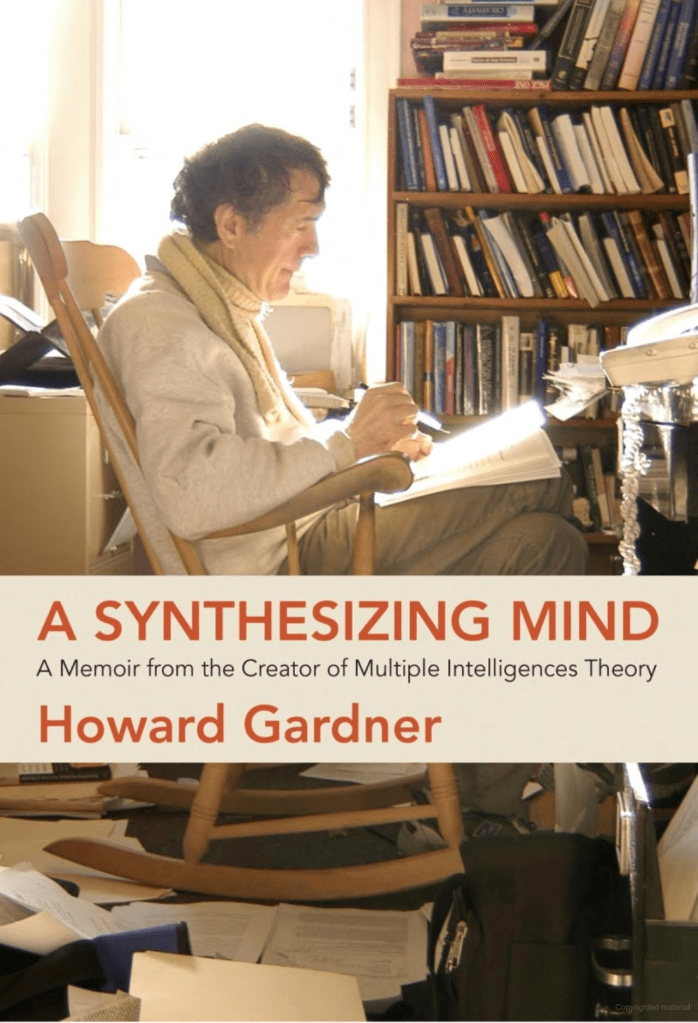
Gardner’s Synthesis

Once in a while, during my research, I come across writing by scholars from other disciplines that gives me a perspective that not only helps me to grasp the complexity of learning across disciplines, but also resonates with some thoughts on education.

Howard Gardner is one such academic who works on developmental psychology and has researched extensively on cognition and education. He has written ~30 books and ~1000 articles, and blogs regularly, even at the age of 82 or so. His recent book is titled A Synthesizing Mind.

Howard Gardner is a renowned Harvard academic and, as his book describes him as follows:

“Throughout his career, Gardner has focused on human minds in general, or on the minds of particular creators and leaders. Reflecting now on his own mind, he concludes that his is a ‘synthesizing mind’—with the ability to survey experiences and data across a wide range of disciplines and perspectives. The thinkers he most admires—including historian Richard Hofstadter, biologist Charles Darwin, and literary critic Edmund Wilson—are exemplary synthesizers. Gardner contends that the synthesizing mind is particularly valuable at this time and proposes ways to cultivate a possibly unique human capacity.”

While exploring the book and the related material, I came across an interview with Howard Gardner. In there, he is conversing about the theme of the book and discusses the synthesis of thought across disciplines. One of the pertinent aspects of learning is to know how innovation can be fostered by cross-disciplinary exploration without diluting disciplinary rigour. As Gardner says:

“I am not opposed to disciplinary learning—indeed I am an enthusiastic advocate. Any person would be a fool to try to create physics or psychology or political science from the start. But if we want to have scholars or professionals who are innovative, creative—and innovation is not something that we can afford to marginalize—then they cannot and should not be slaves of any single discipline or methodology.”

As a physicist, I can relate to this thinking within my discipline, and how innovative ideas, over the ages, have emerged by bringing ideas from mathematics, engineering and biology into physics. Particularly, the combination of biology, physics and mathematics is one of the most exciting frontiers of human exploration today, and Gardner’s words apply well in this scenario.

Going beyond science, I am always intrigued and amazed by artists (especially musicians) who can create art that simultaneously draws the attention of specialists and generalists. This is not a trivial achievement, and as a scientist, I am always trying to understand how artists resonate so well with the public. Gardner, in the abovementioned interview, frames this problem by looking at the goals of science and arts, and draws a contrast that is worth noting:

“Most scholars and observers like to emphasize the similarities between the arts and the sciences, and that is fine. But the goals of the two enterprises are different. Science seeks an accurate and well supported description of the world. The arts seek to capture and convey various aspects of experience; and they have no obligation other than to capture the interest and attention of those who participate in them.

Of course, there are some individuals who excel in both science and art (Leonardo is everyone’s favorite example). But most artists—great or not—would not know their way around a scientific laboratory. And most scientists—even if they like to play the violin or to draw caricatures or to dance the tango—would not make works of art or performances that would interest others.”

I partially agree with this assessment, as I know a few scientists who are deeply involved in various forms of art (including music) and do it very well, even at the professional level. In a way, Gardner is re-emphasizing the “two cultures” debate of C.P. Snow. My own thoughts on this viewpoint are ambivalent, as I see science, arts and sports as important pursuits that cater to different facets of the human mind. Of course, when it comes to expertise, the division may matter. There is a lot more to learn about the interface of art and science, at least for me.

Anyway, Gardner is a fabulous writer, and his blogs and books are worth reading (and studying) if one is seriously interested in understanding how to synthesize thought across disciplines.

Since we are discussing synthesis of thought, which is a kind of harmony, and coming together, let me end the blog with a line from Mankuthimmana Kagga by the Kannada poet-philosopher D.V. Gundappa:

ಎಲ್ಲರೊಳಗೊಂದಾಗು ಮಂಕುತಿಮ್ಮ” (Eladaralongodhagu manku thimma)

which loosely translates to: oh fool…be one among all (blend into world, living in harmony).

Harmony of disciplines and minds – how badly the world needs it today?
ChatGPT – an experiment

Below is a small experiment with ChatGPT (GPT-4o, which is OpenAI’s most advanced model as of July 2025).

I asked for thoughts (from authentic sources) from Indian writers on the nature of the writing process (handwriting vs typewriting).

It confidently gave me quotations from Rabindranath Tagore, R.K. Narayan and U.R. Ananthmurthy. I was intrigued, and below is my conversation:

me: list the quotes from Indian writers above and give the exact sources

Chatgpt: I couldn’t find reputable sources for the exact quotes I previously suggested by Indian writers—so it’s safer to reconsider them.

This is something I have been observing with LLM chatboxes, especially when it comes to the sources that may not be mainstream. One may even say it is hallucinating, but after enquiring further, it said:

The quotes I initially provided appear to be popular paraphrases or second-hand interpretations, but none could be verified in primary texts or reliable interviews.

Then, it asked me if I wanted to use authentic sources to be presented to corroborate the initially mentioned sources. I said yes, and below was its reply:

Here are verified quotes from Rabindranath Tagore, with clear attributions to reliable sources—unfortunately, I couldn’t locate authenticated quotes for other Indian writers on writing methods

The quotes that it gave were peripheral to my initial question. It identified two to three quotations, but none of them were directly connected to my initial query.

There may be at least 2 hypotheses that I can draw from this, which need further testing:

  1. ChatGPT and its kind may be getting trained more intensely on sources that are mainly anglophonic, and its geographical distribution of sources may be skewed. Online literary sources from countries such as India may not be as dense as, say USA, the UK or even some European countries. Will depositing more authentic sources online, including their translations, help the authentic discovery of information from countries such as India?
  2. With the current developments and model training, there may already be a bias in the answers that LLM chatbots give. It may reinforce many viewpoints from Western repositories that may sometimes be disconnected or irrelevant to the user outside Western geographies. In that sense, new information is being built on old information. Are we entering a stage where data deposition asymmetry is creating an asymmetry of discovery?

I know these questions are not trivial to answer, but for LLM chatboxes to be authentic, they need to address questions with proper citations. I know some of them are trying to do that (eg, perplexity AI), but I find the links it provides for certain focused questions are not up to the mark.

My inference:

  1. I am cautiously optimistic about the developments and achievements in source-based LLM interfaces, especially when you feed an authentic source (eg, NotebookLM).
  2. But LLM chatboxes may be hyped when:
    • It comes to its capability of sourcing authentic information, and
    • The immediacy of replacements of existing knowledge systems.
  3. LLM chatboxes should be treated as an experimental tool for utilitarian tasks where the information can be verified independently.
  4. It is important to take the bottom line of ChatGPT seriously: ‘ChatGPT can make mistakes. Check important info.

Open access : a few thoughts and books

I think that knowledge, especially academic knowledge, should be openly accessible to fellow researchers and the public. Given that most of the academic research in India is public-funded, it is imperative that our work is made available for anyone interested in reading and utilizing the knowledge. This makes a strong case for making our work open to access. Unfortunately, the open-access publication venture has been hijacked by some commercial publishers, who have misused the enthusiasm of academic researchers by converting it into a money-making opportunity via so-called ‘gold’ open-access models, where authors pay exorbitant article processing charges (APCs) to publish their work in the journals.

I have been searching literature to understand the philosophy and economics of open-access publishing models, and recently, by chance, I came across a couple of books by Peter Suber.

First is an open-access book on Open Access. Peter Suber has been a philosopher & open-access advocate for a long time. In this book, he explains what it really means to have open access to knowledge & the related philosophy, including its economics. Link to the book.

Second is a collection of writings on open-access publication (link), and as the online blurb says :

Influential writings make the case for open access to research, explore its implications, and document the early struggles and successes of the open access movement.

The green open-access model is very interesting and pertinent to countries such as India, and as per wiki it is defined as :

Green OA, is the practice of placing a version of an author’s manuscript into a repository, making it freely accessible for the scientific community.

The primary motivation of Open Access was
to provide Open Access to Knowledge to the READER of Publications and; to allow Open Access to AUTHORS Publication (unbiased publication of Knowledge)

Open access in the true sense, should neither have barriers to knowledge consumption nor to knowledge generation and dissemination. Therefore, APCs are a major hurdle to researchers and authors who do not have monetary support. This is most of the global south, and hence, a fair policy is needed to make it more democratic.

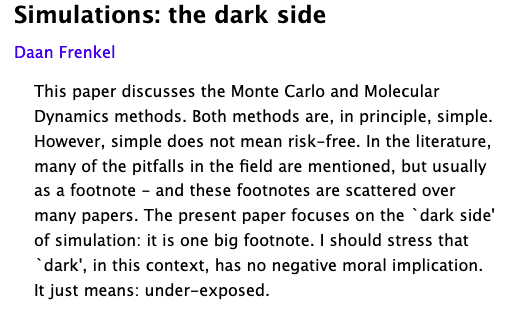
Why write interesting papers ?

A lesson I keep learning from Daan Frenkel: write interesting research papers. Thanks to Arghya Dutta (on X), who brought the paper below to my notice. https://arxiv.org/abs/1211.4440

Sometimes, interesting, well-written papers can have a deeper impact. Even otherwise, it would add clarity.

Scholarship + interesting writing >>>> prestige of the journal.

Don’t worship journals.

A common question when I say so is: what about academic assessment for jobs and promotion?

My answer is that academia (still) values consistent, scholarly output in reasonable journals.

It is very hard to reject scholarship. Aim for this as it is under your control.

Asimov on lasers

Isaac Asimov is undoubtedly one of the greatest science fiction writer in English. He also wrote a lot of non-fiction science books that are interesting and accurate in their exposition. I recently came across an interesting book by him on lasers. Written around 1990s, this book discusses the origins of lasers and the basic physics and engineering aspects of lasers. True to his reputation, he weaves interesting history into the science, that makes an engaging read. Some grayscale (charcoal-kind) illustrations in the book are appealing, and makes it a smooth read.

The book also has a short discussion on applications of lasers, and eye surgery is one of them which is explained lucidly.

If you are not from a scientific background, or want to have a light read on lasers, then I would recommend this book. As usual, Asimov does not disappoint you !

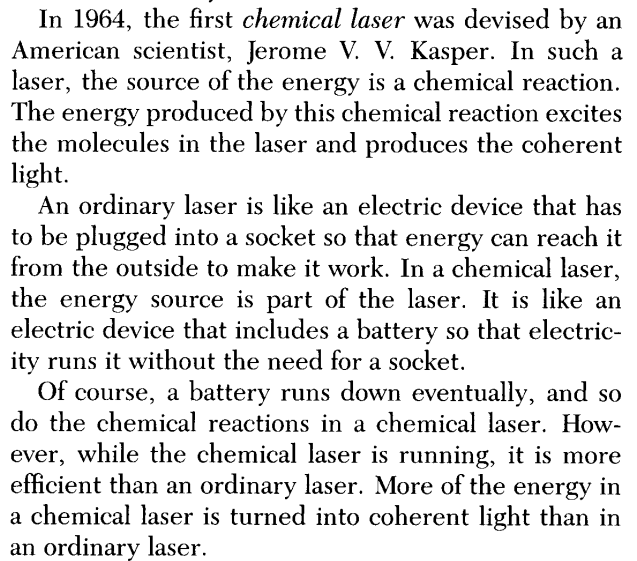
Asimov was a biochemistry professor before he became a full time writer. His incliniation towards chemistry is evident when he discusses ‘chemical laser’. I reproduce a couple of paragraphs from his book:

This idea of the so called ‘chemical laser’ is still under exploration, and has not found its full potential. Perhaps there is an interesting research problem here for the interested.

Internet archives has a link to this book, but it is not complete. On the internet, you may find other links to this book.

What was surprising to me is that I found a Marathi translation of this book online. I don’t know how good is the translation, but I will urge you check it out if you know the language well.

Asimov was a unique person, as he blended science, storytelling and writing very efficiently. We need more of his kind in this world.

Conversation with Biman Nath

Biman Nath is a cosmologist and a Professor at Raman Research Institute, Bengaluru

His webpage : https://wwws.rri.res.in/~biman/

He is also bi-lingual author (non-fiction+fiction)

We discuss

  • his bio, growing up in Assam, career trajectory in India & US, his research, books, writing process ++
  • his current research interest in cosmology especially related to diffuse gases and deliberated on some contemporary questions.
  • on a variety of books he has authored and what motivated him to write in Bengali and English. What has been his experience in communicating science in two different languages.
  • many other topics including a segment in Bengali

Listen, as we humanize science…

Youtube audio :

spotify :

google podcast : https://podcasts.google.com/feed/aHR0cHM6Ly9hbmNob3IuZm0vcy9lMTcyMGUwYy9wb2RjYXN0L3Jzcw/episode/N2VjMWUxNWEtYWY5NS00ZjUwLWI1MWEtZGJkYmNlZmY1Y2Q3?sa=X&ved=0CAUQkfYCahcKEwjo4tnWgbiBAxUAAAAAHQAAAAAQAQ

apple podcast : https://podcasts.apple.com/us/podcast/ep-21-conversation-with-biman-nath-cosmologist-bi/id1687861465?i=1000628507584

References :

  1. “Biman B. Nath.” Accessed September 9, 2023. https://wwws.rri.res.in/~biman/.
  2. “Biman B. Nath | Raman Research Institute.” Accessed September 9, 2023. https://www.rri.res.in/people/faculty/biman-b-nath.
  3. “‪Biman B. Nath‬ – ‪Google Scholar‬.” Accessed September 9, 2023. https://scholar.google.co.in/citations?user=yQa01BoAAAAJ&hl=en.
  4. Amazon.In.” Accessed September 9, 2023. https://www.amazon.in/Books-Biman-Nath/s?rh=n%3A976389031%2Cp_27%3ABiman+Nath.
  5. “International Astronomical Union | IAU.” Accessed September 9, 2023. https://www.iau.org/administration/membership/individual/427/.
  6. Nath, Biman. Homi J Bhabha: A Renaissance Man among Scientists. Niyogi Books Pvt. Ltd., 2022.
  7. Nath, Biman. Solar System in Verse. Niyogi Books India Private Limited, 2023.
  8. Nath, Biman B. The Dawn of the Universe. Universities Press, 2005.
  9. Nath, Biman. The Story of Helium and the Birth of Astrophysics. 2013th edition. Springer, 2012.
  10. Similarities Between Sanskrit and Lithuanian, 2023. https://www.youtube.com/watch?v=bzRxSVK7qIU.
  11. “Ibn Al-Haytham.” In Wikipedia, September 6, 2023. https://en.wikipedia.org/w/index.php?title=Ibn_al-Haytham&oldid=1174142032.