
Category: soft matter
Soft Matter – emergence of a physics domain
Recently, I read a nice interview with Sid Nagel, who is a pioneer in soft condensed matter physics.
Sid Nagel has given an aura to an area of physics that was not considered fashionable even as late as the 2010s. Part of his elevation is because “Soft Matter Physics” has become so vital to understand our everyday world (including biological) that it is hard to ignore it anymore. Chemical Engineers, too, have played a major role in this elevation, and the James Frank Institute at Chicago has been an epicenter for this way of thinking.
A major shift in thinking, especially among physicists, is thanks to PW Anderson. His essay – ‘More is Different” did a great service to soft matter and complex systems by highlighting the importance of emergence (side note: the word emergence does not occur in his essay, even once !) It further got a major headway with a Nobel to de Gennes. Suddenly, condensed matter physicists had something to explore beyond electrons and their density functions. The French school had a major hand in this.
For me, soft matter physics, in a way, makes physics experiments democratic. One can still dare to do some ‘breakthrough science’ in a tiny kitchen 🙂
Optothermally induced active & chiral motion – a new paper
We have a new paper in Soft Matter

link to the paper (free to access, thanks to IISER Pune library)
We use optical illumination to generate thermal fields, creating non-reciprocal interactions between passive and active colloids. Active colloids absorb light and produce thermal gradients, driving thermo-osmotic forces that induce propulsion and chiral motion. Our Langevin simulations, backed by experimental observation, reveal how to control colloidal behavior. May have implications in light-driven chiral motion and nonlinear dynamics.
Super effort by Rahul, Ashutosh & Sneha from our group, who combined numerical simulations, analytical theory, with experimental observations.
The 2 anonymous reviewers made us think and work hard, and we thank them!
Also, the paper is part of the journal’s themed collection on “Colloidal interactions, dynamics and rheology”
Where Ideas Merge: A Visit to the Institute of Science Tokyo
New ideas are often created by the merging of two old ideas. How often is this true, and how often do we tend to forget this?
Today I visited the Institute of Science Tokyo, formerly known as Tokyo Tech. This is a new avatar of a very interesting institution funded by the government of Japan. By merging the Tokyo Institute of Technology with the Tokyo Medical and Dental University, a very interesting concept has emerged: the Institute of Science Tokyo. These two institutions have been important pillars of the research and educational landscape of Tokyo, and I had the privilege of visiting this new place, which is a result of a new merger.
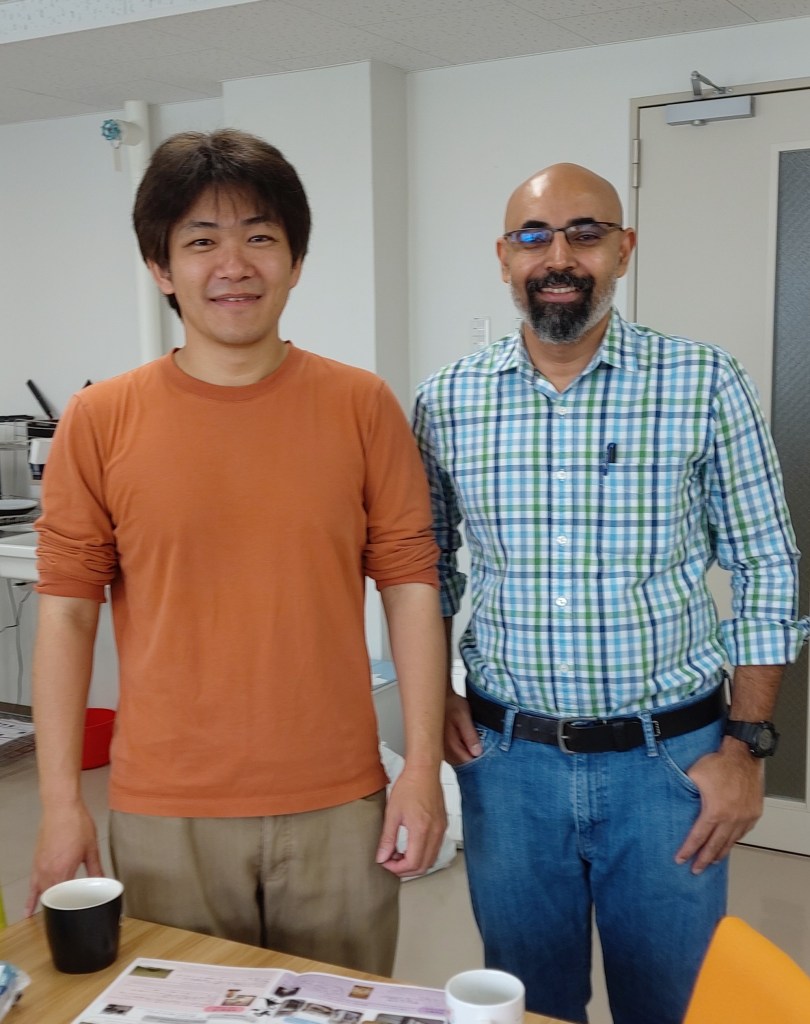
Thanks to the invitation and fantastic hospitality of Prof. Daiki Nishiguchi, a faculty member in the Physics Department of the Institute of Science Tokyo, I had a memorable experience. I met Daiki a couple of years ago at the University of Tokyo, where he previously held a faculty position. Recently, he has moved to the Institute of Science Tokyo to establish his independent research group as an Associate Professor.


Daiki has done amazing work on topological soft matter, and his recent results include remarkable observations related to turbulence and vorticity in suspensions of bacteria under spatial confinement. He has also been setting up interesting experiments involving Janus particles, and I got a nice overview of his work. Thanks to him and his research group, I got a flavor of the research being carried out in their lab, and I was also treated to a wonderful lunch by Daiki.
I gave a physics seminar on some of our work on structured light and confinement of soft matter, especially thermally active colloidal matter in optothermal potentials. Since Daiki and his group (see image below) have expertise in topological soft matter, my seminar emphasized structured topological beams, including ring optical beams and optical vortices. I gave an overview of our experimental results and highlighted the prospect of utilizing the topology of light to interact with topological soft matter.

There is much to explore at this interface, and again, it brings me back to the point that new ideas often emerge from the merging of evolving old ideas, such as topological light and topological soft matter.
This is my third visit to Japan, and I always find their calm, focused, and deeply committed research environment inspiring. There is much to learn from their approach to science and technology, and my visit to the Institute of Science Tokyo reinforced this thought.
I thank Daiki and his research group for the wonderful time I had at their laboratory and offer my best wishes to him in his new explorations.
Current Science – Editorial Board
I have joined the editorial board of Current Science (Indian Academy of Sciences)

Look forward to papers on the listed topics in the physical science section.
Optothermal dynamics with broadband illumination – preprint
We have an arxiv preprint :
We explore some dynamic regimes of optical matter driven by heat+light…
https://arxiv.org/abs/2411.12488

APL perspective article

The perspective article is online: https://doi.org/10.1063/5.0235507
arxiv preprint: https://arxiv.org/abs/2408.15791
Optothermal revolution – preprint
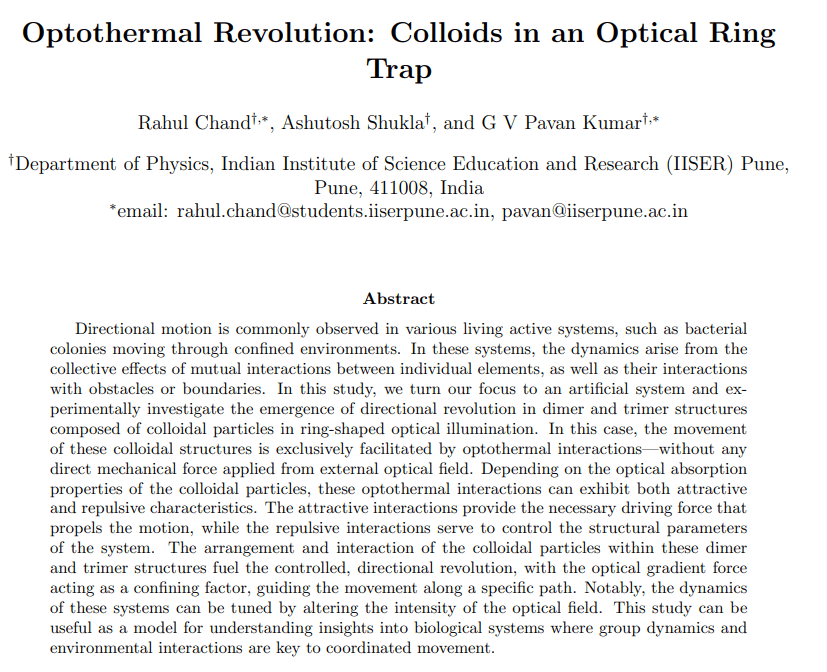

We have an Arxiv preprint on how a mixture of colloids (thermally active + passive particles in water) can lead to the emergence of revolution dynamics in an optical ring trap (dotted line). Super effort by our lab members Rahul Chand and Ashutosh Shukla.
Interestingly, the revolution emerges only when an active and a passive colloid are combined (not as individuals) in a ring potential (dotted line)
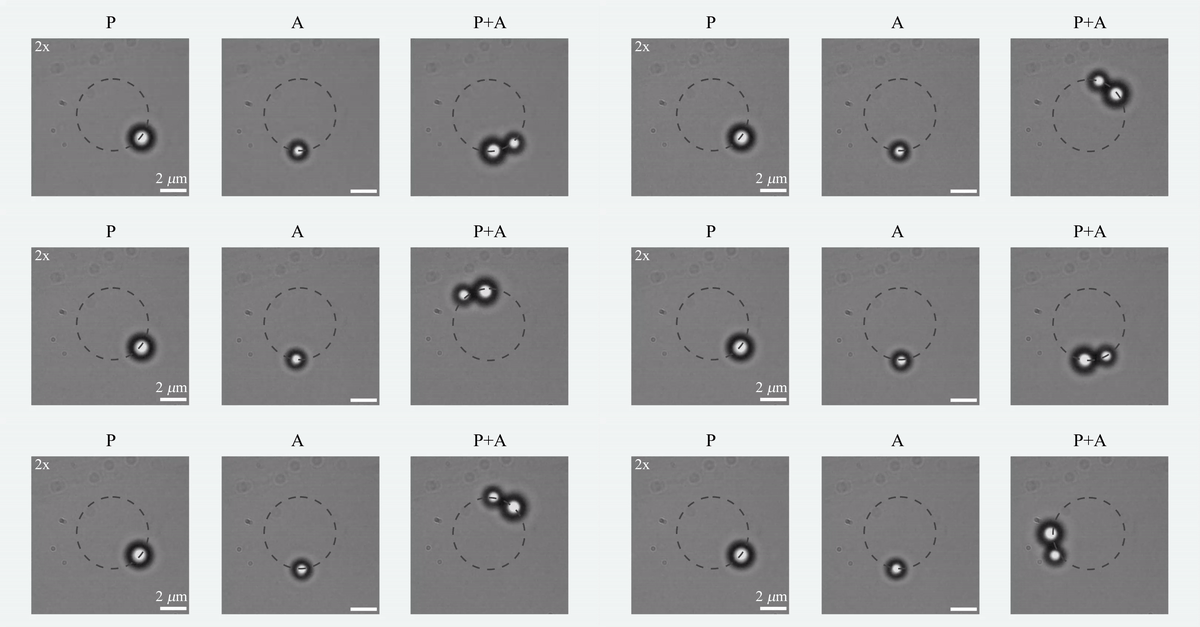
the direction (clock or anti-clockwise) of the revolution depends on the relative placement of the colloids in the trap
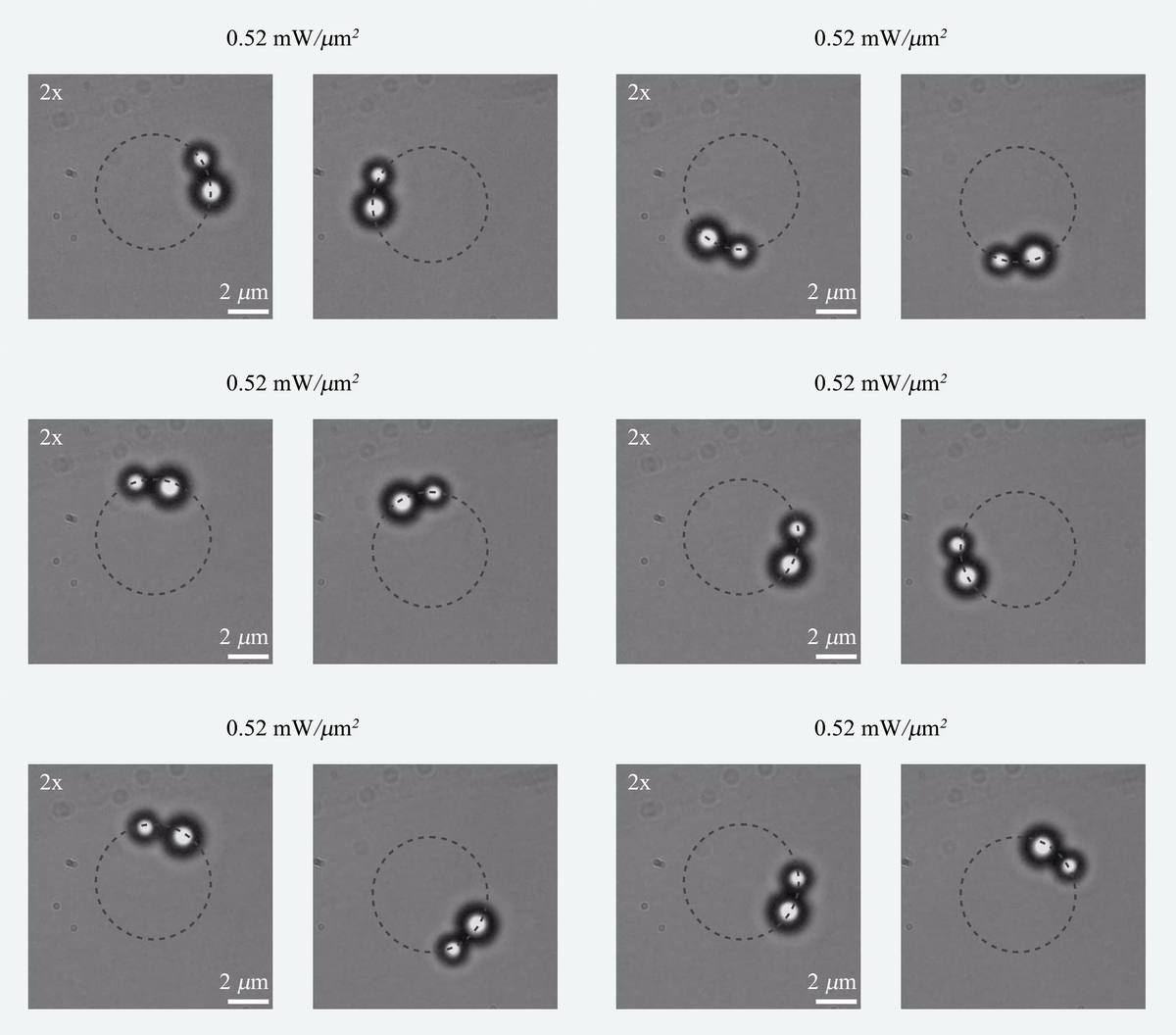
This revolution can be further used to propel a third active colloid

There are many more details in the paper. Check it out: https://arxiv.org/abs/2409.16792

How confinement leads to emergence ?
New vlog post: I take, e.g. from the game of cricket (ft. Laxman, Dravid), soft matter physics, ants, Feynman’s seminar & a few other references to explain the emergence, self-organization and spontaneous order in our world
References:
“Second Test, 2000–01 Border–Gavaskar Trophy.” 2024. In Wikipedia. https://en.wikipedia.org/w/index.php?title=Second_Test,_2000%E2%80%9301_Border%E2%80%93Gavaskar_Trophy&oldid=1207694527.
Araújo, Nuno A. M., Liesbeth M. C. Janssen, Thomas Barois, Guido Boffetta, Itai Cohen, Alessandro Corbetta, Olivier Dauchot, et al. 2023. “Steering Self-Organisation through Confinement.” Soft Matter 19 (9): 1695–1704. https://doi.org/10.1039/D2SM01562E.
arxiv link : https://arxiv.org/abs/2204.10059
FeynmanChaser, dir. 2008. Feynman Chaser – Imagination in a Straitjacket. https://www.youtube.com/watch?v=IFBtlZfwEwM.
“Why Constraints Are Good for Innovation.” n.d. Accessed May 3, 2024. https://hbr.org/2019/11/why-constraints-are-good-for-innovation.
Tromp, Catrinel, and John Baer. 2022. “Creativity from Constraints: Theory and Applications to Education.” Thinking Skills and Creativity 46 (December): 101184. https://doi.org/10.1016/j.tsc.2022.101184.
Water droplets on a cobweb – video
Water droplets on a cobweb, fascinating #softmatter..
Interestingly, this has conceptual connection to protein droplets on a cell surface..
See this very short video and the references in the description:
References to understand the conceptual connections:
https://www.princeton.edu/news/2021/01/29/dewdrops-spiderweb-reveal-physics-behind-cell-structures
https://www.nature.com/articles/s41567-020-01141-8
 VISMAYA - History & Philosophy of Physics