What happens when Carnatic music, eastern and western philosophy and optics come together?
Well….if you ask my friend Karthik Raveendran, who is a Carnatic vocalist and a physicist, he will say Kānthimathīm – which is his musical video perspective on ‘Pursuit of Radiance’.
Below I post his spectacular art, which includes his music and philosophical thoughts on the mentioned topics. All this visualized through Indian architecture, Finnish lakes and auroras over its sky.
He has been very kind to acknowledge me in his video for my minor input on scientific philosophy. I am truly honored.
Recently, I came across an interview with Tony Tyson, one of the main scientists related to the Rubin telescope. He says:
“We can do better than this. We can build a larger telescope by making larger mosaics of larger CCDs.” — Tony Tyson
On a day when India lost a test match, the first sentence rings loud…anyway, the topic of this post is a fascinating development happening in observational cosmology.
Tony’s suggestion above is a great, ambitious way to explore the Universe….by building effective observational tools that can image and comprehend the observable…and perhaps unobservable too…
For students: Observational cosmology is a great place to explore cutting-edge science: physics (experiments + theory), maths, engineering & computation…all come together..
Check out the interview of Tony Tyson…one of the brains behind the cameras of Rubin Observatory…plenty to learn…
Just like test cricket, observational cosmology needs patience…perhaps a good lesson for life too…
Today is election day in Pune (Lok Sabha), and I voted.
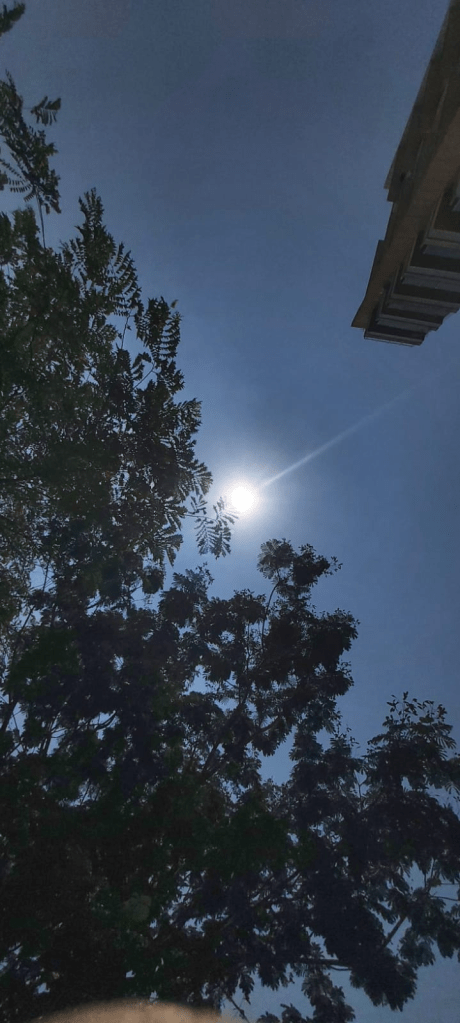
Today is also a ‘zero shadow day’ in Pune. The sun is exactly over our head (zenith), and no angle is subtended by the shadow. In the pic, the sun is captured at its zenith.
Caution: don’t look at the sun directly. This image was captured wearing filtered glass
Check the webpage of the Astronomical Society of India linked below. It has some good explanations and geographical locations in India where zero shadow day is observed.
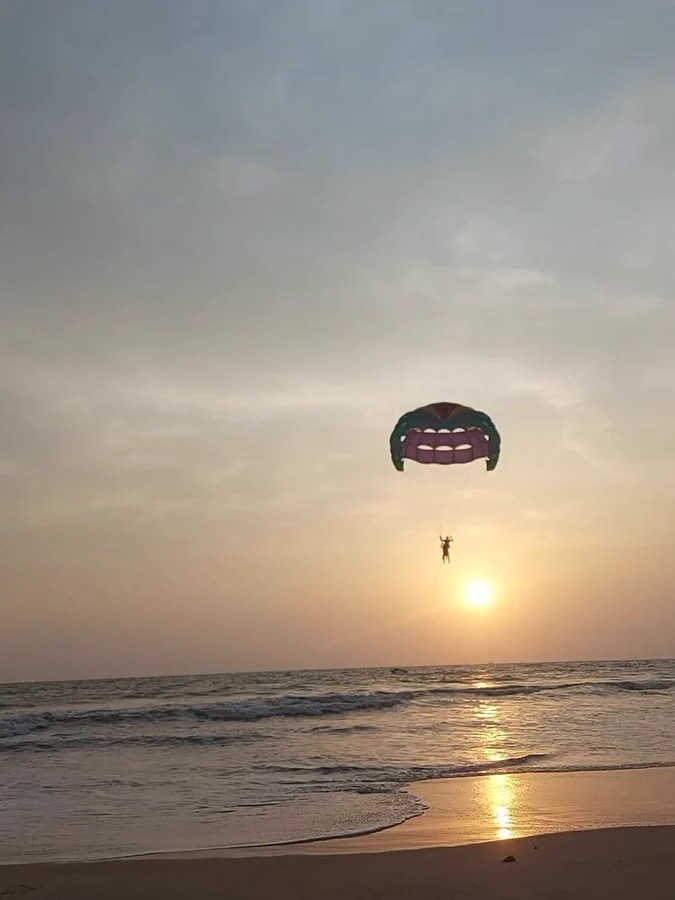
This is my daughter and me flying high on boat-assisted paragliding, circa June 2023, somewhere near North Goa…was riveting 3 minutes up in the sky…a great experience. The view towards the sun-set was great and so was the view in the opposite direction to the sun, where we could see backwaters from the top.
Albert A Michelson. Image credit : Nobel Prize webpage
Albert Abraham Michelson was a celebrated American experimental physicist. He was associated with one of the most famous experiments in physics : Michelson-Morley Experiment, which formed an important input for Einstein’s special theory of relativity.
Michelson’s ability to design and develop optical instruments including the interferometer named after him, was one of vital elements in his legendary pursuit to measure velocity of light. He continued to refine this measurement over a period of 40 years or so.
He was also the first American to win a Nobel prize in science (physics, 1907). Americans adored him, and he shot up to fame with his ingenious experiments and became a folklore of United States.
(Yes, you read it right, there was another guy called Dayton Miller who played a critical role in refining the experiment initiated by Michelson and Morley )
In Swenson’s book, there are two stanzas from a poem by Edwin Herbert Lewis that highlights Michelson’s legend. Below I reproduce the same :
But in Kyerson rainbows murmur the music of heavenly things. Is not this stranger than heaven that a man should hear around The whole of earth and the half of heaven and see the shadow of sound? He gathereth up the iris from the plunging of planet’s rim With bright precision of fingers that Uriel envies him. But when from the plunging planet he spread out a hand to feel How fast the ether drifted back through flesh or stone or steel The fine fiducial fingers felt no ethereal breath. They penciled the night in a cross of light and found it still as death. Have the stars conspired against him? Do measurements only seem? Are time and space but shadows enmeshed in a private dream?
But dreaming or not, he measured. He made him a rainbow bar, And first he measured the measures of man, and then he measured a star. Now tell us how long is the metre, lest fire should steal it away? Ye shall fashion it new, immortal, of the crimson cadmium ray. Now tell us how big is Antares, a spear-point in the night? Four hundred million miles across a single point of light. He has taught a world to measure. They read the furnace and gauge By lines of the fringe of glory that knows nor aging nor age. Now this is the law of Ryerson and this is the price of peace- That men shall learn to measure or ever their strife shall cease.
E.H. Lewis
Indeed humans shall learn to measure or ever their strife shall cease…
What you see in this image (observed on 6th April 2023, 7.13am, Pune, India) is the emergence of sunlight from clouds in a peculiar expanding beam of rays. Such rays are called crepuscular rays.
The etymology of the word –
crepuscular (adj.)
figurative use, “dim, indistinct,” is attested from 1660s; literal use, “pertaining to or resembling twilight,” from 1755, from Latin crepusculum “twilight, dusk,” related to creper “obscure, uncertain,”
These rays are generally observed during the twilight and persist for a short time. The location of observation is close to the horizon, although I sighted it at a reasonable angle above the horizon (on Dr. Homi Bhabha road, in front of IISER-Pune Pashan gate).
There is a large class of optical phenomena including sunbeams and moonshines, which are exclusively observed at twilight. For more details read this article by Shields, Janet. “Sunbeams and Moonshine.” Optics and Photonics News 5, no. 7 (July 1, 1994): 57. https://doi.org/10.1364/OPN.5.7.000057.
One may think this phenomenon is related to some kind of diffraction, but it is not. It mainly arises due to the linear perspective of how we visualize this optical effect in an open sky. Of course light scattering has some interesting role in this observation. A very nice discussion on this can be found in an article by Bohren, Craig, and Mark L. Sowers. “Simple Experiments in Atmospheric Physics.” Weatherwise 45, no. 2 (May 1, 1992): 34–38. https://doi.org/10.1080/00431672.1992.9925919.
A Surprise in Western Ghats
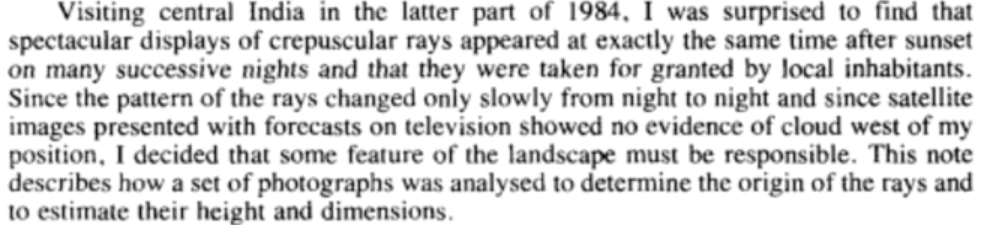
Western ghats are known to show this optical effect. In the year 1984, J. L. Monteith, a researcher who was visiting India from Goddard space center, USA (which is part of NASA) made an interesting and surprising observation. Below I reproduce his text –
For more details on this observation, read this paper by Monteith, J. L. “Crepuscular Rays Formed by the Western Ghats.” Weather 41, no. 9 (September 1986): 292–99. https://doi.org/10.1002/j.1477-8696.1986.tb03862.x.
Interestingly, such rays have also been periodically found in China and was reported as early as 1888 ! See this remarkable observation by Doberck, W. “Crepuscular Rays in China.” Nature 37, no. 959 (March 1888): 464–464. https://doi.org/10.1038/037464b0. Doberck also makes a connection to a historical text by Homer, in which Greek mariners describe the beautiful skies with peculiar rays.
Around 2011, the crepuscular rays were simulated in a laboratory and further corroborated using numerical simulations. In order to mimic the behavior of clouds, “artificial fogs and milk–water solutions” were used and interesting quantitative observations were made. For more details read : Gedzelman, Stanley David, and Michael Vollmer. “Crepuscular Rays: Laboratory Experiments and Simulations.” Applied Optics 50, no. 28 (October 1, 2011): F142–51. https://doi.org/10.1364/AO.50.00F142.
Atmospheric and meteorological optics are fascinating topics with some historical connections. For interested readers I highly recommend the following (fascinating and readable) books :
Bohren, Craig F. Clouds in a Glass of Beer: Simple Experiments in Atmospheric Physics. Courier Corporation, 2001.
What Light Through Yonder Window Breaks?: More Experiments in Atmospheric Physics. Courier Corporation, 2006.
Minnaert, M. The Nature of Light and Colour in the Open Air. Revised ed. edition. New York, N.Y: Dover Publications, 1954.
Minnaert, Marcel. Light and Color in the Outdoors. Translated by L. Seymour. Corrected edition. New York: Springer, 1993.


 VISMAYA - History & Philosophy of Physics