Create to Understand

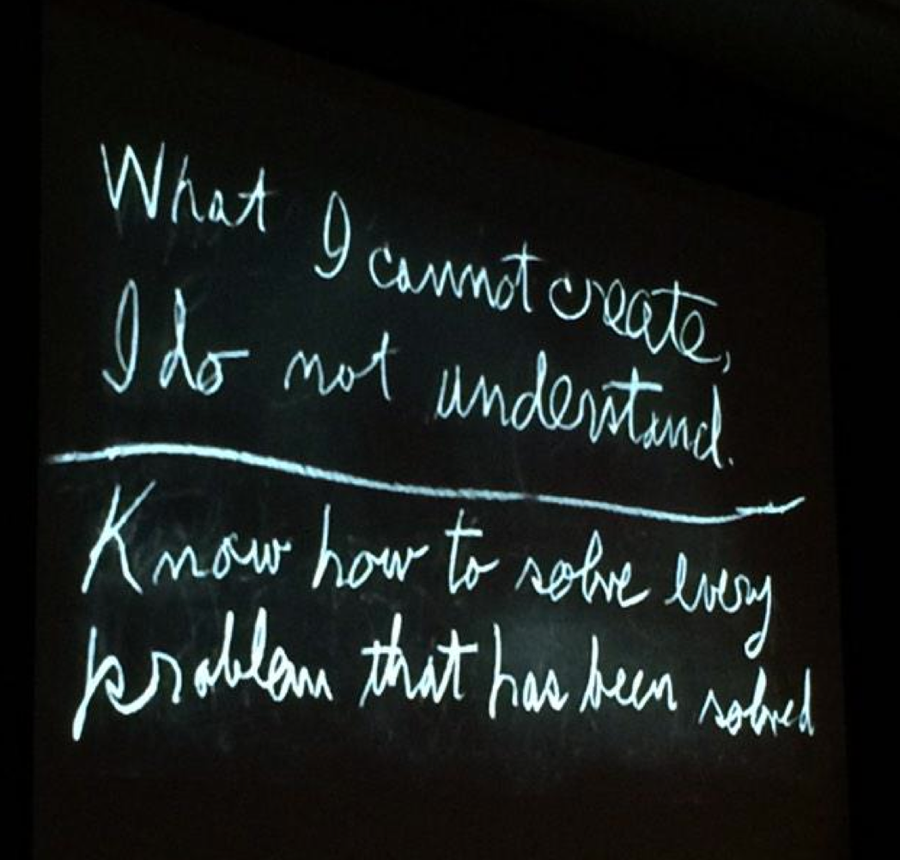
Below are two quotes on the blackboard of Feynman’s office in Caltech which were found just after his death.

 
The first of these quotes by Feynman is a guiding principle for anyone who wants to learn. The second quote is an idealistic one, but a good approach to becoming a ‘problem-solving’ researcher. Feynman was a master of this approach.
 
From a philosophy of science perspective, researchers can be both ‘problem creators’ and ‘problem solvers’. The latter ones are usually famous.
 
Michael Nielsen, a pioneer of quantum computing and champion of open science movement, has an essay titled: Principles of Effective Research, in which he explicitly identifies these two categories of researchers, and mentions that “they’re not really disjoint or exclusive styles of working, but rather idealizations which are useful ways of thinking about how people go about creative work.”.
 
He defines problem solvers as those “who works intensively on well-posed technical problems, often problems known (and sometimes well-known) to the entire research community in which they work.” Interesting, he connects this to sociology of researchers, and mentions that they “often attach great social cache to the level of difficulty of the problem they solve.”
 
On the other hand, problem creators, as Nielsen indicates, “ask an interesting new question, or pose an old problem in a new way, or demonstrate a simple but fruitful connection that no-one previously realized existed.”
 
He acknowledges that such bifurcation of researchers is an idealization, but a good model to “clarify our thinking about the creative process.”
 
Central to both of these processes is the problem itself, and what is a good research problem depends both on the taste of an individual and the consensus of a research community. This is one of the main reasons why researchers emphasize defining a problem so much. A counterintuitive aspect of the definition of the problem is that one does not know how good the ‘question’ is until one tries to answer and communicate it to others. This means feedback plays an important role in pursuing the problem further, and this aptly circles back to Feynman’s quote: “What I cannot create, I do not understand”.


Humanizing Science – A Conversation with a Student

Recently, I was talking to a college student who had read some of my blogs. He was interested in knowing what it means to humanize science. I told him that there are at least three aspects to it.

First is to bring out the wonder and curiosity in a human being in the pursuit of science. The second was to emphasize human qualities such as compassion, effort, mistakes, wrong directions, greed, competition and humour in the pursuit of science. The third thing was to bring out the utilitarian perspective.

The student was able to understand the first two points but wondered why utility was important in the pursuit of humanizing science. I mentioned that the origins of curiosity and various human tendencies can also be intertwined with the ability to use ideas. Some of the great discoveries and inventions, including those in the so-called “pure science” categories, have happened in the process of addressing a question that had its origin in some form of an application.

Some of the remarkable ideas in science have emerged in the process of applying another idea. Two great examples came into my mind: the invention of LASERs, and pasteurization.

I mentioned that economics has had a major role in influencing human ideas – directly or indirectly. As we conversed, I told the student that there is sometimes a tendency among young people who are motivated to do science to look down upon ideas that may have application and utility. I said that this needs a change in the mindset, and one way to do so is to study the history, philosophy and economics of science. I said that there are umpteen examples in history where applications have led to great ideas, both experimental and theoretical in nature, including mathematics.

Further, the student asked me for a few references, and I suggested a few sources. Specifically, I quoted to him what Einstein had said:

 “….So many people today—and even professional scientists—seem to me like someone who has seen thousands of trees but has never seen a forest. A knowledge of the historic and philosophical background gives that kind of independence from prejudices of his generation from which most scientists are suffering. This independence created by philosophical insight is—in my opinion—the mark of distinction between a mere artisan or specialist and a real seeker after truth..”

The student was pleasantly surprised and asked me how this is connected to economics. I mentioned that physicists like Marie Curie, Einstein and Feynman did think of applications and referred to the famous lecture by Feynman titled “There is Plenty of Room at the Bottom(1959).

To give a gist of his thinking, I showed what Feynman had to say on miniaturization:

There may even be an economic point to this business of making things very small. Let me remind you of some of the problems of computing machines. In computers we have to store an enormous amount of information. The kind of writing that I was mentioning before, in which I had everything down as a distribution of metal, is permanent. Much more interesting to a computer is a way of writing, erasing, and writing something else. (This is usually because we don’t want to waste the material on which we have just written. Yet if we could write it in a very small space, it wouldn’t make any difference; it could just be thrown away after it was read. It doesn’t cost very much for the material).”

I mentioned that this line of thinking on minaturization is now a major area of physics and has reached the quantum limit. The student was excited and left after noting the references.

On reflecting on the conversation, now I think that there is plenty of room to humanize science.

Why is astronomy interesting? Chandra likes Wigner’s answer

The questions “Why is astronomy interesting; and what is the case for astronomy?” have intrigued me; I have often discussed these questions with my friends and associates. Granted that physical science, as a whole, is worth pursuing, the question is what the particular case for astronomy is? My own answer has been this: Physical science deals with the entire range of natural phenomena; and nature exhibits different patterns at different levels; and the patterns of the largest scales are those of astronomy. (Thus Jeans’ criterion of gravitational instability is something which we cannot experience except when the scale is astronomical.) Of the many other answers to my questions, I find the following of Wigner most profound: “The study of laboratory physics can only tell us what the basic laws of nature are; only astronomy can tell us what the initial conditions for those laws are.”

from A Scientific Autobiography: S. Chandrasekhar (2011) by edited by Kameshwar C. Wali 

Polanyi’s quote

“…The example of great scientists is the light which guides all workers in science, but we must guard against being blinded by it. There has been too much talk about the flash of discovery and this has tended to obscure the fact that discoveries, however great, can only give effect to some intrinsic potentiality of the intellectual situation in which scientists find themselves…”

Michael Polanyi, in an essay titled  “My Time with X-Rays and Crystals” (1969)

π and population

There is a story about two friends, who were classmates in high school,
talking about their jobs. One of them became a statistician and was working
on population trends. He showed a reprint to his former classmate, The
reprint started, as usual, with the Gaussian distribution and the statistician
explained to his former classmate the meaning of the symbols for the actual
population, for the average population, and so on. His classmate was a
bit incredulous and was not quite sure whether the statistician was pulling
his leg. “How can you know that?” was his query. “And what is this
symbol here?” “Oh,” said the statistician, “this is π.” “What is that?”
“The ratio of the circumference of the circle to its diameter.” “Well, now
you are pushing your joke too far,” said the classmate, “surely the population has nothing to do with the circumference of the circle.
”’

These are the opening lines of Wigner’s famous essay titled: The Unreasonable Effectiveness of Mathematics in the Natural Sciences

Ability to Wonder

More than 25 years ago, Prof. G. Srinivasan (RRI, Bengaluru), in an astrophysics class, narrated something that has stuck in my mind. 

I am paraphrasing here. 

He told us about a conversation he had with Prof. Jocelyn Bell, the discoverer of pulsars (rotating neutron stars). 

When Jocelyn was asked: What is the most important quality to do scientific research? 

She replied: ‘ability to wonder’. 

Meghnad Saha – lest we forget

Meghnad Saha (6 October 1893 – 16 February 1956), of the fame of Saha’s ionization formula, was born this day. In 1993, a postage stamp in India was released commemorating his birth centenary.

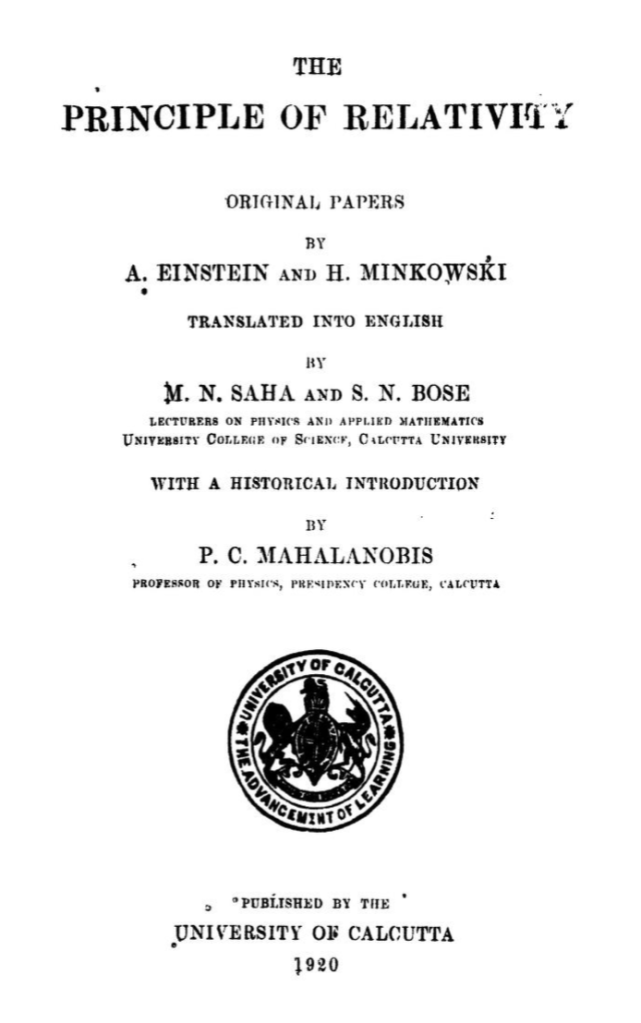
Saha was an astrophysicist with a broad knowledge and appreciation of various branches of physics. One of the earliest English translations (1920) of the papers on relativity by Einstein and Minkowski was written by Meghnad Saha and S.N.Bose.

At the beginning of the book, Mahalanobis introduces the topic with a historical introduction. He begins with a thoughtful discussion on experiments that eventually ruled out the presence of ether, and it sets the stage as follows:

Lord Kelvin writing in 1893 in hig preface to the English edition of Hertz’s Researches on Electric Waves, says many workers and many thinkers have helped to build up the nineteenth century school of plenum, one ether for light, heat, electricity, magnetism; and the German and English volumes containing Hertz’s electrical papers, given to the world in the last decade of the century, will be a permanent monument of the splendid consummation now realised.”

Ten years later, in 1905, we find Einstein declaring that “the ether will be proved to be superflous”. At first sight the revolution in scientific thought brought about in the course of a single decade appears to be almost too violent. A more careful even though a rapid review of the subject will, however, show how the Theory of Relativity gradually became a historical necessity.

Towards the beginning of the nineteenth century, the luminiferous ether came into prominence as a result of the brilliant successes of the wave theory in the hands of Young and Fresnel. In its stationary aspect, the elastic solid ether was the outcome of the search for a medium in which the light waves may “undulate.” This stationary ether, as shown by Young, also afforded a satisfactory explanation of astronomical aberration. But its very success gave rise to a host of new questions all bearing on the central problem of relative motion of ether and matter.

Saha, in various capacities, took a stance against British colonialism. Although it affected some opportunities, he continued to do science and was recognized for his outstanding contributions. As Rajesh Kochhar mentions:

Saha had wanted to join the government service, but was refused permission because of his pronounced anti-British stance. For the same reason, the British government would have liked The Royal Society to exclude Saha. It goes to the credit of the Society that it ignored the pressures and the hints, and elected him a fellow, in 1927. This recognition brought him an annual research grant of £300 from the Indian government followed by the Royal Society’s grant of £250 in 1929 (DeVorkin 1994, p. 164).

Saha led a tough life. He not only had to face suppressive British colonial rule but also academic politics and battles (versus Raman, no less). His knowledge of physics, his contributions to Indian science, and his commitment to people (he was a politician too) were significant. Let me end the blog with a few lines from Arnab Rai Choudhuri’s article, which nicely summarizes Saha’s work (specifically his ionization formula), and his scientific life:

Saha’s tale of extraordinary scientific achievements is simultaneously a tale of triumph and defeat, a tale both uplifting and tragic. Saha showed what a man coming from a humble background in an impoverished colony far from the active centres of science could achieve by the sheer intellectual power of his mind. But his inability to follow the trail which he himself had blazed makes it clear that there are limits to what even an exceptionally brilliant person could achieve in science under very adverse circumstances.

India and Indian science should remember Meghnad Saha.

Satish Dhawan – truly a man for all seasons

Image credit: Current Science 119, no. 9 (2020): 1427–32

Today is the birth anniversary of Satish Dhawan (25 September 1920 – 3 January 2002). He was probably India’s best scientist-administrator who headed institutions such as the Indian Institute of Science and the Indian Space Research Organization. With a PhD from Caltech, he came back to India and set up a marvellous research enterprise on fluid mechanics, including aerospace science and engineering. He mentored some of the outstanding scientists of India and led scientific institutions with vision, openness and informality, which is still a great benchmark to emulate1.

Below are a couple of historical documents related to Dhawan:

The first one is a lecture note from 1979, on making a case for a national satellite system and how it influences science and scientific activity (a copy of this note has been reproduced in a wonderful tribute to Satish Dhawan written by P. Balaram on his birth centenary2).

The next one is a beautiful perspective article written by Dhawan on ‘Bird Flight’ from an aerodynamics perspective3. It is a detailed overview of the dynamics of bird flight and shows Dhawan’s interest and ability to bridge two facets of science. It is a prototypical example of interdisciplinary research.

Finally, let me end the blog with a quote from P. Balaram on Satish Dhawan4:

“Dhawan mentored some remarkable students and built the discipline of aeronautical engineering at the Institute. He influenced aeronautical research and industry in India in a major way. He shepherded the Indian space programme following Vikram Sarabhai’s untimely death. He served the Indian scientific community in many ways. His stewardship transformed IISc. How then do we describe such a man? Dhawan studied English literature obtaining a Master’s degree in his youth. It may therefore be appropriate for me to borrow a 16th century description of Sir Thomas More:


‘[Sir Thomas] More is a man of an angel’s wit and
singular learning. I know not his fellow. For where is
the man of that gentleness, lowliness and affability?
And, as time requireth, a man of marvelous mirth and
pastimes, and sometime of as sad gravity. A man for
all seasons.’

Satish Dhawan was truly a man for all seasons.”

Happy Birthday to Prof. Satish Dhawan!

References:

  1. Current Science, in 2020, had a section of a volume dedicated to the birth centenary of Satish Dhawan, and has a foreword by his daughter and articles by many of his students and co-workers. https://www.jstor.org/stable/e27139029 ↩︎
  2. P. Balaram, “Satish Dhawan: The Transformation of the Indian Institute of Science, Bangalore,” Current Science 119, no. 9 (2020): 1427–32. This reference has many interesting references, including a handwritten obituary of CV Raman written by Dhawan https://www.jstor.org/stable/27139041. ↩︎
  3. S. Dhawan, “Bird Flight,” Sadhana 16, no. 4 (1991): 275–352, https://doi.org/10.1007/BF02745345. ↩︎
  4. P. Balaram, Current Science 119, no. 9 (2020), page 1432. https://www.jstor.org/stable/27139041. ↩︎

Sir MV on Education

In India, “National Engineers’ Day is celebrated every year on September 15 to honor the birth anniversary of Sir Mokshagundam Visvesvaraya, one of India’s greatest engineers”. Sir MV, as he was known, is one of the 20th-century Indians I admire. He was a forward-looking statesman who contributed immensely to building India (literally and figuratively). MV was a well-read and well-travelled person for his era, and wrote a few books and memos that are still pertinent to the current developments in India and the world.

Reconstructing India (1920)

One of his books, Reconstructing India (1920), reveals his thoughts on how and why India needs to reconstruct itself based on knowledge in science, technology and humanities. The title page is shown below, and the book is free to read online, thanks to the Internet Archive.

The book, as mentioned by MV in the preface, was written just after the First World War, and contemplates problems faced by India in light of geopolitical developments. In the 17 chapters of the book, divided into 4 parts, MV discusses specific issues faced by India, and proposes that political and administrative reforms can help India become a progressive society.

The largest part of the book is on economic reconstruction, in which he proposes contemporary methods (for the 1920s) to improve various sectors of manufacturing, including agricultural technology and communication media.

The third part of the book is on social reforms, and in there, he has a dedicated chapter on Education, which caught my attention, and I found it relevant even for today’s India.

Education, Humanities, and STEM

It is important that students of science and technology have a good exposure to some aspects of the humanities, including economics, history and philosophy. The pursuit and ability to choose good problems in science and technology critically depend on the social and economic structure in which they are practiced in universities and research institutions. MV anticipated this and highlights it as:

“Secondary and university education, though producing many able recruits for subordinate positions in the Civil Service, does not provide the men needed to carry on the work of agriculture, engineering, commerce and technology. The provision for training in economics and history is inadequate, and the study of those subjects is even discouraged. An attempt is actually made to teach economics in such a way as to render India’s emergence from a state of dependency difficult.”

Even in 2025, I would suggest that STEM students pay attention to economics, as it anchors them to understand the need and functions of a society, and therefore, their work can be calibrated accordingly. This is not to discourage open-ended research, but to understand how natural sciences are connected to the societal thoughts and needs. It gives us a broader understanding of the context, which is so important while understanding the evolution of ideas.

Comparative Education Systems

There is always a lot to learn from various societies and cultures. In order to do so, one needs comparative analysis. This helps one to choose some good elements from a society that can be emulated elsewhere. MV compares and comments on the 1900s British educational system in contrast to the German and Japanese counterparts. Note that India in the 1920s was still a British colony, and in a way, MV is critical of the system in which he himself was educated and trained. As he notes:

“Britain herself has had to pay a heavy price for her hand-to-mouth policy in regard to education. The educational chaos still existing there compares unfavourably with the great yet orderly progress made by Germany and Japan, both of which countries, after weighing and testing the educational systems of the world, absorbed the best of all.”

These were words written long before the Second World War, and give us a glimpse of how German and Japanese systems were functioning in the 1920s and had a lot to offer to the world. Of course, history took its own path, and German and Japanese society had other ideas.

Incidentally, I am writing this piece sitting in Leipzig (eastern Germany), and I am amazed by its architectural marvels that date back centuries. Indeed, German society had (and has) a lot to offer to the world. As MV indicates above, we need to absorb the best that is on offer. In doing so, we also need to reject that which is not good for any society.

Liberal Education and Financial Support

He further adds how liberal education adds value to a society, and calls not only the government but also the people to recognize the importance of financial support for education.

“Both the Government and the people must recognize that only by pursuing a liberal educational policy, and making generous financial provision for schools and colleges can they lift India out of her present low condition and ensure rapid progress.”

These words still hold good, and as a society, India has to re-emphasize modern education that helps us become not only better doctors and engineers, but also better human characters that can add value to the “modern” world.

Call to Action

In the final part of the book, MV makes a passionate appeal to the people of India, calling them to take action and move towards becoming a progressive nation:

“Do the people of India propose to profit by the lessons which world experience has to teach them, or will they be content to allow matters to drift and themselves grow weaker and poorer year by year?
This is the problem of the hour. They have to choose whether they will be educated or remain ignorant; whether they will come into closer touch with the outer world and become responsive to its influences, or remain secluded and indifferent; whether they will be organized or disunited, bold or timid, enterprising or passive ; an industrial or an agricultural nation ; rich or poor ; strong and respected, or weak and dominated by forward nations. The future is in their own hands.”

Indeed, the future is in our hands, and these words written more than 100 years ago still resonate loudly. We need more engineers like Sir MV. The reason he was so effective was that he combined thinking and doing. Importantly, the lesson we can learn from MV’s life and by reading this book, is that an open mind can grasp good ideas at any time and anywhere. Implementing those ideas is an equally important challenge, and MV was up to this in his own way. Are we, as Indians, open to this prospect and engineer our future?

Gardner’s Synthesis

Once in a while, during my research, I come across writing by scholars from other disciplines that gives me a perspective that not only helps me to grasp the complexity of learning across disciplines, but also resonates with some thoughts on education.

Howard Gardner is one such academic who works on developmental psychology and has researched extensively on cognition and education. He has written ~30 books and ~1000 articles, and blogs regularly, even at the age of 82 or so. His recent book is titled A Synthesizing Mind.

Howard Gardner is a renowned Harvard academic and, as his book describes him as follows:

“Throughout his career, Gardner has focused on human minds in general, or on the minds of particular creators and leaders. Reflecting now on his own mind, he concludes that his is a ‘synthesizing mind’—with the ability to survey experiences and data across a wide range of disciplines and perspectives. The thinkers he most admires—including historian Richard Hofstadter, biologist Charles Darwin, and literary critic Edmund Wilson—are exemplary synthesizers. Gardner contends that the synthesizing mind is particularly valuable at this time and proposes ways to cultivate a possibly unique human capacity.”

While exploring the book and the related material, I came across an interview with Howard Gardner. In there, he is conversing about the theme of the book and discusses the synthesis of thought across disciplines. One of the pertinent aspects of learning is to know how innovation can be fostered by cross-disciplinary exploration without diluting disciplinary rigour. As Gardner says:

“I am not opposed to disciplinary learning—indeed I am an enthusiastic advocate. Any person would be a fool to try to create physics or psychology or political science from the start. But if we want to have scholars or professionals who are innovative, creative—and innovation is not something that we can afford to marginalize—then they cannot and should not be slaves of any single discipline or methodology.”

As a physicist, I can relate to this thinking within my discipline, and how innovative ideas, over the ages, have emerged by bringing ideas from mathematics, engineering and biology into physics. Particularly, the combination of biology, physics and mathematics is one of the most exciting frontiers of human exploration today, and Gardner’s words apply well in this scenario.

Going beyond science, I am always intrigued and amazed by artists (especially musicians) who can create art that simultaneously draws the attention of specialists and generalists. This is not a trivial achievement, and as a scientist, I am always trying to understand how artists resonate so well with the public. Gardner, in the abovementioned interview, frames this problem by looking at the goals of science and arts, and draws a contrast that is worth noting:

“Most scholars and observers like to emphasize the similarities between the arts and the sciences, and that is fine. But the goals of the two enterprises are different. Science seeks an accurate and well supported description of the world. The arts seek to capture and convey various aspects of experience; and they have no obligation other than to capture the interest and attention of those who participate in them.

Of course, there are some individuals who excel in both science and art (Leonardo is everyone’s favorite example). But most artists—great or not—would not know their way around a scientific laboratory. And most scientists—even if they like to play the violin or to draw caricatures or to dance the tango—would not make works of art or performances that would interest others.”

I partially agree with this assessment, as I know a few scientists who are deeply involved in various forms of art (including music) and do it very well, even at the professional level. In a way, Gardner is re-emphasizing the “two cultures” debate of C.P. Snow. My own thoughts on this viewpoint are ambivalent, as I see science, arts and sports as important pursuits that cater to different facets of the human mind. Of course, when it comes to expertise, the division may matter. There is a lot more to learn about the interface of art and science, at least for me.

Anyway, Gardner is a fabulous writer, and his blogs and books are worth reading (and studying) if one is seriously interested in understanding how to synthesize thought across disciplines.

Since we are discussing synthesis of thought, which is a kind of harmony, and coming together, let me end the blog with a line from Mankuthimmana Kagga by the Kannada poet-philosopher D.V. Gundappa:

ಎಲ್ಲರೊಳಗೊಂದಾಗು ಮಂಕುತಿಮ್ಮ” (Eladaralongodhagu manku thimma)

which loosely translates to: oh fool…be one among all (blend into world, living in harmony).

Harmony of disciplines and minds – how badly the world needs it today?