Ability to Wonder

More than 25 years ago, Prof. G. Srinivasan (RRI, Bengaluru), in an astrophysics class, narrated something that has stuck in my mind. 

I am paraphrasing here. 

He told us about a conversation he had with Prof. Jocelyn Bell, the discoverer of pulsars (rotating neutron stars). 

When Jocelyn was asked: What is the most important quality to do scientific research? 

She replied: ‘ability to wonder’. 

A telescope built over 20 years

For ages, human beings have been curious about stars. Telescopes as observational tools have changed how human beings have studied and understood astronomical objects. Below is a snapshot from a 1947 edition of popular mechanics that features someone named John Cartlidge from USA. He was a mechanical engineer and an amateur astronomer. The story reveals that he took 20 years to build the telescope, and the description text from the magazine is an interesting read. An amount of $600 plus, for that era, sounds expensive. But what is astonishing is the 20-year effort to build a telescope.

This instance of human effort to pursue curiosity connects well to a wonderful poem: ‘Curiosity’ by David Jilk, and below I reproduce a stanza from it:

Your greatest teacher is the world itself
and glory comes to those who find her codes;
for she is coy, no book upon a shelf,
and must be queried via crab-walk modes:
your question is, which questions make inroads?
Instruction thus proceeds aesthetically
with obverse strokes of creativity.

Amateur astronomy fosters that strokes of creativity. After all, sky is the only limit !

Light pressure – Lebedev coin

Today, in my optics class, I discussed optical forces due to momentum in electromagnetic waves. Towards the late 1800s, it was realized that light can impart momentum. This manifested as radiation pressure in the electromagnetic theory proposed by James Maxwell.

Pyotr Nikolaevich Lebedev (24 February 1866 – 1 March 1912) was one of the earliest to experimentally measure (~1899) the radiation pressure on a surface (link to his 1900 paper in German). In 1991, the Soviet Union released a 1 ruble coin (pictured above) to commemorate Lebedev’s scientific achievement.

The formula expresses the total momentum transferred per unit time ( radiation pressure, P) by a beam of N photons, each of energy hν, that is incident on a surface with a coefficient of reflectivity ρ. The constant, c, is the speed of light.

The discussion in the class was mainly related to Ashkin’s work. I have written about this in the past.

Shared below is a delightful lecture given by Ashkin at the age of ~96, after he received his Nobel prize.

Some writing advice (mainly physics) for UG students

Some writing advice (mainly physics) I shared with my undergraduate class. This may be useful to others.

  1. Equations, data and figures make meaning when you include a context. This context is expressed using words. Symbols and data by themselves cannot complete the meaning of an argument, unless one knows the context. A common mistake undergraduates make in an exam is to answer questions using only symbols and figures and assume the reader can understand the context.
  2. One way to treat writing in physics (in this case, an exam paper or an assignment) is to imagine you are talking to a fellow physics student who is not part of the course you are writing about. This means you can assume some knowledge, but not the context. Anticipate their questions and address them in the text you are writing. This model also works while writing research papers with some caveats.
  3. While you refer to equations, data and figures in your assignment, make sure you cite the reference at the location of the content you are discussing. Merely listing the references at the end of the document does not make the connection. Remember, while talking, you never do this kind of referencing.
  4. It is useful to structure your arguments with headings, sub-headings and a numbered list. This gives a visual representation of your arguments. You may not find this kind of structured writing in novels, other forms of fictional writing and also in some literature related to social sciences, but in natural sciences with dense information, this will be very useful. Always remember, while writing science (or any form of nonfiction writing), clarity comes before aesthetics.

Also, below is another blog related to written assignments.

Blog highlighted by SciRio

A nice article by @RutujaUgale in @Sci_Rio that discusses public engagement by scientists as influencers of scientific thought.

Thanks, Rutuja, for profiling my blog, ‘Vismaya’.

Here is my quote from the article:

For me, there are two implications of doing science. One is that science is extremely useful to society, and the second is that it is a good, thoughtful way of living one’s life. Communicating the second implication is important to me, and I do this by researching, writing, and podcasting about the history and philosophy of science (physics in particular). This path helps people understand the human element of doing science and reveals a context. Some of my blogs (filtered here) discuss why I do science and how I do it. More than ‘influencing’ the audience, I am interested in inviting them to explore science by themselves via their own curiosity. That is one reason why my blog is called VISMAYA.”

Link to the full article.

Builders of Modern Scientific India

Images from: Leslie, Stuart W., and Indira Chowdhury. ‘Homi Bhabha Master Builder of Nuclear India’. Physics Today 71, no. 9 (2018): 48–55. https://doi.org/10.1063/PT.3.4021.

When we remember and talk about building modern, scientific India, we must acknowledge past scientists who played a critical role in taking ideas and turning them into reality. Homi Bhabha (image on left) was one of the pioneers. But we must also remember many unknown people of India who literally built modern scientific facilities, such as the CIRUS nuclear reactor (image on right is from 1958). Although their faces are invisible, their contributions should not be.

Physics Nobel – 2025 : Schrödinger’s cat and her laboratory cousins

The 2025 Nobel Prize in physics has been awarded to John Clarke, Michel H. Devoret and John M. Martinis “for the discovery of macroscopic quantum mechanical tunnelling and energy quantisation in an electric circuit.

The Nobel Prize webpage has an excellent summary of the work at popular and technical levels.

In this blog, I want to draw attention to an interesting review article from 1984 by Anthony Leggett that pre-empts the awarded work. Leggett himself was a Nobel laureate (2003), and his work on the theory of superconductors and superfluids forms one of the conceptual foundations for this year’s Nobel prize. Four of his papers have been cited by the Nobel committee as part of the scientific description of the award, and one of them is a review article I wish to emphasize.

The title of Leggett’s review is “Schrödinger’s cat and her laboratory cousins“. It discusses the detection and implication of macroscopic quantum mechanical entities, and has a description of the so-called Schrödinger’s cat, which is essentially a thought experiment describing quantum superposition and the bizarre consequence of such a formulation. Leggett utilizes this conceptual picture of the cat (in alive and dead states) and extends this to possible scenarios in which the macroscopic quantum superposition can be detected and verified under laboratory conditions. The text below from his review captures the essence of the concept and connects it to experimental verification :

It is probably true to say that most physicists who are even conscious of the existence of the Cat paradox are inclined to dismiss it somewhat impatiently as a typical philosophers’ problem which no practising scientist need worry about. The reason why such an attitude can be maintained is that close examination of the paradox has seemed to lead to the conclusion that, worrying or not at the metaphysical level, it has at any rate no observable consequences: that is, the experimental consequences of the above apparently bizarre description are quite undetectable. Since physicists, by virtue of their profession, tend to be impatient of questions to which they know a priori no experiment can conceivably be relevant, they have tended to shrug off the paradox and leave the philosophers to worry about it.

Over the last few years, thanks to rapid advances in cryogenics, noise control and microfabrication technologies, it has become clear that the above conclusion may be over-optimistic (or pessimistic, depending on one’s point of view!). To be sure, it is unlikely that in the foreseeable future we will be able to exhibit the experimental consequences of a cat being in a linear superposition of states corresponding to life and death. However, at a more modest level it is possible to ask whether it would be possible to exhibit any macroscopic object in a superposition of states which by a reasonable common-sense criterion could be called macroscopically different. The answer which seems to be emerging is that it is almost certainly possible to obtain circumstantial evidence of such a state of affairs, and not out of the question that one might be able to set up a more spectacular, direct demonstration. This is the subject of this article.

Cut to 2025, this is also the subject of the Nobel Prize in Physics today.

This year’s laureates, John Clarke, Michel H. Devoret and John M. Martinis, experimentally revealed the quantum mechanics of a macroscopic variable in the form of a phase difference of a Josephson Junction. They called their system a “macroscopic nucleus with wires.”

Quantum Physics Zindabad.

Meghnad Saha – lest we forget

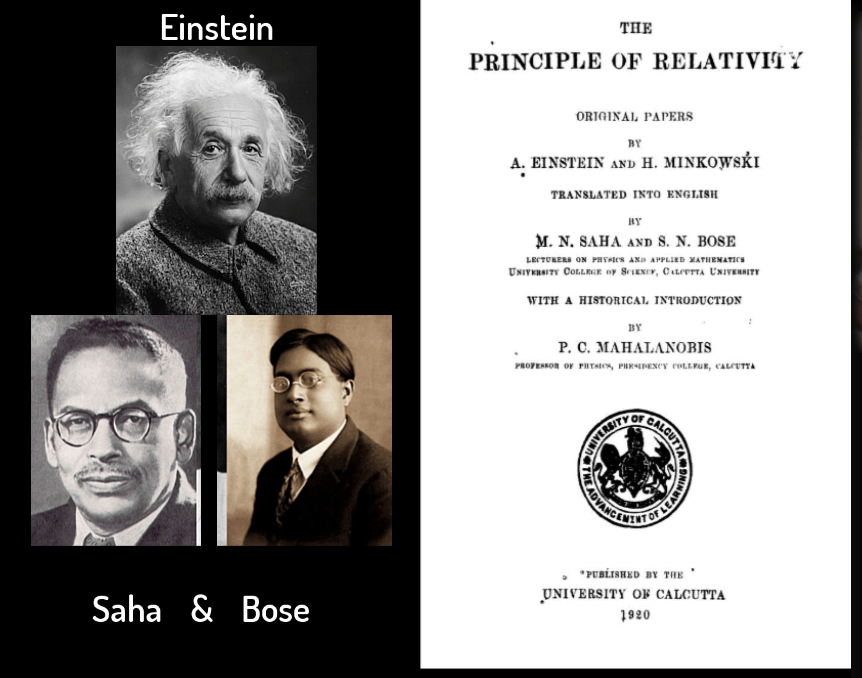
Meghnad Saha (6 October 1893 – 16 February 1956), of the fame of Saha’s ionization formula, was born this day. In 1993, a postage stamp in India was released commemorating his birth centenary.

Saha was an astrophysicist with a broad knowledge and appreciation of various branches of physics. One of the earliest English translations (1920) of the papers on relativity by Einstein and Minkowski was written by Meghnad Saha and S.N.Bose.

At the beginning of the book, Mahalanobis introduces the topic with a historical introduction. He begins with a thoughtful discussion on experiments that eventually ruled out the presence of ether, and it sets the stage as follows:

Lord Kelvin writing in 1893 in hig preface to the English edition of Hertz’s Researches on Electric Waves, says many workers and many thinkers have helped to build up the nineteenth century school of plenum, one ether for light, heat, electricity, magnetism; and the German and English volumes containing Hertz’s electrical papers, given to the world in the last decade of the century, will be a permanent monument of the splendid consummation now realised.”

Ten years later, in 1905, we find Einstein declaring that “the ether will be proved to be superflous”. At first sight the revolution in scientific thought brought about in the course of a single decade appears to be almost too violent. A more careful even though a rapid review of the subject will, however, show how the Theory of Relativity gradually became a historical necessity.

Towards the beginning of the nineteenth century, the luminiferous ether came into prominence as a result of the brilliant successes of the wave theory in the hands of Young and Fresnel. In its stationary aspect, the elastic solid ether was the outcome of the search for a medium in which the light waves may “undulate.” This stationary ether, as shown by Young, also afforded a satisfactory explanation of astronomical aberration. But its very success gave rise to a host of new questions all bearing on the central problem of relative motion of ether and matter.

Saha, in various capacities, took a stance against British colonialism. Although it affected some opportunities, he continued to do science and was recognized for his outstanding contributions. As Rajesh Kochhar mentions:

Saha had wanted to join the government service, but was refused permission because of his pronounced anti-British stance. For the same reason, the British government would have liked The Royal Society to exclude Saha. It goes to the credit of the Society that it ignored the pressures and the hints, and elected him a fellow, in 1927. This recognition brought him an annual research grant of £300 from the Indian government followed by the Royal Society’s grant of £250 in 1929 (DeVorkin 1994, p. 164).

Saha led a tough life. He not only had to face suppressive British colonial rule but also academic politics and battles (versus Raman, no less). His knowledge of physics, his contributions to Indian science, and his commitment to people (he was a politician too) were significant. Let me end the blog with a few lines from Arnab Rai Choudhuri’s article, which nicely summarizes Saha’s work (specifically his ionization formula), and his scientific life:

Saha’s tale of extraordinary scientific achievements is simultaneously a tale of triumph and defeat, a tale both uplifting and tragic. Saha showed what a man coming from a humble background in an impoverished colony far from the active centres of science could achieve by the sheer intellectual power of his mind. But his inability to follow the trail which he himself had blazed makes it clear that there are limits to what even an exceptionally brilliant person could achieve in science under very adverse circumstances.

India and Indian science should remember Meghnad Saha.

Satish Dhawan – truly a man for all seasons

Image credit: Current Science 119, no. 9 (2020): 1427–32

Today is the birth anniversary of Satish Dhawan (25 September 1920 – 3 January 2002). He was probably India’s best scientist-administrator who headed institutions such as the Indian Institute of Science and the Indian Space Research Organization. With a PhD from Caltech, he came back to India and set up a marvellous research enterprise on fluid mechanics, including aerospace science and engineering. He mentored some of the outstanding scientists of India and led scientific institutions with vision, openness and informality, which is still a great benchmark to emulate1.

Below are a couple of historical documents related to Dhawan:

The first one is a lecture note from 1979, on making a case for a national satellite system and how it influences science and scientific activity (a copy of this note has been reproduced in a wonderful tribute to Satish Dhawan written by P. Balaram on his birth centenary2).

The next one is a beautiful perspective article written by Dhawan on ‘Bird Flight’ from an aerodynamics perspective3. It is a detailed overview of the dynamics of bird flight and shows Dhawan’s interest and ability to bridge two facets of science. It is a prototypical example of interdisciplinary research.

Finally, let me end the blog with a quote from P. Balaram on Satish Dhawan4:

“Dhawan mentored some remarkable students and built the discipline of aeronautical engineering at the Institute. He influenced aeronautical research and industry in India in a major way. He shepherded the Indian space programme following Vikram Sarabhai’s untimely death. He served the Indian scientific community in many ways. His stewardship transformed IISc. How then do we describe such a man? Dhawan studied English literature obtaining a Master’s degree in his youth. It may therefore be appropriate for me to borrow a 16th century description of Sir Thomas More:


‘[Sir Thomas] More is a man of an angel’s wit and
singular learning. I know not his fellow. For where is
the man of that gentleness, lowliness and affability?
And, as time requireth, a man of marvelous mirth and
pastimes, and sometime of as sad gravity. A man for
all seasons.’

Satish Dhawan was truly a man for all seasons.”

Happy Birthday to Prof. Satish Dhawan!

References:

  1. Current Science, in 2020, had a section of a volume dedicated to the birth centenary of Satish Dhawan, and has a foreword by his daughter and articles by many of his students and co-workers. https://www.jstor.org/stable/e27139029 ↩︎
  2. P. Balaram, “Satish Dhawan: The Transformation of the Indian Institute of Science, Bangalore,” Current Science 119, no. 9 (2020): 1427–32. This reference has many interesting references, including a handwritten obituary of CV Raman written by Dhawan https://www.jstor.org/stable/27139041. ↩︎
  3. S. Dhawan, “Bird Flight,” Sadhana 16, no. 4 (1991): 275–352, https://doi.org/10.1007/BF02745345. ↩︎
  4. P. Balaram, Current Science 119, no. 9 (2020), page 1432. https://www.jstor.org/stable/27139041. ↩︎

Leipzig – where Heisenberg worked…

From 16th to 18th Sept, 2025, I attended and gave a talk at Optofluidix 2025, thanks to the invitation of Prof. Frank Cichos and his team, Department of Physics, University of Leipzig.

This department is steeped in history, and this post is to give you a pictorial glimpse of some people who worked there.

Werner Heisenberg, aged 25, became a Professor at the University of Leipzig, Germany. It was an illustrious department then, had professors such as Peter Debye, Gustav Hertz (of the Franck-Hertz experiment fame), Friedrich Hund and many others. Felix Bloch was a student of Heisenberg in Leipzig.

As the AIP archives describe, “Only 25 years old in October 1927, Heisenberg accepted appointment as professor of theoretical physics at the University of Leipzig, Germany. Friedrich Hund soon joined his former Göttingen colleague as Leipzig’s second professor of theoretical physics. Heisenberg headed the Institute for Theoretical Physics, which was a sub-section of the university’s Physics Institute, headed until 1936 by the experimentalist Peter Debye. Each of the three professors had his own students, assistants, postdocs, and laboratory technicians.”

Below are a few snapshots that I took while visiting the department. Special thanks to Diptabrata Paul (my former PhD student and currently a post-doc in Cichos’ group) for showing me around the department.