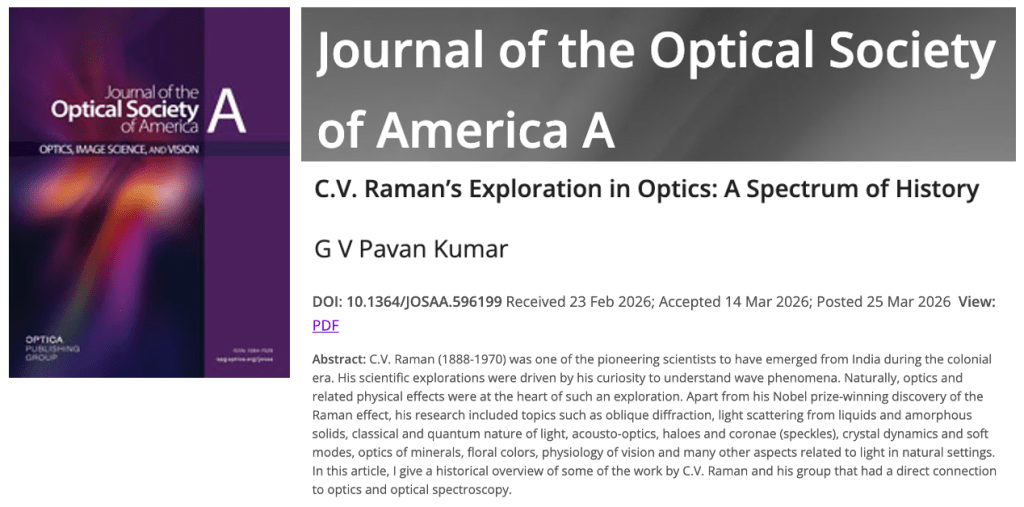
The accepted paper is online now. Thanks to the anonymous reviewer(s) for the encouraging feedback. It made my day :-)
The paper will be published as part of a special issue on optics in South Asia
Link to the online version here.
The accepted paper is online now. Thanks to the anonymous reviewer(s) for the encouraging feedback. It made my day :-)
The paper will be published as part of a special issue on optics in South Asia
Link to the online version here.
Journal of the Optical Society of America is coming up with a special issue on Optics in South Asia. I was invited to write a historical overview of Raman’s work on optics. Below is the snapshot of the pre-print. It should also appear in the axriv in the coming week. Meanwhile, you can access the preprint PDF below.
Also, look out for a research article from my group on multipolar optical binding submitted to the same issue. I will post a link when it appears as a pre-print.
Acknowledgements:
arXiv link here.
We have a new paper in Soft Matter
link to the paper (free to access, thanks to IISER Pune library)
We use optical illumination to generate thermal fields, creating non-reciprocal interactions between passive and active colloids. Active colloids absorb light and produce thermal gradients, driving thermo-osmotic forces that induce propulsion and chiral motion. Our Langevin simulations, backed by experimental observation, reveal how to control colloidal behavior. May have implications in light-driven chiral motion and nonlinear dynamics.
Super effort by Rahul, Ashutosh & Sneha from our group, who combined numerical simulations, analytical theory, with experimental observations.
The 2 anonymous reviewers made us think and work hard, and we thank them!
Also, the paper is part of the journal’s themed collection on “Colloidal interactions, dynamics and rheology”
“How might optical computers beat electronic computers? …….. There are three main metrics of computing performance for which we might aim to achieve an advantage: latency, throughput and energy efficiency…”
A very readable review by Peter MacMahon of Cornell.
In the immediate future, designing energy-efficient computational platforms will be a necessity. Electronic transport is noisy and dissipative. Optical alternatives can be important, but challenges remain…
Given that the speed of light is the upper limit of information transport and processing, optics will be a vital ingredient in computation. In hindsight, it has already been. But there is more to it than just the speed, as the review article explains elaborately..
Interesting times ahead…
In scientific research, comparative analysis is an excellent way to objectively quantify two measurable entities. The recent Google quantum chip (named Willow) does that efficiently as it compares its capability with today’s fastest supercomputers. The comparison note on Google’s blog is worth reading.
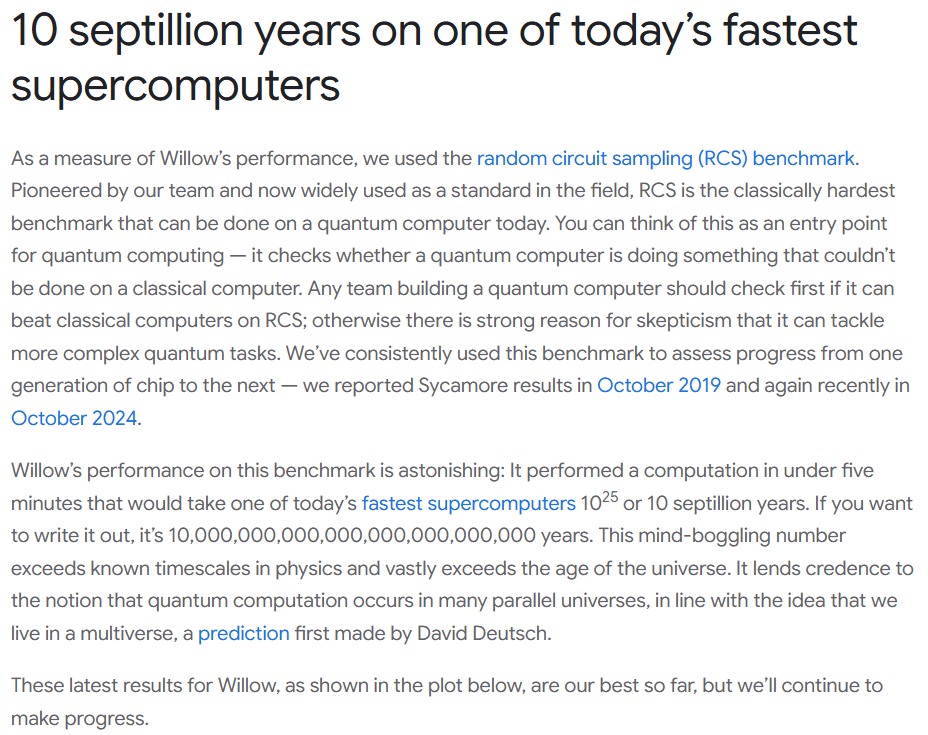
In scientific analysis, such comparison teaches us three things:
a) how a scientific boundary is claimed to be pushed?
b) how a benchmark problem is used to achieve comparison?
c) what is the current state-of-the-art in that research area?
Some further observations on the work:
More to learn and explore…interesting times ahead..
We have a new preprint: https://arxiv.org/abs/2411.15512


We have an arxiv preprint :
We explore some dynamic regimes of optical matter driven by heat+light…
https://arxiv.org/abs/2411.12488

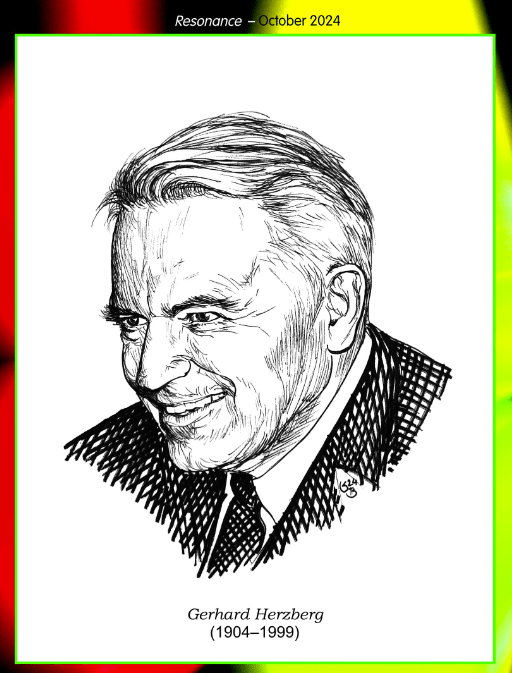
The October 2024 issue of Resonance, Journal of Science Education
highlights the life and science of Gerhard Herzberg.
He was one of the greatest molecular spectroscopists who laid the foundation of atomic and molecular quantum mechanics and deeply impacted molecular astrophysics and astrochemistry.
He lived an extraordinary life, first in Europe learning quantum mechanics and then escaping 1930s Germany as his wife was of Jewish origin. Then, he settled in Canada to build and lead his lab, which was considered the ‘mecca of spectroscopy’ at NRC, Ottowa.
I wrote a sci-biography article about him in this issue
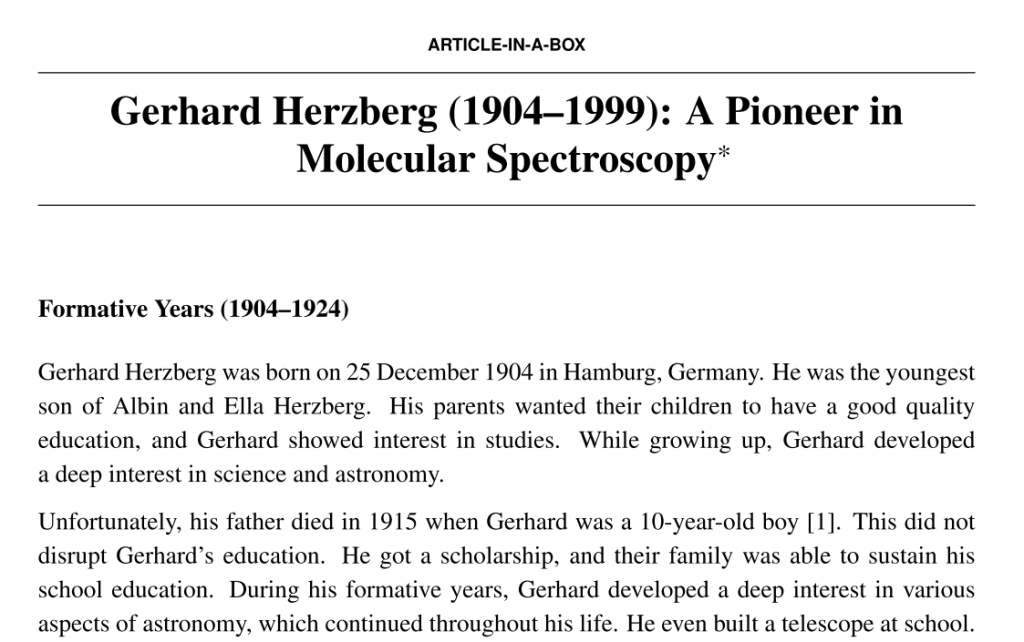
Link to full edition: https://www.ias.ac.in/listing/articles/reso/029/10
If you don’t know – Resonance is a pedagogical journal published by the Indian Academy of Sciences. It is a true open-access journal. Free to read and does not charge the authors to publish.
Do explore the past editions. There are some absolute gems. https://www.ias.ac.in/listing/issues/reso

The perspective article is online: https://doi.org/10.1063/5.0235507
arxiv preprint: https://arxiv.org/abs/2408.15791

 VISMAYA - History & Philosophy of Physics