Here I discuss the paper that announced the Raman effect to the world…
Category: optics
Quantum Optics course – thoughts and notes
Jan 2026 – Apr 2026 – I am teaching a course on Quantum Optics. Below you will find some random thoughts and notes related to my reading. I will be updating the list as I go along the semester. You can add your comments below.
Some timelines for reference:
Interactive timeline – includes pre-quantum optics
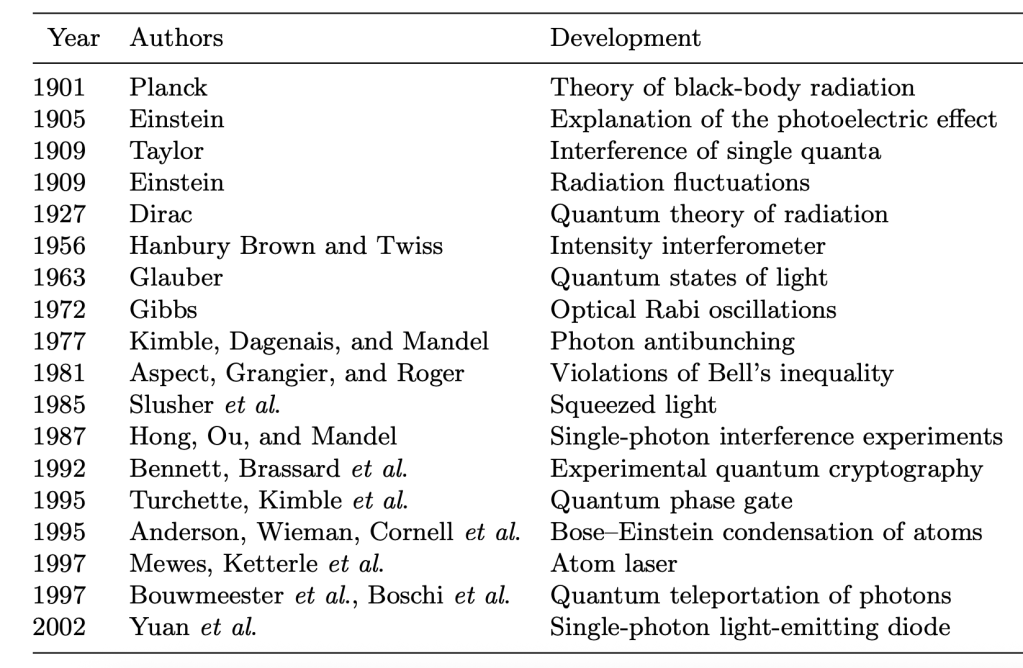
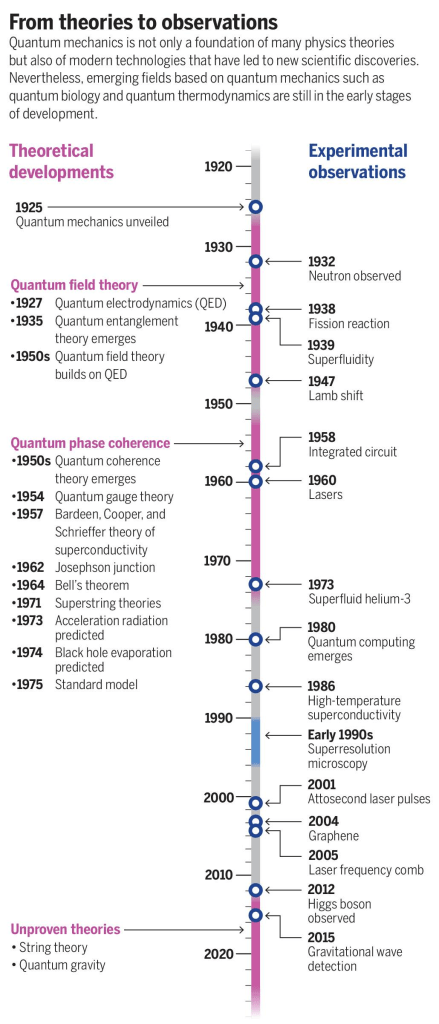
https://doi.org/10.1126/science.ady6092
- Anyone interested in physics should know a bit about renormalized QED and the efforts that went behind it… It still remains a benchmark of how experiments and theory work in elevating each other…
- Hari Dass (erstwhile, IMSc) on FB made an interesting observation:it’s unfortunate that after all those and subsequent developments, a mystery is being built out of renormalisation..it was the price to pay for assuming, without any justification, that the microscopic description held to arbitrarily small distances..wilson,schwinger and even feynman have clarified that the right way to do physics is to start with an effective description with a cutoff, which can be fully quantum in nature, and keep extending it to higher and higher scales with the help of further data, as well as with better theoretical understanding..
- “The photon is the only particle that was known as a field before it was detected as a particle.”
- This is how Weinberg introduces the birth of quantum field theory. He further adds: “Thus it is natural that the formalism of quantum field theory should have been developed in the first instance in connection with radiation and only later applied to other particles and fields.”Ref: S. Weinberg (in Quantum Theory of Fields, p.15, 1995)
- Sudipta Sarkar (IIT G) made an interesting observation in facebook:
- “In some sense, it did right! Dirac started QFT with the effort to quantise radiation! But formally, it is not easy to write down the quantum version of electrodynamics owing to gauge symmetry. It took quite a bit of time to understand how to manage a quantum theory with massless states!“
- My reply: “indeed..the reconciliation of symmetry was a bottleneck. I am also amazed by the progress of thought, especially by Dirac, who took the harmonic oscillator problem and treated it the way he did. Historically, the question of quantization of particles was already an established programme, but to quantize the field was indeed a major challenge, and hence ‘second quantization’.“
- The concept of creation and annihilation operators is an intriguing one because it brings in the thoughts from the commutation relationship that existed in classical physics and transfers that into quantum mechanics. This intellectual connection is mainly attributed to Dirac, and historically, this has been one of the most important connections to be made. The question of field quantization already existed in 1920s, but it is thanks to Dirac who really made this connection in a systematic and mathematically consistent way.
- Sudipta Sarkar (IIT G) made an interesting observation in facebook:
- This is how Weinberg introduces the birth of quantum field theory. He further adds: “Thus it is natural that the formalism of quantum field theory should have been developed in the first instance in connection with radiation and only later applied to other particles and fields.”Ref: S. Weinberg (in Quantum Theory of Fields, p.15, 1995)
- In the context of the quantum harmonic oscillator model of electromagnetic radiation, the shift from canonical variables such as position and momentum to creation and annihilation operators is a fascinating one. Interestingly, this progression further leads to the so-called number operator. It is also a progression from Hermitian to non-Hermitian and again back to a Hermitian operator. In the process of understanding the number operators, one realizes that the ground-state results in the so-called zero-point energy. Taken further, the commutation of the number operator with the electric field of the electromagnetic radiation results in the number-amplitude uncertainty. This further gives an insight into why the field amplitude has a non-zero spread, even for the n = 0 state, and therefore results in the so-called vacuum fluctuations.
- It can’t get more quantum than this…
- An essay on Quantum States in Argand Diagrams: https://historyofscience.in/2026/02/03/quantum-states-in-argand-diagrams-vacuum-coherent-and-squeezed/
- The word photon has an interesting and surprising origin – see this paper.
- also see: Kragh, Helge. ‘The Names of Physics: Plasma, Fission, Photon’. The European Physical Journal H 39, no. 3 (2014): 263–81. https://doi.org/10.1140/epjh/e2014-50007-7.
- also see: Kragh, Helge. ‘The Names of Physics: Plasma, Fission, Photon’. The European Physical Journal H 39, no. 3 (2014): 263–81. https://doi.org/10.1140/epjh/e2014-50007-7.
Teaching & Meaning
What adds meaning to my academic work?
Perhaps, an anonymous feedback on your teaching is one of them….
“very well taught course at a well defined pace. The interesting way various different aspects and fields in Optics was introduced was fascinating, made us so very keen on knowing more! The mind maps at the beginning of every topic, the indexes professor made was a great way to keep the bigger picture in mind and helped us glide through it. The assignment was also a great way to make us go through materials without feeling it it be imposing, rather finding it more interesting! Thank you so much Sir for this amazing course, the enthusiastic way in which you taught, all the great conversations you engaged in with us, and opened our eyes to explore so much more in this field! thank you!!“
I had a diverse class (BS-Physics majors, MS Quantum Tech, iPhD) with 110+ students, and I am glad a lot of students enjoyed the course this time.
I am a bit overwhelmed by the positive feedback I received on my teaching methods. For sure, I learnt about the subject as much as they did.
And as I always say: there is more to learn…for all of us..
Human interaction zindabad :-)
Quantum Optics – teaching in Jan 2026
More than 22 years ago, I started my journey as a research student in theoretical physics – Quantum Electrodynamics (QED) + Radiative Transfer (MSc summer project at the Indian Institute of Astrophysics), and my special paper in the MSc final semester was QED. Later in my PhD, I branched into experiments on light scattering (Raman, Mie & Rayleigh).
Over the years, QED and quantum optics have always been at the back of my mind while studying, researching and teaching.
Come January, I will be teaching a course on Quantum Optics to MS(Quantum Tech), MS-PhDs, and 4th-year physics UGs
I designed the first course on this topic at IISER Pune about a decade ago with the able inputs from Prof. Rajaram Nityananda, and I have taught the course a few times. Now, after a few years, I will teach it again.
With the emergence of quantum sci & tech, there is a new impetus and excitement on this topic.
Having said that, the foundations of the topic remain the same, and Quantum Optics has a wonderful history and philosophy associated with it…and where better to start than Dirac’s classic (see below).
Look out for ‘quantum blogs’ in 2026…

Rotational jamming – preprint

Random Walks in Polarization
I have been teaching polarization of light in my optics class. In there, I introduced them to matrix representation of polarization states. One of the standard references that I use for explanation is a 1954 paper in American J. Physics, by McMaster titled: “Polarization and the Stokes Parameters.”
While skimming through the pdf of the journal paper, I found an excerpt from a 1954 book, which quotes Fresnel writing to Thomas Young:
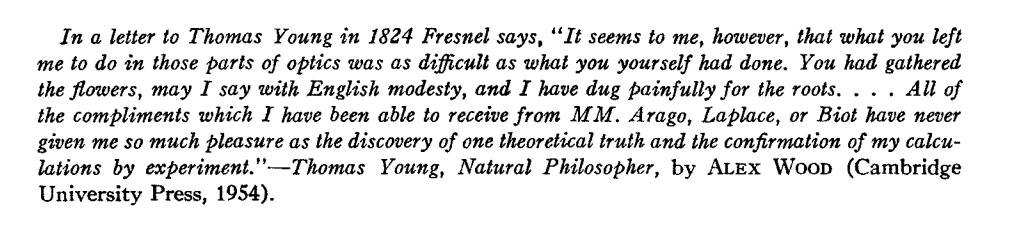
Further, I knew from the past that S. Chandrasekhar (astrophysicist) had a role in rejuvenating Stokes vector formalism in radiative transfer. Below is his description from AIP oral history archives (May 1977):
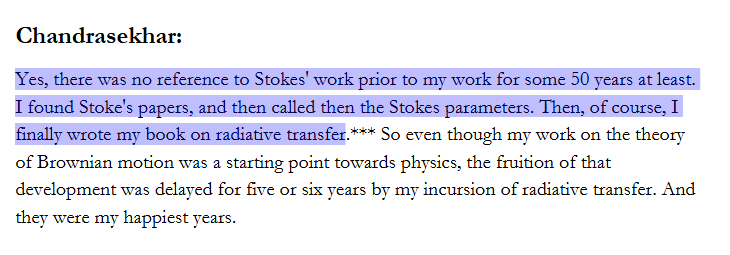
” I started the sequence of papers, and almost at the time I started it, I read the paper by Wick in which he had used the method of discrete coordinates,* and I realized at once that that method can be used in a large scale way for solving all problems. So that went on. I have always said and felt that the five years in which I worked on radiative transfer [1944 – 49] is the happiest period of my scientific life. I started on it with no idea that one paper would lead to another, which would lead to another, which would lead to another and soon for some 24 papers — and the whole subject moved with its own momentum.” (emphasis added)
He further states how he rediscovered Stokes polarization vector formalism:
“All this had a momentum of it own. Then suddenly I realized one had to put polarization in; the problems of characterizing polarized light — my rediscovery of Stokes original paper, writing on Stokes parameters and calling them Stokes parameters for the first time“
Chandra further adds that the Stokes formalism was almost forgotten for 50 years, and he had a role in resurrecting it.
Next, there was some noise on social media where some one questioned the utility of matrix multiplication. For them, below is a wonderful review article by McMaster (again), to explore from polarization viewpoint, and realize the power of non-commutative matrix algebra:

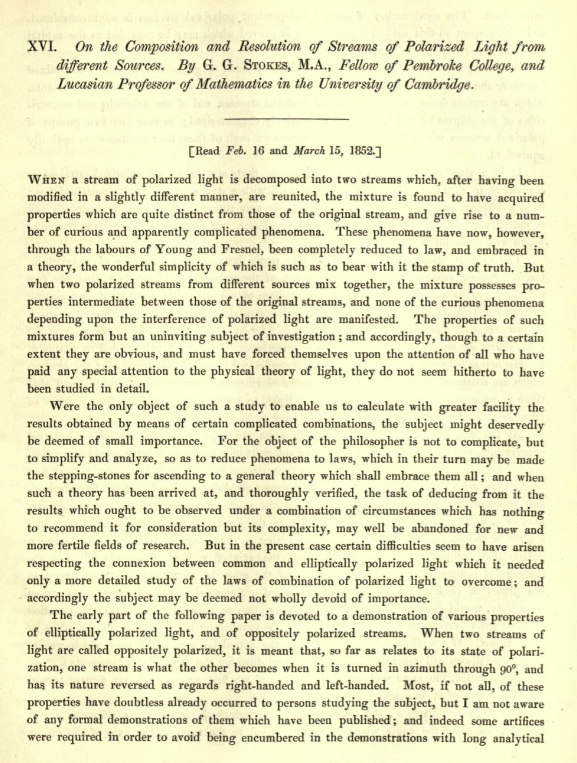
Finally, the original paper by Stokes on his formalism, which is hard to find (thanks to paywall). But, classic papers are hard to suppress, and I found the full paper on internet archives.
Below is a snapshot:
Enjoy your random walk !
Pursuit of Radiance – musical & philosophical
What happens when Carnatic music, eastern and western philosophy and optics come together?
Well….if you ask my friend Karthik Raveendran, who is a Carnatic vocalist and a physicist, he will say Kānthimathīm – which is his musical video perspective on ‘Pursuit of Radiance’.
Below I post his spectacular art, which includes his music and philosophical thoughts on the mentioned topics. All this visualized through Indian architecture, Finnish lakes and auroras over its sky.
He has been very kind to acknowledge me in his video for my minor input on scientific philosophy. I am truly honored.
Do watch+listen (~ 14 min)
Light pressure – Lebedev coin
Today, in my optics class, I discussed optical forces due to momentum in electromagnetic waves. Towards the late 1800s, it was realized that light can impart momentum. This manifested as radiation pressure in the electromagnetic theory proposed by James Maxwell.

Pyotr Nikolaevich Lebedev (24 February 1866 – 1 March 1912) was one of the earliest to experimentally measure (~1899) the radiation pressure on a surface (link to his 1900 paper in German). In 1991, the Soviet Union released a 1 ruble coin (pictured above) to commemorate Lebedev’s scientific achievement.
The formula expresses the total momentum transferred per unit time ( radiation pressure, P) by a beam of N photons, each of energy hν, that is incident on a surface with a coefficient of reflectivity ρ. The constant, c, is the speed of light.
The discussion in the class was mainly related to Ashkin’s work. I have written about this in the past.
Shared below is a delightful lecture given by Ashkin at the age of ~96, after he received his Nobel prize.
Liquid Crystal Droplets + Plasmonic nanoparticle clusters
A droplet of liquid can act as an optical resonator. One can create a droplet of a liquid crystal and utilize its optical and topological properties. In recent times, liquid crystal droplets have emerged as a ‘soft photonic element’ in topological optics and photonics. Studying their optical behaviour in a controlled environment is a contemporary research problem.
In this context, we have an arXiv preprint on liquid crystal droplets and their reversible coupling to a small assembly of nanoparticles on a glass surface (see video).
Specifically, we ask: What happens to the modes of light inside the droplet due to such an interaction?
Thanks to the efforts of Sumant Pandey, we experimentally demonstrate the utility of optical tweezers to proximally couple (and decouple) nematic liquid crystal droplets to gold nanoparticle clusters, and record whispering gallery modes in coupled and decoupled states. We observe tuning of sharp resonant modes.
For more details, see the preprint: https://arxiv.org/abs/2509.10126v1
Art and Chu – in Bell labs
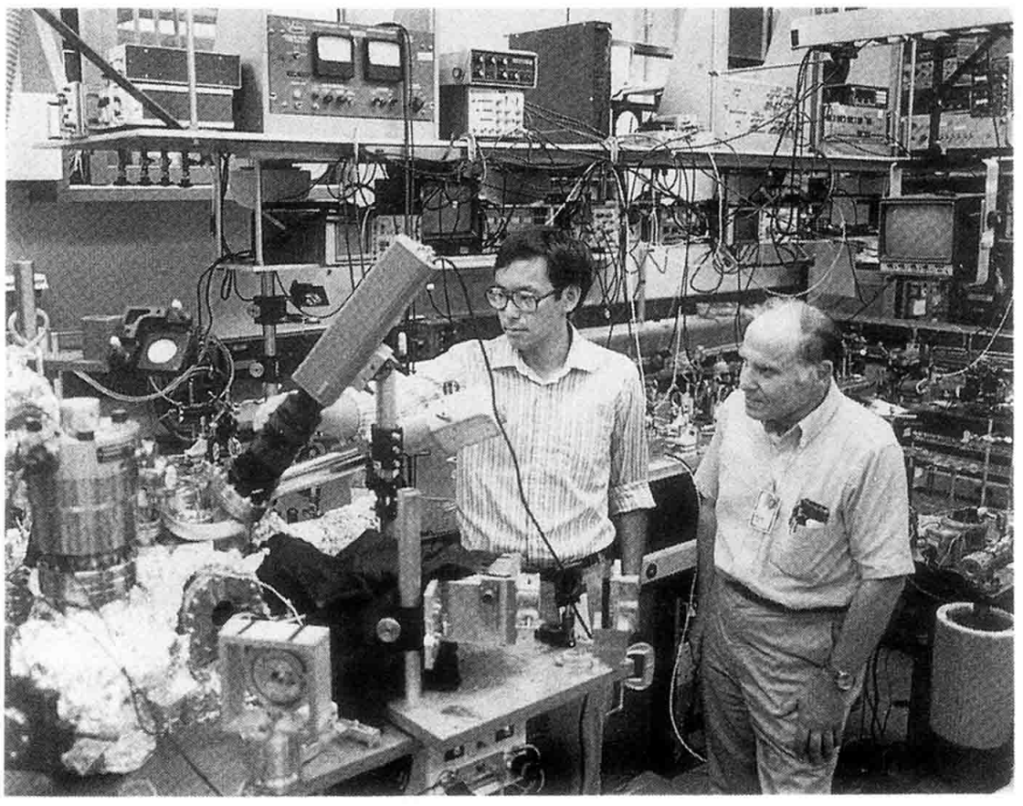
Steven Chu’s Nobel lecture has some gems. Below, he shares his experience of working with Arthur Ashkin.
“In 1986, the world was excited about atom trapping. During this time, Art Ashkin began to use optical tweezers to trap micron sized particles. While experimenting with colloidal tobacco mosaic viruses, he noticed tiny, translucent objects in his sample. Rushing into my lab, he excitedly proclaimed that he had ‘discovered Life’. I went into his lab, half thinking that the excitement of the last few years had finally gotten the better of him. In his lab was a microscope objective focusing an argon laser beam into a petri dish of water. Off to the side was an old Edmund Scientific microscope. Squinting into the microscope, I saw my eye lashes. Squinting harder, I occasionally saw some translucent objects. Many of these objects were ‘floaters’, debris in my vitreous humor that could be moved by blinking my eyes. Art assured me that there were other objects there that would not move when I blinked my eyes. Sure enough, there were objects in the water that could be trapped and would swim away if the light were turned off. Art had discovered bugs in his apparatus, but these were real bugs, bacteria that had eventually grown in his sample beads and water.”
Chu won the physics Nobel in 1997, and Ashkin won the same in 2018. Ashkin was the pioneer of optical trapping and tweezers, and applied it to a variety of problems, including the manipulation of biological matter. Chu harnessed the momentum of light to trap and cool atoms. Both started their work and collaborated at Bell Labs. Chu moved to Stanford, whereas Ashkin stayed back. Bell Labs was a remarkable place in the 1980s, as Chu describes in his lecture :
“Bell Labs was a researcher’s paradise. Our management supplied us with funding, shielded us from bureaucracy, and urged us to do the best science possible. The cramped labs and office cubicles forced us to rub shoulders with each other. Animated discussions frequently interrupted seminars and casual conversations in the cafeteria would sometimes mark the beginning of a new collaboration.”
Can the world afford to have another Bell Labs in 2025? Can it recreate the magic?
 VISMAYA - History & Philosophy of Physics