New vlog post: I take, e.g. from the game of cricket (ft. Laxman, Dravid), soft matter physics, ants, Feynman’s seminar & a few other references to explain the emergence, self-organization and spontaneous order in our world
Araújo, Nuno A. M., Liesbeth M. C. Janssen, Thomas Barois, Guido Boffetta, Itai Cohen, Alessandro Corbetta, Olivier Dauchot, et al. 2023. “Steering Self-Organisation through Confinement.” Soft Matter 19 (9): 1695–1704. https://doi.org/10.1039/D2SM01562E.
Tromp, Catrinel, and John Baer. 2022. “Creativity from Constraints: Theory and Applications to Education.” Thinking Skills and Creativity 46 (December): 101184. https://doi.org/10.1016/j.tsc.2022.101184.
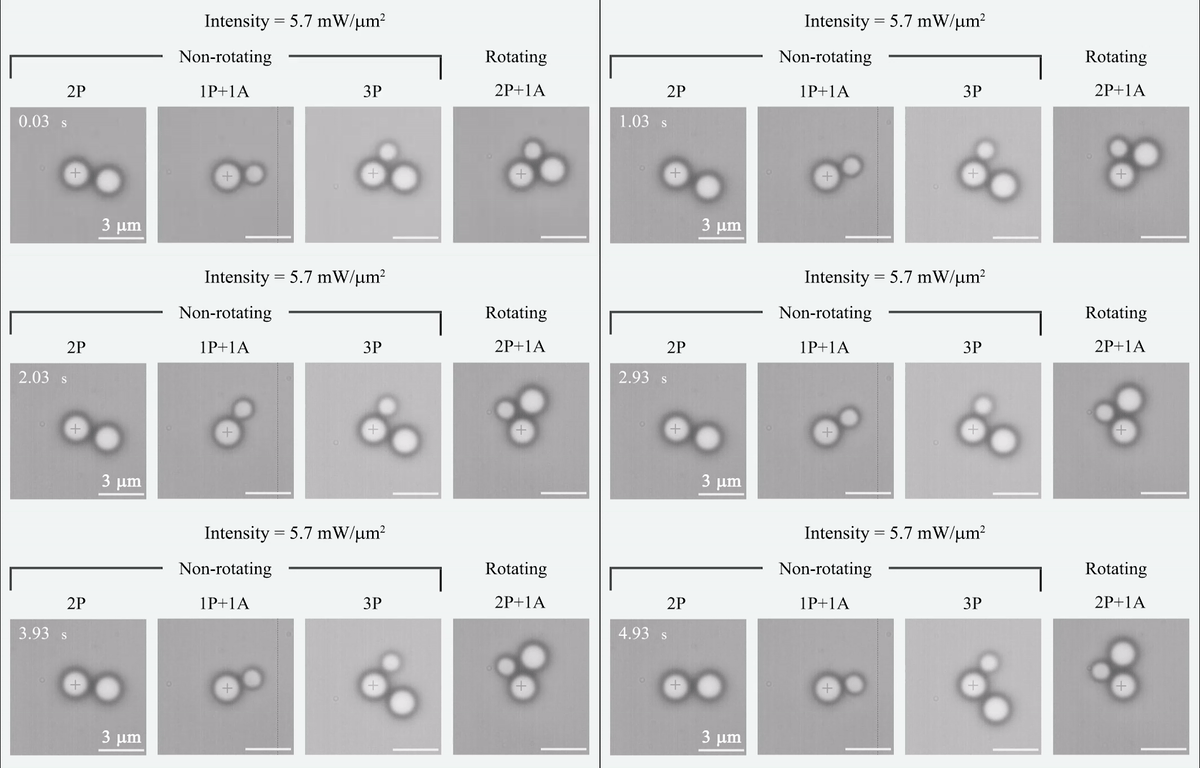
We have a new paper to appear in ACSPhotonics. Great effort by Rahul Chand, Chaudhary Eksha Rani and Diptabrata Paul from our group. We ask : How & why does directional rotation emerge in an optical trap of thermally active (smaller) + passive colloidal combination ?
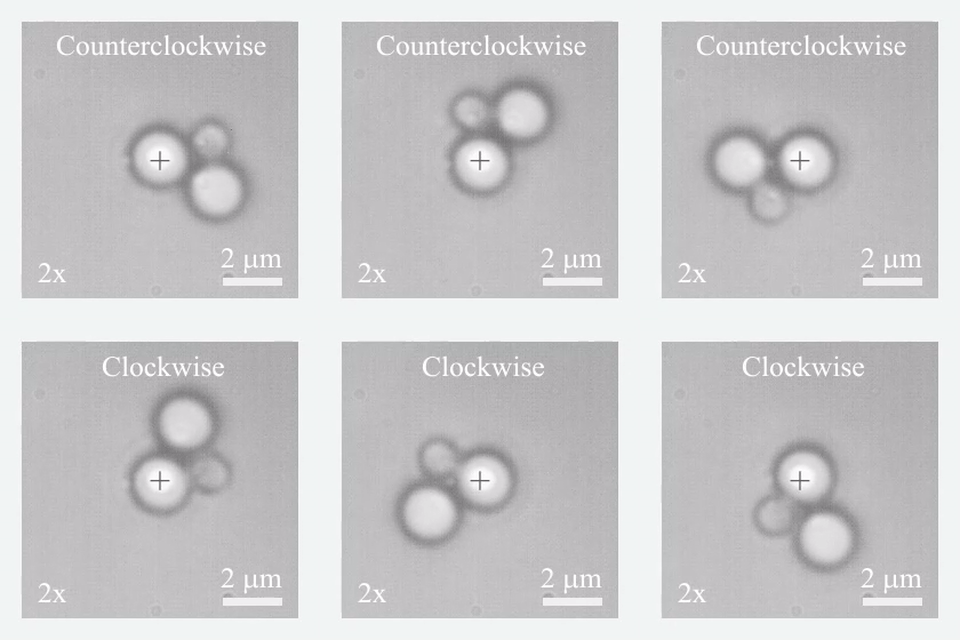
By combining light absorbing colloid (smaller one) with a normal colloid (bigger ones), we can observe directional rotation in a 2D optical trap. What determines the rotation direction is the relative position of the active colloid in the assembly.
One can switch the direction of rotation, by changing the relative position of active colloid.
For the rotation to emerge, the symmetry of the colloidal arrangement matters. As you see, if there are two active colloids (smaller ones) are symmetrically positions with respect to passive colloids (bigger one), we do not observe rotation.
There is a lot more interesting stuff and explanation of the observed effect discussed in our paper. You can read the pre-print of the our paper in arxiv : https://arxiv.org/abs/2309.12740
Thanks to the invitation of Prof. Hajime Ishihara, I visited Osaka from 29th April to 2nd May 2023.
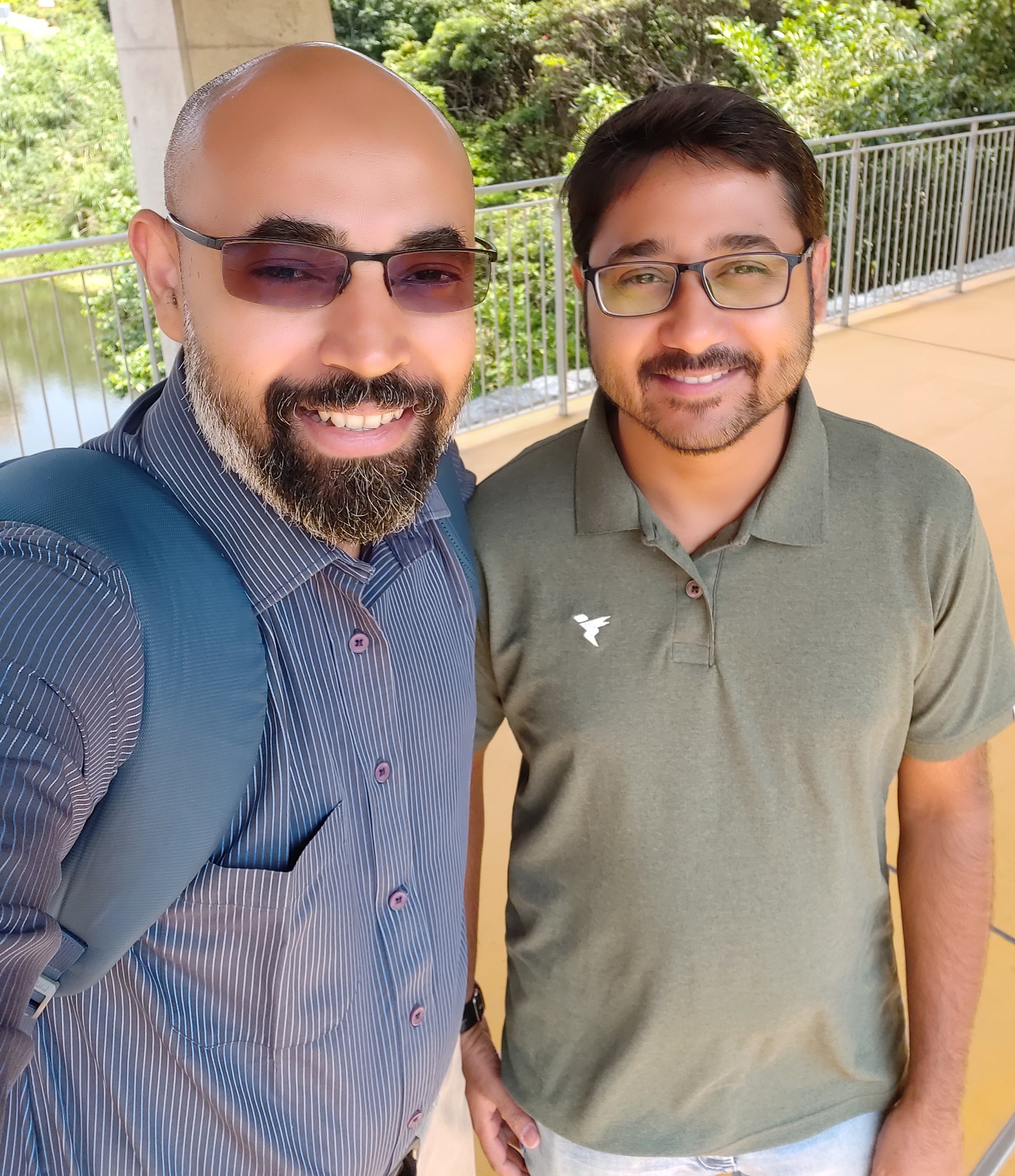
I arrived in Osaka on Saturday (29th Apr). On 30th Apr (Sunday) I headed out to visit the famous Kiyomizudera Temple in Kyoto with 2 PhD students from Ishihara’s group : Hideki Arahari and Takao Horai
Kiyomizudera Temple towards the right and beautiful landscape surrounding it.
Apart from the temple, we had a wonderful time exploring the Nishiki Market and Kamo river.
On 1st May, I visited Osaka University to officially meet Prof Ishihara, his group and other research groups in the university. We had a wonderful discussion on optical manipulation and major projects related to it especially in Japan, and undoubtedly Osaka has emerged as a major center in optical manipulation.
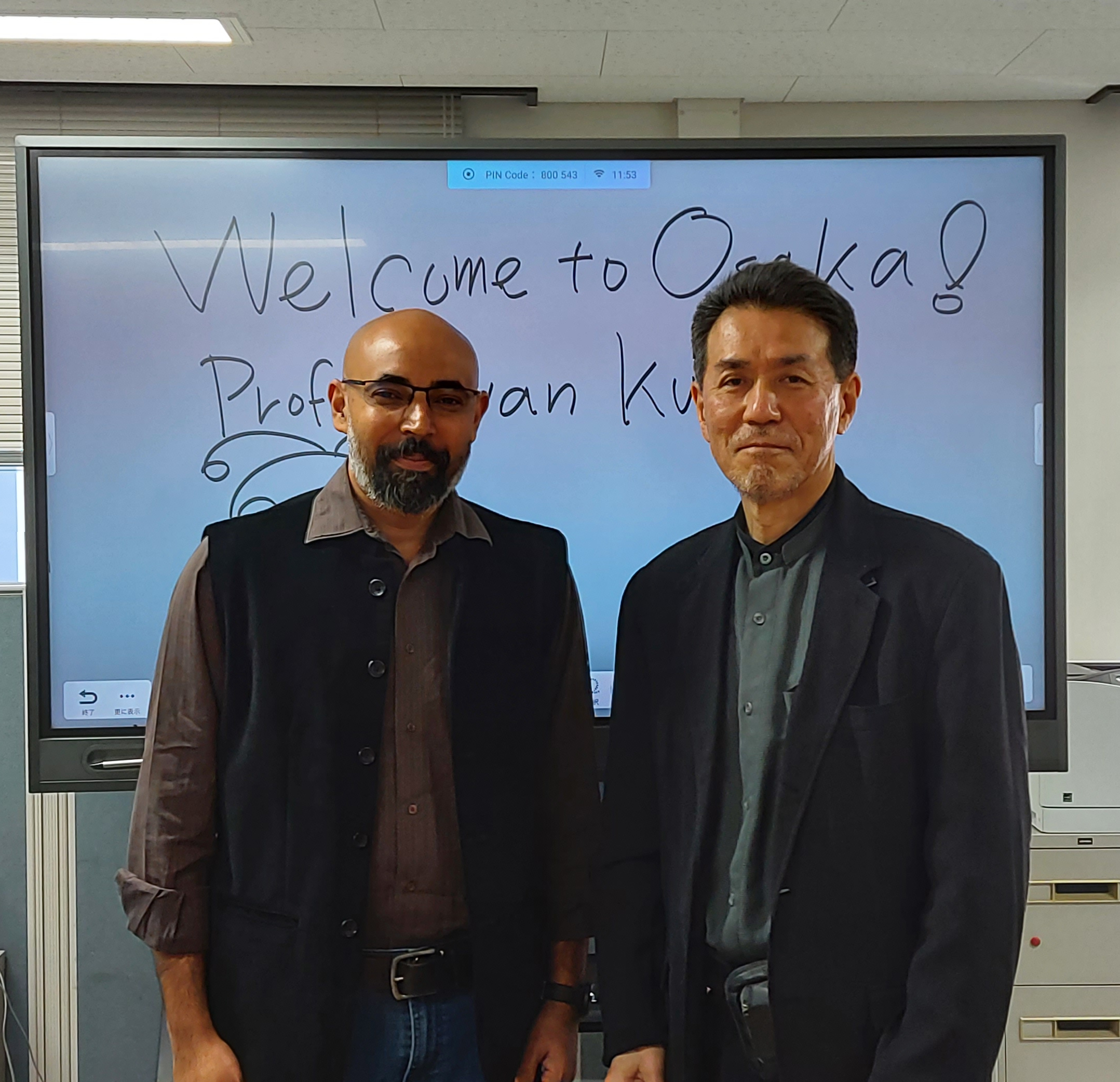
with Prof. Ishihara
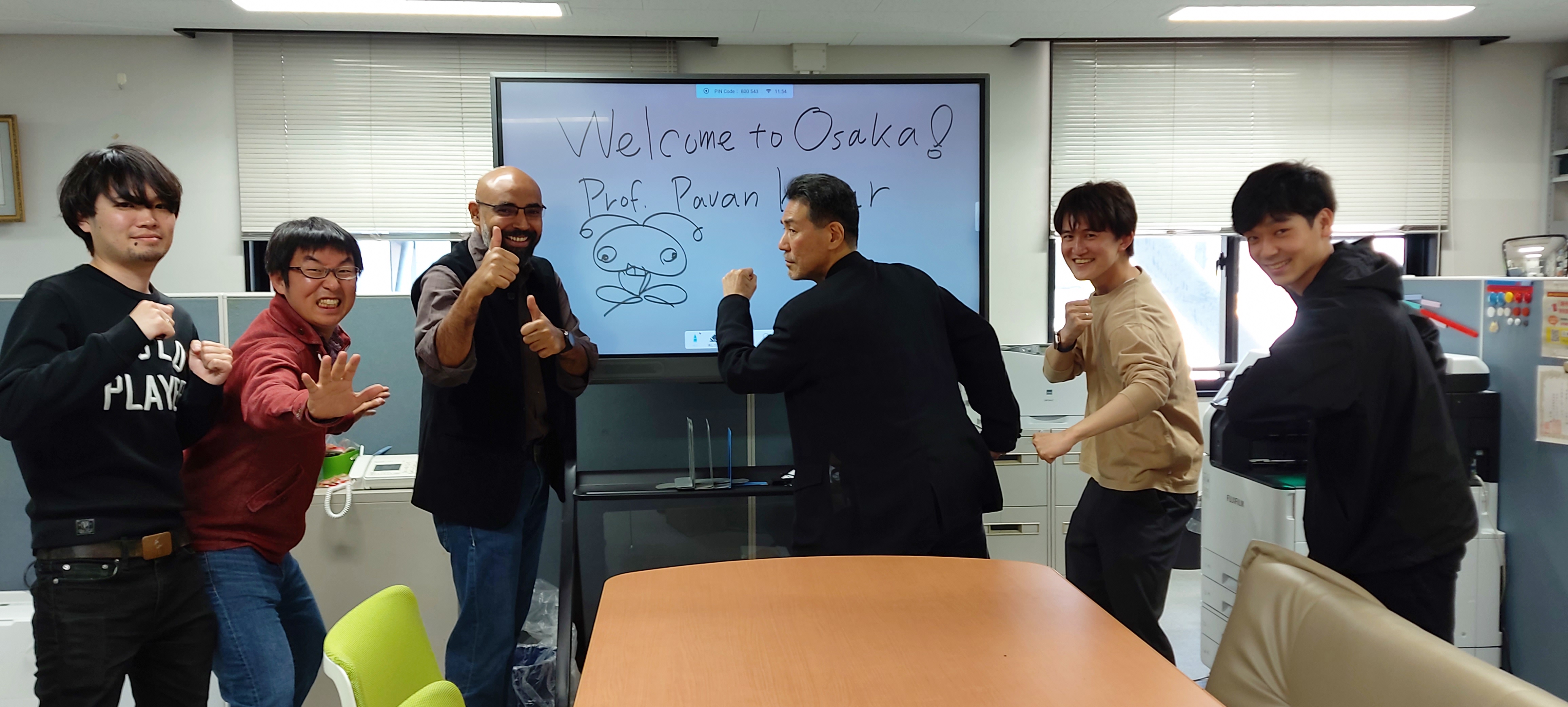
I was delighted to see so many students and research groups interested in optical trapping/manipulation and related science and technology. I learnt about some very interesting applications of optical manipulation. Also, it was great to see such a great sense of humor in this group of researchers. It was truly amazing.
Science + Humor …..we had a great time..
I also visited labs of Prof. Ashida and Prof Ito, and got a very nice overview of their work including optical manipulation in liquid helium and photochemical reactions in an optical trap.
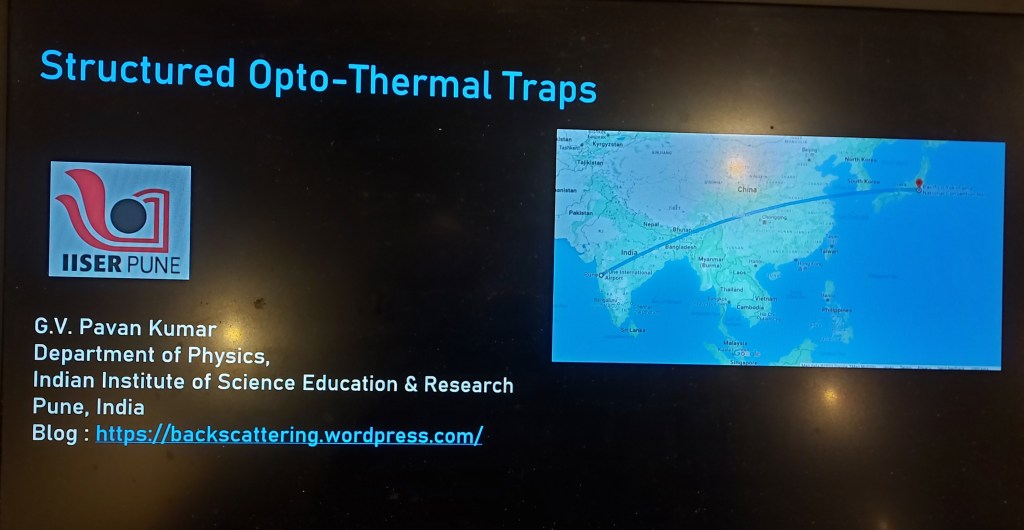
At 4pm, I gave my talk on “Optical Manipulation based on Opto-Thermal Gradients“. I elaborated on the role of absorption and related thermal gradient in optical manipulation. I presented some of our ongoing work on optical manipulation with structured light. The talk was attended by at least 30 to 40 people, and I was informed that students from various groups in Osaka were present (there are a few universities). The quality of questions and the follow up discussion was very good, and really enjoyed it.
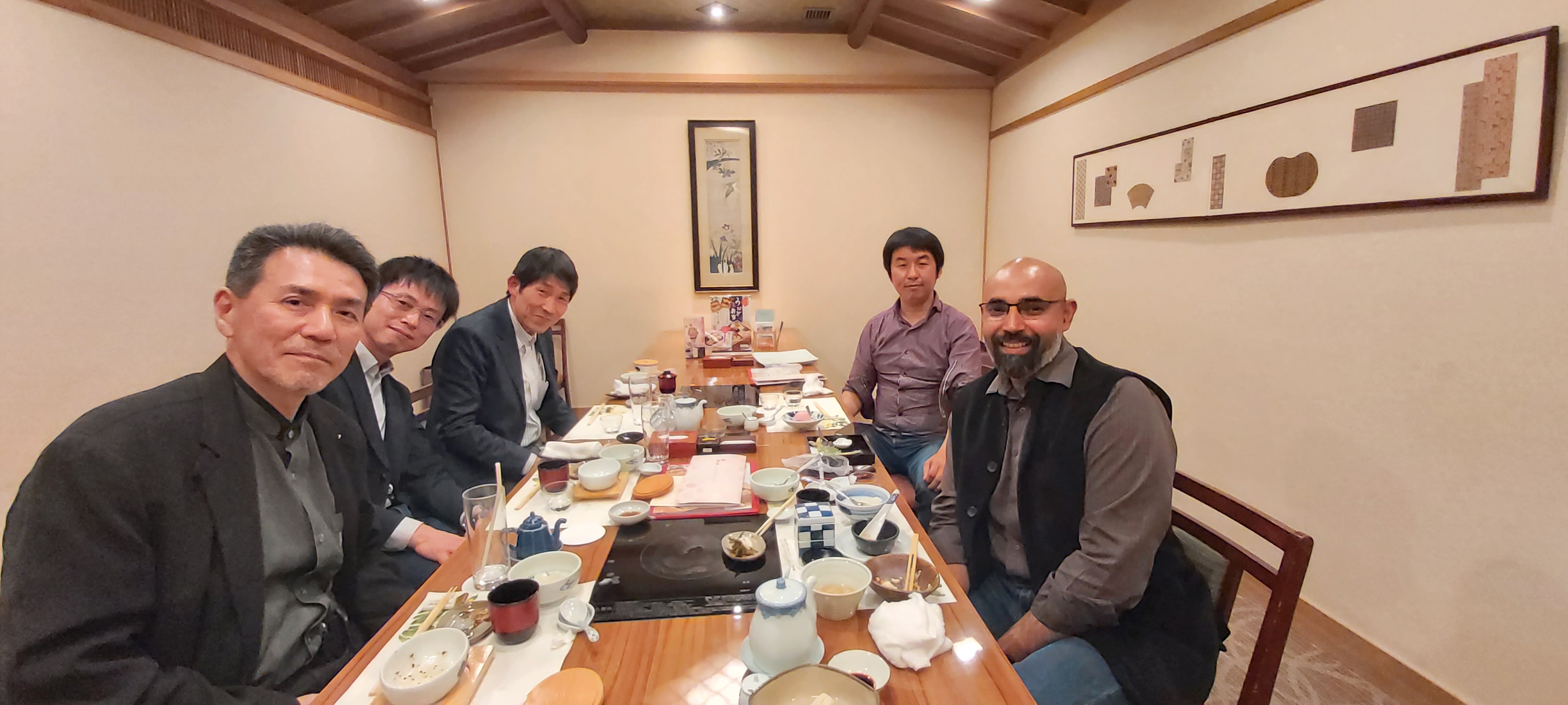
Finally, the day ended with a wonderful dinner at a tofu-themed Japanese restaurant. We had wonderful discussion on history and philosophy in our countries, and was very interesting.
Dinner with Professors Ishihara, Ito, Ashida and Yokoyama
My trajectory in Japan has been Yokohama –> Tokyo –> Okinawa –> Osaka. After 16 days, one conference talk and 4 research seminar across Japan, I am now heading back from Osaka to Tokyo (and writing this blog) on Shinkansen – the bullet train. Tomorrow, I will be leaving to India.
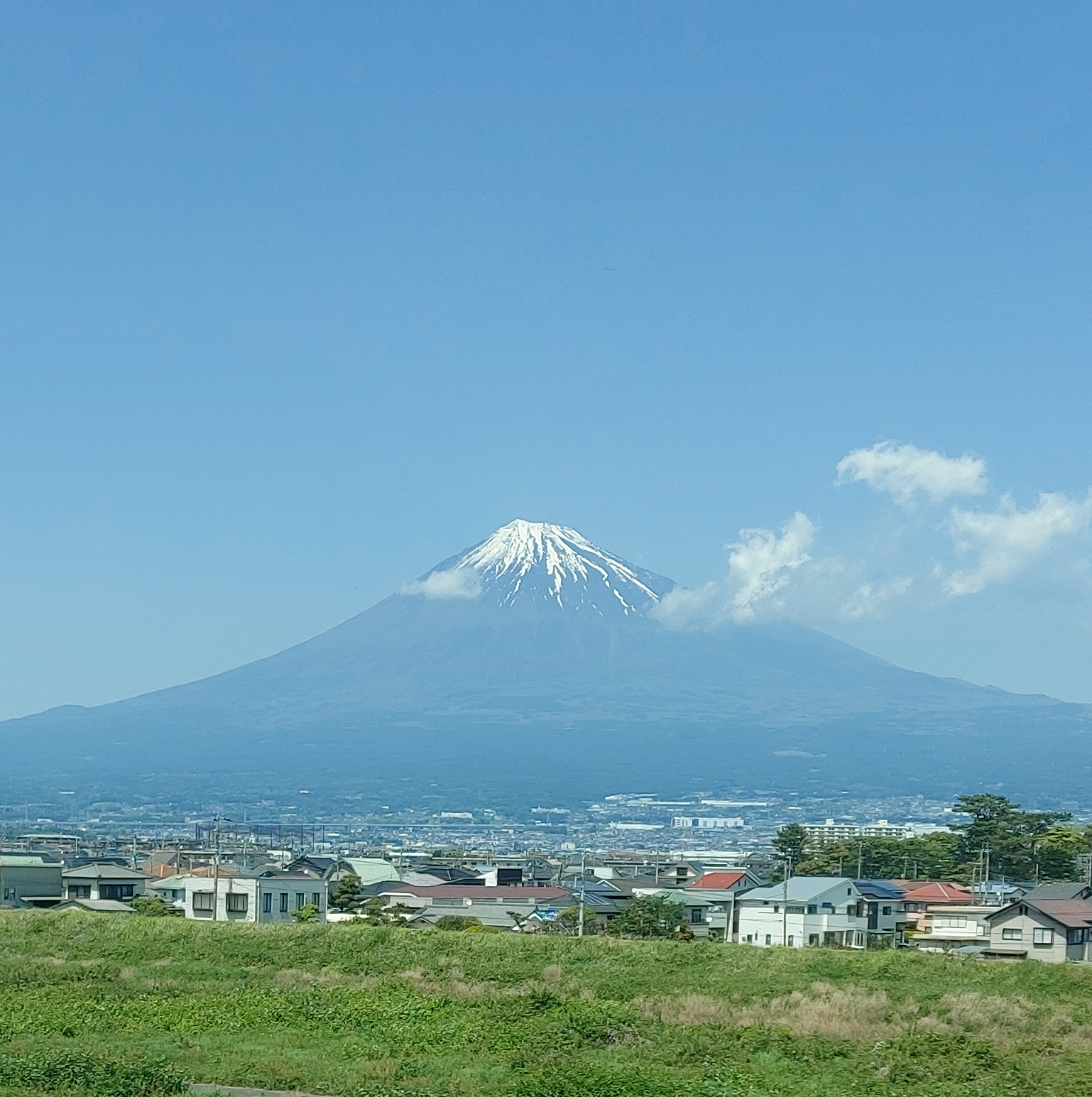
In Japanese, the word ‘Osaka’ also means ‘a large hill’. Japan’s geography has many large hills (see a picture of Mt. Fuji I took from the moving Shinkansen), and metaphorically speaking Japanese like to scale complex landscapes of life by bringing culture with science and technology. There is a lot to learn from this approach to life.
the majestic Mt. Fuji
Osaka, optical manipulation and the perennial ascent towards knowledge. What a memorable trip this has been.
To Japan and to all the people I met here – Doumo Arigatou Gozaimasu !
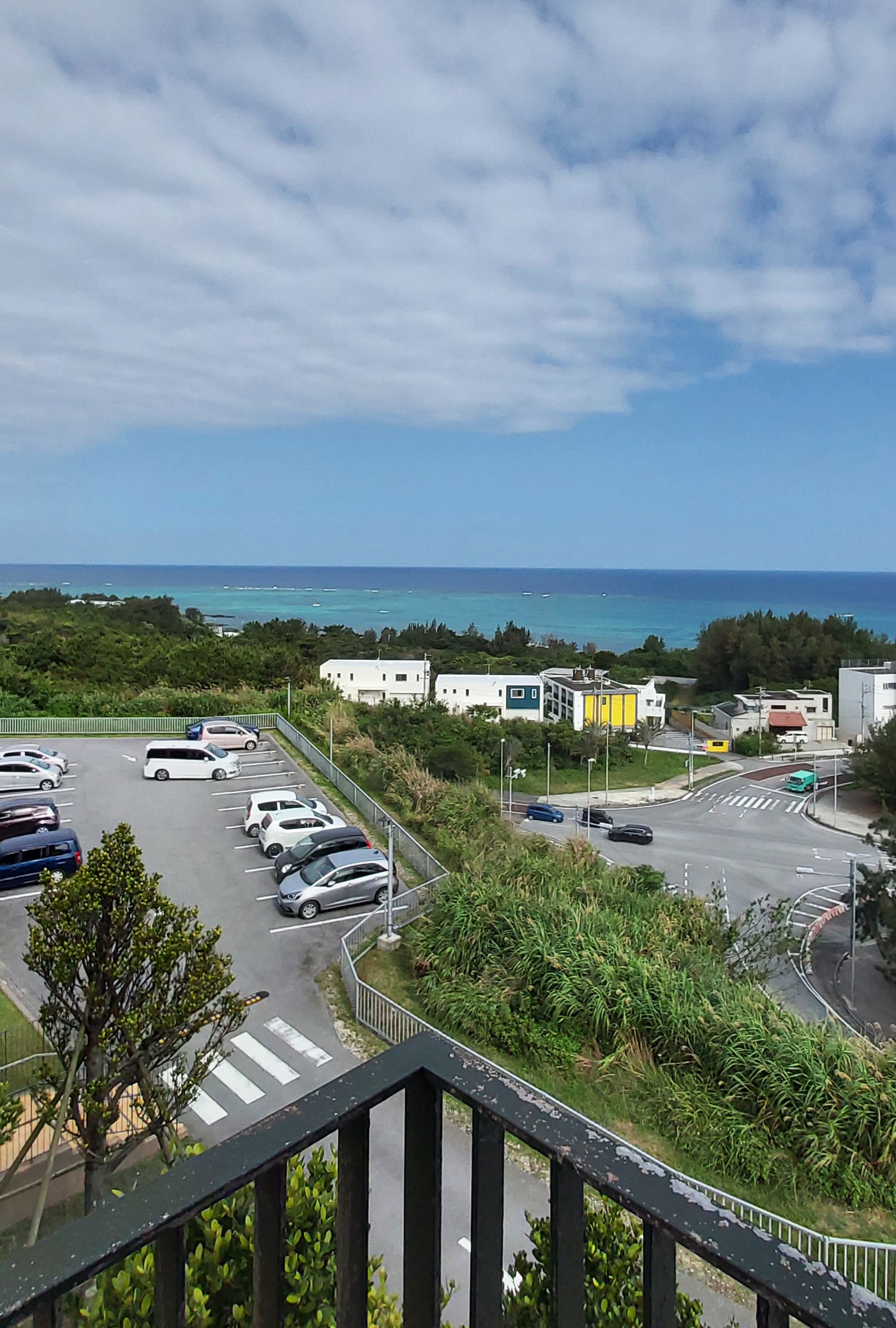
First, the geography : located in the midst of the ocean(s), away from the mainland Japan, Okinawa is the southern most part of Japan. I took a 2.5 hrs. flight from Tokyo and reached the destination when it was dark.
In the morning, I woke up and opened the window to be pleasantly surprised to see the beautiful ocean in my field of view. Below is a photo I took from the balcony of the room.
At the outset, I had a fabulous discussion. Mahesh and I had a excellent free-wheeling discussion on various topics including science, arts and history. Also, I visited his lab to see very creative experiments on non-equilibrium physics including some fascinating experimental designs to probe dynamics at liquid-air interface. He has a fabulous set of students working on interesting problems. It was both refreshing and stimulating.
with Mahesh Bandi
In the afternoon, I gave my seminar and below is an interesting announcement (because it spells out my full name :-)). I discussed about some non-equilibrium aspects of our work, and towards the end emphasized some interesting prospects of statistical optics in an optothermal-assembly.
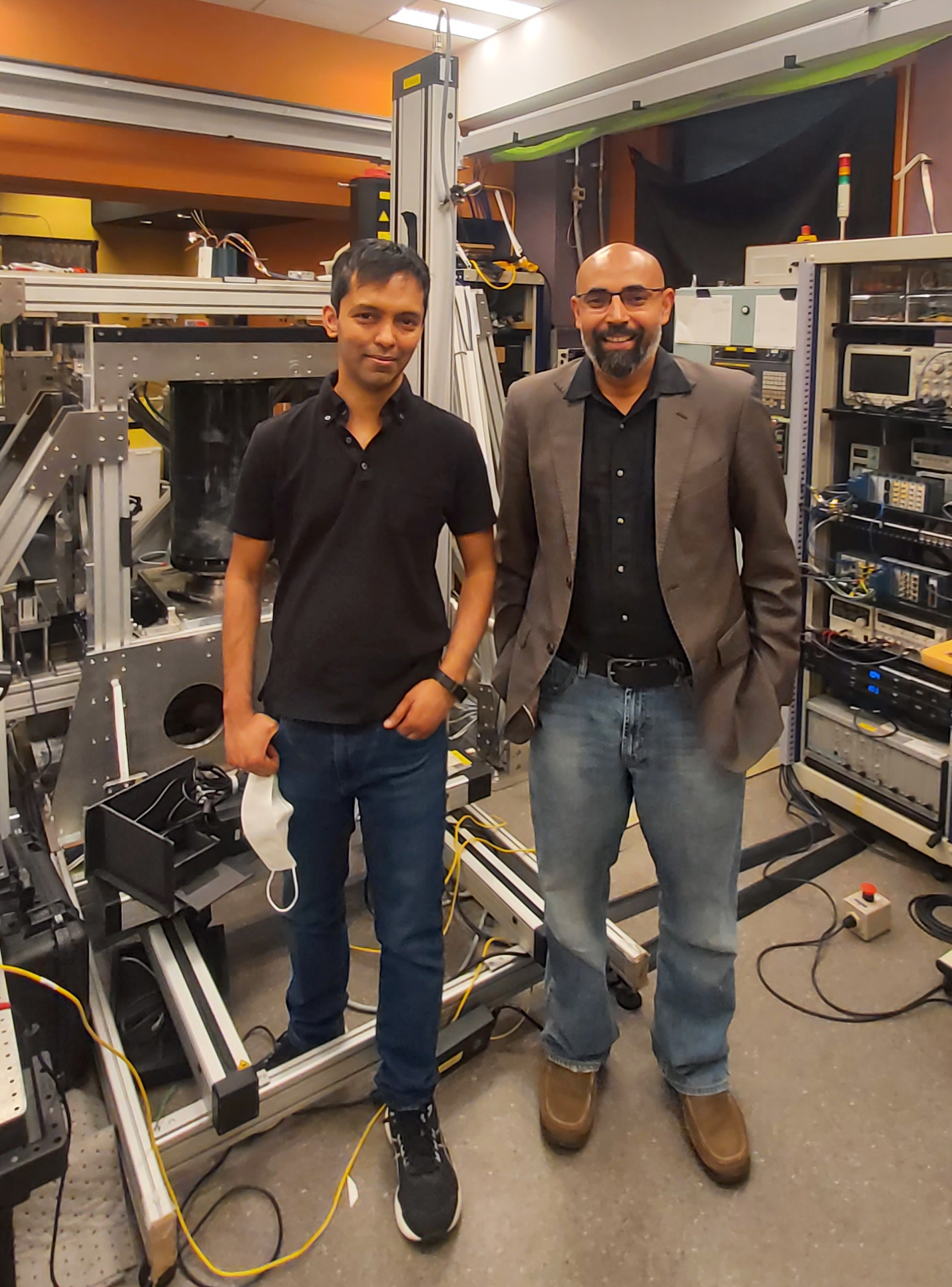
After my talk, I had illuminating discussion with Prof. Pinaki Chakraborty on thermal diffusion, fluid dynamics and history of science. I enjoyed visiting his lab, in which they have built one of the biggest Taylor-Couette flow set up I have ever seen (see the frame behind Pinaki in the picture below).
with Pinaki
Next day, I had an elaborate lab tour of Prof. Sile Nic Chormaic, who is an expert in various topics related to optics/photonics including optical trapping. As she was travelling, her post-doc Dr. Souvik Sil, hosted me and took me around to show various aspects of their lab. It was a great learning experience.
with Souvik
On the same day, I visited the cutting-edge lab of Prof. Keshav Dani. Since he was travelling, his team members gave me a brief tour and I was amazed by some of their experiments.
Another major highlight of my trip was to meet many IISER students. Specifically, I met Amit Bhunia (post-doc) and Saurav Raj (PhD student) who are IISER Pune alumnus. I also met many IISER Kolkata students (Souvik being one of them).
Overall, I was mighty impressed by the research infrastructure at OIST and the people working there. It is quite remarkable how they have been able to build such a great facility in such a short time (their campus started around 2010).
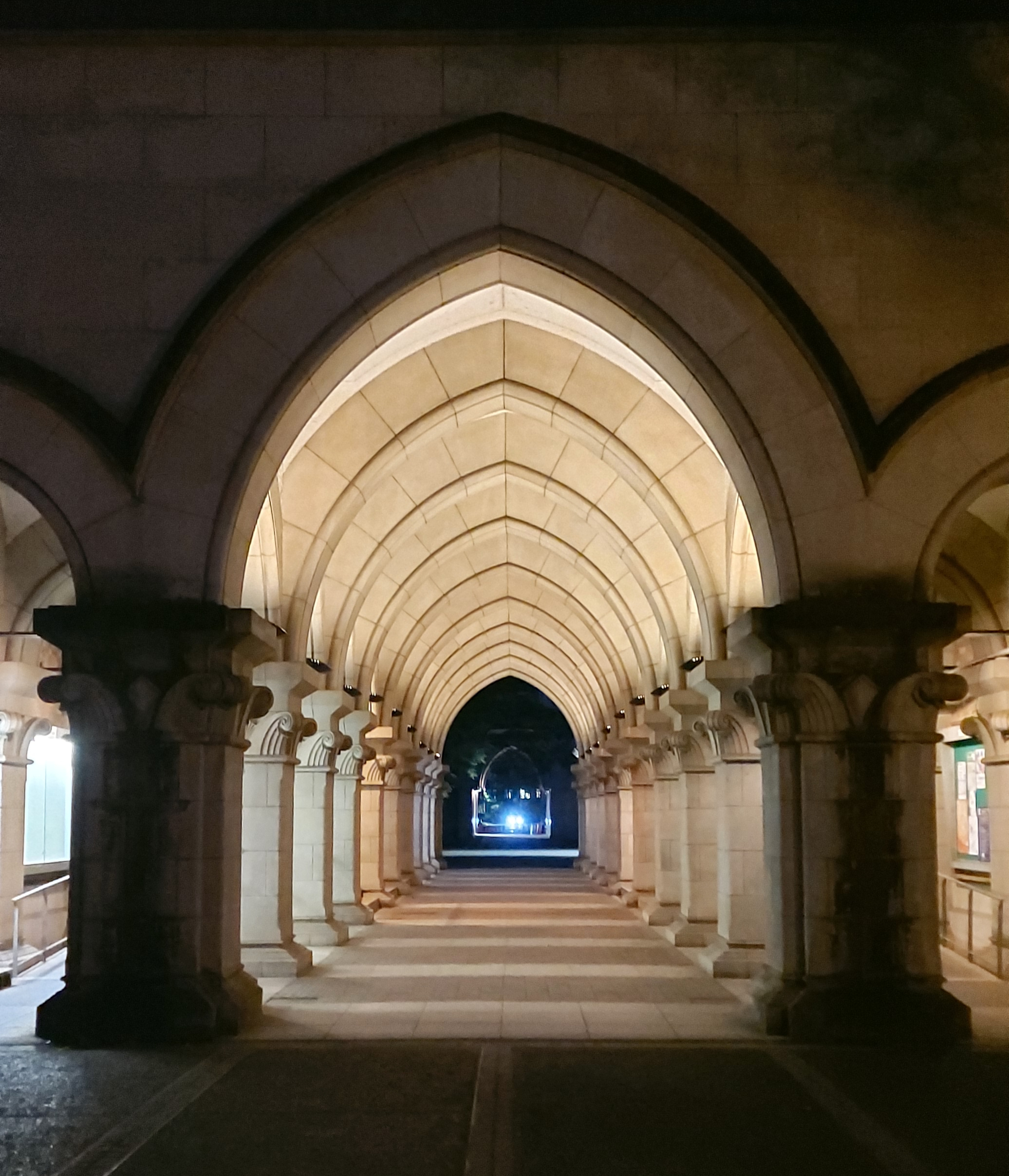
a corridor in OIST
Today, I have reached Osaka, and on Monday will be giving a talk and visiting a few groups at Osaka Unviersity. Prof. Hajime Ishihara is my host, and I look forward to plenty of interaction on optical manipulation.
Fluorescent video imaging of trapping a single fluorescent nano-diamond on a gold nanoparticle
We have a new paper appearing in Optics Letters on optical manipulation of fluorescent nano-diamonds. This experimental work (with some simulations) was performed by our group member Ashutosh Shukla in collaboration with the group of Prof. Kasturi Saha (IIT-Bombay). Our alumni, Sunny Tiwari, gave vital inputs to perform the experiments.
Fluorescent nano-diamonds have emerged as important (quantum) imaging agents in biological applications. It remains a challenge to manipulate them in complex fluidic environments.
Herein, we have come up with an optical trapping method based on opto-thermoelectric effect (see Fluorescence imaging video above). By using opto-thermal potentials created by a single gold nanoparticle (~200nm) on a glass surface, we have been able to trap individual nano-diamonds, and capture their spectral signatures. The Brownian motion in the trap can be tracked, and this leads to the measurement of effective trap stiffness. Furthermore, we extrapolate this thermo-plasmonic trapping method to trap and track individual nano-diamonds on silver nanowires.
As mentioned in the abstract of the manuscript, we envisage that our drop-casting platform can be extrapolated to perform targeted, low-power trapping, manipulation, and multimodal imaging of FNDs inside biological systems such as cells.
Wonderful Japanese-Gothic architecture at The University of Tokyo
I gave two talks in Tokyo.
First was on 24th April at Department of Applied Physics, Faculty of Advanced Engineering, Tokyo University of Science. My host was Prof. Yutaka Sumino. I spoke about “Soft Matter in Opto-Thermal Gradients“. I gave a short introduction to opto-thermal perturbations and potentials, and discussed some of our work on opto-thermophoretic trapping and Brownian dynamics. The audience contained a few master students too, and I really enjoyed discussing some concepts related to Brownian motion in an optothermal trap, and related experiments. Also, I had a very interesting discussion with Sumino and his students on their experiments on Janus particles.
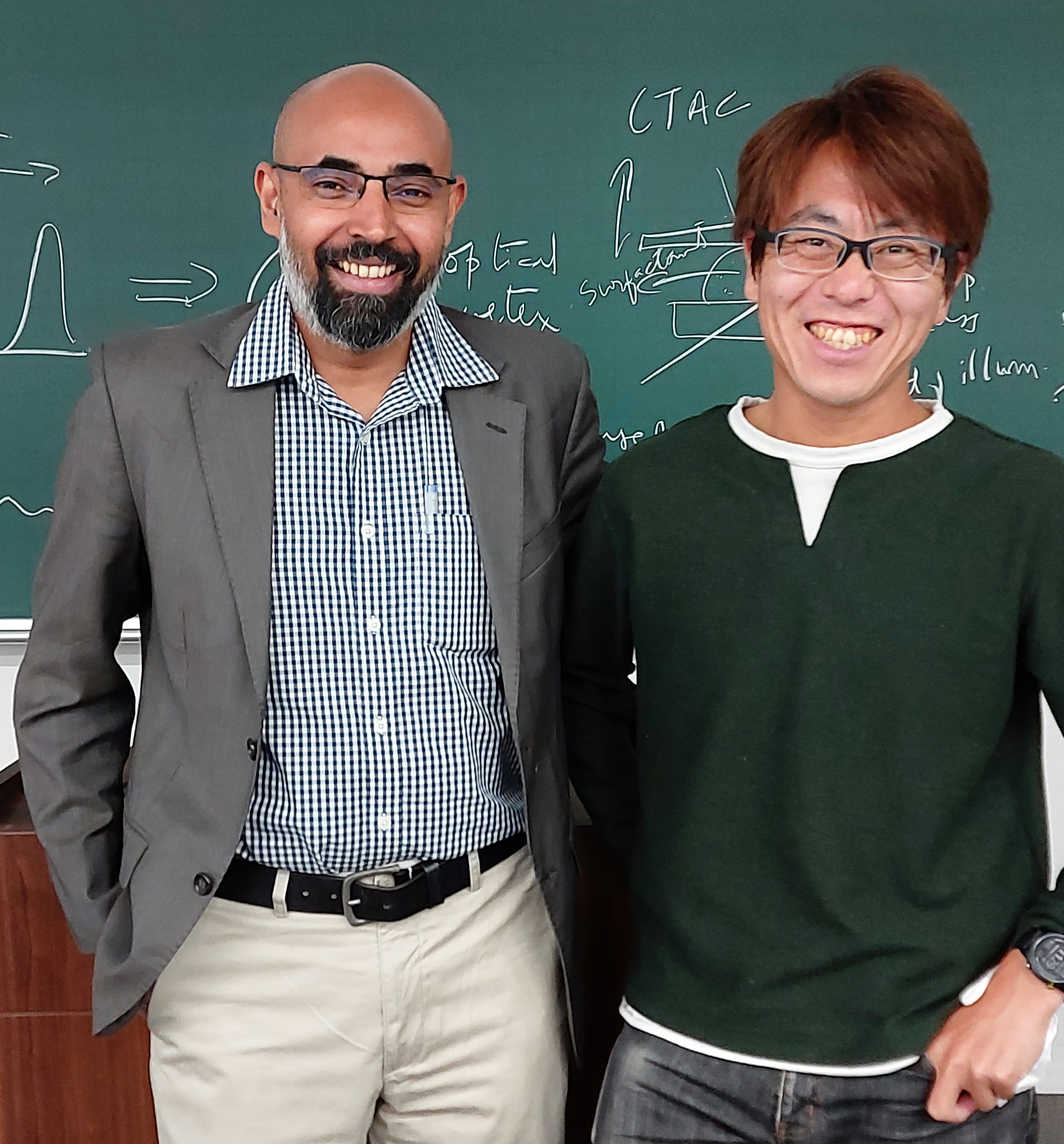
with Yutaka
with Yutaka”s group
The second talk was on 25th April at Department of Physics, University of Tokyo. My host was Prof. Kazumasa Takeuchi. I spoke about “Soft Matter in Opto-Thermal Gradients : Evolutionary Dynamics and Pattern Formation“.
This talk was also announced on Japan’s statphys mailing list, and also live-casted over zoom. I discussed about the origins of optothermal effects in a laser trap, and how it can lead to some interesting dynamics and pattern formation in soft-matter system. Specifically, I highlighted the concept of Hot Brownian motion, and how it can be influenced using thermo-plasmons. The talk and discussion went on for almost 2 hours, and I really loved it. Also, Takeuchi and his students gave an overview of their work including a live demonstration on turbulence in liquid crystals, and it was fantastic.
We had a great discussion after the talk… spoke on how temperature gradients can be harnessed for optical manipulation in colloidal fluids… which further leads to some interesting Brownian dynamics
The 10th Optical Manipulation and Structured Materials Conference (OMC2023) was superb….learnt a lot. This was part of Optics & Photonics International Congress 2023
Thanks to Prof. Takashige Omatsu for the invitation and amazing Japanese hospitality…
Below is a video blog featuring Halina Rubinsztein-Dunlop as part of history of optical manipulation. Also pictured in the blog are : Giorgio Volpe (UC, London) and Agnese Callegari (University of Gothenburg). Pictures taken at OMC 2023 in Yokohama, Japan.
Friese, M.E.J. et al. (1998) ‘Optical alignment and spinning of laser-trapped microscopic particles’, Nature, 394(6691), pp. 348–350. Available at: https://doi.org/10.1038/28566.
He, H. et al. (1995) ‘Direct Observation of Transfer of Angular Momentum to Absorptive Particles from a Laser Beam with a Phase Singularity’, Physical Review Letters, 75(5), pp. 826–829. Available at: https://doi.org/10.1103/PhysRevLett.75.826.
I mainly spoke about emergent Brownian dynamics of laser-heated colloids under optical confinement. Below is the link to the talk.
I concluded my talk quoting P W Anderson’s essay “More is Different“
“The constructionist hypothesis breaks down when confronted with the twin difficulties of scale and complexity. The behavior of large and complex aggregates of elementary particles, it turns out, is not to be understood in terms of a simple extrapolation of the properties of a few particles.
Instead, at each level of complexity entirely new properties appear, and the understanding of the new behaviors requires research which I think is as fundamental in its nature as any other.”
P.W. Anderson ‘More is Different’ Science, 177, 4047 (1972)











 VISMAYA - History & Philosophy of Physics