
Category: optical trap
Light pressure – Lebedev coin
Today, in my optics class, I discussed optical forces due to momentum in electromagnetic waves. Towards the late 1800s, it was realized that light can impart momentum. This manifested as radiation pressure in the electromagnetic theory proposed by James Maxwell.

Pyotr Nikolaevich Lebedev (24 February 1866 – 1 March 1912) was one of the earliest to experimentally measure (~1899) the radiation pressure on a surface (link to his 1900 paper in German). In 1991, the Soviet Union released a 1 ruble coin (pictured above) to commemorate Lebedev’s scientific achievement.
The formula expresses the total momentum transferred per unit time ( radiation pressure, P) by a beam of N photons, each of energy hν, that is incident on a surface with a coefficient of reflectivity ρ. The constant, c, is the speed of light.
The discussion in the class was mainly related to Ashkin’s work. I have written about this in the past.
Shared below is a delightful lecture given by Ashkin at the age of ~96, after he received his Nobel prize.
Art and Chu – in Bell labs
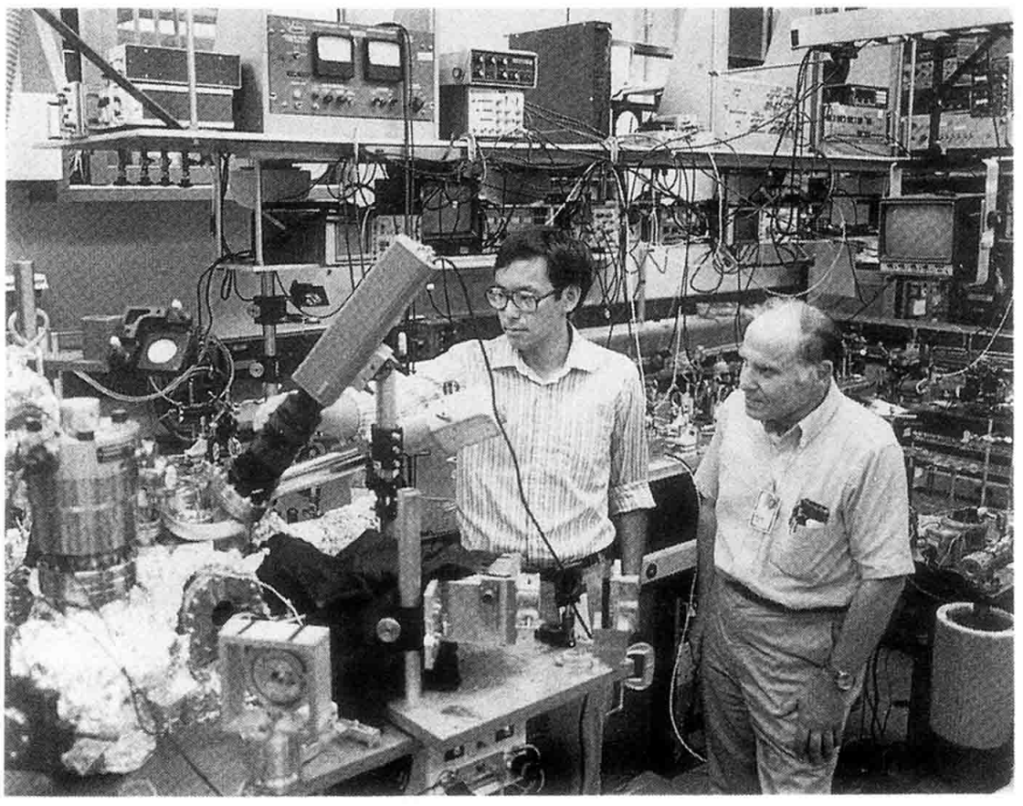
Steven Chu’s Nobel lecture has some gems. Below, he shares his experience of working with Arthur Ashkin.
“In 1986, the world was excited about atom trapping. During this time, Art Ashkin began to use optical tweezers to trap micron sized particles. While experimenting with colloidal tobacco mosaic viruses, he noticed tiny, translucent objects in his sample. Rushing into my lab, he excitedly proclaimed that he had ‘discovered Life’. I went into his lab, half thinking that the excitement of the last few years had finally gotten the better of him. In his lab was a microscope objective focusing an argon laser beam into a petri dish of water. Off to the side was an old Edmund Scientific microscope. Squinting into the microscope, I saw my eye lashes. Squinting harder, I occasionally saw some translucent objects. Many of these objects were ‘floaters’, debris in my vitreous humor that could be moved by blinking my eyes. Art assured me that there were other objects there that would not move when I blinked my eyes. Sure enough, there were objects in the water that could be trapped and would swim away if the light were turned off. Art had discovered bugs in his apparatus, but these were real bugs, bacteria that had eventually grown in his sample beads and water.”
Chu won the physics Nobel in 1997, and Ashkin won the same in 2018. Ashkin was the pioneer of optical trapping and tweezers, and applied it to a variety of problems, including the manipulation of biological matter. Chu harnessed the momentum of light to trap and cool atoms. Both started their work and collaborated at Bell Labs. Chu moved to Stanford, whereas Ashkin stayed back. Bell Labs was a remarkable place in the 1980s, as Chu describes in his lecture :
“Bell Labs was a researcher’s paradise. Our management supplied us with funding, shielded us from bureaucracy, and urged us to do the best science possible. The cramped labs and office cubicles forced us to rub shoulders with each other. Animated discussions frequently interrupted seminars and casual conversations in the cafeteria would sometimes mark the beginning of a new collaboration.”
Can the world afford to have another Bell Labs in 2025? Can it recreate the magic?
Optothermally induced active & chiral motion – a new paper
We have a new paper in Soft Matter
link to the paper (free to access, thanks to IISER Pune library)
We use optical illumination to generate thermal fields, creating non-reciprocal interactions between passive and active colloids. Active colloids absorb light and produce thermal gradients, driving thermo-osmotic forces that induce propulsion and chiral motion. Our Langevin simulations, backed by experimental observation, reveal how to control colloidal behavior. May have implications in light-driven chiral motion and nonlinear dynamics.
Super effort by Rahul, Ashutosh & Sneha from our group, who combined numerical simulations, analytical theory, with experimental observations.
The 2 anonymous reviewers made us think and work hard, and we thank them!
Also, the paper is part of the journal’s themed collection on “Colloidal interactions, dynamics and rheology”
Where Ideas Merge: A Visit to the Institute of Science Tokyo
New ideas are often created by the merging of two old ideas. How often is this true, and how often do we tend to forget this?
Today I visited the Institute of Science Tokyo, formerly known as Tokyo Tech. This is a new avatar of a very interesting institution funded by the government of Japan. By merging the Tokyo Institute of Technology with the Tokyo Medical and Dental University, a very interesting concept has emerged: the Institute of Science Tokyo. These two institutions have been important pillars of the research and educational landscape of Tokyo, and I had the privilege of visiting this new place, which is a result of a new merger.
Thanks to the invitation and fantastic hospitality of Prof. Daiki Nishiguchi, a faculty member in the Physics Department of the Institute of Science Tokyo, I had a memorable experience. I met Daiki a couple of years ago at the University of Tokyo, where he previously held a faculty position. Recently, he has moved to the Institute of Science Tokyo to establish his independent research group as an Associate Professor.
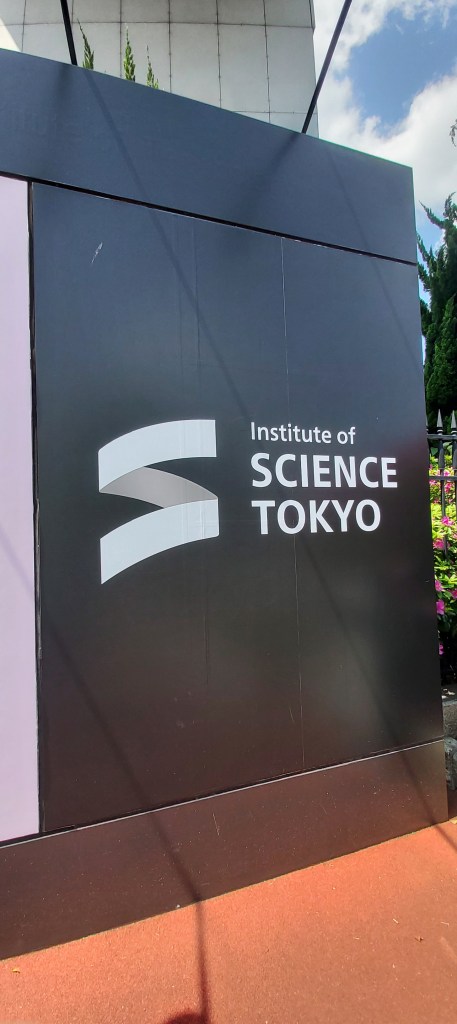

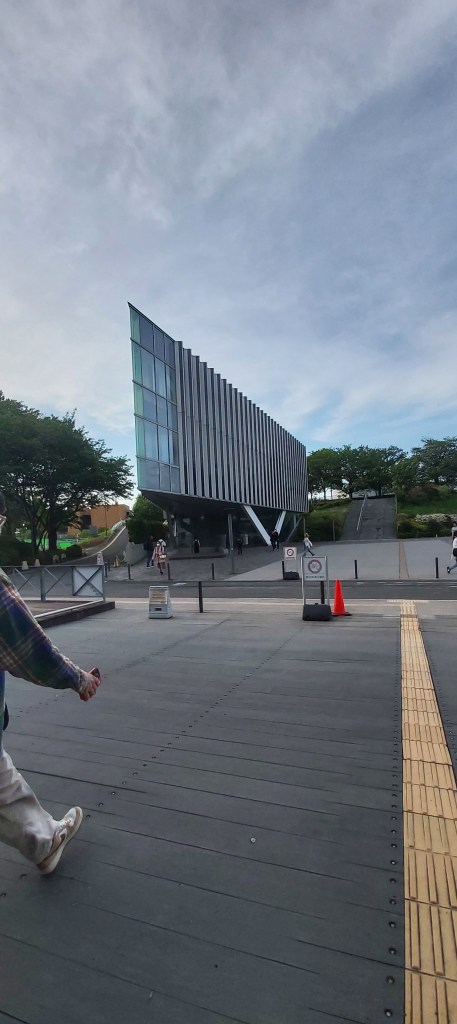
Daiki has done amazing work on topological soft matter, and his recent results include remarkable observations related to turbulence and vorticity in suspensions of bacteria under spatial confinement. He has also been setting up interesting experiments involving Janus particles, and I got a nice overview of his work. Thanks to him and his research group, I got a flavor of the research being carried out in their lab, and I was also treated to a wonderful lunch by Daiki.
I gave a physics seminar on some of our work on structured light and confinement of soft matter, especially thermally active colloidal matter in optothermal potentials. Since Daiki and his group (see image below) have expertise in topological soft matter, my seminar emphasized structured topological beams, including ring optical beams and optical vortices. I gave an overview of our experimental results and highlighted the prospect of utilizing the topology of light to interact with topological soft matter.

There is much to explore at this interface, and again, it brings me back to the point that new ideas often emerge from the merging of evolving old ideas, such as topological light and topological soft matter.
This is my third visit to Japan, and I always find their calm, focused, and deeply committed research environment inspiring. There is much to learn from their approach to science and technology, and my visit to the Institute of Science Tokyo reinforced this thought.
I thank Daiki and his research group for the wonderful time I had at their laboratory and offer my best wishes to him in his new explorations.
Talk at Kyoto University
Whereas Sunday was bright, sunny, and clear for outdoor activities, Monday started cloudy with a forecast of rain. I started from my living place to Kyoto University around 10 in the morning. I took the city bus, which shuttles people from the city centre to the university. Within half an hour, I was in a serene, green, and beautiful campus, typical of a Japanese university. Kyoto University has a rich blend of modern and ancient architecture, and I was not surprised to see a large maroon-coloured ark at the entrance of the university.

With Prof. Tetsuro, who hosted me at the Graduate School of Informatics at Kyoto University.
I met Tesuji Tetsuro upon arrival (our previous in-person meeting was in the 2023 Optics & Photonics Congress on optical manipulation at Yokohama). He had just arrived from his run (he is a regular marathon runner), and we had a brief chat. He had arranged an office for me to occupy for the day. We had a short discussion and thereafter went for lunch. Prof. Kazuo Aoki (Tetsuro’s erstwhile advisor at Kyoto University) accompanied us, and I was delighted to meet him. We had a delicious lunch at a small Italian restaurant.
Around 3 pm, we met at the seminar hall where I gave my talk titled Hot Brownian Dynamics Driven by Structured Light. One of the key points I emphasized in my talk was the relevance of structured light in driving Brownian dynamics of colloids. I spoke about various parts of the stochastic differential equation (see equation 1 below) that represent the dynamics of a colloidal system interacting with an external force.

A key element of my discussion was the generalized driving force on the right-hand side of the equation, where the conventional restoring force in an optical trap can be generalized to an external driving force due to structured light. This versatile force is a result of a large set of linear and angular momentum states of structured light. These states can drive soft matter, further resulting in unconventional assembly and dynamics. Furthermore, the generalized driving force can include not only the optical force but also the thermal and hydrodynamic effects initiated by optical illumination. The combination of these forces culminates in a resultant force, offering an unconventional driving mechanism to drive the structure, assembly, and dynamics of colloids and other kinds of soft matter systems, including droplets and fluids. I showed some of our experimental results related to the above-mentioned concepts with emphasis on rotational and orbital degrees of freedom. I also presented our recent results on synchronization in an optothermal trap.


We had a long discussion on how to measure fluid dynamic properties around such colloids, especially when there is an external perturbation force, such as a laser beam, which can itself influence the colloidal dynamics. Tetsuro also mentioned his protocols and certain simulation strategies utilized to study thermo-osmotic flows in such situations. I learned about interesting methods they have been developing to numerically simulate the interactions using differential temperatures. The strategy is interesting and deserves further attention by the community. He also showed his experimental setup and gave a tour of his laboratory facilities.
Overall, it was a long, thoughtful day with wonderful discussions on topics of common scientific interest. We ended with a delicious dinner at a Japanese izakaya, and I thank Tetsuro for his invitation and hospitality. Kyoto University has a wonderful atmosphere for research, and I hope to visit again.
Gold nanoparticles in sync – preprint
We have a new preprint: https://arxiv.org/abs/2411.15512


APL perspective article

The perspective article is online: https://doi.org/10.1063/5.0235507
arxiv preprint: https://arxiv.org/abs/2408.15791
Optothermal revolution – preprint
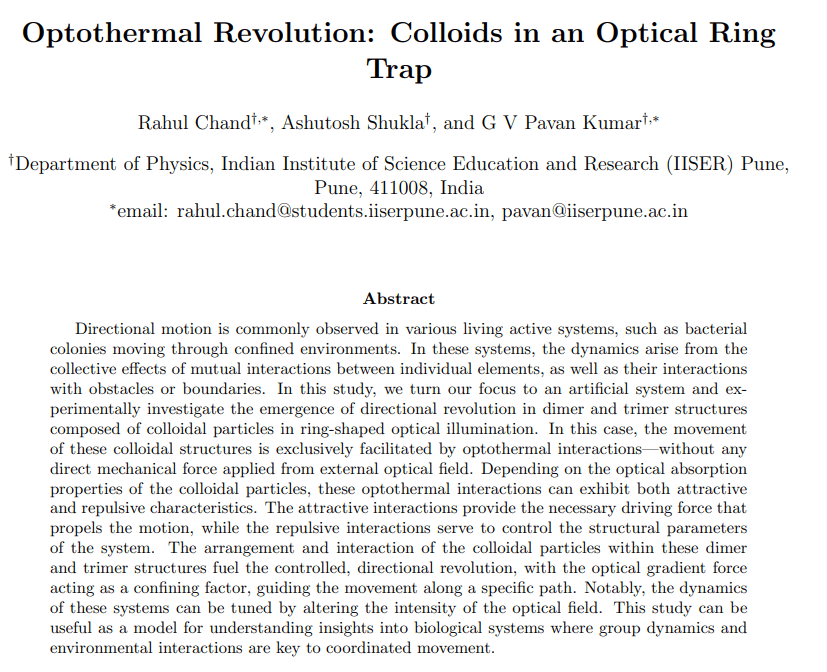

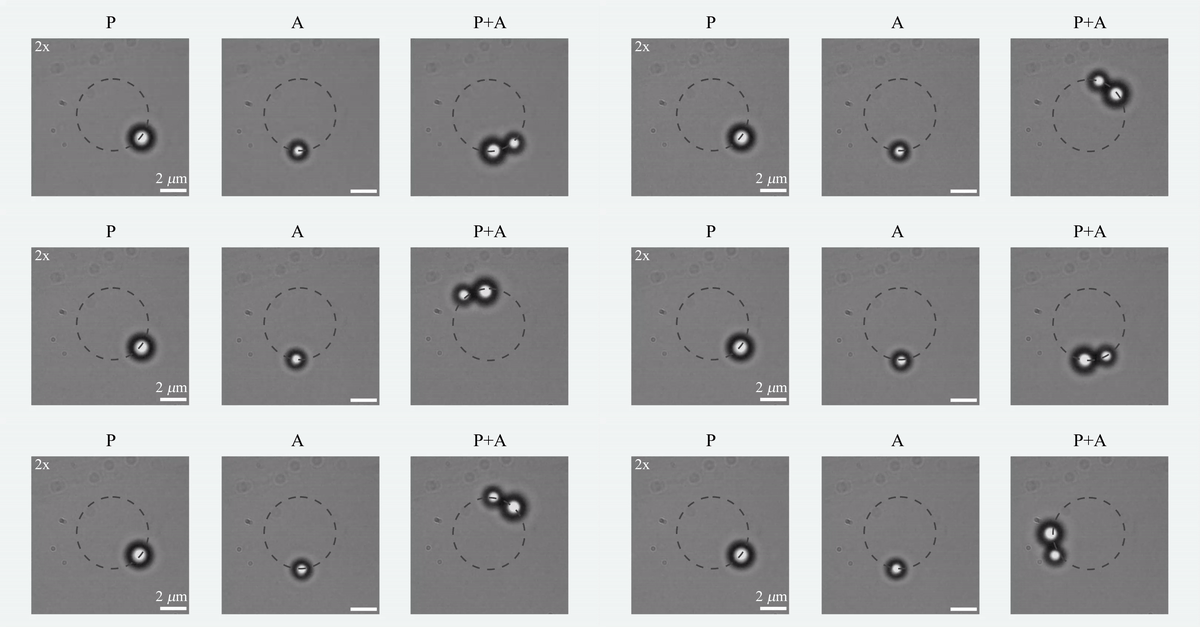
We have an Arxiv preprint on how a mixture of colloids (thermally active + passive particles in water) can lead to the emergence of revolution dynamics in an optical ring trap (dotted line). Super effort by our lab members Rahul Chand and Ashutosh Shukla.
Interestingly, the revolution emerges only when an active and a passive colloid are combined (not as individuals) in a ring potential (dotted line)
the direction (clock or anti-clockwise) of the revolution depends on the relative placement of the colloids in the trap
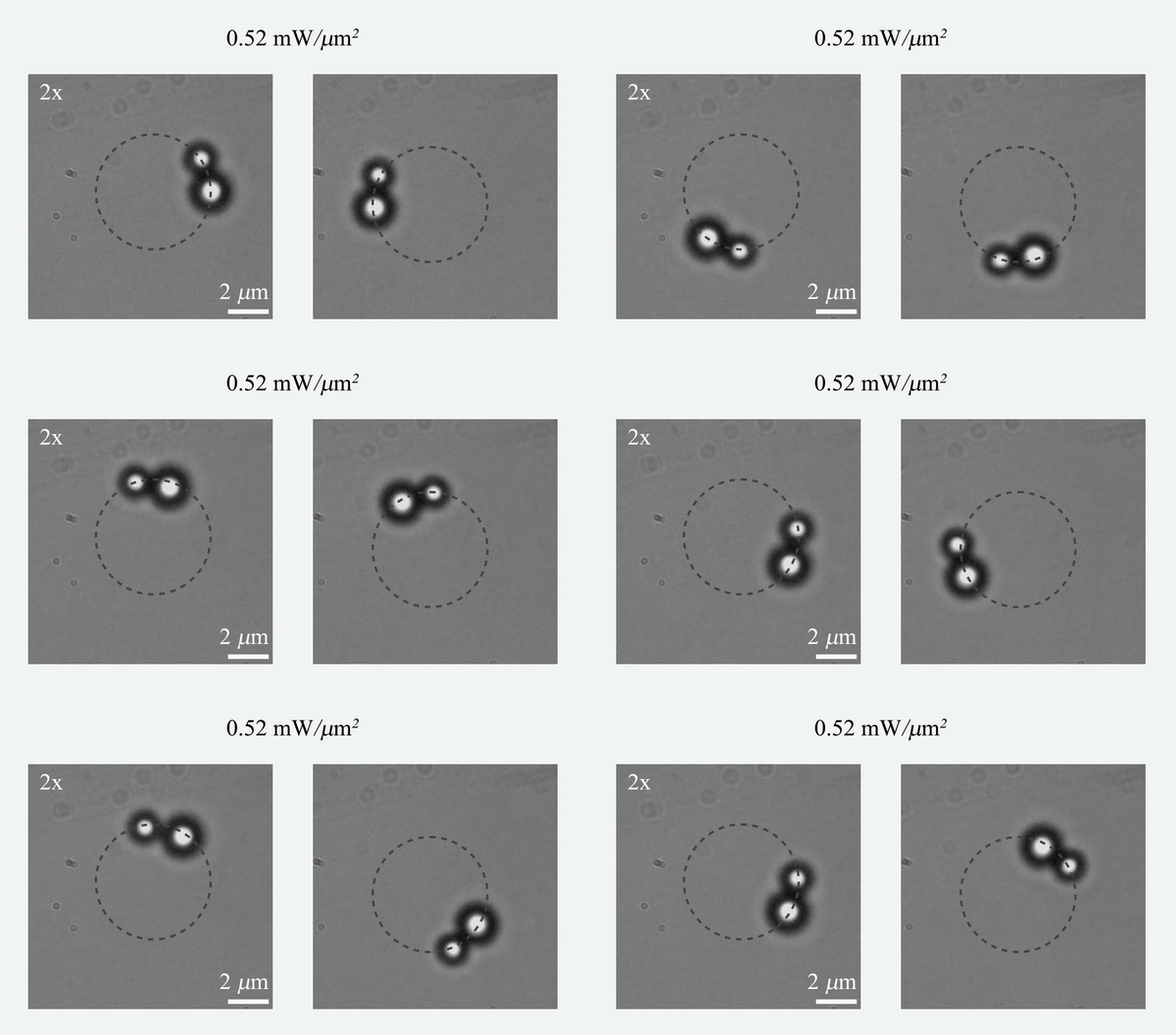
This revolution can be further used to propel a third active colloid

There are many more details in the paper. Check it out: https://arxiv.org/abs/2409.16792

 VISMAYA - History & Philosophy of Physics