Light pressure – Lebedev coin

Today, in my optics class, I discussed optical forces due to momentum in electromagnetic waves. Towards the late 1800s, it was realized that light can impart momentum. This manifested as radiation pressure in the electromagnetic theory proposed by James Maxwell.

Pyotr Nikolaevich Lebedev (24 February 1866 – 1 March 1912) was one of the earliest to experimentally measure (~1899) the radiation pressure on a surface (link to his 1900 paper in German). In 1991, the Soviet Union released a 1 ruble coin (pictured above) to commemorate Lebedev’s scientific achievement.

The formula expresses the total momentum transferred per unit time ( radiation pressure, P) by a beam of N photons, each of energy hν, that is incident on a surface with a coefficient of reflectivity ρ. The constant, c, is the speed of light.

The discussion in the class was mainly related to Ashkin’s work. I have written about this in the past.

Shared below is a delightful lecture given by Ashkin at the age of ~96, after he received his Nobel prize.

Gerhard Herzberg – scientific life


References:

Pavan Kumar, G. V. “Gerhard Herzberg (1904–1999): A Pioneer in Molecular Spectroscopy.” Resonance 29 (2024): 1339. https://www.ias.ac.in/describe/article/reso/029/10/1339-1345.

Stoicheff, Boris. Gerhard Herzberg: An Illustrious Life in Science. Ottawa : Montréal ; Ithaca N.Y.: Canadian Forest Service,Canada, 2002.

Stoicheff, Boris P. “Gerhard Herzberg PC CC. 25 December 1904 – 3 March 1999.” Biographical Memoirs of Fellows of the Royal Society 49 (December 2003): 179–95. https://doi.org/10.1098/rsbm.2003.0011.

Graviton modes in solids: Old Argentinian wine in new Bottle ?

Recently, there has been a buzz about a Nature paper titled Evidence for chiral graviton modes in fractional quantum Hall liquids. There has been some media reportage on the paper too.

The paper makes interesting claim on observation of ‘chiral graviton modes’ in certain ultra-cooled semiconductors (Gallium Arsenide – famously called GaAs). The cooled temperature is quite low (~50 mK), which is impressive, and the chirality of the mode is unveiled using polarization-resolved Raman scattering. The observation of this so-called ‘Graviton modes’ is essentially a quasiparticle excitation, and has created some buzz. In my opinion, graviton-like behavior is a bit of an exaggeration.

Anyway, this paper has set an interesting discussion among my colleagues (condensed matter and high energy physics) in our department. To add to their discussion, I wrote on 2 points (and an inference) from optics perspective, which I am sharing below :

  1. The measurement scheme used to unveil the chirality of the quasi-particles is a well-known trick in polarization optics. In fact, I teach it to our undergrads. Notice the use of quarter-wave plates (indicated by the arrow in the figure below). This is also the measurement at the heart of unveiling optical anisotropy. Experimentally, what is impressive is the ultra-low energy excitation captured via Raman scattering. This is again thanks to the excellent cooling of the sample (50 mK).
Figure from the Nature paper.

2. The last author of this paper, Aron Pinczuk, was a well-known expert in light scattering in solids. He was an Argentinian-American professor at Columbia University, and passed away in 2022.

Aron Pinczuk

He and the legendary Manuel Cardona were instrumental (pun intended) in laying the foundation for using inelastic light scattering methods in solids. The first edition of the series “Light Scattering in Solids”, written in 1976, has Pincuk discussing the very measurement scheme used in the paper (see picture).  

The first edition (1976) of a great series : Light Scattering in Solids

My initial inference on the paper : This is an old Argentinan wine of quasiparticles in a new GaAs bottle at ultra-low temperature….and NATURE is selling it as champagne de graviton made in China ! 

Speckles from boiling water

Osaka and Optical Manipulation

Thanks to the invitation of Prof. Hajime Ishihara, I visited Osaka from 29th April to 2nd May 2023.

I arrived in Osaka on Saturday (29th Apr). On 30th Apr (Sunday) I headed out to visit the famous Kiyomizudera Temple in Kyoto with 2 PhD students from Ishihara’s group : Hideki Arahari and Takao Horai

Kiyomizudera Temple towards the right and beautiful landscape surrounding it.

Apart from the temple, we had a wonderful time exploring the Nishiki Market and Kamo river.

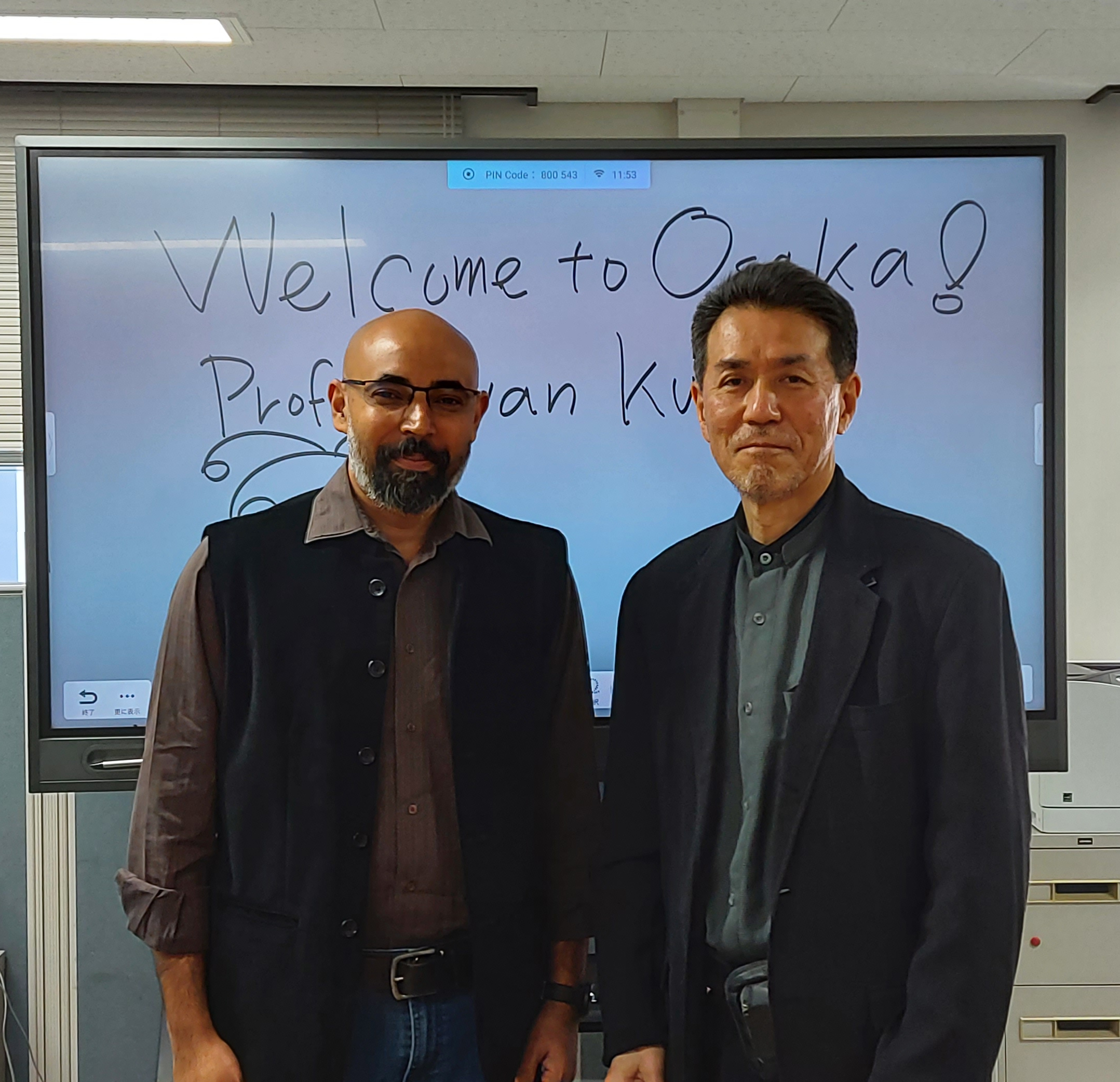
On 1st May, I visited Osaka University to officially meet Prof Ishihara, his group and other research groups in the university. We had a wonderful discussion on optical manipulation and major projects related to it especially in Japan, and undoubtedly Osaka has emerged as a major center in optical manipulation.

with Prof. Ishihara

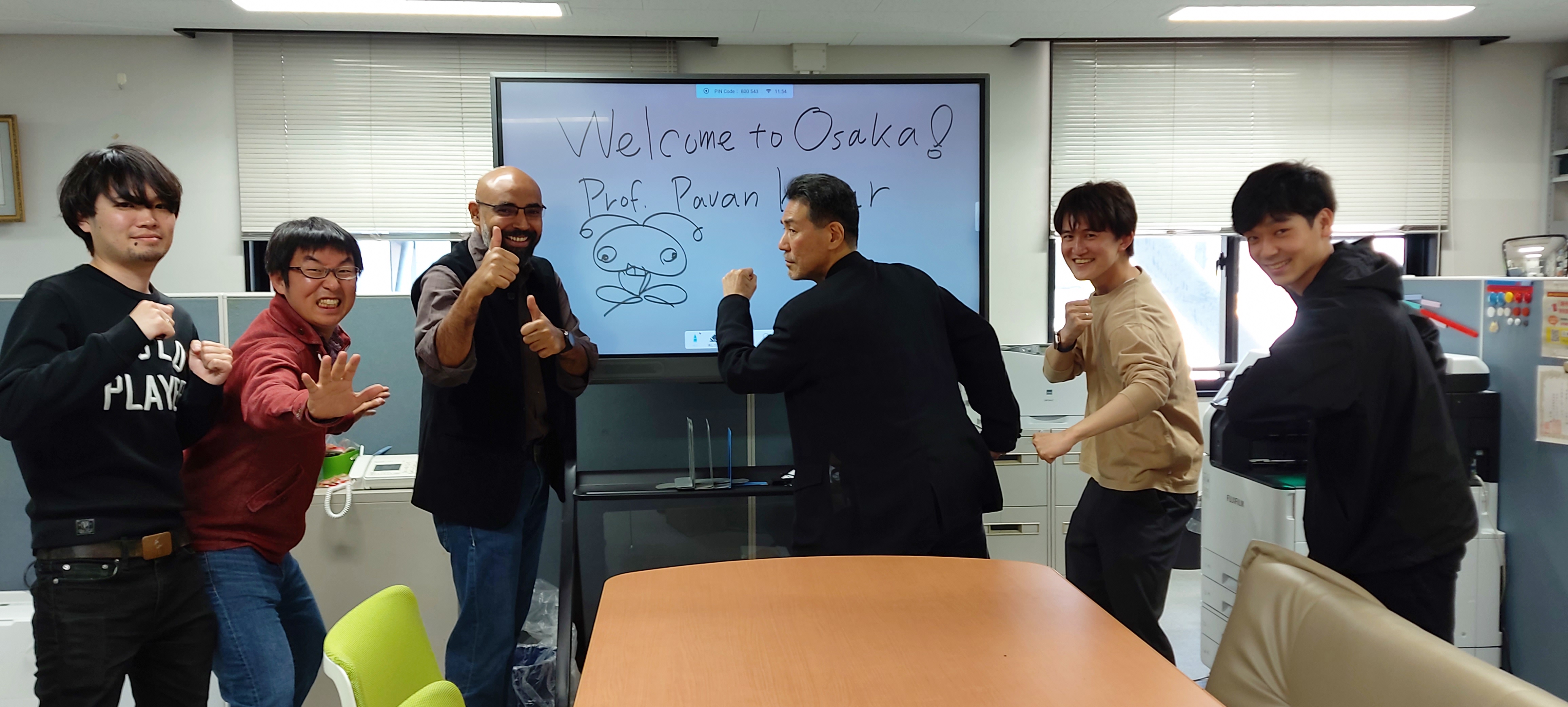
I was delighted to see so many students and research groups interested in optical trapping/manipulation and related science and technology. I learnt about some very interesting applications of optical manipulation. Also, it was great to see such a great sense of humor in this group of researchers. It was truly amazing.

Science + Humor …..we had a great time..

I also visited labs of Prof. Ashida and Prof Ito, and got a very nice overview of their work including optical manipulation in liquid helium and photochemical reactions in an optical trap.

At 4pm, I gave my talk on “Optical Manipulation based on Opto-Thermal Gradients“. I elaborated on the role of absorption and related thermal gradient in optical manipulation. I presented some of our ongoing work on optical manipulation with structured light. The talk was attended by at least 30 to 40 people, and I was informed that students from various groups in Osaka were present (there are a few universities). The quality of questions and the follow up discussion was very good, and really enjoyed it.

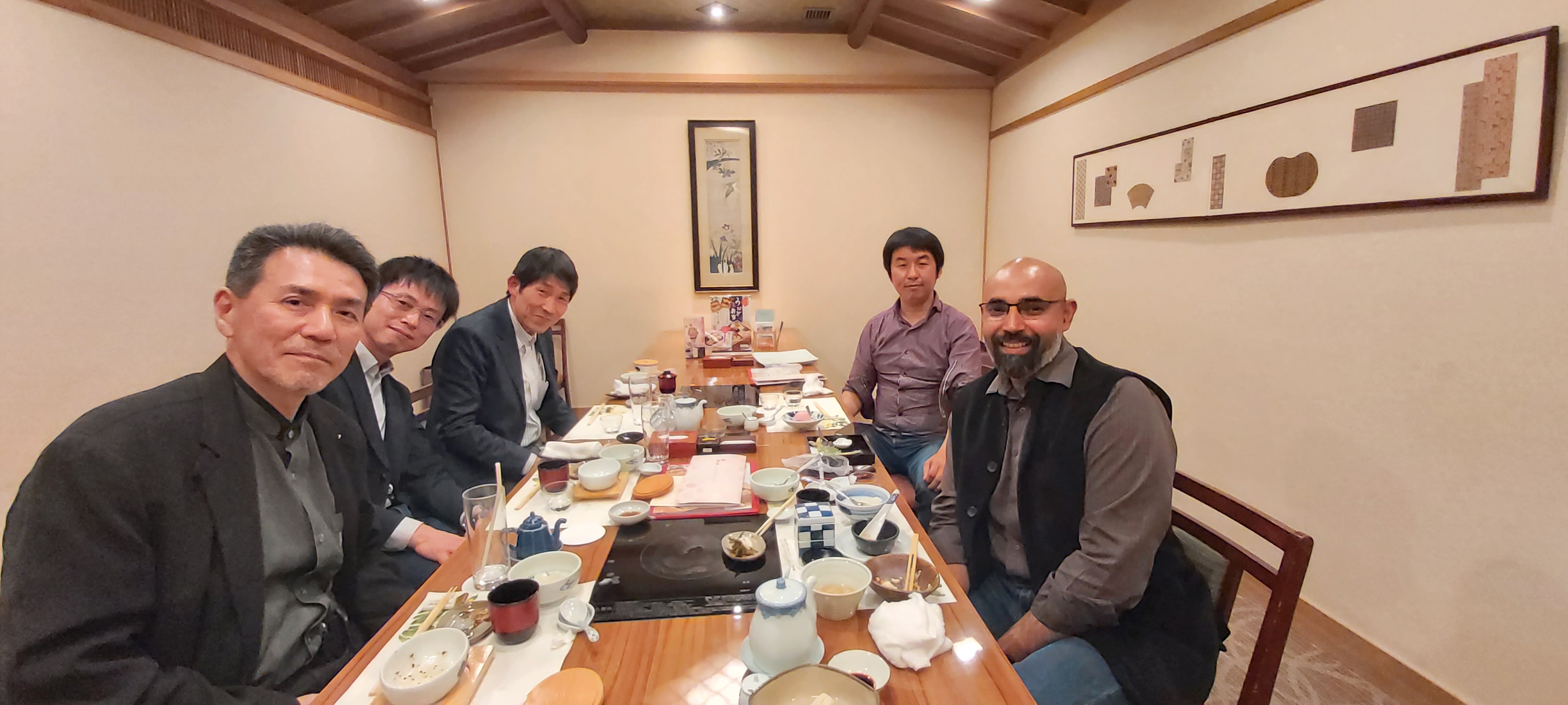
Finally, the day ended with a wonderful dinner at a tofu-themed Japanese restaurant. We had wonderful discussion on history and philosophy in our countries, and was very interesting.

Dinner with Professors Ishihara, Ito, Ashida and Yokoyama

My trajectory in Japan has been Yokohama –> Tokyo –> Okinawa –> Osaka. After 16 days, one conference talk and 4 research seminar across Japan, I am now heading back from Osaka to Tokyo (and writing this blog) on Shinkansen – the bullet train. Tomorrow, I will be leaving to India.

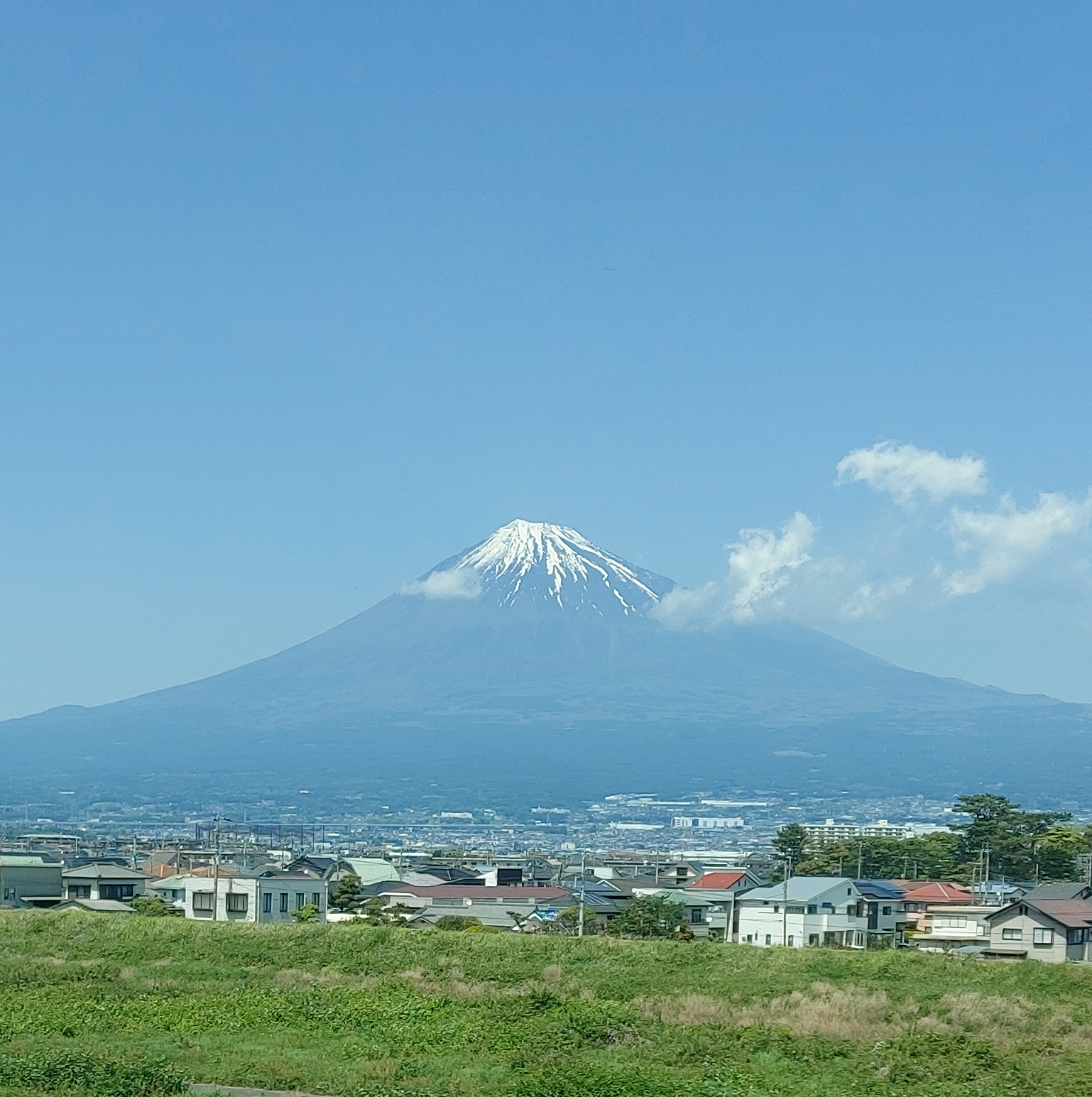
In Japanese, the word ‘Osaka’ also means ‘a large hill’. Japan’s geography has many large hills (see a picture of Mt. Fuji I took from the moving Shinkansen), and metaphorically speaking Japanese like to scale complex landscapes of life by bringing culture with science and technology. There is a lot to learn from this approach to life.

the majestic Mt. Fuji

Osaka, optical manipulation and the perennial ascent towards knowledge. What a memorable trip this has been.

To Japan and to all the people I met here – Doumo Arigatou Gozaimasu !

Halina Rubinsztein-Dunlop – History of Optical Manipulation

Below is a video blog featuring Halina Rubinsztein-Dunlop as part of history of optical manipulation. Also pictured in the blog are : Giorgio Volpe (UC, London) and Agnese Callegari (University of Gothenburg). Pictures taken at OMC 2023 in Yokohama, Japan.

Some relevant links at the end :

Notes :

Professor Halina Rubinsztein-Dunlop (2023). Available at: https://smp.uq.edu.au/profile/204/halina-rubinsztein-dunlop (Accessed: 19 April 2023).

Halina Rubinsztein-Dunlop‬ – ‪Google Scholar‬ Available at: https://scholar.google.se/citations?user=4_sqVfYAAAAJ&hl=en (Accessed: 19 April 2023).

‘Halina Rubinsztein-Dunlop’ (2023) Wikipedia. Available at: https://en.wikipedia.org/w/index.php?title=Halina_Rubinsztein-Dunlop&oldid=1145639271 (Accessed: 19 April 2023).

seminal papers :

Friese, M.E.J. et al. (1998) ‘Optical alignment and spinning of laser-trapped microscopic particles’, Nature, 394(6691), pp. 348–350. Available at: https://doi.org/10.1038/28566.

He, H. et al. (1995) ‘Direct Observation of Transfer of Angular Momentum to Absorptive Particles from a Laser Beam with a Phase Singularity’, Physical Review Letters, 75(5), pp. 826–829. Available at: https://doi.org/10.1103/PhysRevLett.75.826.

Preamble to the discovery of Raman Effect

Today is India’s National Science Day. It celebrates the discovery of Raman effect on 28th February, 1928.

For more details on the discovery of the effect, and various human aspects related to it : you can see my past blogs here, here, here and here.

In this blog, I will briefly discuss about some of the work that directly influenced Raman’s thinking that further led to a remarkable discovery that we know by his name.

All creative pursuits are motivated by ideas from the past. No one gets their ideas in vacuum. All of us are influenced by the information which we perceive and receive. This means consciously or subconsciously the world that we are creating, both in our minds and in reality, is fundamentally influenced by the information in the world.

The discovery behind the Raman effect is no exception to this particular principle. In his formative years, C V Raman was heavily influenced by the research of Rayleigh and Helmholtz, and some classical thinkers including Euclid. Raman was also closely following the development of quantum mechanics in the early 1920s, and he was keenly studying the theoretical and experimental developments in this field.

Two aspects which played a crucial role in motivating Raman’s (Nobel prize winning) work was Compton scattering and Kramers-Heisenberg formula.

Compton scattering was as outstanding experimental achievement that revealed two aspects of light-matter interaction. First, it demonstrated inelastic scattering of electromagnetic radiation interacting with a quantum object (in this case free electrons) in the laboratory frame. Second is that it laid a foundation to revisit the wave-particle duality of light from an experimental viewpoint. Raman and Krishnan’s main paper on light scattering starts by explicitly referring to Compton effect, and motivates observation for optical analogue of Compton scattering.

To quote from Raman’s Nobel lecture :

“In interpreting the observed phenomena, the analogy with the Compton effect was adopted as the guiding principle. The work of Compton had gained general acceptance for the idea that the scattering of radiation is a unitary process in which the conservation principles hold good.”

Next is the Kramers-Heisenberg formula. This mathematical description gives the scattering cross section of a photon interacting with a quantum object (in this case electron). This formula uses second-order perturbation theory, and evokes the famous ‘sum of all the intermediate states’ for non-resonant optical interaction. PAM Dirac played a vital role in deriving this formula from a quantum mechanical framework of radiation. An important and logical consequence of this formula is the emergence of stimulated emission of radiation, and this has had deep implications in understanding LASERs. Raman was keenly studying the formula and made a brilliant conceptual connection between laboratory observation and this formula that revealed the scattering cross-section.

Again to quote from Raman’s Nobel lecture:

“The work of Kramers and Heisenberg, and the newer developments in quantum mechanics which have their root in Bohr’s correspondence principle seem to offer a promising way of approach towards an understanding of the experimental results.”

The above two concepts were important ideas that motivated Raman scattering experiments. Importantly it highlights the jugalbandi between theoretical intuition with concrete experimental observations, which forms the bedrock of modern physics.

Newton famously mentioned about the discoveries he made by ‘standing on the shoulders of the giants’. Various people involved in creative pursuits including scientists acknowledge the fact that new ideas emerge from convergence/mutation of old ideas. The harder part of creativity in science, or for that matter any art form, is to choose the right ideas to combine so that the ’emergent’ new idea has greater value compared to the individual parts. In that sense, science is a great form of creative activity that not only combines old ideas to create new valuable ideas, but also transforms the perspective of the individual seed ideas. Thus ideas combine and evolve.

So let us combine good ideas and evolve. Happy Science Day !

Soft Matter Optics – talk at ACS -India

About 2 years ago (22nd May 2020), when all the academic activities were online, I gave a talk on “Soft-Matter Optics: A Cabinet of Curiosities” organized by American Chemical Society as part of India Science Talks. Below is the embedded video of the online talk.

Link to ACS website can be found here.

In there, I give a broad overview of how interesting optical function can emerge from the complex world of soft matter. In addition to this, I have emphasized how optics can be harnessed to study structure and dynamics of soft-matter systems including colloids, liquid crystal and some biological matter. The target audience are new PhD students and anyone who is entering the field of light-soft matter interaction.

Hot Brownian Colloids – talk

On 19th Jan 2023, I gave a ~40 min talk on “Hot Brownian Colloids in Structured Optical Tweezers” in a very interesting conference on Frontiers in Non-Equilibrium Physics (FNEP) held at Institute of Mathematical Sciences, Chennai.

I mainly spoke about emergent Brownian dynamics of laser-heated colloids under optical confinement. Below is the link to the talk.

I concluded my talk quoting P W Anderson’s essay “More is Different

“The constructionist hypothesis breaks down when confronted with the twin difficulties of scale and complexity.  The behavior of large and complex aggregates of elementary particles, it turns out, is not to be understood in terms of a simple extrapolation of the properties of a few particles.

Instead, at each level of complexity entirely new properties appear, and the understanding of the new behaviors requires research which I think is as fundamental in its nature as any other.”

P.W. Anderson  ‘More is Different’
Science, 177, 4047 (1972)

More is not only different, but also wonderful !