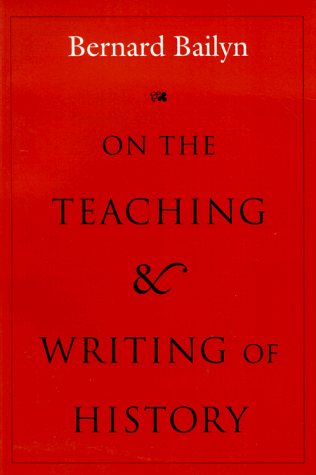
Recently, I came across a short but interesting book:
Bailyn, Bernard. On the Teaching and Writing of History: Responses to a Series of Questions. UPNE, 1994.
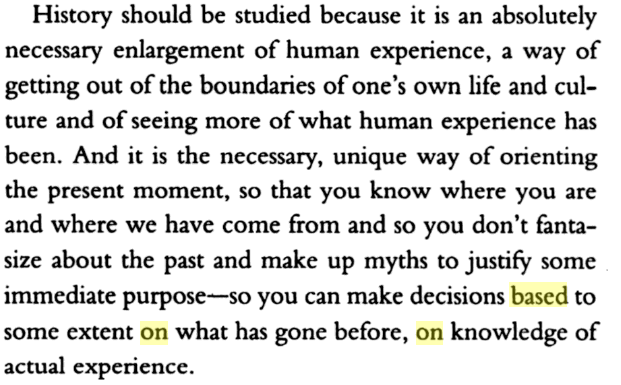
On page 12, there is an interesting discussion on why one should study history, both at the level of an individual and the collective. Below, I reproduce a paragraph related to this.
One of the interesting aspects of the Nobel Prize in Sciences this time is that all the 8 laureates are experimentalists. This is not to underplay the contribution of theoreticians but to emphasize the point that experimental observations are central to the progress of sciences and follow-up technology. Also note that many of these laureates were equally well-versed in theoretical ideas, and hence were able to connect the abstract to the real. An effective way to do science.
Another aspect is that all the experimentalists are strongly anchored in the West. They have performed all their work in an ecosystem that has supported their efforts, even when their ideas were not well known. A case in point is Katalin Karikó (one of the medicine/physiology laureates). Although U Penn treated her badly, she was still able to sustain her research thanks to the research-driven business ecosystem in the West, including the USA and Germany, where she could establish herself in the biotech research industry. This means the Western research ecosystem, including its businesses, was open enough to allow someone who was almost discarded by the US academic system. Karikó’s is a great story, but we must not forget that eventually, the system in which she worked recognized her contribution.
Now, some things to ponder – what if Karikó had moved to a place such as India? Could she have survived and thrived in our research ecosystem? If she had moved, was our academic and market ecosystem open to welcome her, take her expertise, and utilize it effectively? Answers to these questions are not straightforward but may indicate where we are as a research ecosystem.
One should not be surprised nowadays if a Nobel prize in physics goes to something related to light. As a person working in optics and light-matter interaction, I welcome any recognition of one of the most profound aspects of nature: light. This time, the prize has gone to some great experimental effort dating back to the late 1980s to early 2000s when amazing progress was made in three aspects related to the prize: a) higher harmonic generation of light in rare gases, b) production of a train of attosecond light pulses, and c) eventually production of single attosecond light pulses that can interact with matter, especially electrons in matter. Such an interaction can lead to the mapping of dynamics of quantum entities such as electrons and will have far-reaching consequences in probing the internal degrees of molecules and atoms. The scientific information published by the Nobel Committee has wonderful illustrations and is worth reading.
This time, the Nobel Prize website has published a fantastic set of illustrations to convey the relevance of the research. The above one shows the spectrum of temporal scales. It elegantly illustrates the breadth of the scale – attosecond to heartbeat:: Heartbeat to the age of the universe.. Oh, how beautiful science is!
Via Twitter, thanks to a student who was attending a lecture by Anne (one of the Nobel laureates), we got to see continuing her lecture even after a Nobel announcement. Now that is the spirit of academics!
This is the fundamental paper that triggered higher harmonic generation in gases and laid the foundation for attosecond pulse generation. of today, the impact factor of this journal is 1.6. The impact is not proportional to the impact factor of a journal
Gandhi lived a life in pursuit of non-violence and truth (the meaning of the above two words in Devanagari script).
The beauty of Gandhi’s life is his astonishing honesty. You can still disagree with him on certain aspects of his politics, including economics, and yet engage with his ideas and learn something deep. If you observe his writings, he was always engaging in disagreement and yet never dismissive of an opposing idea. He subjected himself to scrutiny of his character and yet emerged with a deeper meaning of flaws and self-introspection. Talk about confidence!
This is perhaps the hallmark of his education. A lesson he took not only as a teacher but also as a student of life.
Probably Gandhi’s most innovative idea was to recognize the deep philosophical and human aspects of life and incorporate them into his work. He practiced what he preached, which is a rarity. Einstein realized this very early (see the quote).
The two ideas mentioned at the beginning have stood the test of time, and I think they will continue to serve as benchmarks of human intellectual life. That is the lesson I take away from his life.
Campanario, Juan Miguel. “Rejecting and Resisting Nobel Class Discoveries: Accounts by Nobel Laureates.” Scientometrics 81, no. 2 (November 1, 2009): 549–65. https://doi.org/10.1007/s11192-008-2141-5.
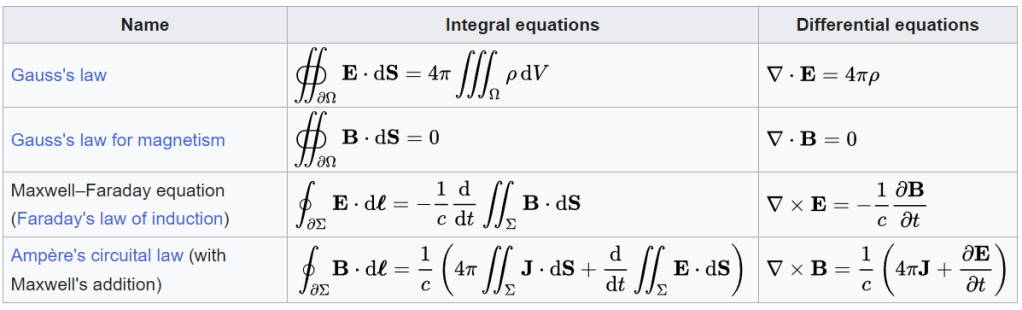
Maxwell’s equation as per Heaviside formulation. Image courtesy Wikipedia.
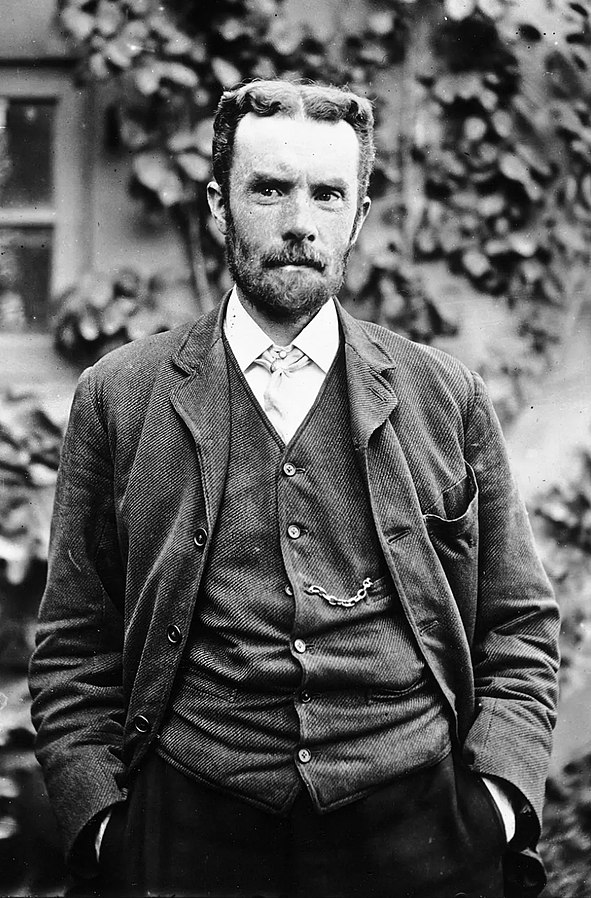
I have been teaching Optics course this semester, and in order to introduce wave theory of light, I had to use Maxwell’s equation. In there, I mentioned that the expression for Maxwell’s equation that we use now is mainly thanks to the formulation of Oliver Heaviside.
Born in 1850, Heaviside grew up in poverty and had physical illness in his childhood.
Oliver Heaviside had an unusual life. He did not have a formal education in science or engineering, but contributed immensely to what is now called as classical electromagnetism.
He was nephew of Wheatstone (of the fame of Wheatstone network), who helped him to find a job in a telegraph company, which was in 1870s, a booming industry.
Heaviside showed a lot of promise in his work, and learnt a lot on the go.
Around 1872, at the age of 22, he published his first research paper in Philosophical Magazine, which caught the attention of people such as Lord Kelvin and James Maxwell.
At the age of 24, Heaviside quit his job (because of various reasons including ill health), and went back to live with his parents.
Around 1873, Maxwell’s treatise on Electricity and Magnetism was published, and this mesmerized Heaviside.
He studied it with dedication, but could not understand it. Therefore, he decided to re-write Maxwell’s treatise.
Maxwell had used quaternion, which was a number system devised by Hamilton.
This formulation was cumbersome, and was not easy to understand especially in the context of electricity and magnetism.
Heaviside took this formulation, and re-casted it in terms of vector calculus.
Interestingly, Gibbs had also done the same (earlier than Heaviside), but had not published his results.
Nevertheless, both Heaviside and Gibbs pushed this formulation further, and eventually the research community saw its utility.
There are many contributions of Heaviside towards electromagnetism, and inductive loading was one of them. Initially, this loading method of introducing repeated coils along the cable was met with a lot of opposition. But eventually, the advantage was realized and Oliver (and his brother, who initiated the work) were vindicated.
Heaviside was a prolific researcher, and published 3 volumes on electromagnetic theory, in addition to various research papers.
He also wrote a column spanning over 20 years in a magazine named TheElectrician.
After 1914 or so, Heaviside’s could not work due to ill health and paranoia, which disturbed his mind.
In 1925, Oliver Heaviside passed away.
There are some excellent books and biographical notes on Heaviside. Below are a few :
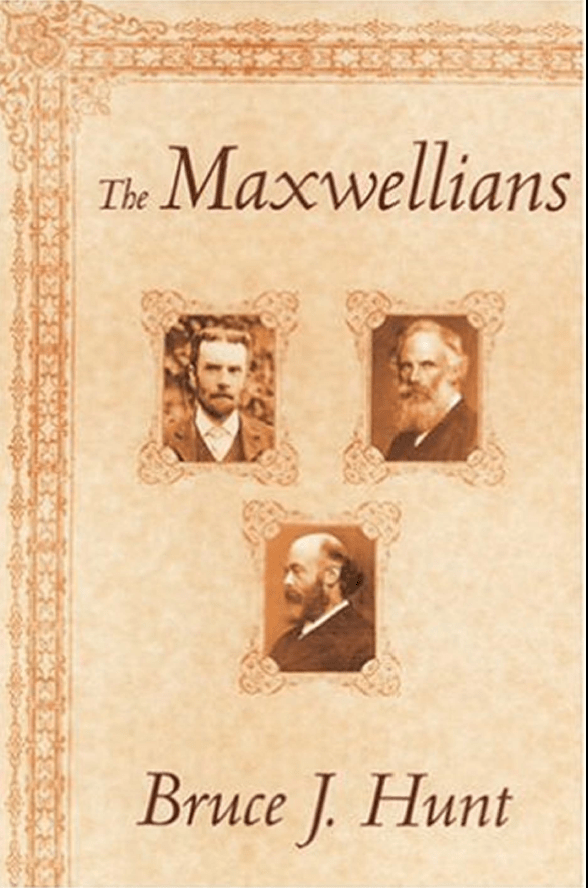
Hunt, Bruce J. The Maxwellians. Cornell University Press, 1994.
Hunt, Bruce J. “Oliver Heaviside: A First-Rate Oddity.” Physics Today 65, no. 11 (November 1, 2012): 48–54. https://doi.org/10.1063/PT.3.1788.
Nahin, Paul J. Oliver Heaviside: The Life, Work, and Times of an Electrical Genius of the Victorian Age. Second Edition. Baltimore, Md: Johns Hopkins University Press, 2002.
Among the books and discussion on this topic, I found this book by science historian Bruce Hunt to be very interesting. He identifies 3 plus 1 people who extensively developed Maxwell’s electromagnetic theory and presented in a way that the world could understand its significance. They were G. F. FitzGerald, Oliver Heaviside, Oliver Lodge and to a certain extent – Heinrich Hertz.
The foreword of this excellent book was written by a well known historian of science L. Peerce Williams and he sums the situation in which the theory was developed :
“Like Newton’s Principia, Maxwell’s Treatise did not immediately convince the scientific community. The concepts in it were strange and the mathematics was clumsy and involved. Most of the experimental basis was drawn from the researches of Michael Faraday, whose results were undeniable, but whose ideas seemed bizarre to the orthodox physicist. The British had, more or less, become accustomed to Faraday’s “vision,” but continental physicists, while accepting the new facts that poured from his laboratory, rejected his conceptual structures. One of Maxwell’s purposes in writing his treatise was to put Faraday’s ideas into the language of mathematical physics precisely so that orthodox physicists would be persuaded of their importance. Maxwell died in 1879, midway through preparing a second edition of the Treatise. At that time, he had convinced only a very few of his fellow countrymen and none of his continental colleagues. That task now fell to his disciples.
The story that Bruce Hunt tells in this volume is the story of the ways in which Maxwell’s ideas were picked up in Great Britain, modified, organized, and reworked mathematically so that the Treatise as a whole and Maxwell’s concepts were clarified and made palatable, indeed irresistible, to the physicists of the late nineteenth century. The men who accomplished this, G. F. FitzGerald, Oliver Heaviside, Oliver Lodge, and others, make up the group that Hunt calls the “Maxwellians.” Their relations with one another and with Maxwell’s works make for a fascinating study of the ways in which new and revolutionary scientific ideas move from the periphery of scientific thought to the very center. In the process, Professor Hunt also, by extensive use of manuscript sources, examines the genesis of some of the more important ideas that fed into and led to the scientific revolution of the twentieth century.“
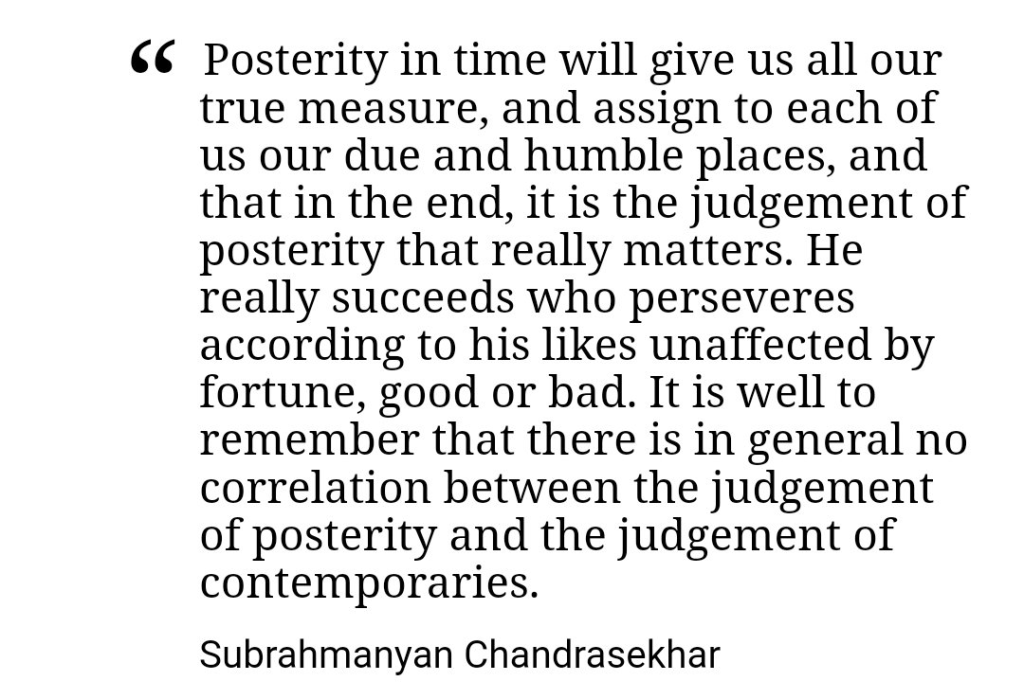
One of my all time fav. quotes. Chandra got it from Milne. Chandra had great temperament for scholarly work, & one can learn a lot from his style of working. His biographer, KC Wali, was a particle physicist, & his article linked is worth reading: https://jstor.org/stable/24100199
If interested, you can listen to a podcast I did on Chandra (one of the two of the similar name)…
On 23rd Aug 2023, ISRO made history by landing a spacecraft close to the south pole of the moon. For a long time in India, I have not seen such an enthusiasm for science and technology, and it was indeed heartening to experience this. In reference to the proceedings in recent times, below are some brief lessons I learnt :
For space programs, strong foundations in computation coupled with deep understanding of computer-assisted hardware is vital. Traditionally, India had good strength in computational aspect, but this mission showcased its capability in computer-assisted hardware and manipulation. As expected, ISRO is leading the way, and it is important to emulate this software-hardware coherence in other sectors.
Science and Technology need not be a zero-sum game. Collectively, they have a lot to offer to the Indian society. The mission shows how investing in scientific activities can positively influence a society. In an essence, collective scientific endeavors like Chandrayaan strengthens our democracy.
ISRO’s ability to learn from past failure is commendable. It showcased how scientific experiments should be approached, and how missions should be accomplished.
There was a significant proportion and contribution of women in Chandrayaan 3.
A reasonable and sustained research-budget given to a dedicated set of people can, sometimes, achieve remarkable things. That should not be a reason to limit funding towards research. This should encourage our society to further support scientific research.
Some parts of social media and online news portals played a better role in broadcasting and discussing the mission than Indian TV channels.
Some news papers (I read Indian Express (in print) and non-paywalled parts of Hindu online) did a good job of explaining many scientific concepts.
Global south has tremendous scientific potential. The Indian sub-continent must take up collective scientific endeavors to have a greater impact in the region. India can lead the way.
Classical physics and Engineering Science is alive and kicking. There is still a lot to explore and understand nature at ‘macro’ scale. It also highlights the importance of strong foundations in science and mathematics.
At the heart of all these things is human curiosity and rationality. Nurturing this curiosity and rationality is our collective responsibility. It not only offers transient joy, but also orients our collective action to make this world a better place. After all, it resonates with वसुधैव कुटुम्बकम (“The World Is One Family“).


 VISMAYA - History & Philosophy of Physics