We use optical illumination to generate thermal fields, creating non-reciprocal interactions between passive and active colloids. Active colloids absorb light and produce thermal gradients, driving thermo-osmotic forces that induce propulsion and chiral motion. Our Langevin simulations, backed by experimental observation, reveal how to control colloidal behavior. May have implications in light-driven chiral motion and nonlinear dynamics.
Super effort by Rahul, Ashutosh & Sneha from our group, who combined numerical simulations, analytical theory, with experimental observations.
The 2 anonymous reviewers made us think and work hard, and we thank them!
Whereas Sunday was bright, sunny, and clear for outdoor activities, Monday started cloudy with a forecast of rain. I started from my living place to Kyoto University around 10 in the morning. I took the city bus, which shuttles people from the city centre to the university. Within half an hour, I was in a serene, green, and beautiful campus, typical of a Japanese university. Kyoto University has a rich blend of modern and ancient architecture, and I was not surprised to see a large maroon-coloured ark at the entrance of the university.
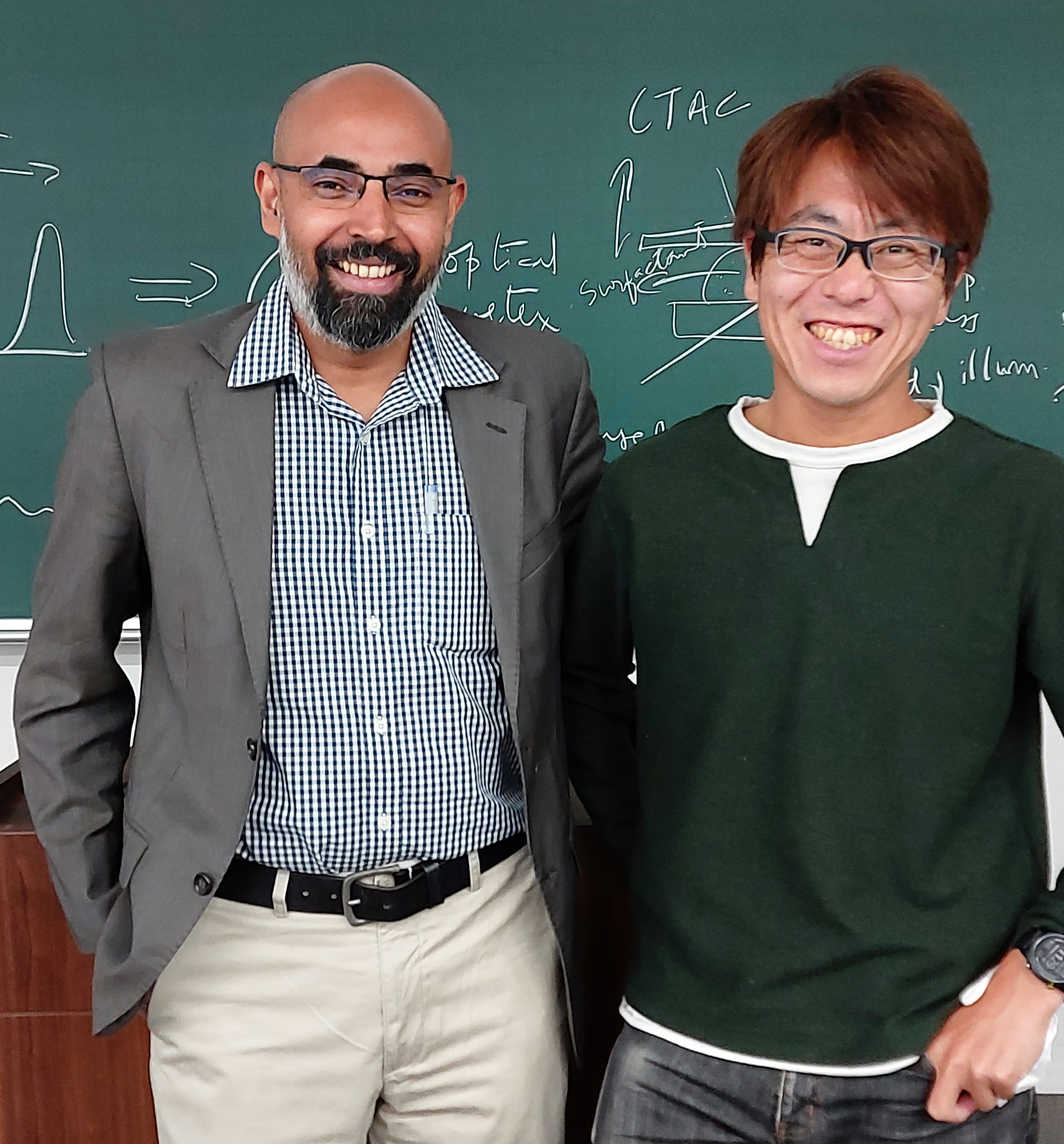
With Prof. Tetsuro, who hosted me at the Graduate School of Informatics at Kyoto University.
I met Tesuji Tetsuro upon arrival (our previous in-person meeting was in the 2023 Optics & Photonics Congress on optical manipulation at Yokohama). He had just arrived from his run (he is a regular marathon runner), and we had a brief chat. He had arranged an office for me to occupy for the day. We had a short discussion and thereafter went for lunch. Prof. Kazuo Aoki (Tetsuro’s erstwhile advisor at Kyoto University) accompanied us, and I was delighted to meet him. We had a delicious lunch at a small Italian restaurant.
Around 3 pm, we met at the seminar hall where I gave my talk titled Hot Brownian Dynamics Driven by Structured Light. One of the key points I emphasized in my talk was the relevance of structured light in driving Brownian dynamics of colloids. I spoke about various parts of the stochastic differential equation (see equation 1 below) that represent the dynamics of a colloidal system interacting with an external force.
A key element of my discussion was the generalized driving force on the right-hand side of the equation, where the conventional restoring force in an optical trap can be generalized to an external driving force due to structured light. This versatile force is a result of a large set of linear and angular momentum states of structured light. These states can drive soft matter, further resulting in unconventional assembly and dynamics. Furthermore, the generalized driving force can include not only the optical force but also the thermal and hydrodynamic effects initiated by optical illumination. The combination of these forces culminates in a resultant force, offering an unconventional driving mechanism to drive the structure, assembly, and dynamics of colloids and other kinds of soft matter systems, including droplets and fluids. I showed some of our experimental results related to the above-mentioned concepts with emphasis on rotational and orbital degrees of freedom. I also presented our recent results on synchronization in an optothermal trap.
campus mapnear the entrance of Kyoto University at a Japanese izakayaWith Tetsuro and some PhD students
We had a long discussion on how to measure fluid dynamic properties around such colloids, especially when there is an external perturbation force, such as a laser beam, which can itself influence the colloidal dynamics. Tetsuro also mentioned his protocols and certain simulation strategies utilized to study thermo-osmotic flows in such situations. I learned about interesting methods they have been developing to numerically simulate the interactions using differential temperatures. The strategy is interesting and deserves further attention by the community. He also showed his experimental setup and gave a tour of his laboratory facilities.
Overall, it was a long, thoughtful day with wonderful discussions on topics of common scientific interest. We ended with a delicious dinner at a Japanese izakaya, and I thank Tetsuro for his invitation and hospitality. Kyoto University has a wonderful atmosphere for research, and I hope to visit again.
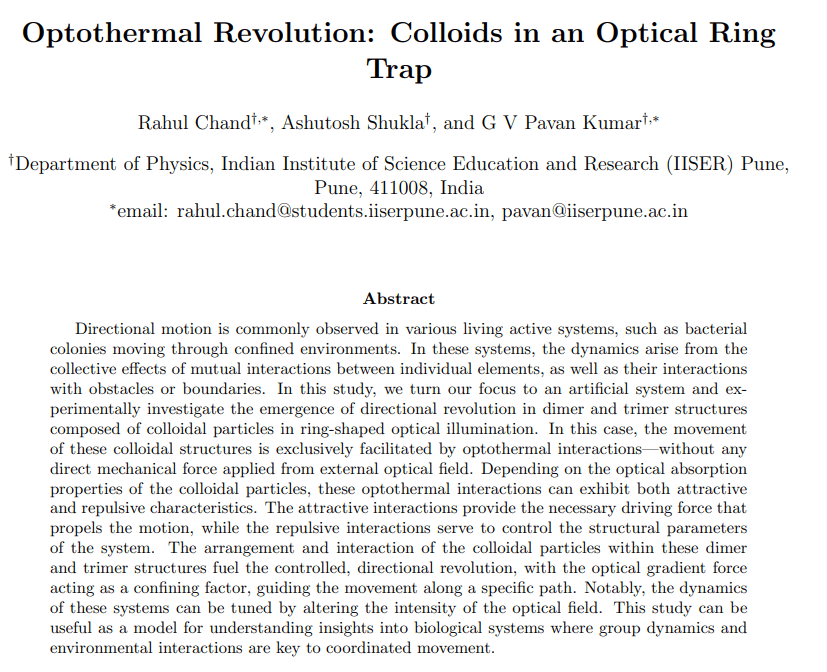
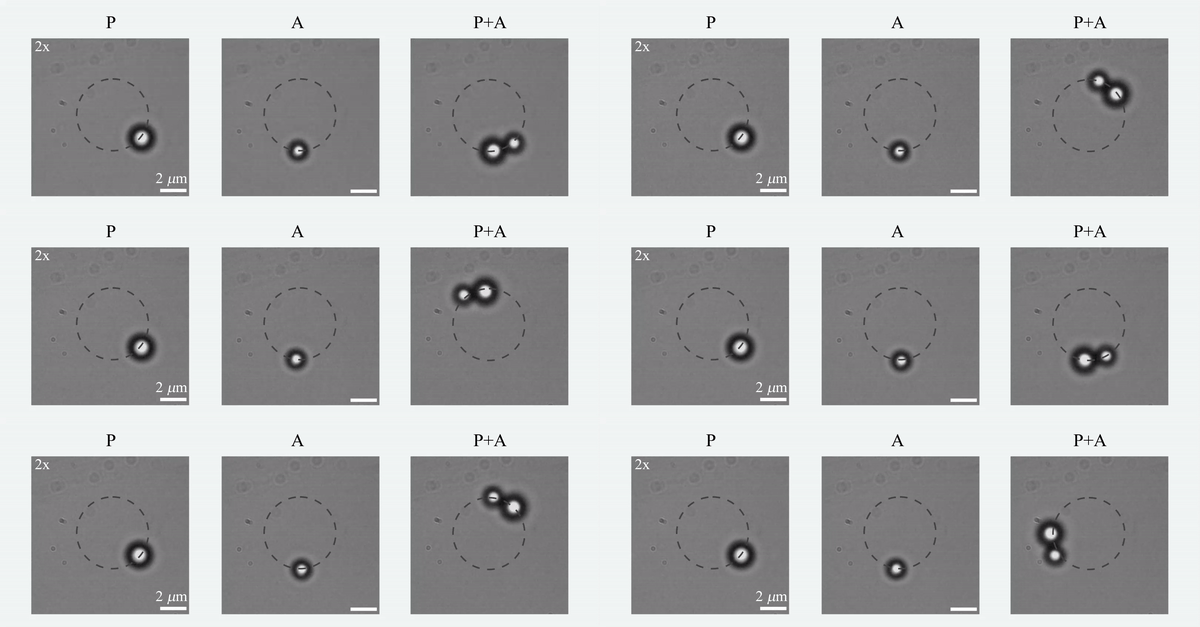
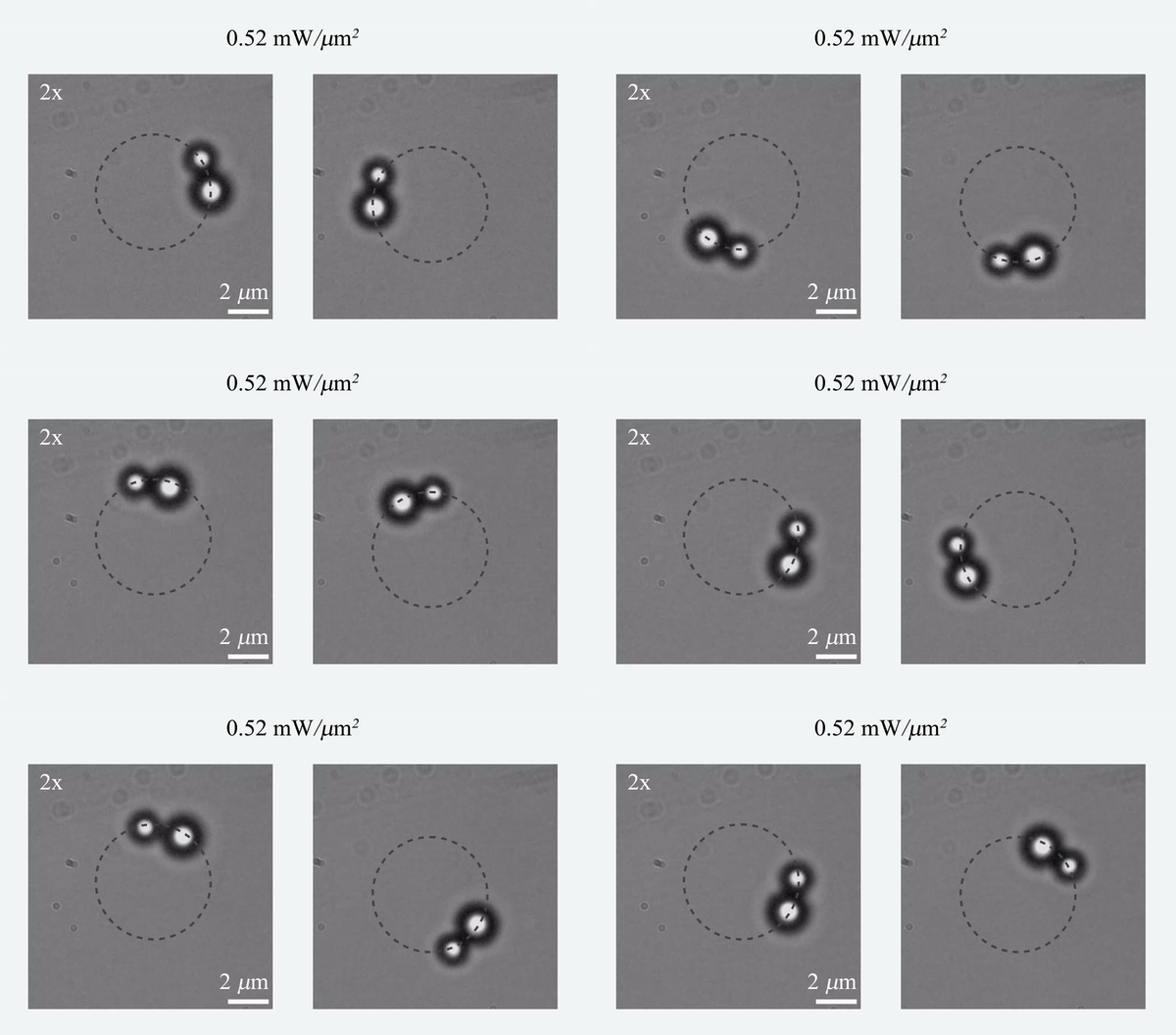
We have an Arxiv preprint on how a mixture of colloids (thermally active + passive particles in water) can lead to the emergence of revolution dynamics in an optical ring trap (dotted line). Super effort by our lab members Rahul Chand and Ashutosh Shukla.
Interestingly, the revolution emerges only when an active and a passive colloid are combined (not as individuals) in a ring potential (dotted line)
the direction (clock or anti-clockwise) of the revolution depends on the relative placement of the colloids in the trap
This revolution can be further used to propel a third active colloid
New vlog post: I take, e.g. from the game of cricket (ft. Laxman, Dravid), soft matter physics, ants, Feynman’s seminar & a few other references to explain the emergence, self-organization and spontaneous order in our world
Araújo, Nuno A. M., Liesbeth M. C. Janssen, Thomas Barois, Guido Boffetta, Itai Cohen, Alessandro Corbetta, Olivier Dauchot, et al. 2023. “Steering Self-Organisation through Confinement.” Soft Matter 19 (9): 1695–1704. https://doi.org/10.1039/D2SM01562E.
Tromp, Catrinel, and John Baer. 2022. “Creativity from Constraints: Theory and Applications to Education.” Thinking Skills and Creativity 46 (December): 101184. https://doi.org/10.1016/j.tsc.2022.101184.
Fluorescent video imaging of trapping a single fluorescent nano-diamond on a gold nanoparticle
We have a new paper appearing in Optics Letters on optical manipulation of fluorescent nano-diamonds. This experimental work (with some simulations) was performed by our group member Ashutosh Shukla in collaboration with the group of Prof. Kasturi Saha (IIT-Bombay). Our alumni, Sunny Tiwari, gave vital inputs to perform the experiments.
Fluorescent nano-diamonds have emerged as important (quantum) imaging agents in biological applications. It remains a challenge to manipulate them in complex fluidic environments.
Herein, we have come up with an optical trapping method based on opto-thermoelectric effect (see Fluorescence imaging video above). By using opto-thermal potentials created by a single gold nanoparticle (~200nm) on a glass surface, we have been able to trap individual nano-diamonds, and capture their spectral signatures. The Brownian motion in the trap can be tracked, and this leads to the measurement of effective trap stiffness. Furthermore, we extrapolate this thermo-plasmonic trapping method to trap and track individual nano-diamonds on silver nanowires.
As mentioned in the abstract of the manuscript, we envisage that our drop-casting platform can be extrapolated to perform targeted, low-power trapping, manipulation, and multimodal imaging of FNDs inside biological systems such as cells.
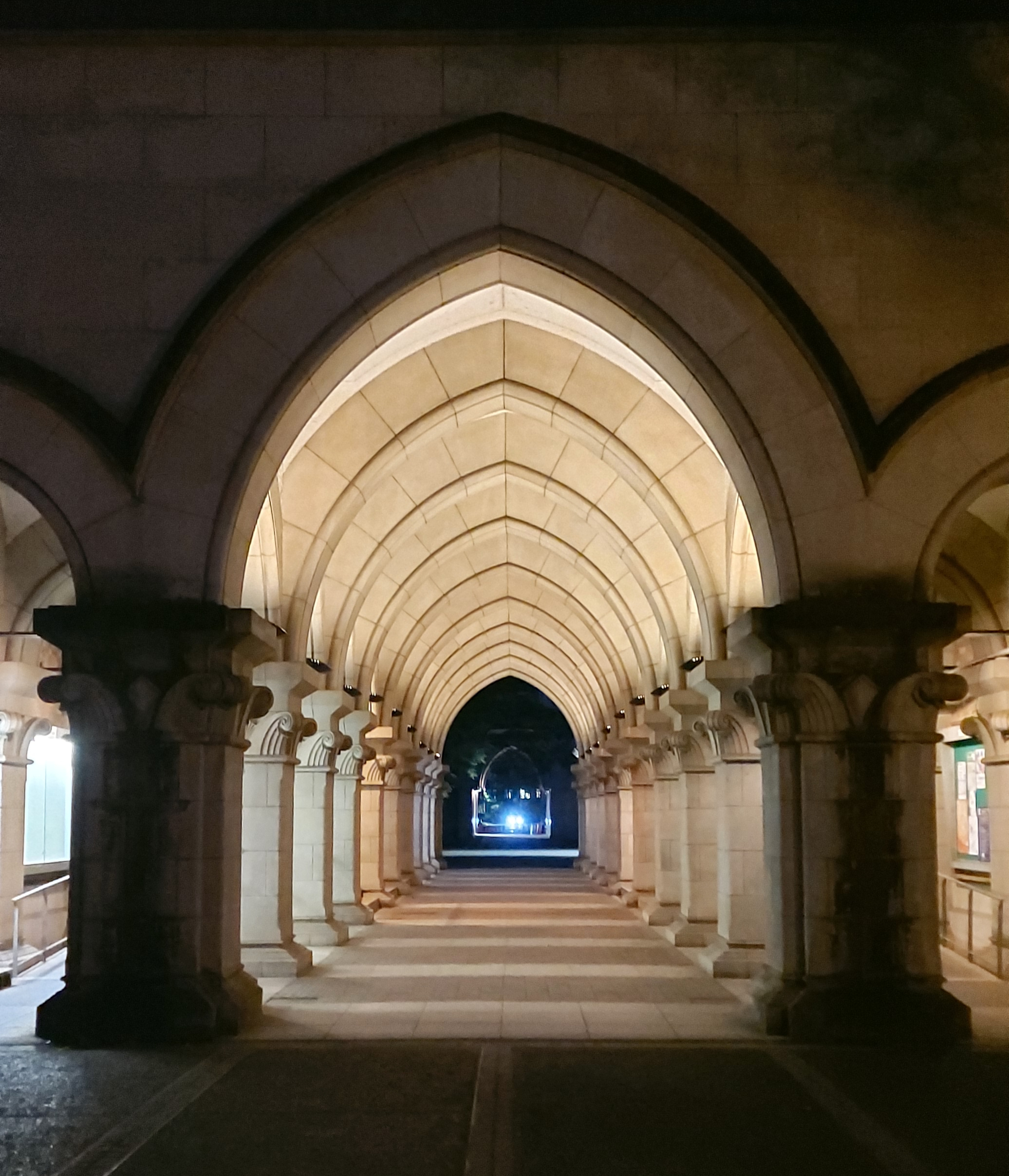
Wonderful Japanese-Gothic architecture at The University of Tokyo
I gave two talks in Tokyo.
First was on 24th April at Department of Applied Physics, Faculty of Advanced Engineering, Tokyo University of Science. My host was Prof. Yutaka Sumino. I spoke about “Soft Matter in Opto-Thermal Gradients“. I gave a short introduction to opto-thermal perturbations and potentials, and discussed some of our work on opto-thermophoretic trapping and Brownian dynamics. The audience contained a few master students too, and I really enjoyed discussing some concepts related to Brownian motion in an optothermal trap, and related experiments. Also, I had a very interesting discussion with Sumino and his students on their experiments on Janus particles.
with Yutaka
with Yutaka”s group
The second talk was on 25th April at Department of Physics, University of Tokyo. My host was Prof. Kazumasa Takeuchi. I spoke about “Soft Matter in Opto-Thermal Gradients : Evolutionary Dynamics and Pattern Formation“.
This talk was also announced on Japan’s statphys mailing list, and also live-casted over zoom. I discussed about the origins of optothermal effects in a laser trap, and how it can lead to some interesting dynamics and pattern formation in soft-matter system. Specifically, I highlighted the concept of Hot Brownian motion, and how it can be influenced using thermo-plasmons. The talk and discussion went on for almost 2 hours, and I really loved it. Also, Takeuchi and his students gave an overview of their work including a live demonstration on turbulence in liquid crystals, and it was fantastic.
I am always amazed to see fractal-like patterns….this one at a geographical scale…captured somewhere over south India..
I took the photo on my trip back to Pune from IIT Madras…
Thanks to IIT-M physics department for their invitation for colloquium…
Special thanks to Basudev Roy and Nirmala for hosting…. greatly enjoyed the discussion with many faculties and students..
In my talk, I mainly spoke on topics at the interface of statistical optics, Brownian motion and pattern formation.. Was delighted to see (and meet) Profs. Balki, Suresh Govindarajan Sunil Kumar Arnab Pal and many more in the audience.
The photo, retrospectively, captures the essence of the science discussed…
About 2 years ago (22nd May 2020), when all the academic activities were online, I gave a talk on “Soft-Matter Optics: A Cabinet of Curiosities” organized by American Chemical Society as part of India Science Talks. Below is the embedded video of the online talk.
In there, I give a broad overview of how interesting optical function can emerge from the complex world of soft matter. In addition to this, I have emphasized how optics can be harnessed to study structure and dynamics of soft-matter systems including colloids, liquid crystal and some biological matter. The target audience are new PhD students and anyone who is entering the field of light-soft matter interaction.







 VISMAYA - History & Philosophy of Physics