Optothermally induced active & chiral motion – a new paper

We have a new paper in Soft Matter
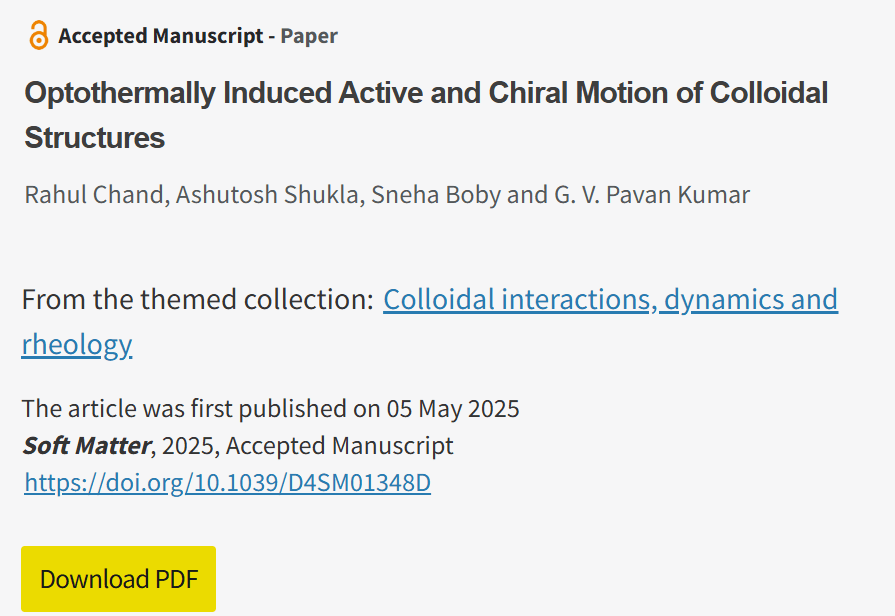
link to the paper (free to access, thanks to IISER Pune library)

We use optical illumination to generate thermal fields, creating non-reciprocal interactions between passive and active colloids. Active colloids absorb light and produce thermal gradients, driving thermo-osmotic forces that induce propulsion and chiral motion. Our Langevin simulations, backed by experimental observation, reveal how to control colloidal behavior. May have implications in light-driven chiral motion and nonlinear dynamics.

Super effort by Rahul, Ashutosh & Sneha from our group, who combined numerical simulations, analytical theory, with experimental observations.

The 2 anonymous reviewers made us think and work hard, and we thank them!

Also, the paper is part of the journal’s themed collection on “Colloidal interactions, dynamics and rheology”

Gold nanoparticles in sync – preprint

We have a new preprint: https://arxiv.org/abs/2411.15512

The central circle indicates anchored gold nanoparticles stuck to the glass, and the two moving circles are gold colloids that are trapped synchronously due to the optothermal potential.

New paper : Optothermoelectric trapping of single nano-diamonds

Fluorescent video imaging of trapping a single fluorescent nano-diamond on a gold nanoparticle

We have a new paper appearing in Optics Letters on optical manipulation of fluorescent nano-diamonds. This experimental work (with some simulations) was performed by our group member Ashutosh Shukla in collaboration with the group of Prof. Kasturi Saha (IIT-Bombay). Our alumni, Sunny Tiwari, gave vital inputs to perform the experiments.

Fluorescent nano-diamonds have emerged as important (quantum) imaging agents in biological applications. It remains a challenge to manipulate them in complex fluidic environments.

Herein, we have come up with an optical trapping method based on opto-thermoelectric effect (see Fluorescence imaging video above). By using opto-thermal potentials created by a single gold nanoparticle (~200nm) on a glass surface, we have been able to trap individual nano-diamonds, and capture their spectral signatures. The Brownian motion in the trap can be tracked, and this leads to the measurement of effective trap stiffness. Furthermore, we extrapolate this thermo-plasmonic trapping method to trap and track individual nano-diamonds on silver nanowires.

As mentioned in the abstract of the manuscript, we envisage that our drop-casting platform can be extrapolated to perform targeted, low-power trapping, manipulation, and multimodal imaging of FNDs inside biological systems such as cells.

arxiv link to the paper : https://arxiv.org/abs/2210.02874

below is the snapshot of the abstract of the paper from journal’s early posting :

Two talks in Tokyo

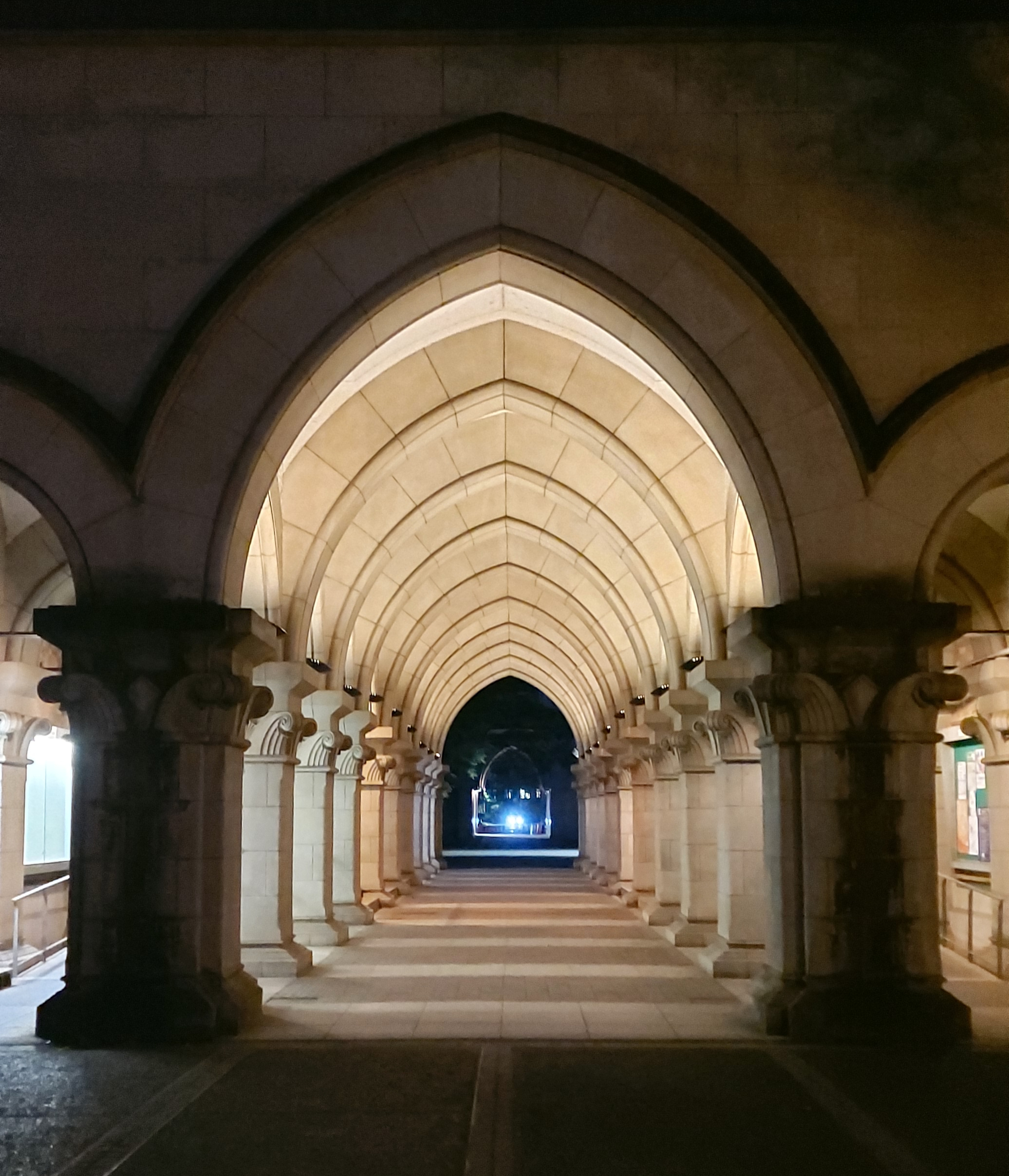
Wonderful Japanese-Gothic architecture at The University of Tokyo

I gave two talks in Tokyo.

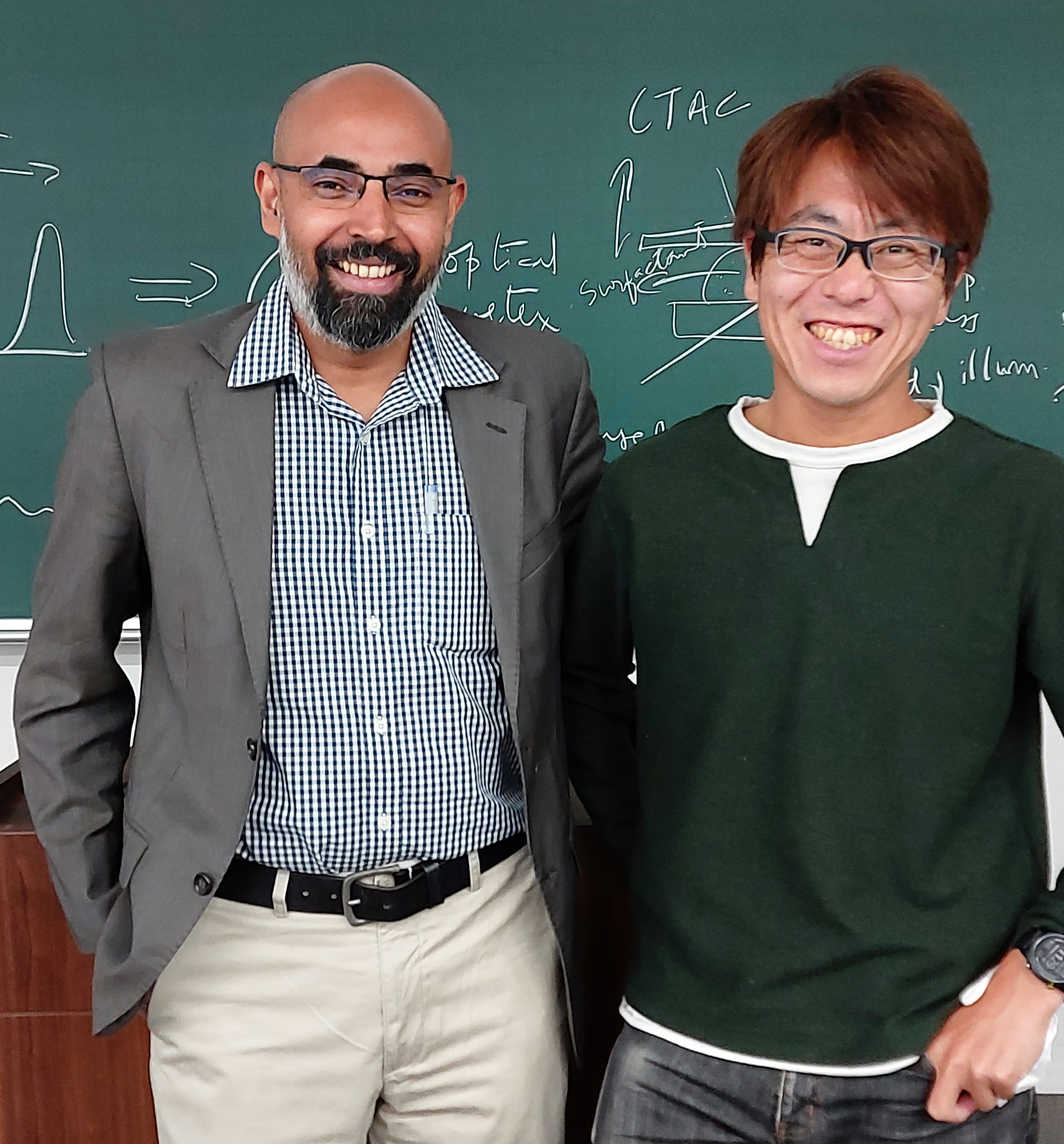
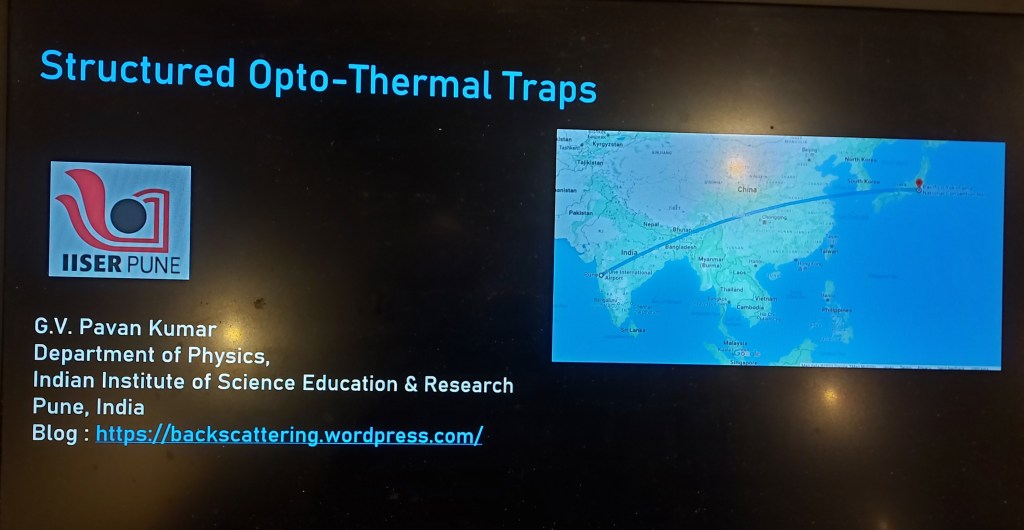
First was on 24th April at Department of Applied Physics, Faculty of Advanced Engineering, Tokyo University of Science. My host was Prof. Yutaka Sumino. I spoke about “Soft Matter in Opto-Thermal Gradients“. I gave a short introduction to opto-thermal perturbations and potentials, and discussed some of our work on opto-thermophoretic trapping and Brownian dynamics. The audience contained a few master students too, and I really enjoyed discussing some concepts related to Brownian motion in an optothermal trap, and related experiments. Also, I had a very interesting discussion with Sumino and his students on their experiments on Janus particles.

with Yutaka
with Yutaka”s group

The second talk was on 25th April at Department of Physics, University of Tokyo. My host was Prof. Kazumasa Takeuchi. I spoke about “Soft Matter in Opto-Thermal Gradients : Evolutionary Dynamics and Pattern Formation“.

This talk was also announced on Japan’s statphys mailing list, and also live-casted over zoom. I discussed about the origins of optothermal effects in a laser trap, and how it can lead to some interesting dynamics and pattern formation in soft-matter system. Specifically, I highlighted the concept of Hot Brownian motion, and how it can be influenced using thermo-plasmons. The talk and discussion went on for almost 2 hours, and I really loved it. Also, Takeuchi and his students gave an overview of their work including a live demonstration on turbulence in liquid crystals, and it was fantastic.

with Takeuchi
with Takeuchi’s group

OMC 2023

We had a great discussion after the talk… spoke on how temperature gradients can be harnessed for optical manipulation in colloidal fluids… which further leads to some interesting Brownian dynamics

The 10th Optical Manipulation and Structured Materials Conference (OMC2023) was superb….learnt a lot.
This was part of Optics & Photonics International Congress 2023

Thanks to Prof. Takashige Omatsu for the invitation and amazing Japanese hospitality…

Geo-fractal…somewhere over south India

I am always amazed to see fractal-like patterns….this one at a geographical scale…captured somewhere over south India..

I took the photo on my trip back to Pune from IIT Madras…

Thanks to IIT-M physics department for their invitation for colloquium…

Special thanks to Basudev Roy and Nirmala for hosting…. greatly enjoyed the discussion with many faculties and students..

In my talk, I mainly spoke on topics at the interface of statistical optics, Brownian motion and pattern formation..
Was delighted to see (and meet) Profs. Balki, Suresh Govindarajan Sunil Kumar Arnab Pal and many more in the audience.

The photo, retrospectively, captures the essence of the science discussed…

Hot Brownian Colloids – talk

On 19th Jan 2023, I gave a ~40 min talk on “Hot Brownian Colloids in Structured Optical Tweezers” in a very interesting conference on Frontiers in Non-Equilibrium Physics (FNEP) held at Institute of Mathematical Sciences, Chennai.

I mainly spoke about emergent Brownian dynamics of laser-heated colloids under optical confinement. Below is the link to the talk.

I concluded my talk quoting P W Anderson’s essay “More is Different

“The constructionist hypothesis breaks down when confronted with the twin difficulties of scale and complexity.  The behavior of large and complex aggregates of elementary particles, it turns out, is not to be understood in terms of a simple extrapolation of the properties of a few particles.

Instead, at each level of complexity entirely new properties appear, and the understanding of the new behaviors requires research which I think is as fundamental in its nature as any other.”

P.W. Anderson  ‘More is Different’
Science, 177, 4047 (1972)

More is not only different, but also wonderful !