The video is inspired by a blog I wrote a few years ago.
Category: academia
Connection between science and creativity
A short comment on a bizarre claim – room temp SC
Why write interesting papers ?
A lesson I keep learning from Daan Frenkel: write interesting research papers. Thanks to Arghya Dutta (on X), who brought the paper below to my notice. https://arxiv.org/abs/1211.4440
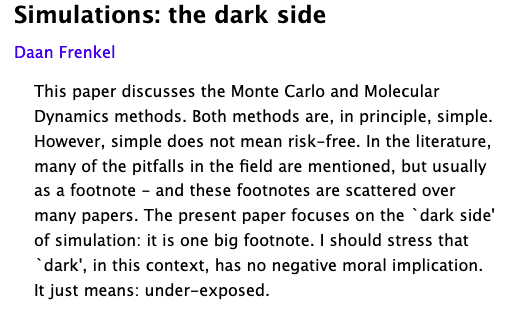
Sometimes, interesting, well-written papers can have a deeper impact. Even otherwise, it would add clarity.
Scholarship + interesting writing >>>> prestige of the journal.
Don’t worship journals.
A common question when I say so is: what about academic assessment for jobs and promotion?
My answer is that academia (still) values consistent, scholarly output in reasonable journals.
It is very hard to reject scholarship. Aim for this as it is under your control.
Some policies of my research
In the past 14 yrs of my research group, I have made a few policies for myself, which may be helpful to others:
1) Any group member is free to criticize my input with reason. This has been one of the most liberating experience. Importantly, it has helped me learn.
2) Physical and mental health of group members is of primary importance. Good health and good research is not a zero sum game.
3) Constancy of thought and work is vital. We overestimate work that can be done in short term and underestimate the long term. Constant effort, spread over months and years, can build intellectual and technical monuments.
4) Set internal standards. Let this standard be reasonable and focused towards oneself. The biggest stress in work comes from comparison with others. Instead, compare your past with present, & strive for a +ve difference. Be sceptical of external metrics.
5) Write regularly. Writing is not only about publication in a journal or a book. It is a way to reflect, learn, revise and communicate. Writing is the process. A publication is one of the outcomes, a temporary goal. Focus on the process, goals will follow.
6) Share your knowledge. If possible – TEACH. Teaching informally is very enjoyable. It is devoid of judgements. In the longer run, it is perhaps the most impactful thing you will do, and will be remembered for. Remember Feynman.
7) None of the above points matter if your work does not make you a better human being. Be compassionate to others. The biggest strength of scientific research, if done well is it elevates the individual & collective – both local & global.
8) Academia, in its good form, can feed your stomach, brain and heart. Nurturing and enabling all the three is the overarching goal of academics. And perhaps the goal of humanity.
Thinking in a Classroom
As I conclude my Optics course this week (40+ hrs, ~80 physics majors ), I have an opinion to express. There is no substitute for in-person human interaction and learning. This form of interaction is not to downplay the role of technology in education, but somehow, as humans, we still connect better in reality than in virtual space.
I have been formally teaching for the past 14 years or so, and for a couple of semesters, I have also taught online courses during the pandemic. During these years, I have learnt that technology can add significant value to teaching but cannot be a substitute for a teacher or a student. As we teach a class with a reasonable number of students, we experience live feedback from each other, which has no equivalent during an online interaction. Humans take this feedback for granted and assume we can replicate it in a virtual space with limited success. Such feedback may have a deeper connection to the evolutionary biology of human beings.
This feedback loop in a live class does not make teaching or learning a perfect act of communication. But it brings in a form of dissipative coherence, which indicates that the whole class, including the teacher, is thinking synchronously at the moment of exposition. I have deliberately used the word ‘dissipative’ because there is always some intellectual noise in the background. The beauty of this noise is that it adds up with the information under discussion and amalgamates with the topic of exposition. This combination is the uniqueness of learning. At that moment in the class, we are all thinking about a topic, but noise in an individual mind combines with the issue at large and possibly emerges as a new thought. This divergence of thinking at a personal level, combined with real-time feedback, makes a live class alive.
And at that hour, it becomes a single living entity with a single meta-brain.
2023 Nobel in Sciences – A few observations and questions
One of the interesting aspects of the Nobel Prize in Sciences this time is that all the 8 laureates are experimentalists. This is not to underplay the contribution of theoreticians but to emphasize the point that experimental observations are central to the progress of sciences and follow-up technology. Also note that many of these laureates were equally well-versed in theoretical ideas, and hence were able to connect the abstract to the real. An effective way to do science.
Another aspect is that all the experimentalists are strongly anchored in the West. They have performed all their work in an ecosystem that has supported their efforts, even when their ideas were not well known. A case in point is Katalin Karikó (one of the medicine/physiology laureates). Although U Penn treated her badly, she was still able to sustain her research thanks to the research-driven business ecosystem in the West, including the USA and Germany, where she could establish herself in the biotech research industry. This means the Western research ecosystem, including its businesses, was open enough to allow someone who was almost discarded by the US academic system. Karikó’s is a great story, but we must not forget that eventually, the system in which she worked recognized her contribution.
Now, some things to ponder – what if Karikó had moved to a place such as India? Could she have survived and thrived in our research ecosystem? If she had moved, was our academic and market ecosystem open to welcome her, take her expertise, and utilize it effectively? Answers to these questions are not straightforward but may indicate where we are as a research ecosystem.
2023 Nobel in Physics – Initial thoughts

One should not be surprised nowadays if a Nobel prize in physics goes to something related to light. As a person working in optics and light-matter interaction, I welcome any recognition of one of the most profound aspects of nature: light. This time, the prize has gone to some great experimental effort dating back to the late 1980s to early 2000s when amazing progress was made in three aspects related to the prize: a) higher harmonic generation of light in rare gases, b) production of a train of attosecond light pulses, and c) eventually production of single attosecond light pulses that can interact with matter, especially electrons in matter. Such an interaction can lead to the mapping of dynamics of quantum entities such as electrons and will have far-reaching consequences in probing the internal degrees of molecules and atoms. The scientific information published by the Nobel Committee has wonderful illustrations and is worth reading.

This time, the Nobel Prize website has published a fantastic set of illustrations to convey the relevance of the research. The above one shows the spectrum of temporal scales. It elegantly illustrates the breadth of the scale – attosecond to heartbeat:: Heartbeat to the age of the universe.. Oh, how beautiful science is!

Via Twitter, thanks to a student who was attending a lecture by Anne (one of the Nobel laureates), we got to see continuing her lecture even after a Nobel announcement. Now that is the spirit of academics!

This is the fundamental paper that triggered higher harmonic generation in gases and laid the foundation for attosecond pulse generation. of today, the impact factor of this journal is 1.6. The impact is not proportional to the impact factor of a journal
Sanskrit quote on learning..
आचार्यात् पादमादत्ते पादं शिष्यः स्वमेधया ।
सब्रह्मचारिभ्यः पादं पादं कालक्रमेण च ॥
One fourth from the teacher, one fourth from own intelligence,
One fourth from classmates, and one fourth only with time.
Happy Teacher’s Day.. learning is eternal..
Zijie Yan…gone too soon
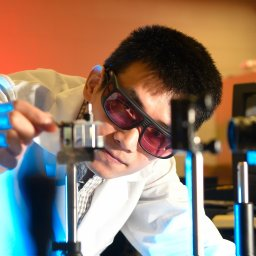
Scientific research is a creative pursuit. As researchers, we are always looking out for new ideas and inculcate them in our work. One way to get new ideas is to explore existing ideas and bring them together with certain degree of uniqueness and utility. As part of this exploration, scientists communicate with each other and gain some new knowledge. Therefore, as researchers, we encourage and value cooperation as part of our work culture.
Over the past couple of decades, I have been greatly benefited, motivated, and inspired by many of my fellow-colleagues across the globe. Dr. Zijie Yan was one of them. I never met Zijie in person, but I and my research group have read many of his interesting papers related to optical trapping and binding of plasmonic nanoparticles. I have been following his work ever since he was a post doc at University of Chicago, and found his work creative, interesting, and illuminating, to say the least.
In 2020, during the pandemic, we exchanged a few emails related to some technical details of trapping plasmonic colloids, and he was very generous and forthcoming in sharing his knowledge. He gave me some important leads into the wavelength-dependence of trapping capabilities, and suggested a few references. These leads were very beneficial for us to build upon some concepts and techniques that we were developing in my lab, which further led to some publications. After we published some of our results, I sent him our pre-prints, and thanked him for his input.
When I heard the sad news of Yan’s untimely death at University of North Carolina (UNC) at Chapel Hill, I was shocked. As you may, know this was caused by gun shooting (allegedly by his own graduate student). What a tragic news.
USA has great universities. In late 2000s, I spent two of my post-doctoral years in the US (Purdue University), and it was a pleasure living and working there. As an intellectual ecosystem, USA still leads the way, and it has been home to so many scientists and intellectuals from across the world. As with any society, USA has some flaws, and among them gun violence is turning out to be a major hurdle to its own progress and values. I sincerely hope that sanity will prevail among a large section of American society, and somehow this meaningless and violent aspect of their society is eliminated.
Sometimes, we take peace of mind for granted, but it is probably the most important pre-requisite to work. It is also a timely reminder for all of us in this world to emphasize the importance of humanness, compassion and rationality. Violence is never an answer.
Zijie was emerging as one of the stars in our research community, and what a shame that we have lost him so early. Let me end with the first few sentences of Zijie’s reply to my email in 2020:
“Dear Pavan,
Thank you for your interest on our research! Glad to hear someone from the community……”
My thoughts are with his family and well-wishers.
Goodbye Zijie. We, as a community, will remember you.
 VISMAYA - History & Philosophy of Physics