The video is based on my recent blog post.
Author: G.V. Pavan Kumar
Namaste, Hola & Welcome from G.V. Pavan Kumar.
I am a Professor of Physics at the Indian Institute of Science Education and Research, Pune, India.
My research interests are :
(1) Optics & Soft Matter: Optically Induced Forces – Assembly, Dynamics & Function;
(2) History and Philosophy of Science – Ideas in Physical Sciences.
I am interested in the historical and philosophical evolution of ideas and tools in the physical sciences and technology. I research the intellectual history of past scientists, innovators, and people driven by curiosity, and I write about them from an Indian and Asian perspective. My motivation is to humanize science.
In the same spirit, I write and host my podcast Pratidhvani – Humanizing Science.
Water droplets on a cobweb – video
Water droplets on a cobweb, fascinating #softmatter..
Interestingly, this has conceptual connection to protein droplets on a cell surface..
See this very short video and the references in the description:
References to understand the conceptual connections:
https://www.princeton.edu/news/2021/01/29/dewdrops-spiderweb-reveal-physics-behind-cell-structures
https://www.nature.com/articles/s41567-020-01141-8
Climate change – report link

Climate change is one of the major problems staring at humanity. It is important that we do not trivialize this matter.
The Intergovernmental Panel on Climate Change (IPCC ) periodically releases excellent reports with scientific evidence. Many Indian scientists have taken a lead in this pursuit https://ipcc.ch/report/ar6/wg3/
Squirrel vs Gravity

Amazing how the squirrel does it..it can climb up or down a vertical wall with ease…
Part of its learning is in the gene, thanks to evolution, and part is in environmental cues..
Science is indeed beautiful..all we need is to open our eyes..
Conversation with M.S. Santhanam
I am delighted to introduce you to my guest on this episode : M S Santhanam
“Website of M. S. Santhanam.” Accessed September 5, 2023. http://sites.iiserpune.ac.in/~santh/.
Santhanam is a physicist and a professor in dept. of physics at Indian Institute of Science Education and Research Pune
He is a theoretical physicist, and his research interest include a variety of topics including chaos and nonlinear dynamics, quantum chaos, quantum computation and machine learning, statistical physics, complex networks, extreme events and complex systems.
In this episode we discussed
- his biography
- on how he developed interest in physics
- his experience of studying at Hyderabad university
- the ecosystem of the university
- he also tells us about his experience on learning and doing research in Quantum classical correspondence, extreme event, data analysis leading to maching learning, nonlinear dynamics and complex systems
- We discussed importance of physics and it role in society and how academics can contribute towards betterment of society
- There is also an excellent segment in Tamil, in which Santhanam describes his research with an interesting analogy.
- We also discussed about his interest in writing about science-society interface, and about politics
- Santhanam wonderfully combines intuitive thinking of physics, with computation approaches to study many interesting problems in complex systems, and he elaborates on this aspect with excellent clarity
- Santhanam and I work in the same department, and I have always found discussion with him both illuminating and interesting. I continue to learn a lot from him.
- I am sure, all of you will enjoy this discussion.
Listen…as we humanize science…
Youtube audio :
spotify :
apple podcast :
References :
- “M. S. Santhanam – IISER Pune.” Accessed September 5, 2023. https://www.iiserpune.ac.in/research/department/physics/people/faculty/regular-faculty/m-s-santhanam/329.
- “M. S. Santhanam’s Articles in News Media.” Accessed September 5, 2023. http://sites.iiserpune.ac.in/~santh/pubs.html#secgeneral.
- Pal, Ritam, Aanjaneya Kumar, and M. S. Santhanam. “Depolarization of Opinions on Social Networks through Random Nudges.” arXiv, February 24, 2023. https://doi.org/10.48550/arXiv.2212.06920.
- Physical Research Laboratory. “Home Page.” Accessed September 5, 2023. https://www.prl.res.in/prl-eng/home.
- Santhanam, M. S., Sanku Paul, and J. Bharathi Kannan. “Quantum Kicked Rotor and Its Variants: Chaos, Localization and Beyond.” Physics Reports, Quantum kicked rotor and its variants: Chaos, localization and beyond, 956 (April 22, 2022): 1–87. https://doi.org/10.1016/j.physrep.2022.01.002.
- “University of Hyderabad.” Accessed September 5, 2023. https://uohyd.irins.org/.
Sanskrit quote on learning..
आचार्यात् पादमादत्ते पादं शिष्यः स्वमेधया ।
सब्रह्मचारिभ्यः पादं पादं कालक्रमेण च ॥
One fourth from the teacher, one fourth from own intelligence,
One fourth from classmates, and one fourth only with time.
Happy Teacher’s Day.. learning is eternal..
Zijie Yan…gone too soon
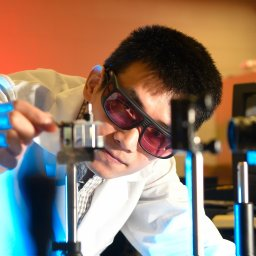
Scientific research is a creative pursuit. As researchers, we are always looking out for new ideas and inculcate them in our work. One way to get new ideas is to explore existing ideas and bring them together with certain degree of uniqueness and utility. As part of this exploration, scientists communicate with each other and gain some new knowledge. Therefore, as researchers, we encourage and value cooperation as part of our work culture.
Over the past couple of decades, I have been greatly benefited, motivated, and inspired by many of my fellow-colleagues across the globe. Dr. Zijie Yan was one of them. I never met Zijie in person, but I and my research group have read many of his interesting papers related to optical trapping and binding of plasmonic nanoparticles. I have been following his work ever since he was a post doc at University of Chicago, and found his work creative, interesting, and illuminating, to say the least.
In 2020, during the pandemic, we exchanged a few emails related to some technical details of trapping plasmonic colloids, and he was very generous and forthcoming in sharing his knowledge. He gave me some important leads into the wavelength-dependence of trapping capabilities, and suggested a few references. These leads were very beneficial for us to build upon some concepts and techniques that we were developing in my lab, which further led to some publications. After we published some of our results, I sent him our pre-prints, and thanked him for his input.
When I heard the sad news of Yan’s untimely death at University of North Carolina (UNC) at Chapel Hill, I was shocked. As you may, know this was caused by gun shooting (allegedly by his own graduate student). What a tragic news.
USA has great universities. In late 2000s, I spent two of my post-doctoral years in the US (Purdue University), and it was a pleasure living and working there. As an intellectual ecosystem, USA still leads the way, and it has been home to so many scientists and intellectuals from across the world. As with any society, USA has some flaws, and among them gun violence is turning out to be a major hurdle to its own progress and values. I sincerely hope that sanity will prevail among a large section of American society, and somehow this meaningless and violent aspect of their society is eliminated.
Sometimes, we take peace of mind for granted, but it is probably the most important pre-requisite to work. It is also a timely reminder for all of us in this world to emphasize the importance of humanness, compassion and rationality. Violence is never an answer.
Zijie was emerging as one of the stars in our research community, and what a shame that we have lost him so early. Let me end with the first few sentences of Zijie’s reply to my email in 2020:
“Dear Pavan,
Thank you for your interest on our research! Glad to hear someone from the community……”
My thoughts are with his family and well-wishers.
Goodbye Zijie. We, as a community, will remember you.
Conversation with Kaneenika Sinha
Kaneenika Sinha is a mathematician and is as associate professor in department of mathematics at Indian Institute of Science Education and Research Pune. She is a number theorist, and her research interest is in analytic number theory and arithmetic statistics of modular forms. Kaneenika did her PhD from Queen’s University in Canada, and spent a few more years as post doc in Univ of Toronto, Univ of Alberta and Mathematical Sciences Research Institute, Berkeley. She started her independent career at IISER Kolkata before moving to IISER Pune.
“Kaneenika Sinha’s webpage.” Accessed August 26, 2023. http://sites.iiserpune.ac.in/~kaneenika/.
Twitter. “Kaneenika Sinha (@kaneenikasinha) / X,” June 15, 2023. https://twitter.com/kaneenikasinha.
Youtube (audio) :
Spotify :
google podcast :
apple podcast :
In this episode we discussed
- her biography
- on how she developed interest in mathematics
- her influences during college days in Delhi
- her exposure to a summer programme in TIFR, Mumbai
- where she found her spark and origins for mathematics research
- She also tells us about her experience on learning and doing research in mathematics including number theory
- We discussed various aspects of her research including her recent book and the process of writing, and why it is so important to research, teaching and learning
- We discussed importance of mathematics and its role in society and how academics, scientists and of course mathematicians can contribute towards betterment of society
- There is also an excellent segment in pristine hindi, in which Kaneenika describes her research with eloquence, which is fascinating to hear.
- We also discussed about her interest in literature and reading and she wonderfully elaborates on some of her influences and likings including Harivansh Rai Bachchan
- Kaneenika is one the most articulate colleagues i have interacted with, and discussing research and its motivations with her is always a pleasure. I learnt a lot from this conversation, and I am sure you will too…Listen, as we humanize science..
References :
1. Link to her article on Prime numbers in the Bhavana Magazine: https://bhavana.org.in/primes-of-our-lives/
2. Link to a biographical article she wrote on Sarvadaman Chowla: https://bhavana.org.in/sarvadaman-chowla-the-perpetual-ambassador-for-number-theory/
3. Her TedX talk on Prime numbers:
4. Link to a blog post on Harivansh Rai Bachchan: https://academic-garden.blogspot.com/2022/12/harivansh-rai-bachchan-inspiring-phd.html
5. Link to two articles on C R Rao in Bhavana Magazine :
6. Link to Resonance: https://www.ias.ac.in/Journals/Resonance_%E2%80%93_Journal_of_Science_Education
7. Link to her book on the AMS webpage: https://bookstore.ams.org/STML/104
8. Link to preface of the book : https://www.ams.org/bookstore/pspdf/stml-104-pref.pdf
Chandra quoting Milne..
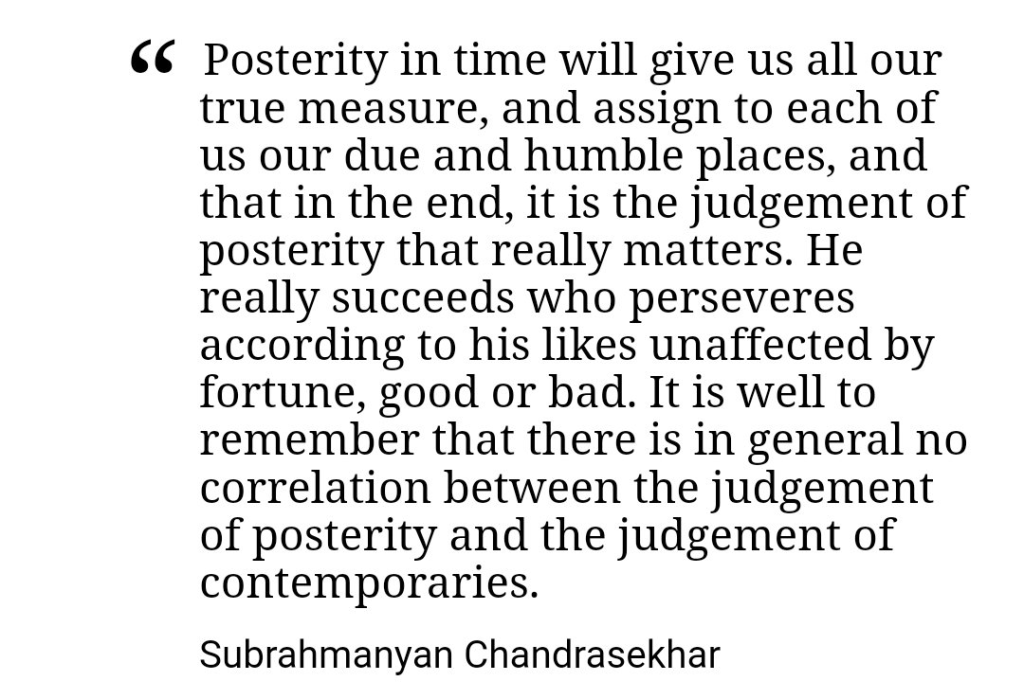
One of my all time fav. quotes. Chandra got it from Milne. Chandra had great temperament for scholarly work, & one can learn a lot from his style of working. His biographer, KC Wali, was a particle physicist, & his article linked is worth reading: https://jstor.org/stable/24100199
If interested, you can listen to a podcast I did on Chandra (one of the two of the similar name)…
Paragliding…
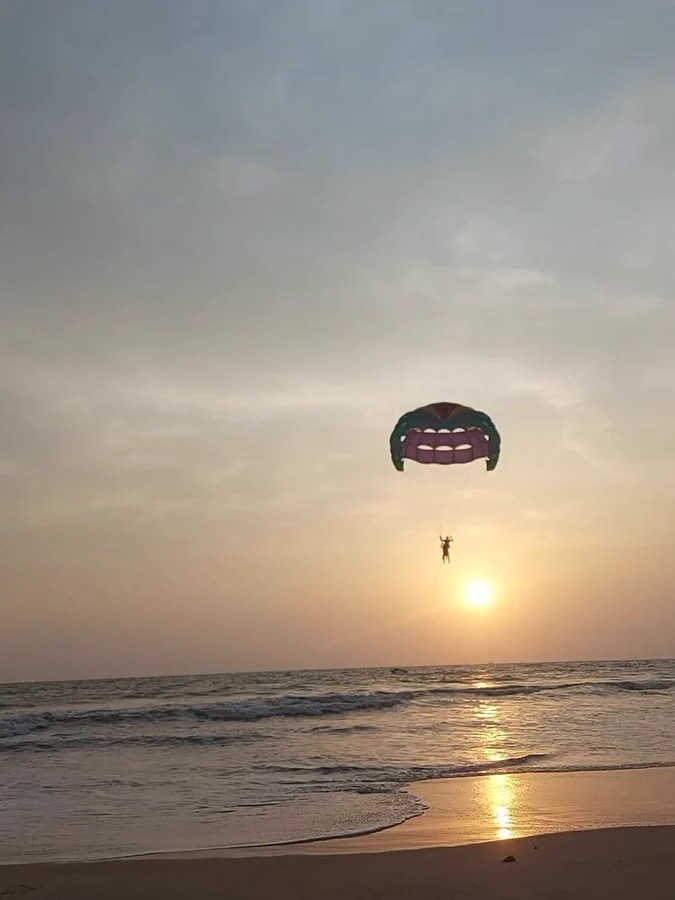
This is my daughter and me flying high on boat-assisted paragliding, circa June 2023, somewhere near North Goa…was riveting 3 minutes up in the sky…a great experience. The view towards the sun-set was great and so was the view in the opposite direction to the sun, where we could see backwaters from the top.
 VISMAYA - History & Philosophy of Physics