When Chandra wrote to Hawking

Learning is a lifelong process, and even the best researchers have to update their knowledge as and when they come across new information. Subrahmanyan Chandrasekhar was undoubtedly one of the most accomplished mathematical astrophysicists in the 20th century, and his range of topics covered almost all aspects of astrophysics.  Chandra (as he was known) was a lifelong learner, and took up new topics within astrophysics, researched them deeply, and wrote definitive books on them, which are still of great utility even today. In his research process, Chandra consulted various scholars across the world, irrespective of their age, and learned new things.

In 1967, Chandra, aged 57, wrote a letter to a 25-year-old researcher, Stephan Hawking, to learn more about his work ‘on the occurrence of singularities in cosmology’. In this letter, which is written in a desperate tone, Chandra mentions that he is grappling with some mathematical aspects of Stephen Hawking’s work and is asking him for references that he can consult to understand his papers. Chandra describes reading Hawking’s papers as  ‘climbing a staircase moving downwards’. Below, I reproduce the letter (from the University of Chicago archives).

 To this letter, Hawking dutifully replies (see below), suggesting specific books on topology and differential geometry. Hawking also suggests some of his published papers. Hawking himself downplays his knowledge of mathematical aspects related to the work, and mentions that it improved after he consulted the mentioned books. Below, I reproduce the handwritten letter (from the University of Chicago archives).

There are two aspects that are interesting to note:  one is the fact that even accomplished researchers have to learn and relearn many things as they get exposed to new information, which calls for humility and setting aside egos, and the second aspect is that ideas are built on existing ideas available at that time, and a major part of it is to learn from papers, books and of course communicating with people, as Chandra did in this case.

Science, after all, is a human endeavor.

A bit of advice…to students

To paraphrase something I tell my students, especially when they are starting a research project –

There are certainly many people in the world who think better than us. But the competition reduces when it comes to the people who take their thoughts and ‘do’ something with them. Novelty of ideas is in the novelty of connections of ideas. There is always more scope for new connections of old ideas.

Generally, the game is won not in out-thinking, but in out-doing. This does not mean that doing excludes thinking. In fact, many times, doing fosters thinking.

Conversation with Robert T. Pennock

Welcome to the podcast Pratidhvani – Humanizing Science

My guest this time is Professor Robert T. Pennock, University Distinguished Professor at Michigan State University, with appointments in Lyman Briggs College, the Department of Philosophy, and the Department of Computer Science and Engineering: https://pennock5.msu.domains/

Robert’s research explores the deep connections between science, ethics, and philosophy. His recent book, An Instinct for Truth, presents science as a moral discipline grounded in intellectual virtues like honesty, curiosity, and humility.

At the BEACON Center for the Study of Evolution in Action, he leads interdisciplinary work on digital evolution, using artificial life systems to explore questions about complexity, adaptation, and the evolution of intelligent behavior.

In this episode, we explore his intellectual journey with an emphasis on philosophy of science.

Spotify Link

References:

  1. Robert T. Pennock – University Distinguished Professor. n.d. Accessed July 15, 2025. https://pennock5.msu.domains/.
  2. Wikipedia. 2025. “Robert T. Pennock.” April 27. https://en.wikipedia.org/w/index.php?title=Robert_T._Pennock&oldid=1287698177.
  3. Pennock, Robert T. 2019. An Instinct for Truth: Curiosity and the Moral Character of Science. The MIT Press. Amazon link
  4. American Scientist. n.d. Accessed July 16, 2025. https://www.americanscientist.org/author/robert_t._pennock.
  5. American Scientist. 2025. “A Measure of Trust.” January 22. https://www.americanscientist.org/article/a-measure-of-trust.
  6. Miller, Jon D, Belén Laspra, Carmelo Polino, Glenn Branch, Mark S Ackerman, and Robert T Pennock. 2024. “Citizen Attitudes toward Science and Technology, 1957–2020: Measurement, Stability, and the Trump Challenge.” Science and Public Policy 51 (3): 526–42. https://doi.org/10.1093/scipol/scad086.

ChatGPT – an experiment

Below is a small experiment with ChatGPT (GPT-4o, which is OpenAI’s most advanced model as of July 2025).

I asked for thoughts (from authentic sources) from Indian writers on the nature of the writing process (handwriting vs typewriting).

It confidently gave me quotations from Rabindranath Tagore, R.K. Narayan and U.R. Ananthmurthy. I was intrigued, and below is my conversation:

me: list the quotes from Indian writers above and give the exact sources

Chatgpt: I couldn’t find reputable sources for the exact quotes I previously suggested by Indian writers—so it’s safer to reconsider them.

This is something I have been observing with LLM chatboxes, especially when it comes to the sources that may not be mainstream. One may even say it is hallucinating, but after enquiring further, it said:

The quotes I initially provided appear to be popular paraphrases or second-hand interpretations, but none could be verified in primary texts or reliable interviews.

Then, it asked me if I wanted to use authentic sources to be presented to corroborate the initially mentioned sources. I said yes, and below was its reply:

Here are verified quotes from Rabindranath Tagore, with clear attributions to reliable sources—unfortunately, I couldn’t locate authenticated quotes for other Indian writers on writing methods

The quotes that it gave were peripheral to my initial question. It identified two to three quotations, but none of them were directly connected to my initial query.

There may be at least 2 hypotheses that I can draw from this, which need further testing:

  1. ChatGPT and its kind may be getting trained more intensely on sources that are mainly anglophonic, and its geographical distribution of sources may be skewed. Online literary sources from countries such as India may not be as dense as, say USA, the UK or even some European countries. Will depositing more authentic sources online, including their translations, help the authentic discovery of information from countries such as India?
  2. With the current developments and model training, there may already be a bias in the answers that LLM chatbots give. It may reinforce many viewpoints from Western repositories that may sometimes be disconnected or irrelevant to the user outside Western geographies. In that sense, new information is being built on old information. Are we entering a stage where data deposition asymmetry is creating an asymmetry of discovery?

I know these questions are not trivial to answer, but for LLM chatboxes to be authentic, they need to address questions with proper citations. I know some of them are trying to do that (eg, perplexity AI), but I find the links it provides for certain focused questions are not up to the mark.

My inference:

  1. I am cautiously optimistic about the developments and achievements in source-based LLM interfaces, especially when you feed an authentic source (eg, NotebookLM).
  2. But LLM chatboxes may be hyped when:
    • It comes to its capability of sourcing authentic information, and
    • The immediacy of replacements of existing knowledge systems.
  3. LLM chatboxes should be treated as an experimental tool for utilitarian tasks where the information can be verified independently.
  4. It is important to take the bottom line of ChatGPT seriously: ‘ChatGPT can make mistakes. Check important info.

Conversation with Shubashree Desikan

In this episode, we discuss Shubashree’s journey from earning a PhD in physics to building a career in science journalism. She talks about her experiences writing for The Hindu and her current role as Associate Editor at IIT Madras’ Shaastra magazine. As a national award-winning journalist, Shubashree shares insights into making scientific ideas accessible to a wider audience, the challenges she has faced in the field, and her advice for aspiring science writers. This conversation explores her career transition, the role of science communication, and the importance of clarity in sharing scientific knowledge.

REFERENCES:

“Star Stories | Science Is Perspective.” n.d. Accessed June 24, 2025. https://shubadesikan.wordpress.com/.

“(1) Shubashree Desikan | சுபா (@Shubawrite) / X.” 2025. X (Formerly Twitter). April 4, 2025. https://x.com/shubawrite.

“(5) Shubashree Desikan | LinkedIn.” n.d. Accessed June 24, 2025. https://www.linkedin.com/in/shubadesi/?originalSubdomain=in.

Shubashree. 2025. “When Entanglement Reaches for the Stars.” Star Stories (blog). April 3, 2025. https://shubadesikan.wordpress.com/2025/04/03/when-entanglement-reaches-for-the-stars/.

“Shubashree Desikan.” n.d. The Hindu. Accessed June 25, 2025. https://www.thehindu.com/thread/author/Shubashree-Desikan-336/.

More is Different – A Brief Overview

P.W. Anderson (image from wikipedia)

In 1972, P. W. Anderson wrote what is considered one of the most remarkable essays in the history of physics, and the title of that essay is “More is Different.” In the essay, Anderson was trying to make a case for emergence, where new, interesting physical properties can emerge by the combination of matter, which you would not anticipate if you had just kept it as an individual entity.

One of the aspects related to this essay is also the thought that reductionism has its limitations and that groups act very differently compared to individuals. The higher-level rules that can emerge from the combination of small entities are actually very different from the rules that are applicable to individual entities.

For example, if you consider electrons in a solid, you have the emergence of properties of electrons such as magnetism or superconductivity, or, for that matter, putting molecules inside a compartment and, lo and behold, life arises out of that. This has turned out to be one of the most influential ways of thinking in physics because it opened up a new avenue for understanding complex systems not as just combinations of simple systems but as the emergence of properties.

Very interestingly, this essay does not actually mention the word “emergence” at all, but the concept is so fascinating that it has turned out to be one of the most influential essays ever written in physics. The whole point about this particular essay is that the whole is more than the sum of its parts, and P. W. Anderson has to be remembered for this magnificent essay.

Good books : Bohren & Huffman

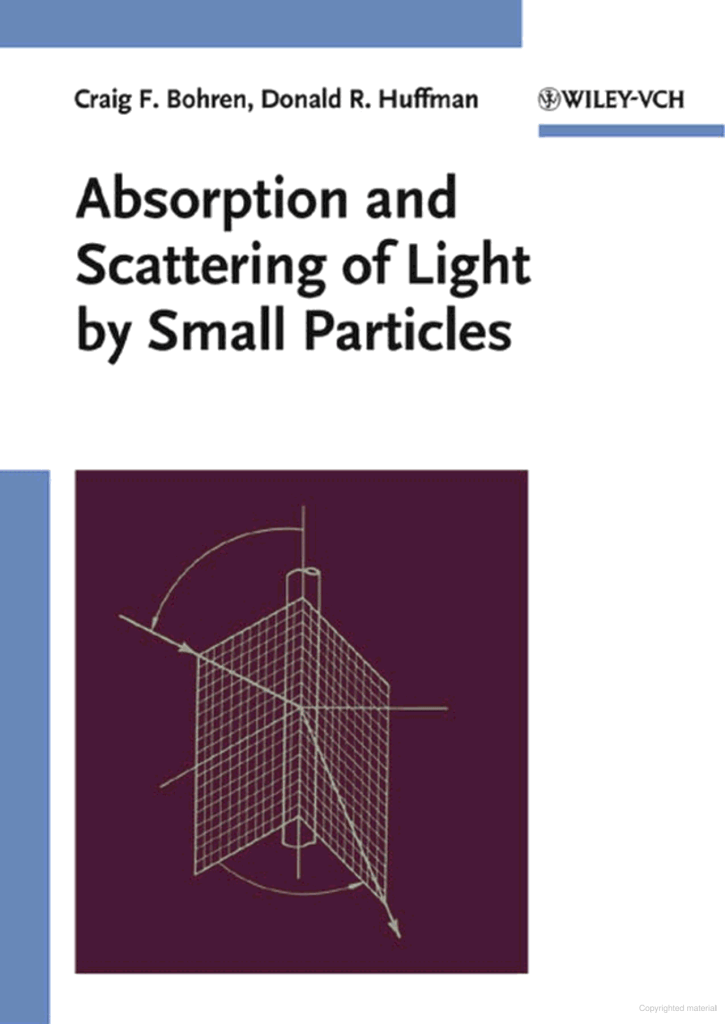
Cover of ‘Absorption and Scattering of Light by Small Particles’ by Craig F. Bohren and Donald R. Huffman.

It is important to read good books. Astrophysics, quantum mechanics, and gravity (including attempts to combine them with quantum mechanics) have been at the forefront in terms of popular physics imagination. These are wonderful subtopics of physics, but there are a few others that need equal emphasis. So, here is my attempt to fill this gap with some book recommendations.

The first one in the optics community is just called ‘Bohren and Huffman’ and is one of the best technical books I have read and continue to read. It is humorous and filled with wonderful insights that still engage researchers and students alike.

Craig Bohren, a theoretical physicist, is a wonderful writer, and you will see more of his books discussed here.

The book introduces the scattering matrix from a ‘light scattering’ viewpoint, and has a direct connection to laboratory measurements.

Humour is one of the key aspects of this book (as with others from Bohren), and the title of chapter 8 gives a nice glimpse:
“A Potpourri of Particles”

There is a famous section in Chapter 11 with the heading – “Extinction = Absorption + Scattering” that wonderfully explains the physics behind it.

Overall, an outstanding book for understanding optics from an electromagnetics viewpoint and also to learn how electromagnetism is harnessed to understand interactions at the classical spatio-temporal scales.

Read this if you are interested in physics…It is a delight!


In audio-visual form:

15 years at IISER Pune – Journey so far

Today, I complete 15 years as a faculty member at IISER-Pune. I have attempted to put together a list of some lessons (based on my previous writings) that I have learnt so far. A disclaimer to note is that this list is by no means a comprehensive one, but a text of self-reflection from my viewpoint on Indian academia. Of course, I write this in my personal capacity. So here it is..

  1. People First, Infrastructure Next
    As an experimental physicist, people and infrastructure in the workplace are of paramount importance. When I am forced to prioritize between them, I have chosen people over infrastructure. I am extremely fortunate to have worked with, and continue to work with, excellent students, faculty colleagues, and administrative staff members. A good workplace is mainly defined by the people who occupy it. I do not neglect the role of infrastructure in academia, especially in a country like India, but people have a greater impact on academic life.
  2. Create Internal Standards
    In academia, there will always be evaluations and judgments on research, teaching, and beyond. Every academic ecosystem has its own standards, but they are generalized and not tailored to individuals. It was important for me to define what good work meant for myself. As long as internal standards are high and consistently met, external evaluation becomes secondary. This mindset frees the mind and allows for growth, without unnecessary comparisons.
  3. Compare with Yourself, Not Others
    The biggest stress in academic life often arises from comparison with peers. I’ve found peace and motivation in comparing my past with my present. Set internal benchmarks. Be skeptical of external metrics. Strive for a positive difference over time.
  4. Constancy and Moderation
    Intellectual work thrives not on intensity alone, but on constancy. Most research outcomes evolve over months and years. Constant effort with moderation keeps motivation high and the work enjoyable. Binge-working is tempting, but rarely effective for sustained intellectual output.
  5. Long-Term Work
    We often overestimate what we can do in a day or a week, and underestimate what we can do in a year. Sustained thought and work over time can build intellectual and technical monuments. Constancy is underrated.
  6. Self-Mentoring
    Much of the academic advice available is tailored for Western systems. Some of it is transferable to Indian contexts, but much of it is not. In such situations, I find it useful to mentor myself by learning from the lives and work of people who have done extraordinary science in India. I have been deeply inspired by many people, including M. Visvesvaraya, Ashoke Sen, R. Srinivasan, and Gagandeep Kang.
  7. Write Regularly—Writing Is Thinking
    Writing is a tool to think. Not just formal academic writing, but any articulation of thought, journals, blogs, drafts, clarifies and sharpens the mind. Many of my ideas have taken shape only after I started writing about them. Writing is part of the research process, not just a means of communicating its outcomes.
  8. Publication is an outcome, not a goal Publication is just one outcome of doing research. The act of doing the work itself is very important. It’s where the real intellectual engagement happens. Focus on the process, not just the destination.
  9. Importance of History and Philosophy of Physics
    Ever since my undergraduate days, I have been interested in the history and philosophy of science, especially physics. Although I never took a formal course, over time I have developed a deep appreciation for how historical and philosophical perspectives shape scientific understanding. They have helped me answer the fundamental question, “Why do I do what I do?” Reflecting on the evolution of ideas in physics—how they emerged, changed, and endured—has profoundly influenced both my teaching and research.
  10. Value of Curiosity-Driven Side Projects
    Some of the most fulfilling work I’ve done has emerged from side projects, not directly tied to funding deadlines or publication pressure, but driven by sheer curiosity. These projects, often small and exploratory, have helped me learn new tools, ask new questions, and sometimes even open up new directions in research. Curiosity, when protected from utilitarian pressures, can be deeply transformative.
  11. Professor as a Post-doc
    A strategy I found useful is to treat myself as a post-doc in my own lab. In India, retaining long-term post-docs is difficult. Hence, many hands-on skills and subtle knowledge are hard to transfer. During the lockdown, I was the only person in the lab for six months, doing experiments, rebuilding setups, and regaining technical depth. That experience was invaluable.
  12. Teaching as a Social Responsibility
    Scientific social responsibility is a buzzword, but for me, it finds its most meaningful expression in teaching. The impact of good teaching is often immeasurable and long-term. Watching students grow is among the most rewarding experiences in academia. Local, visible change matters.
  13. Teaching Informally Matters
    Teaching need not always be formal. Informal teaching, through conversations, mentoring, and public outreach, can be more effective and memorable. It is free of rigid expectations and evaluations. If possible, teach. And teach with joy. As Feynman showed us, it is a great way to learn.
  14. Foster Open Criticism
    In my group, anyone is free to critique my ideas, with reason. This open culture has been liberating and has helped me learn. It builds mutual respect and a more democratic intellectual space.
  15. Share Your Knowledge
    If possible, teach. Sharing knowledge is a fundamental part of academic life and enriches both the teacher and the learner. The joy of passing on what you know is priceless.
  16. Social Media: Effective If Used Properly
    Social media, if used responsibly, is a powerful tool, especially in India. It can bridge linguistic and geographical divides, connect scientists across the world, and communicate science to diverse audiences. For Indian scientists, it is a vital instrument of outreach and dialogue. My motivation to start the podcast was in this dialogue and self-reflection.
  17. Emphasis on Mental and Physical Health
    In my group, our foundational principle is clear: good health first, good work next. Mental and physical well-being are not optional; they are necessary conditions for a sustainable, meaningful academic life. There is no glory in research achieved at the cost of one’s health.
  18. Science, Sports, and Arts: A Trinity
    I enjoy outdoor sports like running, swimming, and cricket. Equally, I love music, poetry, and art from all cultures. This trinity of pursuits—science, sports, and the arts—makes us better human beings and enriches our intellectual and emotional lives. They complement and nourish each other.
  19. Build Compassion into Science
    None of this matters if the journey doesn’t make you a better human being. Be kind to students, collaborators, peers, and especially yourself. Scientific research, when done well, elevates both the individual and the collective. It has motivated me to humanize science.
  20. Academia Can Feed the Stomach, Brain, and Heart
    Academia, in its best form, can feed your stomach, brain and heart. Nurturing and enabling all three is the overarching goal of academics. And perhaps the goal of humanity.

My academic journey so far has given me plenty of reasons to love physics, India and humanity. Hopefully, it has made me a better human being.

Kyoto digital archives 01 – Yukawa’s book

Duff’s famous physics textbook from 1900 (5th edition) owned by Yukawa
Yukawa’s name on the book
Hideki Yukawa’s picture on the Nobel website

Apart from sipping the wonderful Japanese coffee and exploring the streets of Kyoto on foot, I have been looking into the archives of Kyoto University. I am mainly searching for records and books related to their physics department, and obviously, one of the names that pops out very often is Hideki Yukawa.

Yukawa was one of the Nobel laureates from this university. He obtained his Nobel Prize in Physics in 1949 for his prediction of the existence of mesons on the basis of theoretical work on nuclear forces. He is a big name in physics, and there is a physical potential named after him, which means one can understand the intellectual heft he carries as a physicist. Yukawa spent most of his scientific career at Kyoto, specifically at the Kyoto Imperial University (now, no more imperial :-) ), and is regarded as one of the inspirations for a battery of many excellent theoretical physicists to have emerged out of not only Kyoto but also Japan, and perhaps many parts of the world.
While looking through the archival records, I came across one of the textbooks owned by Yukawa, which has his signature on it. It made my day !

The textbook titled “A Text-Book of Physics,” edited by A. Wilmer Duff, is a classic. Yukawa had the 5th edition (1921), and this book went on to have 3 more editions. I hope to write more about this particular textbook because the author, Wilmer Duff, had a connection to Madras University (as a Professor) in India and was also on the faculty of my post-doc alma mater – Purdue University !

The scientific world is a small place with unanticipated, wonderful connections :-)