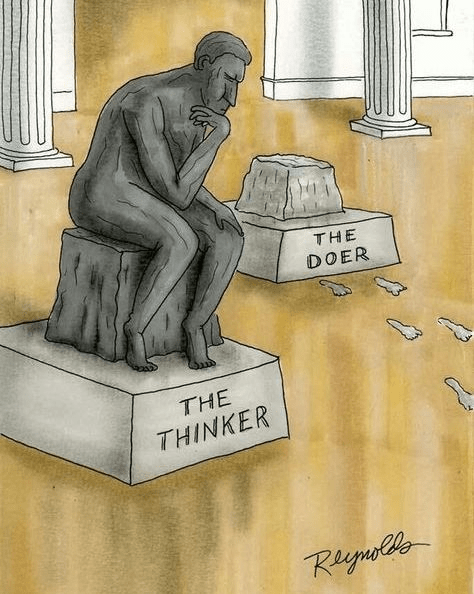
This image is a modern perception of ‘bias for action’ and is extensively used in advertisements. It frames thinking and doing as mutually exclusive tasks. In doing so, it takes a potshot at thinking as an activity.
Why is thinking not popular? Probably because taking time to think delays a decision. In commercial terms, it means the consumer does not ‘buy’ instantaneously, and hence affects the commerce.
But why not consider ‘doing’ as a good thing? Indeed, doing is important, and that is how the world moves. But the point here is to criticize ‘doing without thinking’. The world has many examples of this kind of ‘action without thinking’. The argument is that we can adapt as we go forward with the action. The problem with this approach is that it does not work without a reversibility clause. It works fine for actions that can have reversible consequences. If such a clause is absent, then you are forced to work on new problems that you are not prepared for.
One of the important issues to be addressed in recent (AI-driven) times is: how can research scholars acquire knowledge and simultaneously contribute to and communicate with society? Related to this question is: What is the role of scholarship in contemporary times?
Below are three thoughts that I wrote mainly with young researchers in mind. I am hoping that it may find use even among others.
1) Pursuit and utility of knowledge is the primary task of a scholar, and managing the perception of that knowledge is secondary. This means a scholar should use a majority of their time, resources and energy in enhancing scholarly knowledge, and in cases where there is utility, applying that knowledge in the outside ‘noisy’ world. This is your personal knowledge based on your efforts and experiences, and cannot be replaced instantaneously. This also brings uniqueness. Once you have this, you can venture into creating a realistic perception of your knowledge. Remember that learning and researching, to a large extent, are under your control; whereas how the outside world perceives your knowledge is not. Therefore, it would be prudent to pay more attention to learning and doing rather than creating a perception. Note that I am not saying that perception is unimportant. All I am saying is that perception is secondary in importance.
2) One of the key learnings in research and education is that the world is always open to good knowledge and ideas, be it in academia or industry. People are always interested in interacting with and hiring people with a sound knowledge base. It may take a while for somebody to discover your knowledge, but if you have a strong foundation and then go out to the world and interact with it, it is very difficult for the world to ignore you. This means that, having done good work, you should be able to share that work with the outside world. This can be a research paper or an engineering prototype, or any form of science, art or talent that you have. The crucial point here is to first do the hard work and then venture into the sharing of that work.
3) In your work, do not compromise on rigor. If you are a researcher, your first commitment should be towards addressing your scholarly peers or the specialized industry and then broadening your communication. Within scholarly communication, you will have to address questions within the research community. This means you will be basing your work on a large body of knowledge and subjecting yourself to internal and external criticism. This is where rigor comes in handy. Here, rigor does not mean unclear communication. It means to have thought through the questions, nuances and complications of a problem and have a broad and balanced view of the research problem. The general audience sometimes perceives rigorous scholarly communication as filled with jargon and complications. Therefore, it is always better to create two versions of your work: one for your peers and one for the general audience. In the age of AI, the second version is easier to create. Remember that your expertise will be vital in creating the second version for the general audience. That is where you can bring your authenticity and creativity. This can also broaden the scope of your knowledge without compromising your scholarship.
These are a few fleeting thoughts. You can criticize, edit, expand and adapt it to make your own version of it. After all, that is how knowledge moves forward 😊
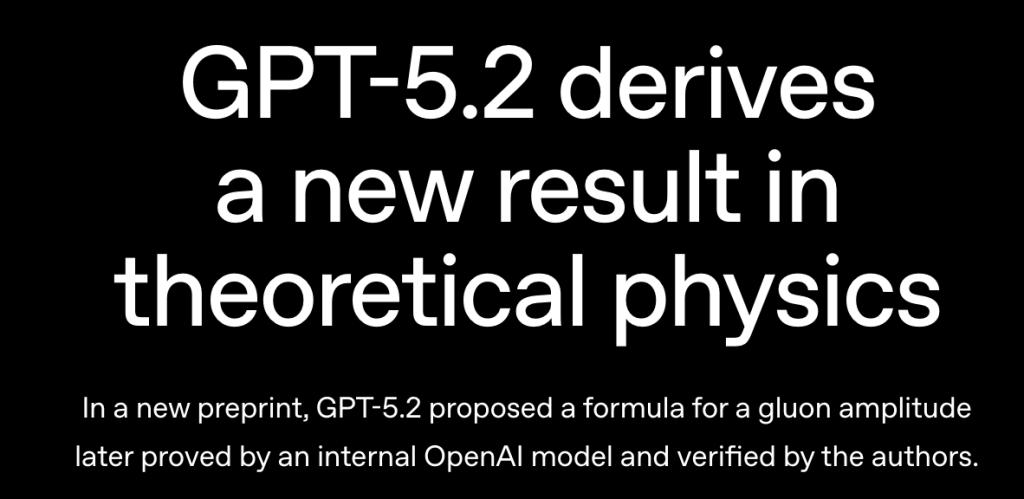
The above snapshot is from OpenAI, which has claimed to have derived a new result in theoretical physics. What is it about, and how good are the claims? Below, I discuss them.
Let me start with some background. Except for the hydrogen atom, the nucleus of all elements in the periodic table consists of neutrons and protons. Neutrons and protons are made of quarks. Quarks interact through gluons. How do these gluons interact? This is a contemporary question.
In this particular case, the authors of the study say: “We’ve published a new preprint showing that a type of particle interaction many physicists expected would not occur can, in fact, arise under specific conditions. The work focuses on gluons, the particles that carry the strong nuclear force.”[1]
The interaction can be computed in terms of probabilities[2], and these probabilities depend on quantum mechanical amplitudes (also called scattering amplitudes). Finding these amplitudes requires a deeper knowledge of strong nuclear forces. Computing such amplitudes is expensive and requires a lot of effort. Physicists, under physical constraints, take a guess on which interaction is more probable and which is not. This study shows that one of the interactions that physicists thought was not probable turns out to be probable, but under specific conditions. “The preprint studies a central concept in particle physics called a scattering amplitude. A scattering amplitude is the quantity physicists use to compute the probability that particles interact in a particular way. …….One case, however, has generally been treated as absent (having zero amplitude)……..As a result, this configuration has largely been set aside. The preprint shows that this conclusion is too strong.”[1]
Of course, this has been possible using the brute force computational capability of the GPT 5.2 model, and it has come up with a particular formula that shows the amplitude to be probable and has further validated it with a formal proof. It is a methodological breakthrough, and the authors claim, “An internal scaffolded version of GPT‑5.2 then spent roughly 12 hours reasoning through the problem, coming up with the same formula and producing a formal proof of its validity.” [1]
I think it is a good development in computational physics and helps in calculating parameters that have relevance in finding probabilities of interaction in particle physics. Overall, my hunch is that it is an important step in computational physics.
Notes:
[1] OpenAI has put out an excellent summary of this problem (without jargon), and it needs basic physics, and the flow of text is good.
Below are a couple of paragraphs that caught my attention:
“Scientific understanding and scientific discovery are both important aims in science. The two are distinct in the sense that scientific discovery is possible without new scientific understanding….
…..to design new efficient molecules for organic laser diodes, a search space of 1.6 million was explored using ML and quantum chemistry insights. The top candidate was experimentally synthesized and investigated. Thereby, the authors of this study discovered new molecules with very high quantum efficiency. Whereas these discoveries could have important technological consequences, the results do not provide new scientific understanding.”
The authors provide two more examples of a similar kind, from different branches of science.
The authors conclude:
“Undoubtedly, advanced computational methods in general and in AI specifically will further revolutionize how scientists investigate the secrets of our world. We outline how these new methods can directly contribute to acquiring new scientific understanding. We suspect that significant future progress in the use of AI to acquire scientific understanding will require multidisciplinary collaborations between natural scientists, computer scientists and philosophers of science. Thus, we firmly believe that these research efforts can — within our lifetimes — transform AI into true agents of understanding that will directly contribute to one of the main goals of science, namely, scientific understanding.”
Nice.. thanks for sharing, will go through it. Although a lot of brute force seems to be passed off as understanding these days (brawn = brain?) I wonder if AI and ML of the varieties we have today are advancements in computing or intelligence?
My reply:
The computational capability is undoubtedly great, and probably the coding/software domain has been conquered, but there is a tendency to extrapolate the immediate impact of AI to every domain of human life, where even basic tech has not made an impact. That needs deeper knowledge of interfacing AI with other domains of engineering. Embedding AI in the virtual domain is one thing, but to put it in the real world with noise is a different game altogether. That needs interfacing with the physical world, and there is also an energy expense that doesn’t get factored into the discussion. It has great potential, and I’m eager to see its impact on the physical infrastructure. Parallelly, it is interesting to see how it has been sold in the public domain.
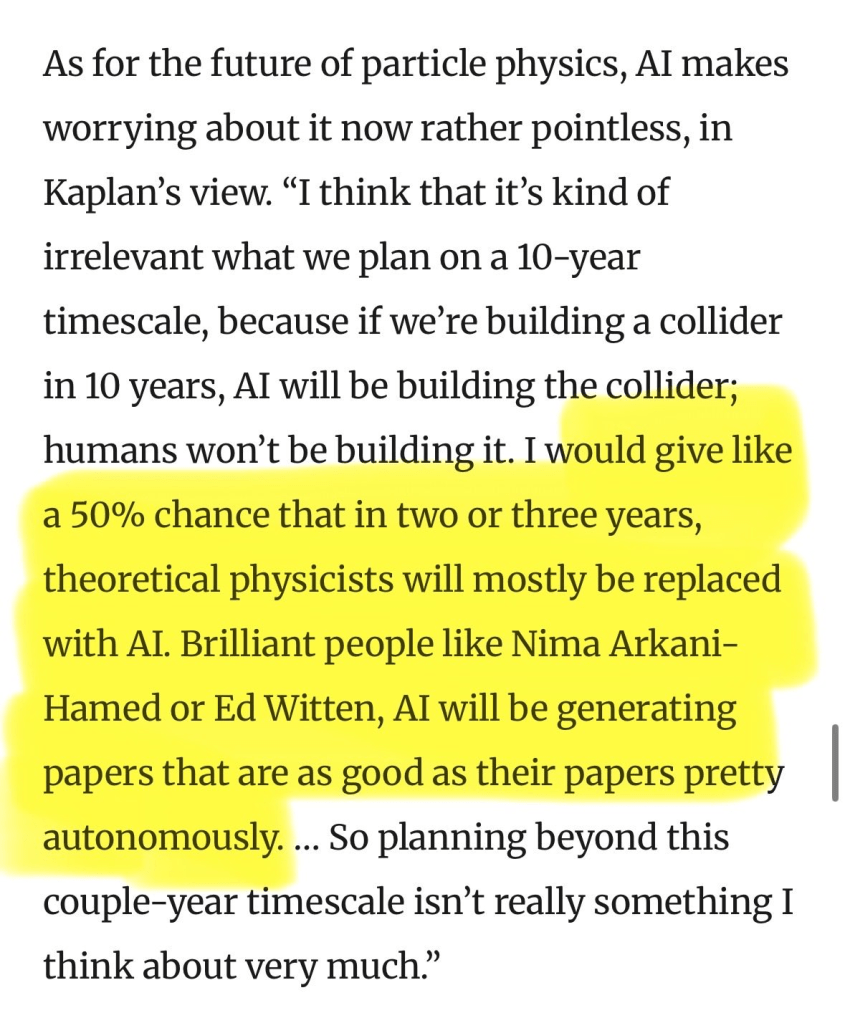
Recently, anthropic co-founder Jared Kaplan, who has a background in physics, made the following comment, which was circulated on X. Below is the excerpt:
Below is my response:
A Remarkable Human Being = Remarkable Attribute(s) + Human Being
The first term in the RHS can be replaced by AI, but not the second term, for the following reasons.
Machines, including AI, can surely change the way humans think, work and live, but it will be difficult to match human connection. A machine can enhance human life, but can it inspire a human life?
People inspire people. Ask a child or any adult who inspires them. It will generally be a fellow human being. Machines add value, but human beings represent a valuable life. We utilize the former, and get inspired by the latter. It is this inspiration that propels people forward to do things that may further turn out to be remarkable. This contribution is not easily quantified, but it is hard to gauge a human life without inspiration.
People like Ed Witten, Ashoke Sen and Terry Tao add value to humanity not only through their work and ideas, but their lives show that human beings can think and do something remarkable. It assures human beings that, individually, our species can do something good. Human beings derive meaning by interacting with fellow human beings and are inspired by the interaction. They also get inspired and draw meaning by studying people from the past. A human’s search for meaning and purpose is always in the background of other human beings. We are 8 billion plus, and it is hard to ignore each other.
It will be very unusual to find a serious student of theoretical physics who says I am inspired to live by ‘ChatGPT’.
Probably a young Kaplan, too, was inspired by a fellow human being! So, my question to Mr. Kaplan. Who inspired you to do physics?
In reference to a recent article on higher education in the Economic Times, a well-known tech entrepreneur and philanthropist wrote the following on X/Twitter: “75% of Indian higher education institutions still not industry-ready. Lot of work left to transform. But the 21st century requires education, research, innovation, and startups as four pillars of a university.”
This is a thought I do support, but I think there is one more important meta-pillar, perhaps a ‘foundation’ on which all these pillars are standing, and that is called ethics. Below are five aspects of ethics that I think need further attention.
If one observes some of the major contemporary and pressing problems in our world, they can be connected to the ethical aspects of how humans function. A vital part of our educational system should re-emphasize this connection and make it central to everything that is done in a society.
Ethics has two important elements to it: first, it has a philosophical grounding and connects to how humans function in a society. Second, it has an important connection to how trust in a society can be developed. Most of the discussions on ethics generally focus on the first element from a morality perspective, whereas the second point has an equally important utility and an economic connection.
Ethical principles have great utility. It is important that we never keep it as an implicit aspect of human endeavour. Instead, we should start everything on the ethical grounds and build it up from there, including businesses, because a strong ethical foundation probably would be the best thing to happen for economic progress in any society, because trust is so important among human beings, and it is one thing that probably brings humans together. In the long run, the meaning of ‘prosper’ critically depends on the meaning of ethics. Being prosperous without being ethical is detrimental to any human pursuit. Zero-sum games are exciting, but in the limit of many games, the number of people who lose will be far more than the people who win. Instead, cooperative games have much larger dividends to all players and are inherently connected to a concept called as double thank you moment.
The philosophy of ethics is something which the world has to revisit in greater detail, especially in an era where technological implications are driving human life in directions which we have not anticipated. One may think that raising ethical issues might hinder progress, but my argument here is that, instead of hindrance, one should look at it as an important requisite for human societies to not only survive but also to flourish. Large human endeavours cannot sustain without trust, and that trust is reinforced through ethical behaviour.
Without ethical implications being factored in, it would be hard to really design anything related to technology. A case in point is the social media restrictions in countries such as Australia. Technology has the amazing capability to move fast before the philosophical debates can come in, but it does not mean that philosophy has to be completely ignored. The downstream of a scientific idea can become a product in a market, and positively impact society, but this evolution has a fellow-traveller, and that is ethics. The feedback loop is incomplete without the ethical considerations, and therefore, it should be looked at as an important ingredient in any human design.
There is an inherent connection between cooperation and trust, and that is founded on an ethical principle. The world requires an ethical recap, and it should be part of individuals, institutions, and governments. There is a rich history of ethics in all the cultures across the world, and it is worth revisiting them in a new light. Perhaps it is high time that we “Make Ethics Great Again.”
Yesterday evening (10th Jan 2026), Shubhanshu Shukla, the recent Indian astronaut, was at IISER Pune as part of the ‘India Science Festival’. There was a huge crowd gathered to see and listen to him. Within IISER, it is rare to see such a massive gathering for a science event, and it was heartening to witness this on a Saturday evening. Thanks to schools and colleges in Pune, science and science-related activities get traction from the people of Pune (especially younger people). They enthusiastically participate in many events related to science.
Such a gathering is very important for at least three reasons:
It connects a scientifically oriented person to the public and thereby connects them to science.
It showcases that there is some science-related activity happening within the Indian scene.
It sends out a message to people that icons can be created out of people who do science funded by the public.
I would want to emphasize four other points:
Scientific icons are as good as the science they represent. A major part of the credit should go to the organizations that supported and trained him, and this includes ISRO, NASA and the Indian Air Force.
To put an astronaut in space, it takes a lot of effort at various levels of society. Public support is vital for such an effort. Public icons such as Shubhanshu Shukla are a good representation of what investment in science can do to the morale of the public, especially for young people.
The created momentum should not be lost, given that recognizable people, such as astronaut Shubhanshu Shukla, have made an imprint on young people. This should be followed up with measures to recruit them for science and technology.
Space science and technology, astronomy and astrophysics have always been among the most fascinating domains to attract people into science. Many Indian scientists and a past astronaut, Rakesh Sharma, have played an important role in this pursuit. One should not forget them.
Let me conclude with a word of appreciation for Pune city. It is not a capital city, but its enthusiasm for intellectual pursuits is high, and it attracts a lot of enterprising people (recently, there was a public policy conference that had some amazing people). If it can get a lift in its public infrastructure, it can create its own path in the landscape of science and technology.
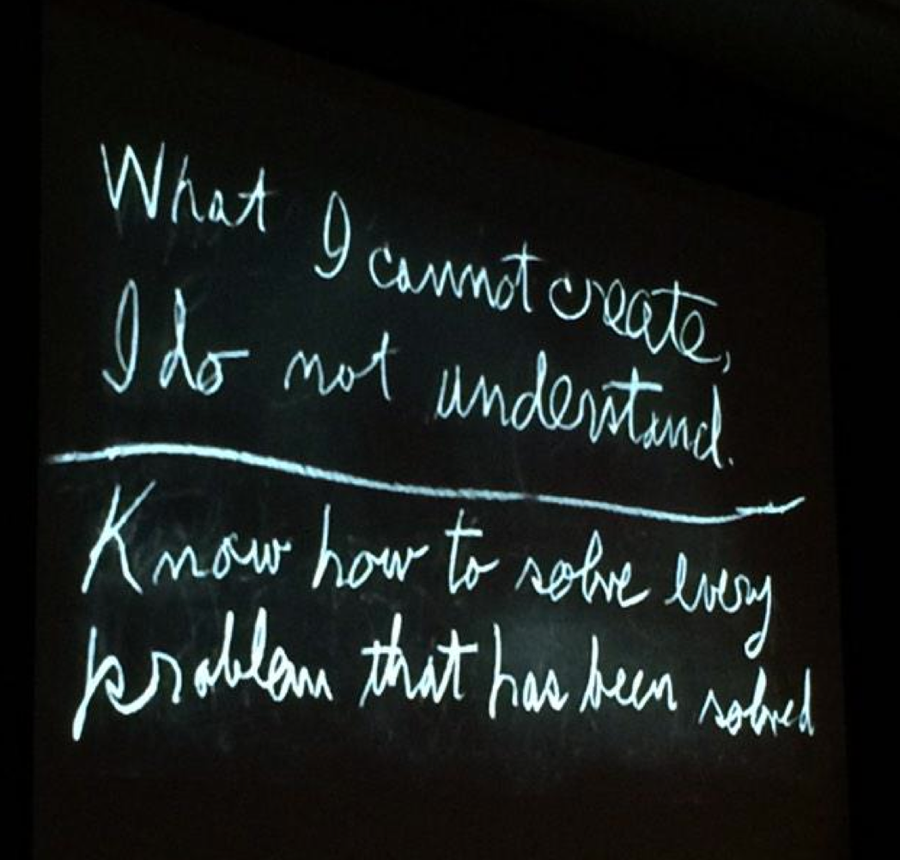
The first of these quotes by Feynman is a guiding principle for anyone who wants to learn. The second quote is an idealistic one, but a good approach to becoming a ‘problem-solving’ researcher. Feynman was a master of this approach.
From a philosophy of science perspective, researchers can be both ‘problem creators’ and ‘problem solvers’. The latter ones are usually famous.
Michael Nielsen, a pioneer of quantum computing and champion of open science movement, has an essay titled: Principles of Effective Research, in which he explicitly identifies these two categories of researchers, and mentions that “they’re not really disjoint or exclusive styles of working, but rather idealizations which are useful ways of thinking about how people go about creative work.”.
He defines problem solvers as those “who works intensively on well-posed technical problems, often problems known (and sometimes well-known) to the entire research community in which they work.” Interesting, he connects this to sociology of researchers, and mentions that they “often attach great social cache to the level of difficulty of the problem they solve.”
On the other hand, problem creators, as Nielsen indicates, “ask an interesting new question, or pose an old problem in a new way, or demonstrate a simple but fruitful connection that no-one previously realized existed.”
He acknowledges that such bifurcation of researchers is an idealization, but a good model to “clarify our thinking about the creative process.”
Central to both of these processes is the problem itself, and what is a good research problem depends both on the taste of an individual and the consensus of a research community. This is one of the main reasons why researchers emphasize defining a problem so much. A counterintuitive aspect of the definition of the problem is that one does not know how good the ‘question’ is until one tries to answer and communicate it to others. This means feedback plays an important role in pursuing the problem further, and this aptly circles back to Feynman’s quote: “What I cannot create, I do not understand”.


 VISMAYA - History & Philosophy of Physics