Quantum States in Argand Diagrams: vacuum, coherent, and squeezed

If you need to admire complex analysis for its elegance and visual utility, try quantum optics. Specifically, the description of quantum states. Thanks to creation and annihilation operators, the position and momentum states of a quantum optical field can be represented as quadratures. These entities can now be represented on the orthogonal axes of a complex plane. The representation of Argand diagrams starting with a classical electromagnetic field and then extrapolating them to quantum theory is a tribute to its geometrical representation. The fact that two axes can be utilized to represent real and imaginary parts of the defined state is itself an interesting thing. By certain operations within the plane, one can realize the vacuum state, the coherent state, and the squeezed state of quantum optics.

The Vacuum Spread – One of the major consequences of quantum theory, and especially the second quantization, is the realization of the vacuum states. Even when there are zero photons, there is a residual energy in the system that manifests as vacuum states. How to define the presence or absence of a photon is a different proposition because vacuum states are also associated with something called virtual photons. That needs a separate discussion. Anyway, in a complex plane of quadrature, a vacuum state is represented by a circular blob and not a point (see fig. 1). It is the spread of the blob that indicates the uncertainty. In a way, it is an elegant representation of the uncertainty principle itself because the spread in the plane indicates the error in its measurement. Importantly, it emphasizes the point that no matter how low the energy of the system is, there is an inherent uncertainty in the quadrature of the field. This also forms the fundamental difference between a classical and a quantum state. The measurement of the vacuum fluctuation is a challenging task, but one of the most prevalent consequences of vacuum fluctuation is the oblivious spontaneous emission. If one looks at the emission process in terms of stimulated and spontaneous pathways, then the logical consequence of the vacuum state becomes evident in some literature on quantum optics. Spontaneous emission is also defined as stimulated emission triggered by vacuum state fluctuations. It is an interesting viewpoint and helps us to create a picture of the emission process vis-à-vis the stimulated emission.
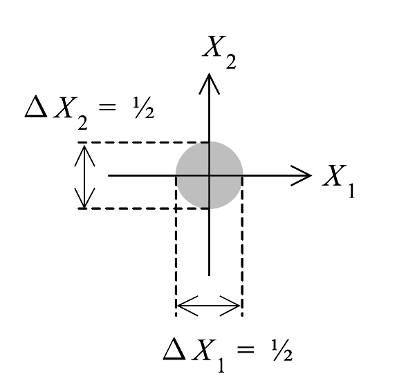
Figure 1. Vacuum state representation. Note that their centre is at the origin and has a finite spread across all the quadrants. Figure adapted from ref. 2.

Another manifestation of the vacuum state is the Casimir effect, where an attractive force is induced as you bring two parallel plates close to each other. The distance being of the order of the wavelength or below this triggers a fascinating phenomenon which has deep implications not only in understanding the fundamentals of quantum optics and electrodynamics, but also in the design and development of quantum nanomechanical devices.

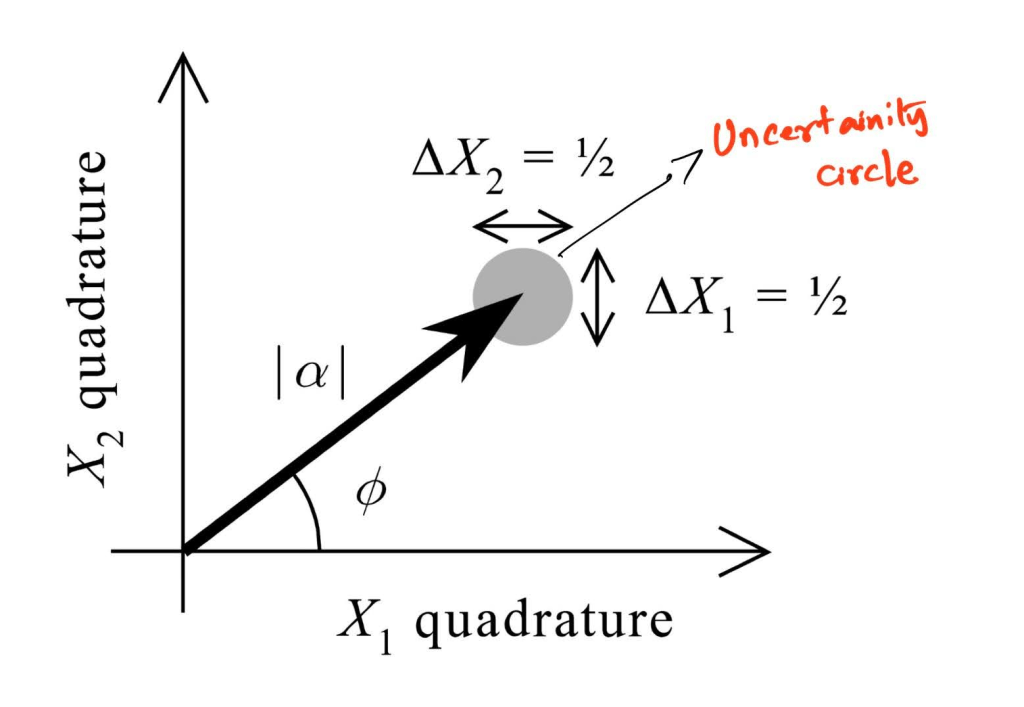
A shift in the plane – Coherent states are also described as displaced vacuum states, and this displacement is evident in the Argand diagrams. The quadrature can now help us visualize the uncertainty in the phase and the number of photons in the optical field. One of the logical consequences of the coherent state is the number-phase uncertainty. This gets clear if one observes the spread in the angle of the vector and the radius of the blob represented (see Fig. 2). Notice that the blob still exists. The only difference is that the location of the blob has shifted. The consequence of this spread has a deeper connection to the uncertainty in the average number of photons and the phase of the optical field. The connection to the number of photons is through the mod alpha, which essentially represents the square root of the average number of photons. Taken together, the blob in the Argand diagram represents the number-phase uncertainty.
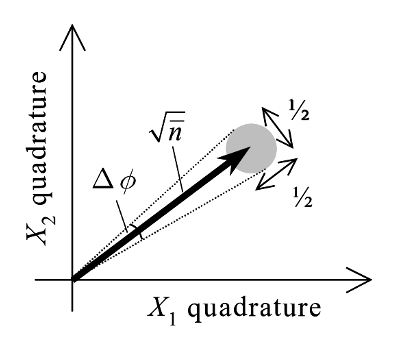
Figure 2.  Coherent state representation. Note that their centre is displaced. Figure adapted from ref. 2.

Lasers are the prototypical examples of coherent states. The fact that they obey Poissonian statistics is the direct consequence of the variance in the photon number, which is equivalent to the square root of the average number of photons. This means one can use photon statistics to discriminate between sources that are sub-Poissonian, Poissonian, or super-Poissonian in nature. The super-Poissonian case is the thermal light, and the sub-Poissonian state represents photon states whose number can reach up to 1 or 0. The coherent states sit in the middle, obeying the Poissonian statistics.

Everything has a cost – Once you have a circle with a defined area, it will be interesting to ask: Can you ‘squeeze’ this circle without changing its area? The answer is yes, and that is what manifests as a squeezed state. In this special state, one can squeeze the blob along one of the axes at the cost of a spread in the orthogonal direction. This converts the circle into an ellipse (see Fig. 3).
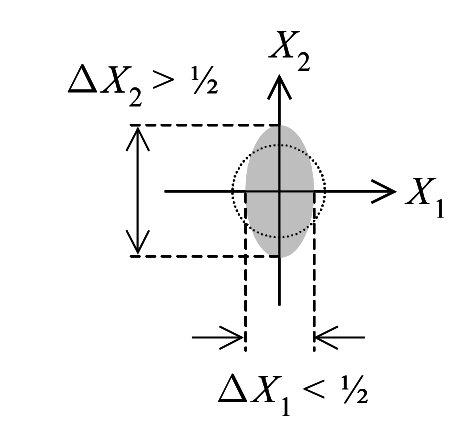
Figure 3. Squeezed State. Note the circle has been squeezed into an ellipse. Figure adapted from ref. 2.

Note that the area must be conserved, which means that the uncertainty principle still holds good; just that the reduction in the uncertainty along one axis is compensated by the increment in another. This geometrical trick has a deep connection to the behaviour of an optical field. If one squeezes the axis along the average number of photons, it means that you are able to create an amplitude-squeezed state. This means the uncertainty in the counting of photons in that state has reduced, albeit at the cost of the uncertainty in the measurement of phase. Similarly, if one squeezes the blob along the axis of the phase, then we end up with a lowering of the uncertainty for the optical phase. Of course, this comes at the cost of counting of number of photons. I should mention that the concept of optical phase itself is not clearly defined in quantum optics. This is because an ill-defined phase can have a value of 2π, which creates the problem. An interesting application of the phase-squeezed quantum states is in interferometric measurements. By reducing the uncertainty in the phase, one can create highly accurate measurements of phase shifts. So much so that this can have direct implications on high-precision measurements, including gravitational wave detection. The anticipation is also that such tiny shifts can be helpful in observing feeble fluctuations in macroscopic quantum systems.

Pictures can lead to more than 1,000 words. And if you add them to a quantum optical description, as in the case of the states that I have defined, they create a quantum tapestry. Perhaps this is the beauty of physics, where there is a coherence between mathematical language, geometrical representation, and physical reality. Feynman semi-jokingly may have said, “Nobody understands quantum mechanics,” but he forgot to add that there is great joy in the process of understanding through mathematical pictures. After all, he knew the power of diagrams.

References:

  1. Ficek, Zbigniew, and Mohamed Ridza Wahiddin. Quantum Optics for Beginners. 1st edition. Jenny Stanford Publishing, 2014.
  2. Fox, Mark. Quantum Optics: An Introduction. Oxford Master Series in Physics 15. Oxford University Press, 2006.
  3. Gerry, Christopher C., and Peter L. Knight. Introductory Quantum Optics. Cambridge, United Kingdom ; New York, NY, 2024.
  4. Saleh, B. E. A., and M. C. Teich. Fundamentals of Photonics. 2nd edition. Wiley India Pvt Ltd, 2012.

Teaching & Meaning

What adds meaning to my academic work?

Perhaps, an anonymous feedback on your teaching is one of them….

very well taught course at a well defined pace. The interesting way various different aspects and fields in Optics was introduced was fascinating, made us so very keen on knowing more! The mind maps at the beginning of every topic, the indexes professor made was a great way to keep the bigger picture in mind and helped us glide through it. The assignment was also a great way to make us go through materials without feeling it it be imposing, rather finding it more interesting! Thank you so much Sir for this amazing course, the enthusiastic way in which you taught, all the great conversations you engaged in with us, and opened our eyes to explore so much more in this field! thank you!!

I had a diverse class (BS-Physics majors, MS Quantum Tech, iPhD) with 110+ students, and I am glad a lot of students enjoyed the course this time.
I am a bit overwhelmed by the positive feedback I received on my teaching methods. For sure, I learnt about the subject as much as they did.

And as I always say: there is more to learn…for all of us..

Human interaction zindabad :-)

Quantum Optics – teaching in Jan 2026

More than 22 years ago, I started my journey as a research student in theoretical physics – Quantum Electrodynamics (QED) + Radiative Transfer (MSc summer project at the Indian Institute of Astrophysics), and my special paper in the MSc final semester was QED. Later in my PhD, I branched into experiments on light scattering (Raman, Mie & Rayleigh).

Over the years, QED and quantum optics have always been at the back of my mind while studying, researching and teaching.

Come January, I will be teaching a course on Quantum Optics to MS(Quantum Tech), MS-PhDs, and 4th-year physics UGs

I designed the first course on this topic at IISER Pune about a decade ago with the able inputs from Prof. Rajaram Nityananda, and I have taught the course a few times. Now, after a few years, I will teach it again.

With the emergence of quantum sci & tech, there is a new impetus and excitement on this topic.

Having said that, the foundations of the topic remain the same, and Quantum Optics has a wonderful history and philosophy associated with it…and where better to start than Dirac’s classic (see below).

Look out for ‘quantum blogs’ in 2026…

Random Walks in Polarization

I have been teaching polarization of light in my optics class. In there, I introduced them to matrix representation of polarization states. One of the standard references that I use for explanation is a 1954 paper in American J. Physics, by McMaster titled: “Polarization and the Stokes Parameters.”

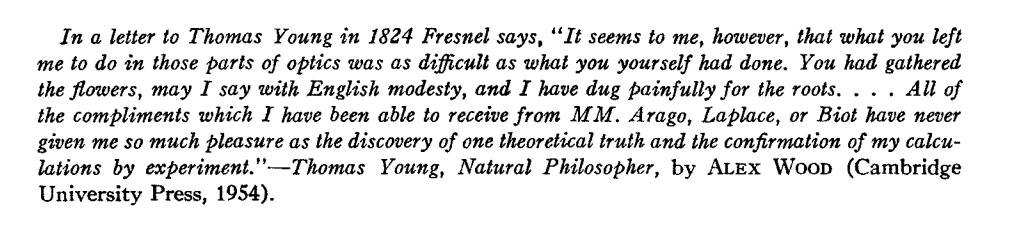
While skimming through the pdf of the journal paper, I found an excerpt from a 1954 book, which quotes Fresnel writing to Thomas Young:

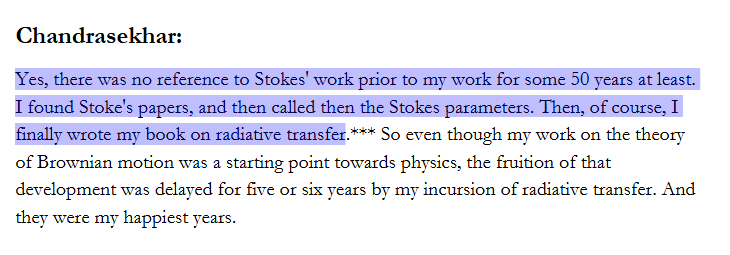
Further, I knew from the past that S. Chandrasekhar (astrophysicist) had a role in rejuvenating Stokes vector formalism in radiative transfer. Below is his description from AIP oral history archives (May 1977):

I started the sequence of papers, and almost at the time I started it, I read the paper by Wick in which he had used the method of discrete coordinates,* and I realized at once that that method can be used in a large scale way for solving all problems. So that went on. I have always said and felt that the five years in which I worked on radiative transfer [1944 – 49] is the happiest period of my scientific life. I started on it with no idea that one paper would lead to another, which would lead to another, which would lead to another and soon for some 24 papers — and the whole subject moved with its own momentum.” (emphasis added)

He further states how he rediscovered Stokes polarization vector formalism:

All this had a momentum of it own. Then suddenly I realized one had to put polarization in; the problems of characterizing polarized light — my rediscovery of Stokes original paper, writing on Stokes parameters and calling them Stokes parameters for the first time

Chandra further adds that the Stokes formalism was almost forgotten for 50 years, and he had a role in resurrecting it.

Next, there was some noise on social media where some one questioned the utility of matrix multiplication. For them, below is a wonderful review article by McMaster (again), to explore from polarization viewpoint, and realize the power of non-commutative matrix algebra:

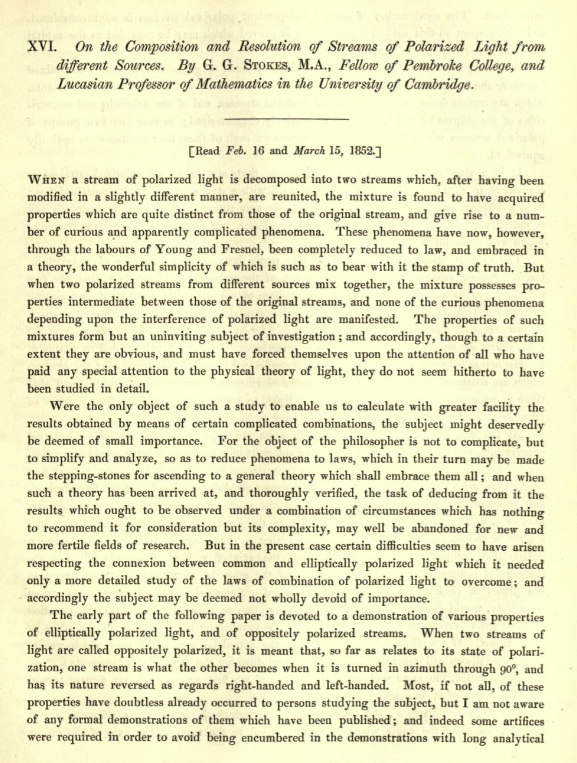
Finally, the original paper by Stokes on his formalism, which is hard to find (thanks to paywall). But, classic papers are hard to suppress, and I found the full paper on internet archives.

Below is a snapshot:

Enjoy your random walk !

15 years at IISER Pune – Journey so far

Today, I complete 15 years as a faculty member at IISER-Pune. I have attempted to put together a list of some lessons (based on my previous writings) that I have learnt so far. A disclaimer to note is that this list is by no means a comprehensive one, but a text of self-reflection from my viewpoint on Indian academia. Of course, I write this in my personal capacity. So here it is..

  1. People First, Infrastructure Next
    As an experimental physicist, people and infrastructure in the workplace are of paramount importance. When I am forced to prioritize between them, I have chosen people over infrastructure. I am extremely fortunate to have worked with, and continue to work with, excellent students, faculty colleagues, and administrative staff members. A good workplace is mainly defined by the people who occupy it. I do not neglect the role of infrastructure in academia, especially in a country like India, but people have a greater impact on academic life.
  2. Create Internal Standards
    In academia, there will always be evaluations and judgments on research, teaching, and beyond. Every academic ecosystem has its own standards, but they are generalized and not tailored to individuals. It was important for me to define what good work meant for myself. As long as internal standards are high and consistently met, external evaluation becomes secondary. This mindset frees the mind and allows for growth, without unnecessary comparisons.
  3. Compare with Yourself, Not Others
    The biggest stress in academic life often arises from comparison with peers. I’ve found peace and motivation in comparing my past with my present. Set internal benchmarks. Be skeptical of external metrics. Strive for a positive difference over time.
  4. Constancy and Moderation
    Intellectual work thrives not on intensity alone, but on constancy. Most research outcomes evolve over months and years. Constant effort with moderation keeps motivation high and the work enjoyable. Binge-working is tempting, but rarely effective for sustained intellectual output.
  5. Long-Term Work
    We often overestimate what we can do in a day or a week, and underestimate what we can do in a year. Sustained thought and work over time can build intellectual and technical monuments. Constancy is underrated.
  6. Self-Mentoring
    Much of the academic advice available is tailored for Western systems. Some of it is transferable to Indian contexts, but much of it is not. In such situations, I find it useful to mentor myself by learning from the lives and work of people who have done extraordinary science in India. I have been deeply inspired by many people, including M. Visvesvaraya, Ashoke Sen, R. Srinivasan, and Gagandeep Kang.
  7. Write Regularly—Writing Is Thinking
    Writing is a tool to think. Not just formal academic writing, but any articulation of thought, journals, blogs, drafts, clarifies and sharpens the mind. Many of my ideas have taken shape only after I started writing about them. Writing is part of the research process, not just a means of communicating its outcomes.
  8. Publication is an outcome, not a goal Publication is just one outcome of doing research. The act of doing the work itself is very important. It’s where the real intellectual engagement happens. Focus on the process, not just the destination.
  9. Importance of History and Philosophy of Physics
    Ever since my undergraduate days, I have been interested in the history and philosophy of science, especially physics. Although I never took a formal course, over time I have developed a deep appreciation for how historical and philosophical perspectives shape scientific understanding. They have helped me answer the fundamental question, “Why do I do what I do?” Reflecting on the evolution of ideas in physics—how they emerged, changed, and endured—has profoundly influenced both my teaching and research.
  10. Value of Curiosity-Driven Side Projects
    Some of the most fulfilling work I’ve done has emerged from side projects, not directly tied to funding deadlines or publication pressure, but driven by sheer curiosity. These projects, often small and exploratory, have helped me learn new tools, ask new questions, and sometimes even open up new directions in research. Curiosity, when protected from utilitarian pressures, can be deeply transformative.
  11. Professor as a Post-doc
    A strategy I found useful is to treat myself as a post-doc in my own lab. In India, retaining long-term post-docs is difficult. Hence, many hands-on skills and subtle knowledge are hard to transfer. During the lockdown, I was the only person in the lab for six months, doing experiments, rebuilding setups, and regaining technical depth. That experience was invaluable.
  12. Teaching as a Social Responsibility
    Scientific social responsibility is a buzzword, but for me, it finds its most meaningful expression in teaching. The impact of good teaching is often immeasurable and long-term. Watching students grow is among the most rewarding experiences in academia. Local, visible change matters.
  13. Teaching Informally Matters
    Teaching need not always be formal. Informal teaching, through conversations, mentoring, and public outreach, can be more effective and memorable. It is free of rigid expectations and evaluations. If possible, teach. And teach with joy. As Feynman showed us, it is a great way to learn.
  14. Foster Open Criticism
    In my group, anyone is free to critique my ideas, with reason. This open culture has been liberating and has helped me learn. It builds mutual respect and a more democratic intellectual space.
  15. Share Your Knowledge
    If possible, teach. Sharing knowledge is a fundamental part of academic life and enriches both the teacher and the learner. The joy of passing on what you know is priceless.
  16. Social Media: Effective If Used Properly
    Social media, if used responsibly, is a powerful tool, especially in India. It can bridge linguistic and geographical divides, connect scientists across the world, and communicate science to diverse audiences. For Indian scientists, it is a vital instrument of outreach and dialogue. My motivation to start the podcast was in this dialogue and self-reflection.
  17. Emphasis on Mental and Physical Health
    In my group, our foundational principle is clear: good health first, good work next. Mental and physical well-being are not optional; they are necessary conditions for a sustainable, meaningful academic life. There is no glory in research achieved at the cost of one’s health.
  18. Science, Sports, and Arts: A Trinity
    I enjoy outdoor sports like running, swimming, and cricket. Equally, I love music, poetry, and art from all cultures. This trinity of pursuits—science, sports, and the arts—makes us better human beings and enriches our intellectual and emotional lives. They complement and nourish each other.
  19. Build Compassion into Science
    None of this matters if the journey doesn’t make you a better human being. Be kind to students, collaborators, peers, and especially yourself. Scientific research, when done well, elevates both the individual and the collective. It has motivated me to humanize science.
  20. Academia Can Feed the Stomach, Brain, and Heart
    Academia, in its best form, can feed your stomach, brain and heart. Nurturing and enabling all three is the overarching goal of academics. And perhaps the goal of humanity.

My academic journey so far has given me plenty of reasons to love physics, India and humanity. Hopefully, it has made me a better human being.

Thinking in a Classroom

As I conclude my Optics course this week (40+ hrs, ~80 physics majors ), I have an opinion to express. There is no substitute for in-person human interaction and learning. This form of interaction is not to downplay the role of technology in education, but somehow, as humans, we still connect better in reality than in virtual space.

I have been formally teaching for the past 14 years or so, and for a couple of semesters, I have also taught online courses during the pandemic. During these years, I have learnt that technology can add significant value to teaching but cannot be a substitute for a teacher or a student. As we teach a class with a reasonable number of students, we experience live feedback from each other, which has no equivalent during an online interaction. Humans take this feedback for granted and assume we can replicate it in a virtual space with limited success. Such feedback may have a deeper connection to the evolutionary biology of human beings.

This feedback loop in a live class does not make teaching or learning a perfect act of communication. But it brings in a form of dissipative coherence, which indicates that the whole class, including the teacher, is thinking synchronously at the moment of exposition. I have deliberately used the word ‘dissipative’ because there is always some intellectual noise in the background. The beauty of this noise is that it adds up with the information under discussion and amalgamates with the topic of exposition. This combination is the uniqueness of learning. At that moment in the class, we are all thinking about a topic, but noise in an individual mind combines with the issue at large and possibly emerges as a new thought. This divergence of thinking at a personal level, combined with real-time feedback, makes a live class alive.

And at that hour, it becomes a single living entity with a single meta-brain.