Some Optical and IR observatories in India

Below are ‘locations of some of the optical and infrared observatories marked on the Indian map’.

from: Narendranath, Shyama, Shashikiran Ganesh, Dipen Sahu, et al. 2025. “Solar System Research Prospects for the Decade and Beyond.” Journal of Astrophysics and Astronomy 46 (2): 34. https://doi.org/10.1007/s12036-025-10060-0.

Happy Independence Day & de Broglie’s birthday

Happy Independence Day to my fellow Indians !

15th Aug also happens to be birthday of Louis de Broglie, the famous French physicist who played a critical role in understanding wave-particle duality in quantum physics, and laid an important foundation through his formula

λ = h / p ;

where, λ is the wavelength of quantum particle with momentum p and h is the Planck constant.

See here for more details.

de Broglie studied and discovered the wave nature of electron, for which he received the Nobel prize in physics in the year 1929. In 1920s, understanding light from a quantum mechanical viewpoint was a challenge. Reconciling light, both as a particle and a wave, was counterintuitive and required a leap of thought that was provided by de Broglie. On 12th Dec 1928, delivered his Nobel lecture and mentions:

“I thus arrived at the following overall concept which guided my studies:
for both matter and radiations, light in particular, it is necessary to introduce
the corpuscle concept and the wave concept at the same time. In other words
the existence of corpuscles accompanied by waves has to be assumed in all
cases. However, since corpuscles and waves cannot be independent because,
according to Bohr’s expression, they constitute two complementary forces
of reality, it must be possible to establish a certain parallelism between the
motion of a corpuscle and the propagation of the associated wave.

This duality still remains, as we try understand the nature of light and harness it for information processing.

Interestingly, de Broglie was one of persons who nominated CV Raman for the Nobel prize in 1930 ! Below snapshot is from the Nobel prize nomination archives.

Conversation with Kollegala Sharma

Welcome to the podcast Pratidhavani – Humanizing Science

Kollegala Sharma is a renowned science communicator and prolific Kannada writer, celebrated for making science accessible through articles, books, radio dramas, podcasts, and translations. A former chief scientist at CSIR-CFTRI Mysore, he has received prestigious awards for his exceptional contributions, including pioneering India’s first Kannada science podcast and editing the state’s popular science magazine, Kutuhali.

In this conversation (in English), we discuss what motivates him to do what he does so well…communicate science…

Spotify link

References:

Akka TV, dir. 2022. Lecture 107 | Science Journalism : Introduction | Shri. Kollegala Sharma. 44:38. https://www.youtube.com/watch?v=031_4I0W9I8.

“Amazon.In.” n.d. Accessed August 6, 2025. https://www.amazon.in/Books-Kollegala-Sharma%60/s?rh=n%3A976389031%2Cp_27%3AKollegala%2BSharma%2560.

“CFTRI.” n.d. Accessed August 8, 2025. https://cftri.res.in/faculty_detail/2062.

Falling Walls Foundation, dir. 2020. Breaking the Wall to Language, Geography and Social Separation. 05:12. https://www.youtube.com/watch?v=_nscnJFd–8.

Kollegala Sharma | Mysuru Literature Festival. n.d. Accessed August 6, 2025. https://www.mysuruliteraturefestival.com/lit-fest-2024/kollegala-sharma/.

Mandram, dir. 2018. Science and Language – Dr Kollegala Sharma. 27:49. https://www.youtube.com/watch?v=dSqO-AOu9io.

Spotify. n.d. “Learn and Unlearn.” Accessed August 6, 2025. https://open.spotify.com/show/1JYHPAvzx3RuWcO8hL6Cjy.

X (Formerly Twitter). 2025. “(4) Kollegala Sharma (@kollegala) / X.” July 27. https://x.com/kollegala.

YouTube. n.d. “Kollegala Sharma.” Accessed August 6, 2025. https://www.youtube.com/channel/UCCtB6my4ohaYOnQvBRnPEuA.

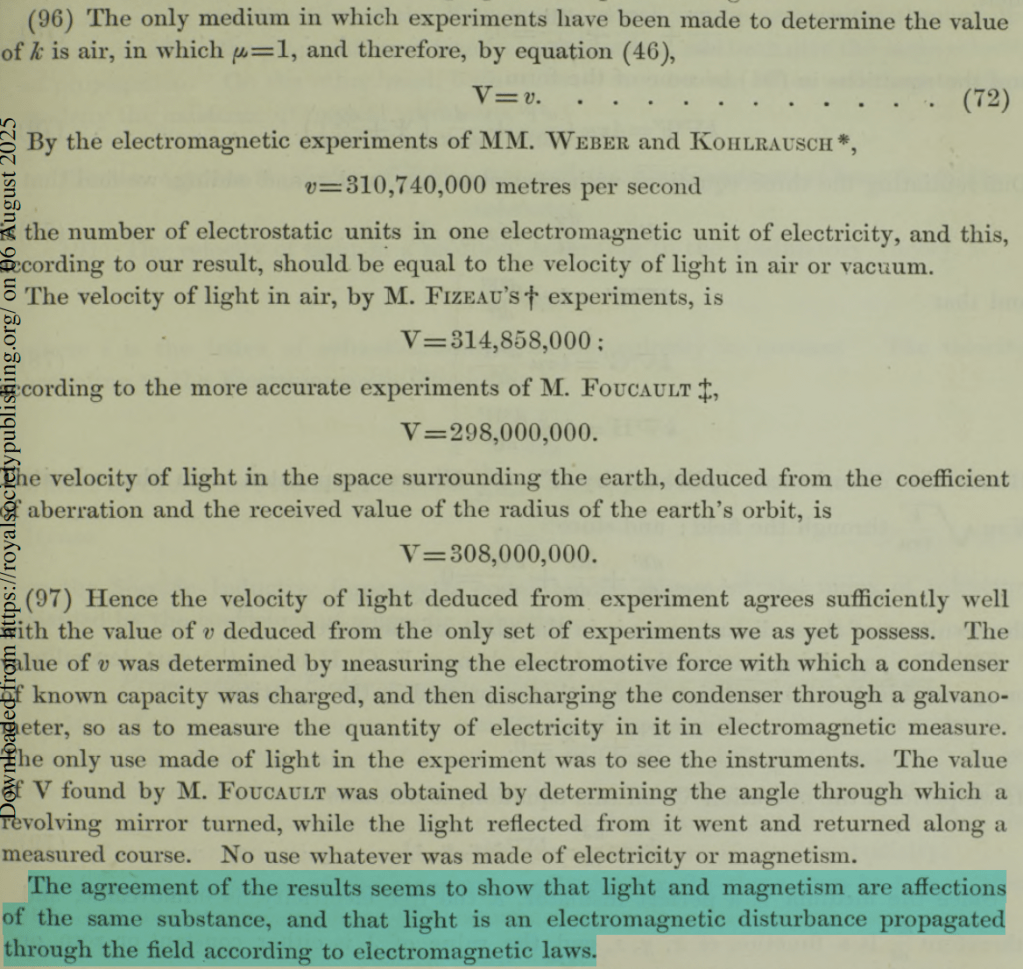
Light as EM wave – in Maxwell’s words

Every year, I teach an optics course to physics majors (including physics iPhD students and MS Quantum Tech students). In the process of introduction, I discuss how light was discovered to be an electromagnetic wave. One of the thrills of this topic is to quote Maxwell from his legendary 1865 paper1, in which he makes this monumental connection. Every time I teach this, I get an intellectual kick, even after doing this for almost 1.5 decades.

The highlighted text is the famous statement. Before that, Maxwell compares his result with two experimental results and confirms his prediction. I follow this up with Hertz’s experiment.

Note: Electric waves and telegraphy were already known before Maxwell’s paper. There were papers that discussed about velocity of light and its connection to electric waves. See this paper2, for example. However, these interpretations were not as comprehensive as Maxwell’s case, and importantly, the field theory viewpoint needed Faraday’s experiments and Maxwell’s interpretation.

  1. Maxwell, James Clerk. 1865. “VIII. A Dynamical Theory of the Electromagnetic Field.” Philosophical Transactions of the Royal Society of London 155 (January): 459–512. https://doi.org/10.1098/rstl.1865.0008.
    ↩︎
  2. https://www.ifi.unicamp.br/~assis/Weber-Kohlrausch(2003).pdf ↩︎

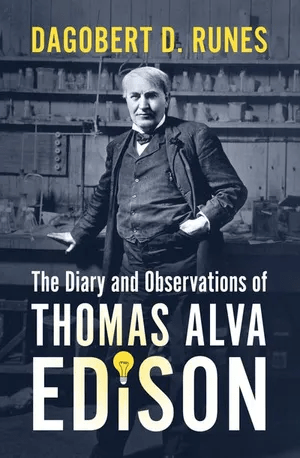
THE DIARY AND OBSERVATIONS OF THOMAS ALVA EDISON

Thomas Alva Edison was one of the greatest inventors we know about. Sometime ago, I stumbled upon a book titled THE DIARY AND OBSERVATIONS OF THOMAS ALVA EDISON, and it was an interesting read. In there, we obtain an insight into Edison’s view on many different subjects, including education, work, religion, etc. Edison was a person with strong views. His working methods were unconventional. Here are a few interesting facts I learnt from this book:

1) Edison had to recruit many executives to his labs; he always emphasized on a memory test and gave them a questionnaire to answer. He insisted that memory is very important for decision making, and he usually employed those people who had very good memory. Edison wrote “…Certainly the brain should have the facts. If a brain possesses an enormous number of facts, those facts, through action of the subconscious mind, will automatically keep themselves available when needed and will automatically keep themselves out of the way, not interfering when not required.”

2) Edison’s view on education was interesting and bold for his times, and he believed that learning through movies would be vital for future education. As early as the 1890s, he said that the best way to teach geography is either by taking the student on a tour or by showing them a movie. Edison wrote

…motion pictures can be applied to a scientific, systematic course of memory training in the schools, taking the children at an early age when the mind is plastic enough to adapt itself most readily to new habit of thought.

Most of our text books fail on two big counts. They are not sufficiently human, and their application is not sufficiently practical”

3) In the following lines, Edison gives an insight into how he worked: “When I want to discover something, I begin by reading up everything that has been done along that line in the past-that’s what all these books in the library are for. I see what has been accomplished at great labor and expense in the past. I gather the data of many thousands of experiments as a starting point, and then I make thousands more.”

“ …..The motive that I have for inventing is, I guess, like the motive of the billiard player, who always wants to do a little better-to add to his record. Under present conditions I use the reasonable profit which I derive from one invention to make experiments looking towards another invention…..”

4) Edison rates the phonograph as his greatest discovery. He writes, “Which do I consider my greatest invention ? Well, my reply to that would be that I like the phonograph best. Doubtless this is because I love music. And then it has brought so much joy into millions of homes all over this country, and , indeed, all over the world.”

5) The following quotation by Joshua Reynolds was hung in every room of Edison’s laboratory “ There is no expedient to which a man will not resort to avoid the real labor of thinking”

There are many more fascinating thoughts of Edison, many agreeable and a few disagreeable ones, in the above-mentioned book, and if you happen to find it, read it through…it’s a classic and insightful read.

The above text is from a 2011 post on my old blog.

Philosophy of Science – ideas – cartoon

Ideas in philosophy of science, especially in the 1800s and early 1900s, had their origin in physics. Two philosophers who were deeply influenced by physics were Karl Popper and Thomas Kuhn. Below is a cartoon depiction of the same. Of course, the origins of ideas in philosophy of science have diversified in recent years, and biology and technology (especially AI) dominate the scene nowadays.

Conversation with Robert T. Pennock

Welcome to the podcast Pratidhvani – Humanizing Science

My guest this time is Professor Robert T. Pennock, University Distinguished Professor at Michigan State University, with appointments in Lyman Briggs College, the Department of Philosophy, and the Department of Computer Science and Engineering: https://pennock5.msu.domains/

Robert’s research explores the deep connections between science, ethics, and philosophy. His recent book, An Instinct for Truth, presents science as a moral discipline grounded in intellectual virtues like honesty, curiosity, and humility.

At the BEACON Center for the Study of Evolution in Action, he leads interdisciplinary work on digital evolution, using artificial life systems to explore questions about complexity, adaptation, and the evolution of intelligent behavior.

In this episode, we explore his intellectual journey with an emphasis on philosophy of science.

Spotify Link

References:

  1. Robert T. Pennock – University Distinguished Professor. n.d. Accessed July 15, 2025. https://pennock5.msu.domains/.
  2. Wikipedia. 2025. “Robert T. Pennock.” April 27. https://en.wikipedia.org/w/index.php?title=Robert_T._Pennock&oldid=1287698177.
  3. Pennock, Robert T. 2019. An Instinct for Truth: Curiosity and the Moral Character of Science. The MIT Press. Amazon link
  4. American Scientist. n.d. Accessed July 16, 2025. https://www.americanscientist.org/author/robert_t._pennock.
  5. American Scientist. 2025. “A Measure of Trust.” January 22. https://www.americanscientist.org/article/a-measure-of-trust.
  6. Miller, Jon D, Belén Laspra, Carmelo Polino, Glenn Branch, Mark S Ackerman, and Robert T Pennock. 2024. “Citizen Attitudes toward Science and Technology, 1957–2020: Measurement, Stability, and the Trump Challenge.” Science and Public Policy 51 (3): 526–42. https://doi.org/10.1093/scipol/scad086.

Tony Tyson and a giant CCD camera

Recently, I came across an interview with Tony Tyson, one of the main scientists related to the Rubin telescope. He says:

“We can do better than this. We can build a larger telescope by making larger mosaics of larger CCDs.”
— Tony Tyson

On a day when India lost a test match, the first sentence rings loud…anyway, the topic of this post is a fascinating development happening in observational cosmology.

Tony’s suggestion above is a great, ambitious way to explore the Universe….by building effective observational tools that can image and comprehend the observable…and perhaps unobservable too…

For students: Observational cosmology is a great place to explore cutting-edge science: physics (experiments + theory), maths, engineering & computation…all come together..

Check out the interview of Tony Tyson…one of the brains behind the cameras of Rubin Observatory…plenty to learn…

Just like test cricket, observational cosmology needs patience…perhaps a good lesson for life too…

Conversation with Shubashree Desikan

In this episode, we discuss Shubashree’s journey from earning a PhD in physics to building a career in science journalism. She talks about her experiences writing for The Hindu and her current role as Associate Editor at IIT Madras’ Shaastra magazine. As a national award-winning journalist, Shubashree shares insights into making scientific ideas accessible to a wider audience, the challenges she has faced in the field, and her advice for aspiring science writers. This conversation explores her career transition, the role of science communication, and the importance of clarity in sharing scientific knowledge.

REFERENCES:

“Star Stories | Science Is Perspective.” n.d. Accessed June 24, 2025. https://shubadesikan.wordpress.com/.

“(1) Shubashree Desikan | சுபா (@Shubawrite) / X.” 2025. X (Formerly Twitter). April 4, 2025. https://x.com/shubawrite.

“(5) Shubashree Desikan | LinkedIn.” n.d. Accessed June 24, 2025. https://www.linkedin.com/in/shubadesi/?originalSubdomain=in.

Shubashree. 2025. “When Entanglement Reaches for the Stars.” Star Stories (blog). April 3, 2025. https://shubadesikan.wordpress.com/2025/04/03/when-entanglement-reaches-for-the-stars/.

“Shubashree Desikan.” n.d. The Hindu. Accessed June 25, 2025. https://www.thehindu.com/thread/author/Shubashree-Desikan-336/.