Conversation with Sanjit Mitra

Sanjit Mitra is a Senior Professor at IUCAA, Pune, and explores gravitational wave astronomy. Serving as the science spokesperson, Laser Interferometer Gravitational-Wave Observatory (LIGO)-India and project coordinator, his research focuses on stochastic backgrounds, detector noise, and CMB analysis.

In this episode, we discuss the science and technology behind LIGO and its Indian expansion.

References:

‘Sanjit Mitra – IUCAA’ Accessed 26 March 2026. https://www.iucaa.in/en/faculty-research/sanjit.

‘Sanjit Mitra’. n.d. Accessed 26 March 2026. https://web.iucaa.in/~sanjit/home/About_Me.html.

GW @ IUCAA. Accessed 26 March 2026. https://www.gw.iucaa.in/.

LIGO-India. Accessed 26 March 2026. https://www.ligo-india.in/.

‘‪Sanjit Mitra‬ – ‪Google Scholar‬’. n.d. Accessed 26 March 2026. https://scholar.google.com/citations?hl=en&user=1LVFYJ0AAAAJ&view_op=list_works.

‘LISA: Laser Interferometer Space Antenna’. n.d. Accessed 26 March 2026. https://lisa.nasa.gov/.

Einstein in conversation with Shankland

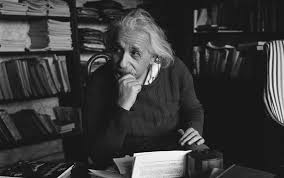
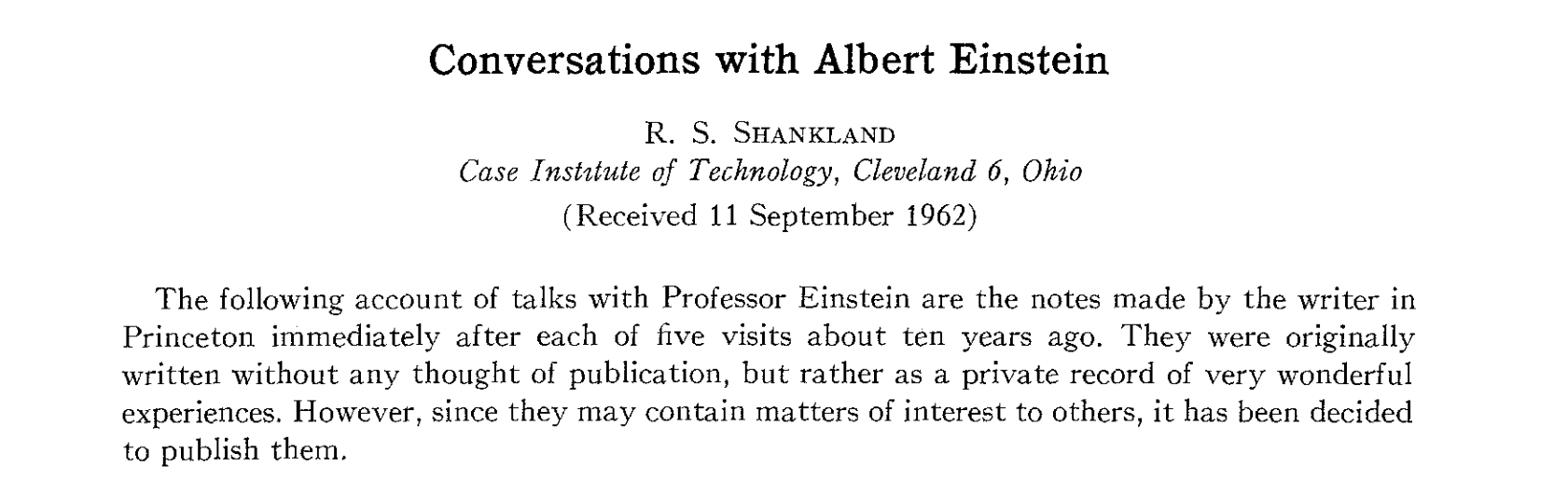
14th of March is Einstein’s birthday. There is so much written about Einstein, and every time you read about him or a text written by him, there is always something interesting to learn. Recently, I came across a wonderful paper by Shankland, who compiled his conversation with Einstein over a period of ten years and published it in 1962 in the American Journal of Physics. Below are three excerpts from the paper to give you a taste of the conversation. I would urge you to read the conversation in full, and it is a delight.


(Shankland 1963, 1)

“When I asked him how he had learned of the Michelson-Morley experiment, he told me that he had become aware of it through the writings of H. A. Lorentz, but only after 1905 had it come to his attention! “Otherwise,” he said, “I would have mentioned it in my paper.” He continued to say the experimental results which had influenced him most were the observations on stellar aberration and Fizeau’s measurements on the speed of light in moving water. “They were enough,” he said. I reminded him that Michelson and Morley had made a very accurate determination at Case in 1886 of the Fresnel dragging coefficient with greatly improved techniques and showed him their values as given in my paper. To this he nodded agreement, but when I added that it seemed to me that Fizeau’s original result was only qualitative, he shook his pipe and smiled, “Oh it was better than that!” He thought Zeeman’s later precise repetition of this experiment was very beautiful. He seemed really delighted when I mentioned to him how elegant I had found (as a student) his method of obtaining the Fresnel dragging coefficient from his composition of velocities law of special relativity.” (Shankland 1963, 2)

“I asked Professor Einstein how long he had worked on the Special Theory of Relativity before 1905. He told me that he had started at age 16 and worked for ten years; first as a student when, of course, he could only spend part-time on it, but the problem was always with him. He abandoned many fruitless attempts, “until at last it came to me that time was suspect!” Only then, after all his earlier efforts to obtain a theory consistent with the experimental facts had failed, was the development of the Special Theory of Relativity possible. This led him to comment at some length on the nature of mental processes in that they do not seem at all to move step by step to a solution, and he emphasized how devious a route our minds take through a problem. “It is only at the last that order seems at all possible in a problem.”” (Shankland 1963, 2)

“Our conversation then returned to the Michelson-Morley experiment and the Special Theory of Relativity. I could not help feeling that this elegant special theory, the product of his youthful efforts, held the place nearest to his heart. I asked him if he felt that writing out the history of the ;v[ichelson-Morley experiment would be worthwhile. He said, “Yes, by all means, but you must write it as Mach wrote his Science of Mechanics.” Then he gave me his ideas on historical writing of science. “Nearly all historians of science are philologists and do not comprehend what physicists were aiming at, how they thought and wrestled with their problems. Even most of the work on Galileo is poorly done.” A means of writing must be found which conveys the thought processes that lead to discoveries. Physicists have been of little help in this because most of them have no “historical sense.” Mach’s Science of Mechanics, however, he considered one of the truly great books and a model for scientific historical writing. He said, “Mach did not know the real facts of how the early workers considered their problems,” but Einstein felt that Mach had sufficient insight so that what he says is very likely correct anyway.” (Shankland 1963, 4)

There is a lot more to explore in the wonderful conversation paper. Link below.

Shankland, R. S. 1963. ‘Conversations with Albert Einstein’. American Journal of Physics 31 (1): 47–57. https://doi.org/10.1119/1.1969236.

3 Thoughts on Scholarship in an AI-driven Age

One of the important issues to be addressed in recent (AI-driven) times is: how can research scholars acquire knowledge and simultaneously contribute to and communicate with society? Related to this question is: What is the role of scholarship in contemporary times?

Below are three thoughts that I wrote mainly with young researchers in mind. I am hoping that it may find use even among others.

1) Pursuit and utility of knowledge is the primary task of a scholar, and managing the perception of that knowledge is secondary. This means a scholar should use a majority of their time, resources and energy in enhancing scholarly knowledge, and in cases where there is utility, applying that knowledge in the outside ‘noisy’ world. This is your personal knowledge based on your efforts and experiences, and cannot be replaced instantaneously. This also brings uniqueness. Once you have this, you can venture into creating a realistic perception of your knowledge. Remember that learning and researching, to a large extent, are under your control; whereas how the outside world perceives your knowledge is not. Therefore, it would be prudent to pay more attention to learning and doing rather than creating a perception. Note that I am not saying that perception is unimportant. All I am saying is that perception is secondary in importance.

2) One of the key learnings in research and education is that the world is always open to good knowledge and ideas, be it in academia or industry. People are always interested in interacting with and hiring people with a sound knowledge base. It may take a while for somebody to discover your knowledge, but if you have a strong foundation and then go out to the world and interact with it, it is very difficult for the world to ignore you. This means that, having done good work, you should be able to share that work with the outside world. This can be a research paper or an engineering prototype, or any form of science, art or talent that you have. The crucial point here is to first do the hard work and then venture into the sharing of that work.

3) In your work, do not compromise on rigor. If you are a researcher, your first commitment should be towards addressing your scholarly peers or the specialized industry and then broadening your communication. Within scholarly communication, you will have to address questions within the research community. This means you will be basing your work on a large body of knowledge and subjecting yourself to internal and external criticism. This is where rigor comes in handy. Here, rigor does not mean unclear communication. It means to have thought through the questions, nuances and complications of a problem and have a broad and balanced view of the research problem. The general audience sometimes perceives rigorous scholarly communication as filled with jargon and complications. Therefore, it is always better to create two versions of your work: one for your peers and one for the general audience. In the age of AI, the second version is easier to create. Remember that your expertise will be vital in creating the second version for the general audience. That is where you can bring your authenticity and creativity. This can also broaden the scope of your knowledge without compromising your scholarship.

These are a few fleeting thoughts. You can criticize, edit, expand and adapt it to make your own version of it. After all, that is how knowledge moves forward 😊

Raman’s pronouncements..

There is a story going around on Facebook related to C.V. Raman and Nehru, and it makes a reference to Raman’s biography. It describes Raman and Nehru’s interaction in a darkened room at Raman Research Institute. Intrigued by the story, I went back and checked some of the biographies of C.V. Raman, and I could not find that story. If someone could find the exact reference, please let me know. (update on 4th March 2026: I dug up the sources further and found this anecdote in chapter 21 of C.V. Raman: A Biography, by Uma Parameswaran, Penguin Books India (2011). Unfortunately, there is no primary or secondary reference associated with the anecdote.)


Among the biographies, Venkatraman’s ‘Journey into the Light’ is comprehensive and mentions Nehru at least 70 times. It does discuss quite a bit about the interaction between these two powerful people and their differences of opinion. It also highlights their common commitment to science and technology. Raman publicly expressed his opinion on the state of science in India. His pronouncements did not go unnoticed, and the press highlighted them. Raman’s biographer, Venkatraman, addresses the issue of Raman’s criticism: “It should not be assumed that Raman was merely making a series of arbitrary and disconnected pronouncements. On the contrary, they were symptoms of a deep concern he had begun to feel about the way science was being promoted. It seemed to him that in the rush for development, scientific excellence and the objectives of science had begun to take a back seat. Sycophancy was on the rise, and ill-equipped people were being propelled into seats they were not ready to occupy. Everyone paid lip sympathy to the universities, but when it came to funding them, they were generally forgotten. What was worse, mediocrity was slowly allowed to become institutionalized. In retrospect, Raman’s utterances, though harsh, implicitly carried a warning that was unfortunately not heeded. And despite all the pious hopes of that period, the linkages between science and technology in India continue to be quite tenuous.” ([Venkataraman, 1989, p. 488])

Having said that, I should mention that almost all of his biographers mention Raman’s confrontation with a variety of people, starting from his Calcutta days till the end of his life. Subsequent scholarship in social sciences has also highlighted Raman’s issue with gender and caste. In contrast to people like Babha, Saha, and Dhawan, Raman was not an institution builder. He had his limitations, but his commitment to science and its role in society is unquestionable.

As I have written before, Raman was not an easy character to study and understand. He contained multitudes. For sure, he was an outstanding experimental physicist. His knowledge of mathematical physics, especially the classical aspect, was very good, and he utilized it extensively in his work. His scientific biographers, both Venkatraman and Ramaseshan, mention that although he had the aptitude to analyze theoretical frameworks, he was more driven by intuition and generally skimmed over the mathematical aspect of his work. This was also observed by Max Born. He also mentored some excellent scientists, such as K.S. Krishnan, Nagendra Nath, Bhagavatham, Pancharatnam, and G.N. Ramachandran, Anna Mani (one of the few women in his lab), to name a few. Probably the most important feature of Raman as an individual was his can-do spirit and his lifelong drive to do science irrespective of the situation.

My broad lesson from all this is to take the positives from the science and the scientific pursuit of a scientist, and yet, remain aware of the flaws in the character of the human being. After all, course correction is from the benefit of hindsight, and its application is in the present and the future.
Commitment to A Scientific Outlook

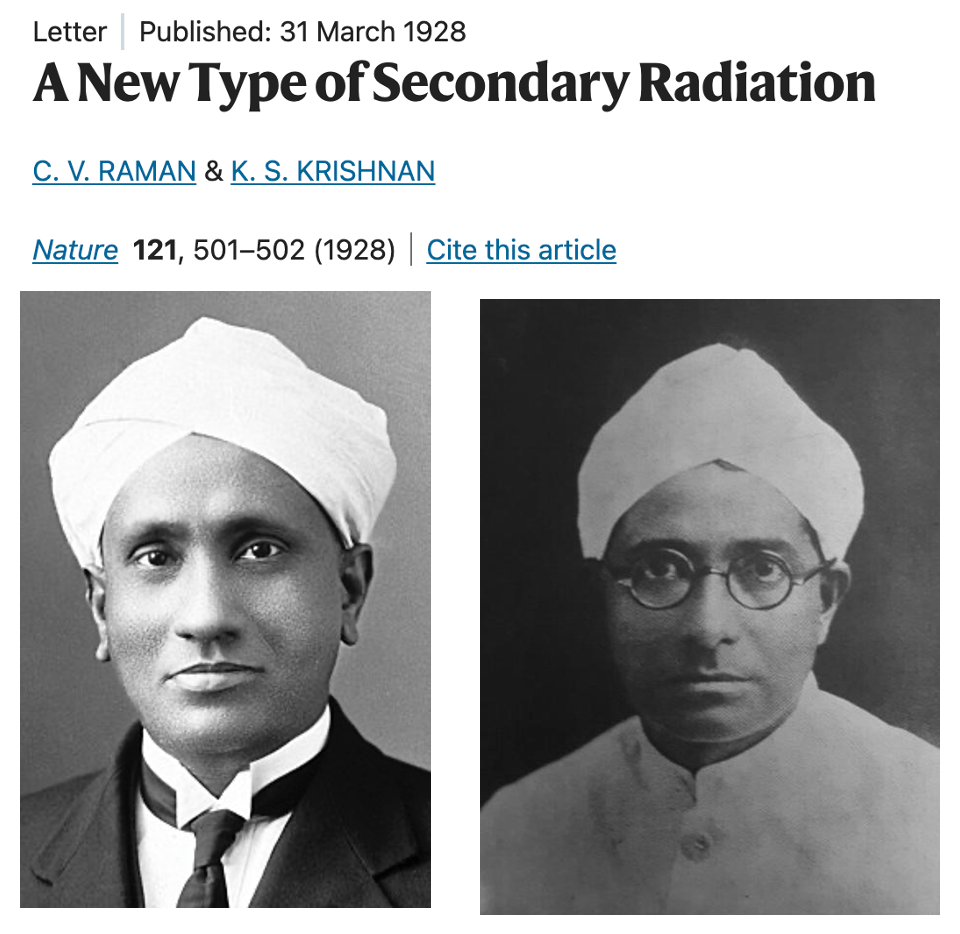
On 28th February, we commemorate the first confirmed observation of the Raman effect, dating back to 1928. Raman’s student, K. S. Krishnan (imaged on the right), had an important role in this observation, and the scientific paper associated with Raman scattering has both Raman and Krishnan as the authors (see picture above). Scientific discoveries and inventions happen with constant effort spread over a long duration. It also happens on a strong foundation of knowledge that has already been established.

Raman recognised this and, as he mentions in his talk on scientific outlook, “The happy discoverer in science is invariably a seeker after knowledge and truth working in a chosen field of his own and inspired in his labours by the hope of finding at least a little grain of something new. The commentators who like to consider discoveries as accidents forget that the most important part of a scientific discovery is the recognition of its true nature by the observer, and this is scarcely possible if he does not possess the requisite capacity or knowledge of the subject. Rarely indeed are any scientific discoveries made except as the result of a carefully thought-out programme of work. They come, if they do come, as the reward of months or years of systematic study and research in a particular branch of knowledge.” (Raman, 1951, p. 243)

This, I think, is generally good advice for researchers, especially the younger ones. One cannot over-emphasize the importance of systematic study.

On this commemorative day, it will be good for us, Indians, to commit ourselves to sincere, honest, hard work motivated by a scientific outlook. As Raman mentions, we need to be seekers of knowledge and truth. Not everything may lead to spectacular results, but it will give us a reason for having done something correct and hopefully useful to humanity. In doing so, we may live a meaningful and purposeful life. Science and scientific thinking can have a central role in realizing such a life.

Happy National Science Day to India…and to the world. After all, science is global.

Reference:
Raman, C. V. ‘The Scientific Outlook’. The New Physics – Talks on Aspects of Science by C V Raman, Philosophical Library, New York, 1951. https://doi.org/10.1007/BF02835148.

Conversation with Renny Thomas

Renny Thomas is an Assistant Professor of Sociology and Social Anthropology at IISER Bhopal. An anthropologist of science, his research explores the intersection of science, religion, and culture in India. He is the author of Science and Religion in India: Beyond Disenchantment (2021) and co-editor of books: Mapping Scientific Method: Disciplinary Narrations (2022) and Decolonial Keywords: South Asian Thoughts and Attitudes (2026). Thomas, recently, was also the Taki Visiting Global Professor at New York University.

In this episode, we explore the sociology of science from an Indian perspective.

References:

  1. ‘HSS/IISER Bhopal’. Accessed 20 February 2026. https://hss.iiserb.ac.in/faculty_details?renny.
  2. Thomas, Renny. Science and Religion in India: Beyond Disenchantment. Taylor & Francis Books India Pvt. Ltd., (2021)
  3. Thomas, Renny, and Gita Chadda. Mapping Scientific Method: Disciplinary Narrations. Routledge, (2022).
  4. Thomas, Renny, and Sasanka Perera, eds. Decolonial Keywords: South Asian Thoughts and Attitudes. Tulika Books, 2026.
  5. Anderson, Robert S. Nucleus and Nation – Scientists, International Networks and Power in India. University of Chicago Press, 2010.
  6. Gray, John. SEVEN TYPES OF ATHEISM. Farrar, Straus and Giroux, 2018.
  7. Latour, Bruno, and Steve Woolgar. Laboratory Life: The Construction of Scientific Facts. Edited by Jonas Salk. Princeton University Press, 2013.
  8. PHYSICS TODAY. ‘Why Should Physicists Study History?’ 1 July 2016. https://doi.org/10.1063/PT.3.3235.
  9. Roy, Arpita. Unfinished Nature: Particle Physics at CERN. Columbia University Press, 2024.
  10. Subramaniam, Banu. Botany of Empire: Plant Worlds and the Scientific Legacies of Colonialism. Univ of Washington Pr, 2024.
  11. Thomas, Renny. ‘“Science Goes Ahead”: Nehru, Modern Science and the Possible Conversations’. India Review 24, no. 5 (2025): 537–56. https://doi.org/10.1080/14736489.2025.2597542.
  12. Anderson, Robert S. ‘Science and Religion in India: Beyond Disenchantment: By Renny Thomas, New York, Routledge, 2022, 203 Pp., $128CAD (Hardback), ISBN 9781032073194’. Tapuya: Latin American Science, Technology and Society 5, no. 1 (2022): 2141013. https://doi.org/10.1080/25729861.2022.2141013.
  13. Mukunth, Vasudevan. ‘Decolonising and De-Nobelising Science’. Comment. The Hindu, 25 February 2026. https://www.thehindu.com/opinion/op-ed/decolonising-and-de-nobelising-science/article70675790.ece.

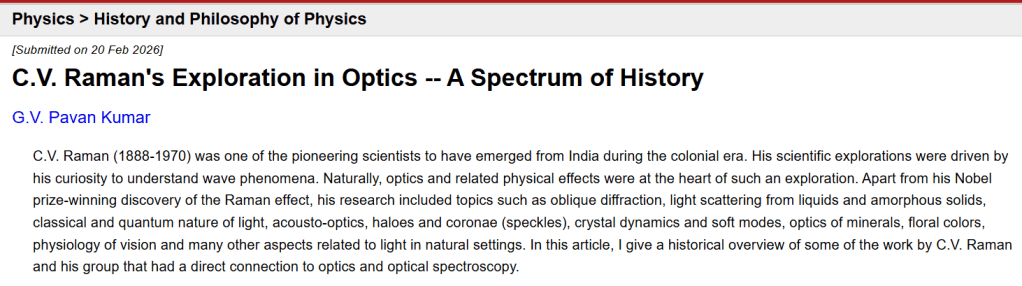
Raman’s Optics – Historical Overview

Journal of the Optical Society of America is coming up with a special issue on Optics in South Asia. I was invited to write a historical overview of Raman’s work on optics. Below is the snapshot of the pre-print. It should also appear in the axriv in the coming week. Meanwhile, you can access the preprint PDF below.

Also, look out for a research article from my group on multipolar optical binding submitted to the same issue. I will post a link when it appears as a pre-print.

Acknowledgements:

  1. Professor Anurag Sharma, IIT, Delhi, for inviting me to write about Raman;
  2. Other editors of this issue for taking the initiative.
  3. Digital Archive Depository of Raman Research Institute

arXiv link here.

OpenAI and Theoretical Physics

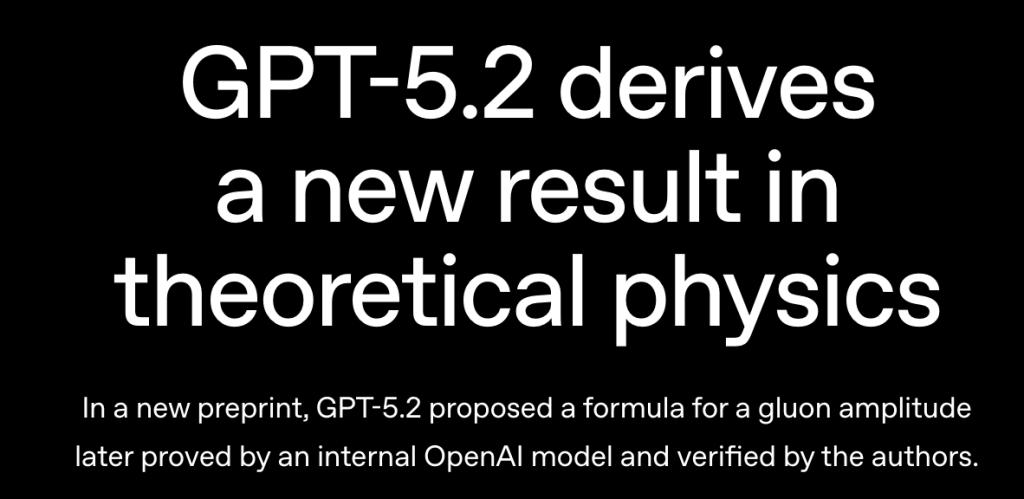
The above snapshot is from OpenAI, which has claimed to have derived a new result in theoretical physics. What is it about, and how good are the claims? Below, I discuss them.

Let me start with some background. Except for the hydrogen atom, the nucleus of all elements in the periodic table consists of neutrons and protons. Neutrons and protons are made of quarks. Quarks interact through gluons. How do these gluons interact? This is a contemporary question.

In this particular case, the authors of the study say: “We’ve published a new preprint showing that a type of particle interaction many physicists expected would not occur can, in fact, arise under specific conditions. The work focuses on gluons, the particles that carry the strong nuclear force.”[1]

The interaction can be computed in terms of probabilities[2], and these probabilities depend on quantum mechanical amplitudes (also called scattering amplitudes). Finding these amplitudes requires a deeper knowledge of strong nuclear forces. Computing such amplitudes is expensive and requires a lot of effort. Physicists, under physical constraints, take a guess on which interaction is more probable and which is not. This study shows that one of the interactions that physicists thought was not probable turns out to be probable, but under specific conditions. “The preprint studies a central concept in particle physics called a scattering amplitude. A scattering amplitude is the quantity physicists use to compute the probability that particles interact in a particular way. …….One case, however, has generally been treated as absent (having zero amplitude)……..As a result, this configuration has largely been set aside. The preprint shows that this conclusion is too strong.”[1]

Of course, this has been possible using the brute force computational capability of the GPT 5.2 model, and it has come up with a particular formula that shows the amplitude to be probable and has further validated it with a formal proof. It is a methodological breakthrough, and the authors claim, “An internal scaffolded version of GPT‑5.2 then spent roughly 12 hours reasoning through the problem, coming up with the same formula and producing a formal proof of its validity.” [1]

I think it is a good development in computational physics and helps in calculating parameters that have relevance in finding probabilities of interaction in particle physics. Overall, my hunch is that it is an important step in computational physics.

Notes:

[1] OpenAI has put out an excellent summary of this problem (without jargon), and it needs basic physics, and the flow of text is good.

[2] Also see Nirmalya Kajuri’s summary on X

Conversation with Siddhesh Kamat

Siddhesh Kamat is Professor of Biology at IISER Pune. His research explores lipid signaling, chemical biology, metabolomics, and serine hydrolases in neurodegeneration and immunity. In 2024, he was awarded the Infosys Prize (Life Sciences). He has also played under-14 cricket for Mumbai.

In this episode, we explore his intellectual journey and how sports played a vital role in his thinking.

References:

‘Infosys Prize – Laureates 2024 – Siddhesh Kamat’. Accessed 12 February 2026. https://www.infosysprize.org/laureates/2024/siddhesh-kamat.html.

‘‪Siddhesh Kamat‬ – ‪Google Scholar‬’. Accessed 12 February 2026. https://scholar.google.com/citations?user=DOMpKfQAAAAJ&hl=en.

The Kamat Lab @ IISE. ‘Home | The Kamat Lab @ IISER Pune’. Accessed 12 February 2026. https://www.kamatlabiiser.com.

Scientific understanding and AI

Let me draw attention, especially of those interested in scientific research, to a relevant review article in Nature Reviews Physics titled “On scientific understanding with artificial intelligence

Below are a couple of paragraphs that caught my attention:

Scientific understanding and scientific discovery are both important aims in science. The two are distinct in the sense that scientific discovery is possible without new scientific understanding….

…..to design new efficient molecules for organic laser diodes, a search space of 1.6 million was explored using ML and quantum chemistry insights. The top candidate was experimentally synthesized and investigated. Thereby, the authors of this study discovered new molecules with very high quantum efficiency. Whereas these discoveries could have important technological consequences, the results do not provide new scientific understanding.”

The authors provide two more examples of a similar kind, from different branches of science.

The authors conclude:

“Undoubtedly, advanced computational methods in general and in AI specifically will further revolutionize how scientists investigate the secrets of our world. We outline how these new methods can directly contribute to acquiring new scientific understanding. We suspect that significant future progress in the use of AI to acquire scientific understanding will require multidisciplinary collaborations between natural scientists, computer scientists and philosophers of science. Thus, we firmly believe that these research efforts can — within our lifetimes — transform AI into true agents of understanding that will directly contribute to one of the main goals of science, namely, scientific understanding.”

Worth reading the full article. Link here.

PS: Prof. Siddharth Tallur (IIT, Bombay) on LinkedIn raised an important question.

Nice.. thanks for sharing, will go through it. Although a lot of brute force seems to be passed off as understanding these days (brawn = brain?) I wonder if AI and ML of the varieties we have today are advancements in computing or intelligence?

My reply:

The computational capability is undoubtedly great, and probably the coding/software domain has been conquered, but there is a tendency to extrapolate the immediate impact of AI to every domain of human life, where even basic tech has not made an impact. That needs deeper knowledge of interfacing AI with other domains of engineering.
Embedding AI in the virtual domain is one thing, but to put it in the real world with noise is a different game altogether. That needs interfacing with the physical world, and there is also an energy expense that doesn’t get factored into the discussion. It has great potential, and I’m eager to see its impact on the physical infrastructure. Parallelly, it is interesting to see how it has been sold in the public domain.

made a video to explain the main blog: