The accepted paper is online now. Thanks to the anonymous reviewer(s) for the encouraging feedback. It made my day :-)
The paper will be published as part of a special issue on optics in South Asia
Link to the online version here.
The accepted paper is online now. Thanks to the anonymous reviewer(s) for the encouraging feedback. It made my day :-)
The paper will be published as part of a special issue on optics in South Asia
Link to the online version here.
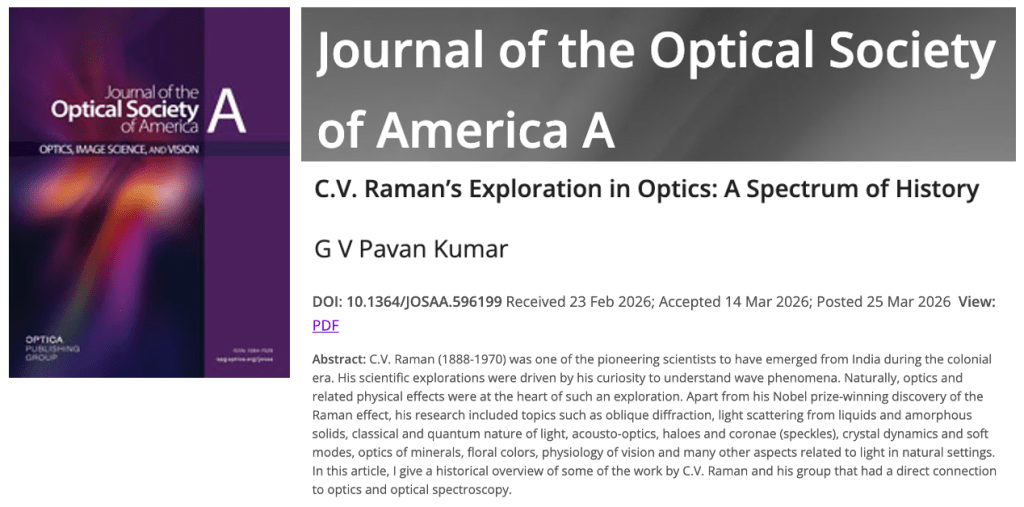
Journal of the Optical Society of America is coming up with a special issue on Optics in South Asia. I was invited to write a historical overview of Raman’s work on optics. Below is the snapshot of the pre-print. It should also appear in the axriv in the coming week. Meanwhile, you can access the preprint PDF below.
Also, look out for a research article from my group on multipolar optical binding submitted to the same issue. I will post a link when it appears as a pre-print.
Acknowledgements:
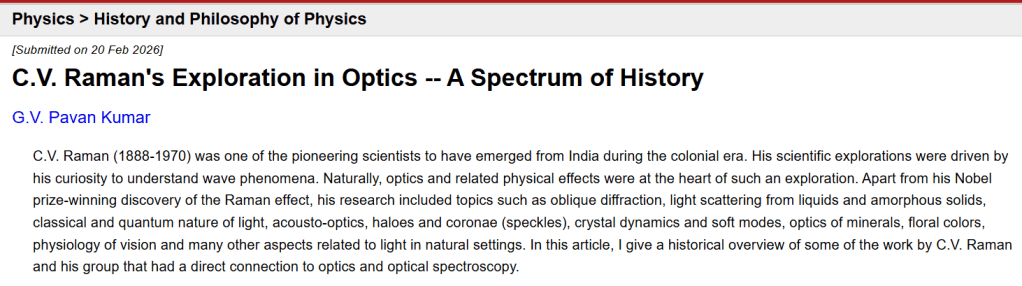
arXiv link here.
One of the last letters written by Rutherford. This was to Raman dated 3rd Aug 1937.
Here, he is consoling Raman after he quit the Directorship of IISc. Rutherford is also discussing his possible travel plans to India.
Unfortunately, Rutherford died on 19th Oct 1937..
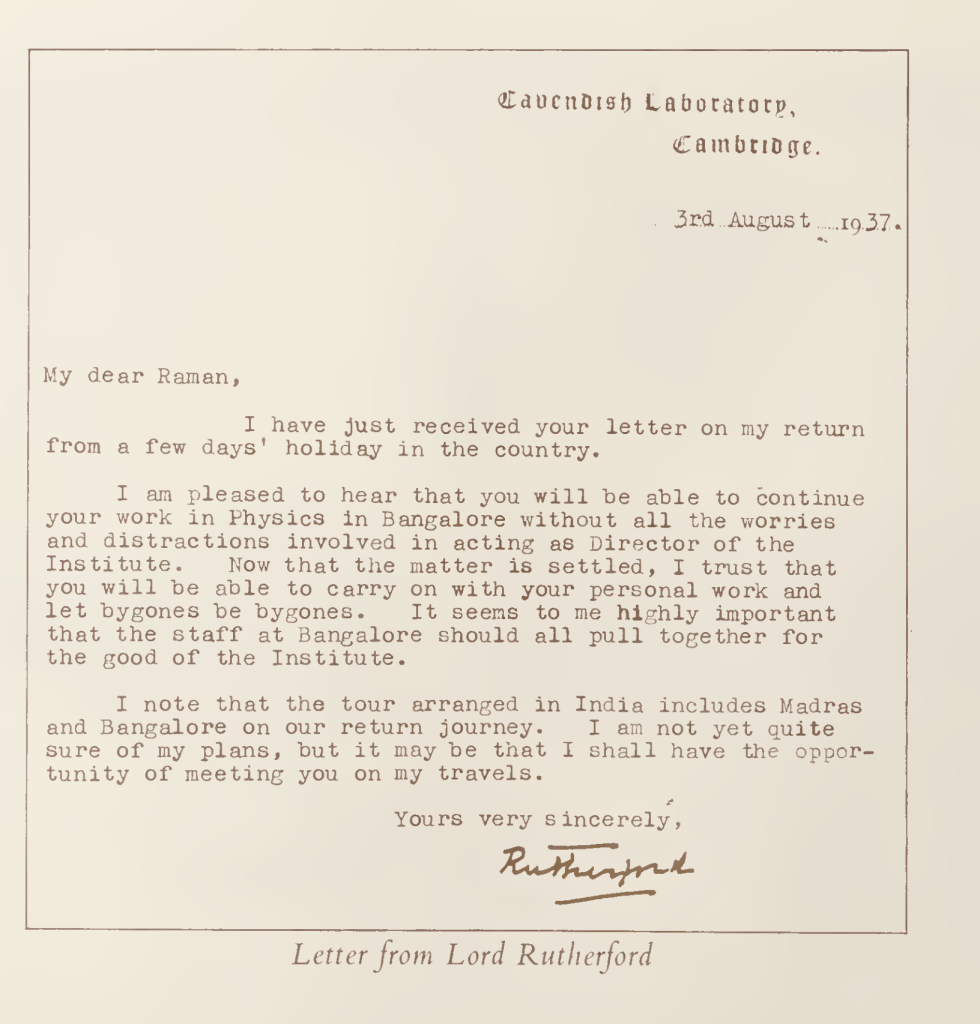
ref: S. Ramaseshan and C. Ramachandra Rao. C.V. Raman : A Pictorial Biography, p 108 (1988)
Here I discuss the paper that announced the Raman effect to the world…
Welcome to the podcast, Pratidhavani – Humanizing Science
Jyotishman Dasgupta is a professor at TIFR, Mumbai, in the Department of Chemical Sciences. His research focuses on probing dynamical structural events leading to charge generation in molecular materials, particularly for bio-inspired photocatalysis and solar electricity generation. He uses ultrafast spectroscopy, including Stimulated Raman spectroscopy, to study reaction mechanisms in these systems.
Jyotishman effectively combines his love and passion for research and teaching with compassion and mentoring researchers. In this free-wheeling conversation, we discuss his intellectual journey so far.
References:
TIFR – Department of Chemical Sciences. ‘TIFR – Department of Chemical Sciences’. Accessed 3 November 2025. https://www.tifr.res.in/dcs/faculty-detail/91.
‘Jyotishman Dasgupta – Google Scholar’. Accessed 3 November 2025. https://scholar.google.com/citations?hl=en&user=DS8RvTcAAAAJ&view_op=list_works&sortby=pubdate.
‘Jyotishman Dasgupta | LinkedIn’. Accessed 3 November 2025. https://www.linkedin.com/in/jyotishman-dasgupta-312578a/.
X (Formerly Twitter). ‘Jyotishman Dasgupta (@jd1278) / X’. 27 October 2025. https://x.com/jd1278.
From 16th to 18th Sept, 2025, I attended and gave a talk at Optofluidix 2025, thanks to the invitation of Prof. Frank Cichos and his team, Department of Physics, University of Leipzig.
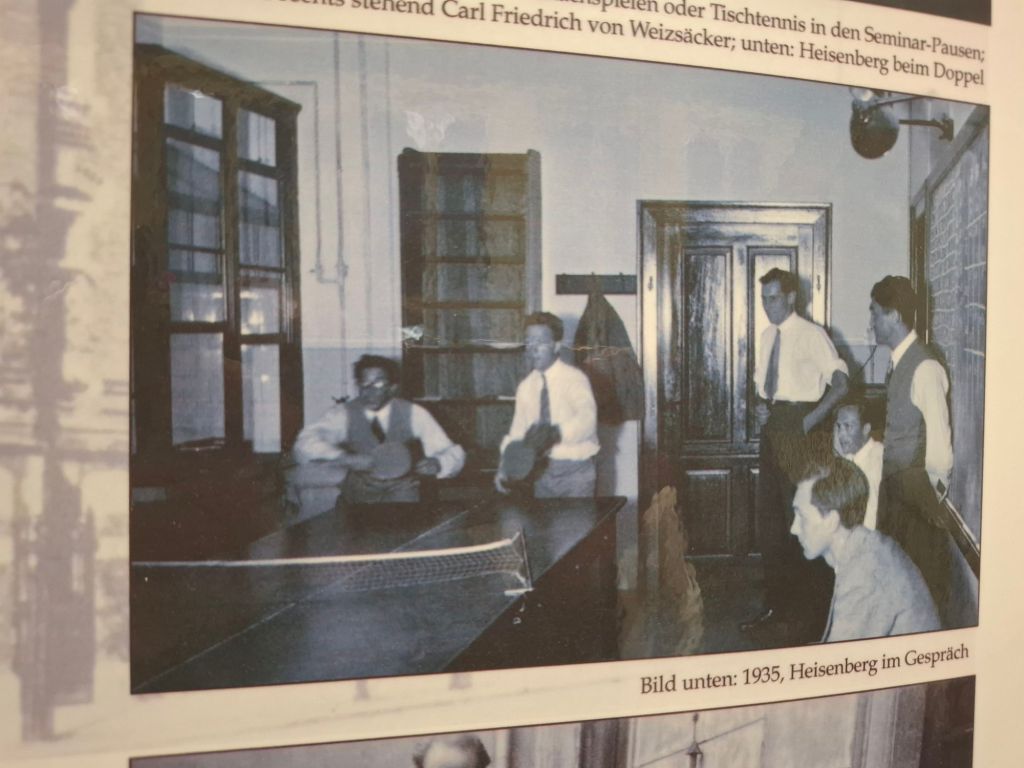
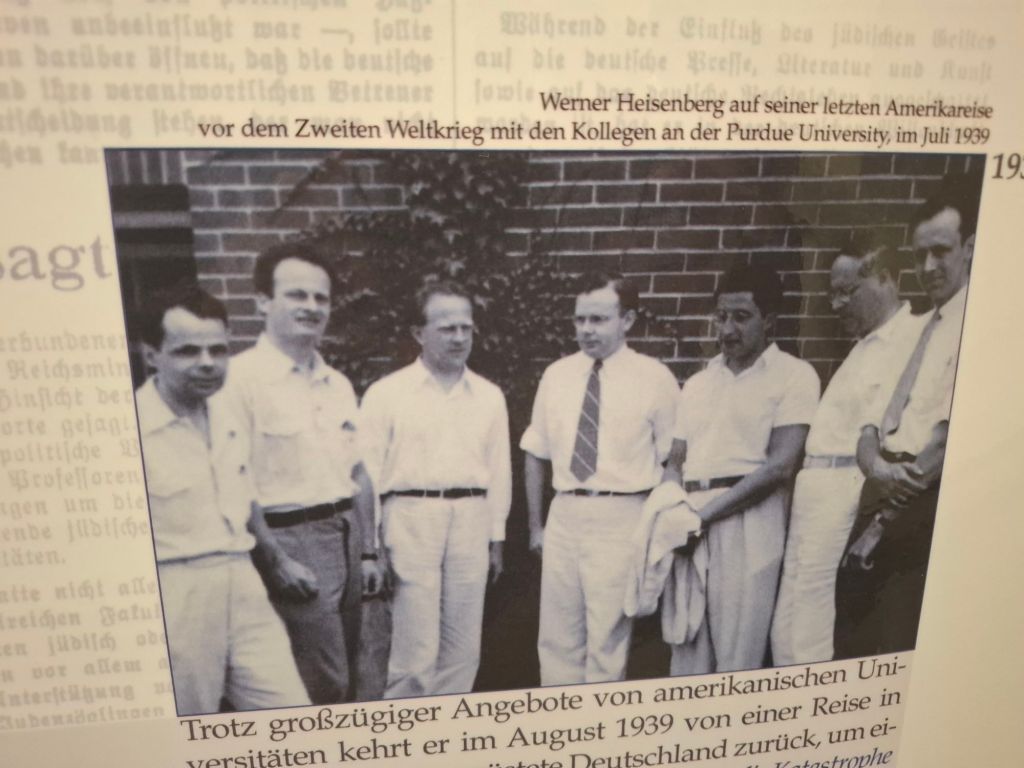
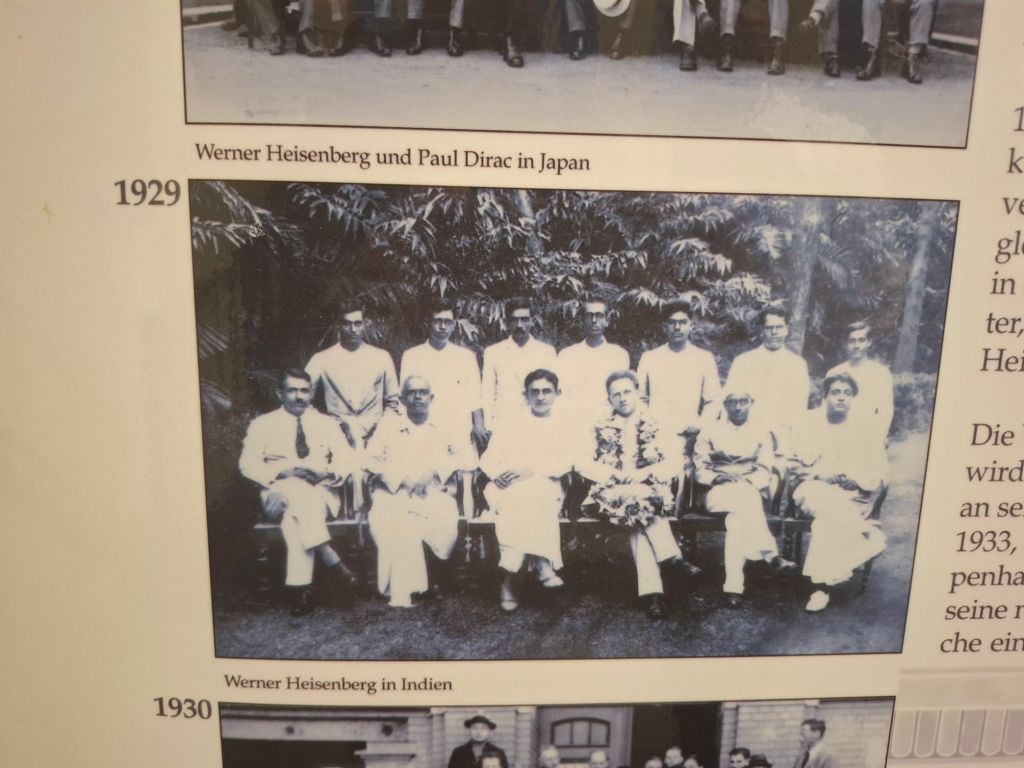
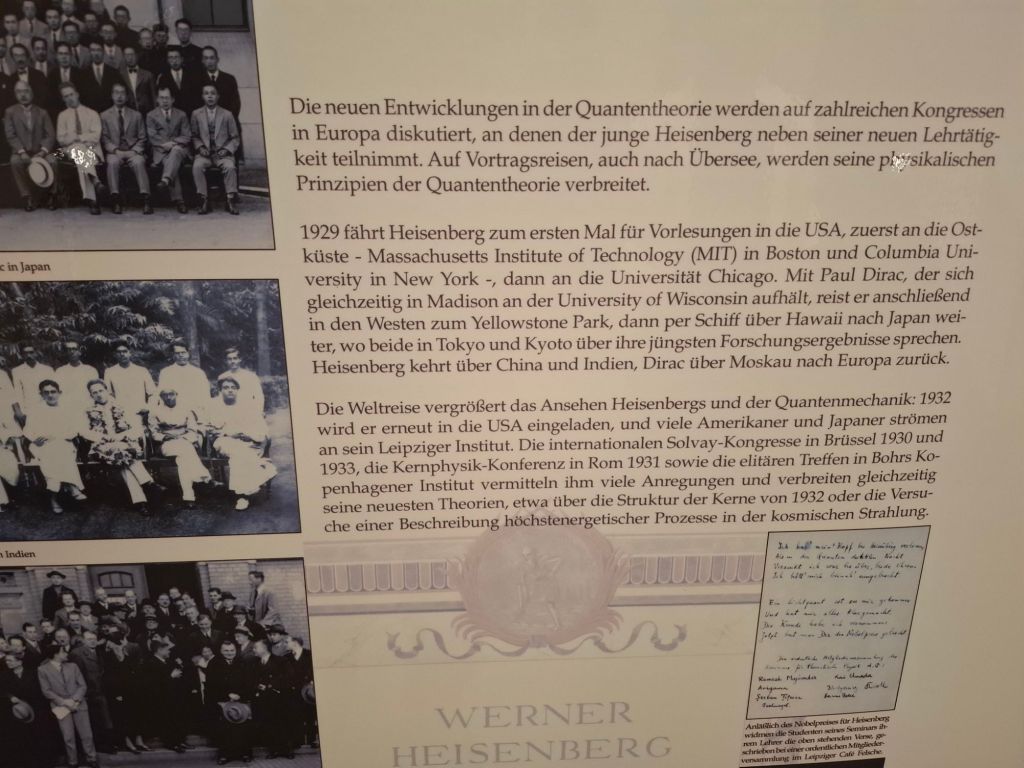
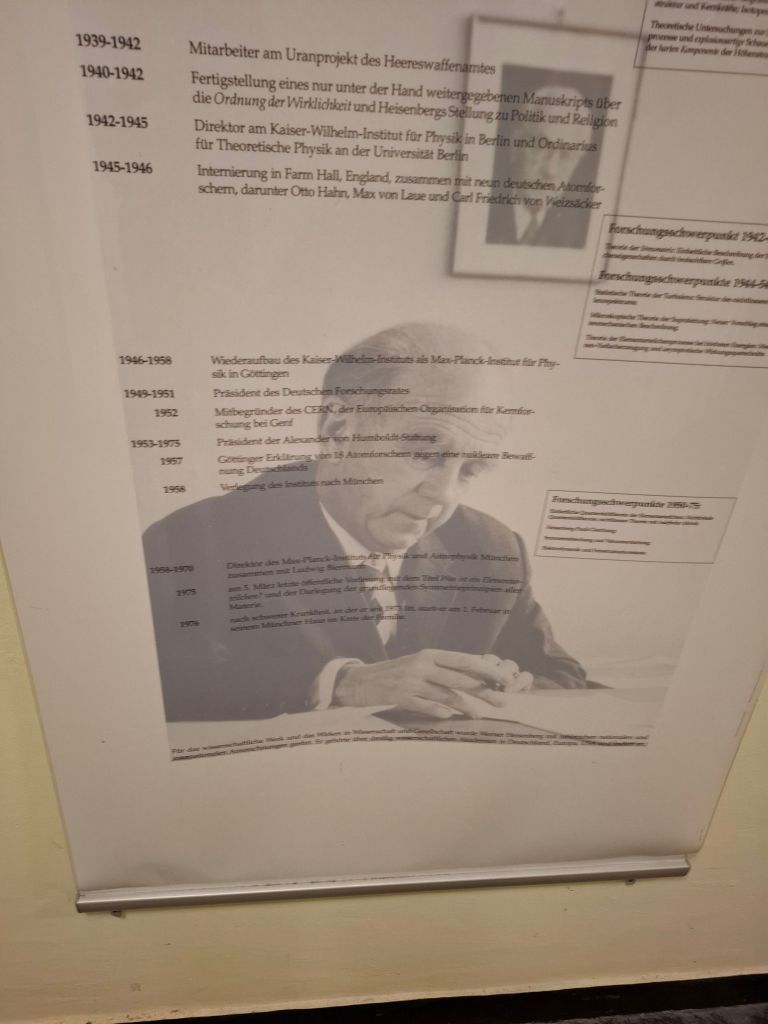
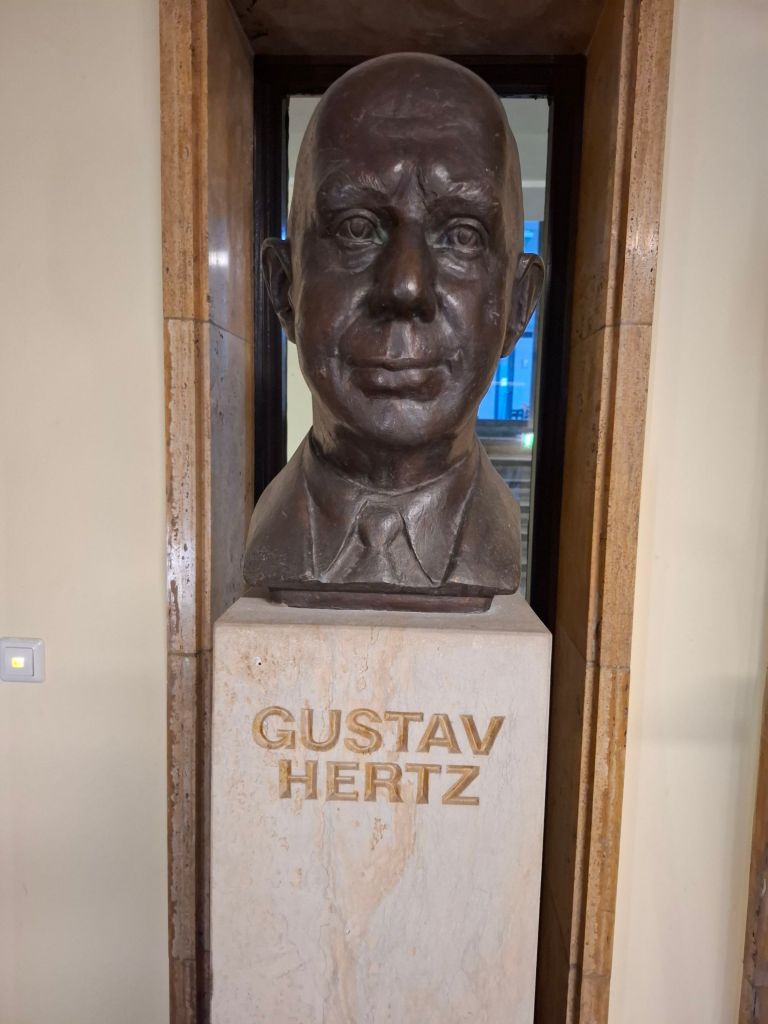
This department is steeped in history, and this post is to give you a pictorial glimpse of some people who worked there.
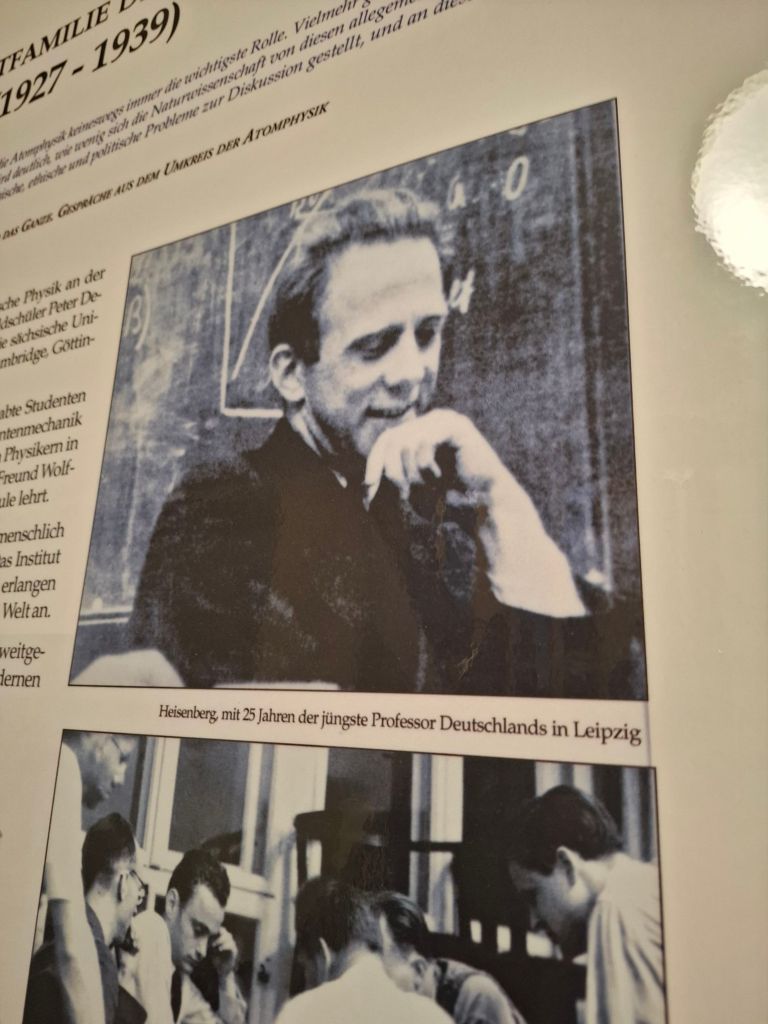
Werner Heisenberg, aged 25, became a Professor at the University of Leipzig, Germany. It was an illustrious department then, had professors such as Peter Debye, Gustav Hertz (of the Franck-Hertz experiment fame), Friedrich Hund and many others. Felix Bloch was a student of Heisenberg in Leipzig.
As the AIP archives describe, “Only 25 years old in October 1927, Heisenberg accepted appointment as professor of theoretical physics at the University of Leipzig, Germany. Friedrich Hund soon joined his former Göttingen colleague as Leipzig’s second professor of theoretical physics. Heisenberg headed the Institute for Theoretical Physics, which was a sub-section of the university’s Physics Institute, headed until 1936 by the experimentalist Peter Debye. Each of the three professors had his own students, assistants, postdocs, and laboratory technicians.”
Below are a few snapshots that I took while visiting the department. Special thanks to Diptabrata Paul (my former PhD student and currently a post-doc in Cichos’ group) for showing me around the department.


Happy Independence Day to my fellow Indians !
15th Aug also happens to be birthday of Louis de Broglie, the famous French physicist who played a critical role in understanding wave-particle duality in quantum physics, and laid an important foundation through his formula
λ = h / p ;
where, λ is the wavelength of quantum particle with momentum p and h is the Planck constant.

See here for more details.
de Broglie studied and discovered the wave nature of electron, for which he received the Nobel prize in physics in the year 1929. In 1920s, understanding light from a quantum mechanical viewpoint was a challenge. Reconciling light, both as a particle and a wave, was counterintuitive and required a leap of thought that was provided by de Broglie. On 12th Dec 1928, delivered his Nobel lecture and mentions:
“I thus arrived at the following overall concept which guided my studies:
for both matter and radiations, light in particular, it is necessary to introduce
the corpuscle concept and the wave concept at the same time. In other words
the existence of corpuscles accompanied by waves has to be assumed in all
cases. However, since corpuscles and waves cannot be independent because,
according to Bohr’s expression, they constitute two complementary forces
of reality, it must be possible to establish a certain parallelism between the
motion of a corpuscle and the propagation of the associated wave.“
This duality still remains, as we try understand the nature of light and harness it for information processing.
Interestingly, de Broglie was one of persons who nominated CV Raman for the Nobel prize in 1930 ! Below snapshot is from the Nobel prize nomination archives.

 VISMAYA - History & Philosophy of Physics