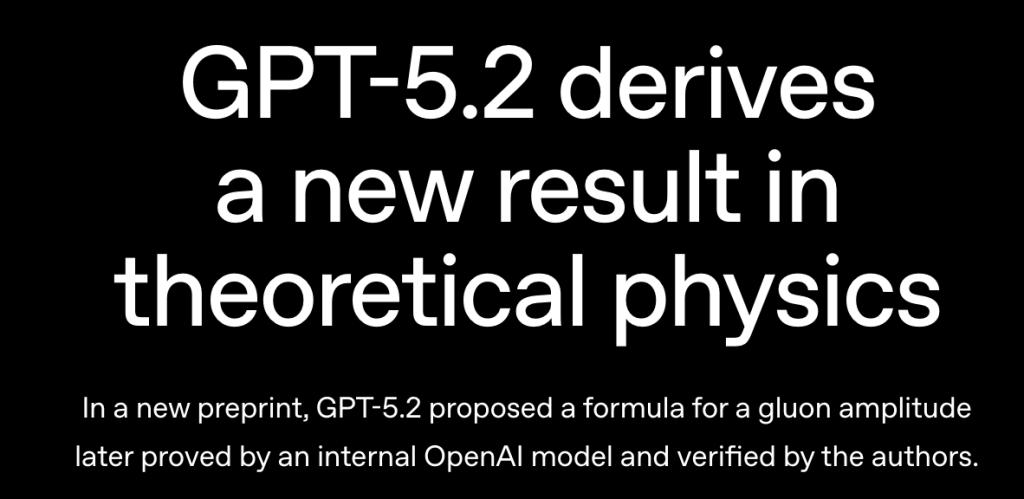
The above snapshot is from OpenAI, which has claimed to have derived a new result in theoretical physics. What is it about, and how good are the claims? Below, I discuss them.
Let me start with some background. Except for the hydrogen atom, the nucleus of all elements in the periodic table consists of neutrons and protons. Neutrons and protons are made of quarks. Quarks interact through gluons. How do these gluons interact? This is a contemporary question.
In this particular case, the authors of the study say: “We’ve published a new preprint showing that a type of particle interaction many physicists expected would not occur can, in fact, arise under specific conditions. The work focuses on gluons, the particles that carry the strong nuclear force.”[1]
The interaction can be computed in terms of probabilities[2], and these probabilities depend on quantum mechanical amplitudes (also called scattering amplitudes). Finding these amplitudes requires a deeper knowledge of strong nuclear forces. Computing such amplitudes is expensive and requires a lot of effort. Physicists, under physical constraints, take a guess on which interaction is more probable and which is not. This study shows that one of the interactions that physicists thought was not probable turns out to be probable, but under specific conditions. “The preprint studies a central concept in particle physics called a scattering amplitude. A scattering amplitude is the quantity physicists use to compute the probability that particles interact in a particular way. …….One case, however, has generally been treated as absent (having zero amplitude)……..As a result, this configuration has largely been set aside. The preprint shows that this conclusion is too strong.”[1]
Of course, this has been possible using the brute force computational capability of the GPT 5.2 model, and it has come up with a particular formula that shows the amplitude to be probable and has further validated it with a formal proof. It is a methodological breakthrough, and the authors claim, “An internal scaffolded version of GPT‑5.2 then spent roughly 12 hours reasoning through the problem, coming up with the same formula and producing a formal proof of its validity.” [1]
I think it is a good development in computational physics and helps in calculating parameters that have relevance in finding probabilities of interaction in particle physics. Overall, my hunch is that it is an important step in computational physics.
Notes:
[1] OpenAI has put out an excellent summary of this problem (without jargon), and it needs basic physics, and the flow of text is good.
If you need to admire complex analysis for its elegance and visual utility, try quantum optics. Specifically, the description of quantum states. Thanks to creation and annihilation operators, the position and momentum states of a quantum optical field can be represented as quadratures. These entities can now be represented on the orthogonal axes of a complex plane. The representation of Argand diagrams starting with a classical electromagnetic field and then extrapolating them to quantum theory is a tribute to its geometrical representation. The fact that two axes can be utilized to represent real and imaginary parts of the defined state is itself an interesting thing. By certain operations within the plane, one can realize the vacuum state, the coherent state, and the squeezed state of quantum optics.
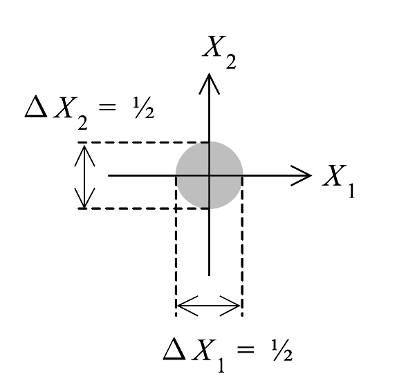
The Vacuum Spread – One of the major consequences of quantum theory, and especially the second quantization, is the realization of the vacuum states. Even when there are zero photons, there is a residual energy in the system that manifests as vacuum states. How to define the presence or absence of a photon is a different proposition because vacuum states are also associated with something called virtual photons. That needs a separate discussion. Anyway, in a complex plane of quadrature, a vacuum state is represented by a circular blob and not a point (see fig. 1). It is the spread of the blob that indicates the uncertainty. In a way, it is an elegant representation of the uncertainty principle itself because the spread in the plane indicates the error in its measurement. Importantly, it emphasizes the point that no matter how low the energy of the system is, there is an inherent uncertainty in the quadrature of the field. This also forms the fundamental difference between a classical and a quantum state. The measurement of the vacuum fluctuation is a challenging task, but one of the most prevalent consequences of vacuum fluctuation is the oblivious spontaneous emission. If one looks at the emission process in terms of stimulated and spontaneous pathways, then the logical consequence of the vacuum state becomes evident in some literature on quantum optics. Spontaneous emission is also defined as stimulated emission triggered by vacuum state fluctuations. It is an interesting viewpoint and helps us to create a picture of the emission process vis-à-vis the stimulated emission.
Figure 1. Vacuum state representation. Note that their centre is at the origin and has a finite spread across all the quadrants. Figure adapted from ref. 2.
Another manifestation of the vacuum state is the Casimir effect, where an attractive force is induced as you bring two parallel plates close to each other. The distance being of the order of the wavelength or below this triggers a fascinating phenomenon which has deep implications not only in understanding the fundamentals of quantum optics and electrodynamics, but also in the design and development of quantum nanomechanical devices.
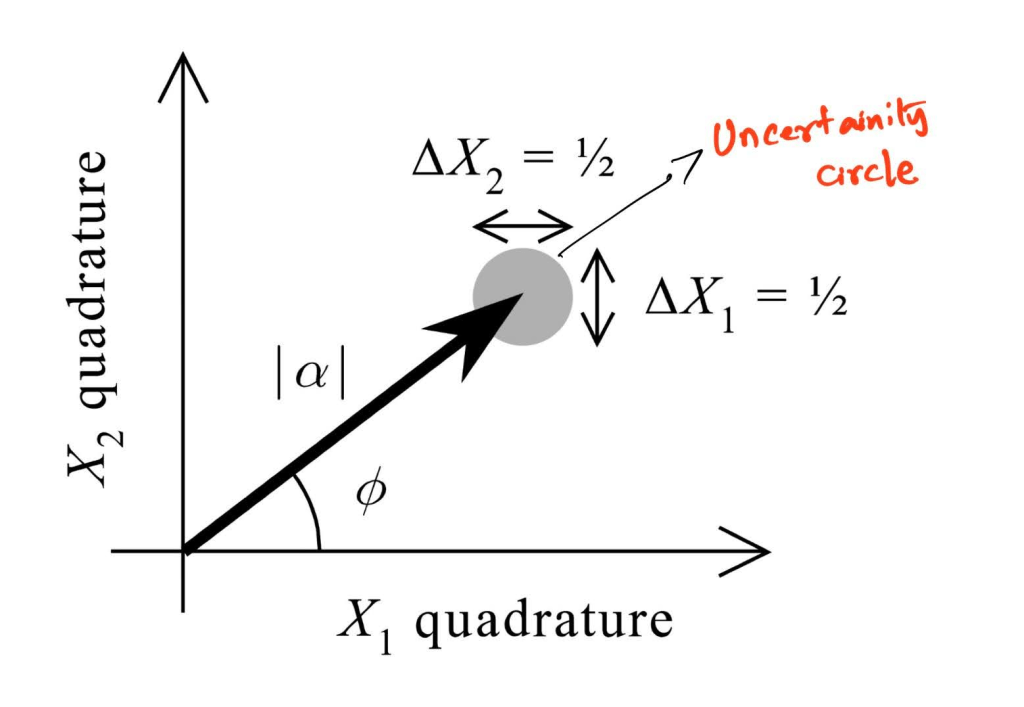
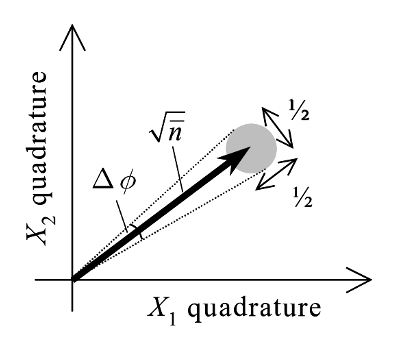
A shift in the plane – Coherent states are also described as displaced vacuum states, and this displacement is evident in the Argand diagrams. The quadrature can now help us visualize the uncertainty in the phase and the number of photons in the optical field. One of the logical consequences of the coherent state is the number-phase uncertainty. This gets clear if one observes the spread in the angle of the vector and the radius of the blob represented (see Fig. 2). Notice that the blob still exists. The only difference is that the location of the blob has shifted. The consequence of this spread has a deeper connection to the uncertainty in the average number of photons and the phase of the optical field. The connection to the number of photons is through the mod alpha, which essentially represents the square root of the average number of photons. Taken together, the blob in the Argand diagram represents the number-phase uncertainty.
Figure 2. Coherent state representation. Note that their centre is displaced. Figure adapted from ref. 2.
Lasers are the prototypical examples of coherent states. The fact that they obey Poissonian statistics is the direct consequence of the variance in the photon number, which is equivalent to the square root of the average number of photons. This means one can use photon statistics to discriminate between sources that are sub-Poissonian, Poissonian, or super-Poissonian in nature. The super-Poissonian case is the thermal light, and the sub-Poissonian state represents photon states whose number can reach up to 1 or 0. The coherent states sit in the middle, obeying the Poissonian statistics.
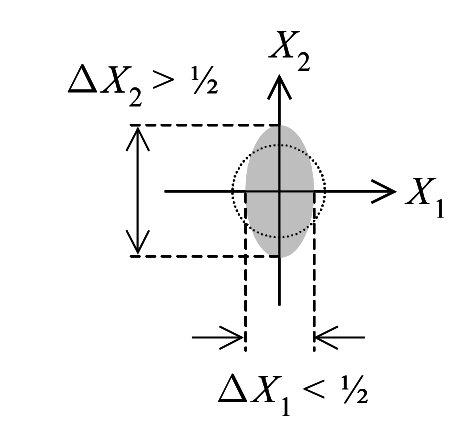
Everything has a cost – Once you have a circle with a defined area, it will be interesting to ask: Can you ‘squeeze’ this circle without changing its area? The answer is yes, and that is what manifests as a squeezed state. In this special state, one can squeeze the blob along one of the axes at the cost of a spread in the orthogonal direction. This converts the circle into an ellipse (see Fig. 3).
Figure 3. Squeezed State. Note the circle has been squeezed into an ellipse. Figure adapted from ref. 2.
Note that the area must be conserved, which means that the uncertainty principle still holds good; just that the reduction in the uncertainty along one axis is compensated by the increment in another. This geometrical trick has a deep connection to the behaviour of an optical field. If one squeezes the axis along the average number of photons, it means that you are able to create an amplitude-squeezed state. This means the uncertainty in the counting of photons in that state has reduced, albeit at the cost of the uncertainty in the measurement of phase. Similarly, if one squeezes the blob along the axis of the phase, then we end up with a lowering of the uncertainty for the optical phase. Of course, this comes at the cost of counting of number of photons. I should mention that the concept of optical phase itself is not clearly defined in quantum optics. This is because an ill-defined phase can have a value of 2π, which creates the problem. An interesting application of the phase-squeezed quantum states is in interferometric measurements. By reducing the uncertainty in the phase, one can create highly accurate measurements of phase shifts. So much so that this can have direct implications on high-precision measurements, including gravitational wave detection. The anticipation is also that such tiny shifts can be helpful in observing feeble fluctuations in macroscopic quantum systems.
Pictures can lead to more than 1,000 words. And if you add them to a quantum optical description, as in the case of the states that I have defined, they create a quantum tapestry. Perhaps this is the beauty of physics, where there is a coherence between mathematical language, geometrical representation, and physical reality. Feynman semi-jokingly may have said, “Nobody understands quantum mechanics,” but he forgot to add that there is great joy in the process of understanding through mathematical pictures. After all, he knew the power of diagrams.
References:
Ficek, Zbigniew, and Mohamed Ridza Wahiddin. Quantum Optics for Beginners. 1st edition. Jenny Stanford Publishing, 2014.
Fox, Mark. Quantum Optics: An Introduction. Oxford Master Series in Physics 15. Oxford University Press, 2006.
Gerry, Christopher C., and Peter L. Knight. Introductory Quantum Optics. Cambridge, United Kingdom ; New York, NY, 2024.
Saleh, B. E. A., and M. C. Teich. Fundamentals of Photonics. 2nd edition. Wiley India Pvt Ltd, 2012.
Recently, I was talking to a college student who had read some of my blogs. He was interested in knowing what it means to humanize science. I told him that there are at least three aspects to it.
First is to bring out the wonder and curiosity in a human being in the pursuit of science. The second was to emphasize human qualities such as compassion, effort, mistakes, wrong directions, greed, competition and humour in the pursuit of science. The third thing was to bring out the utilitarian perspective.
The student was able to understand the first two points but wondered why utility was important in the pursuit of humanizing science. I mentioned that the origins of curiosity and various human tendencies can also be intertwined with the ability to use ideas. Some of the great discoveries and inventions, including those in the so-called “pure science” categories, have happened in the process of addressing a question that had its origin in some form of an application.
Some of the remarkable ideas in science have emerged in the process of applying another idea. Two great examples came into my mind: the invention of LASERs, and pasteurization.
I mentioned that economics has had a major role in influencing human ideas – directly or indirectly. As we conversed, I told the student that there is sometimes a tendency among young people who are motivated to do science to look down upon ideas that may have application and utility. I said that this needs a change in the mindset, and one way to do so is to study the history, philosophy and economics of science. I said that there are umpteen examples in history where applications have led to great ideas, both experimental and theoretical in nature, including mathematics.
“….So many people today—and even professional scientists—seem to me like someone who has seen thousands of trees but has never seen a forest. A knowledge of the historic and philosophical background gives that kind of independence from prejudices of his generation from which most scientists are suffering. This independence created by philosophical insight is—in my opinion—the mark of distinction between a mere artisan or specialist and a real seeker after truth..”
The student was pleasantly surprised and asked me how this is connected to economics. I mentioned that physicists like Marie Curie, Einstein and Feynman did think of applications and referred to the famous lecture by Feynman titled “There is Plenty of Room at the Bottom” (1959).
To give a gist of his thinking, I showed what Feynman had to say on miniaturization:
“There may even be an economic point to this business of making things very small. Let me remind you of some of the problems of computing machines. In computers we have to store an enormous amount of information. The kind of writing that I was mentioning before, in which I had everything down as a distribution of metal, is permanent. Much more interesting to a computer is a way of writing, erasing, and writing something else. (This is usually because we don’t want to waste the material on which we have just written. Yet if we could write it in a very small space, it wouldn’t make any difference; it could just be thrown away after it was read. It doesn’t cost very much for the material).”
I mentioned that this line of thinking on minaturization is now a major area of physics and has reached the quantum limit. The student was excited and left after noting the references.
On reflecting on the conversation, now I think that there is plenty of room to humanize science.
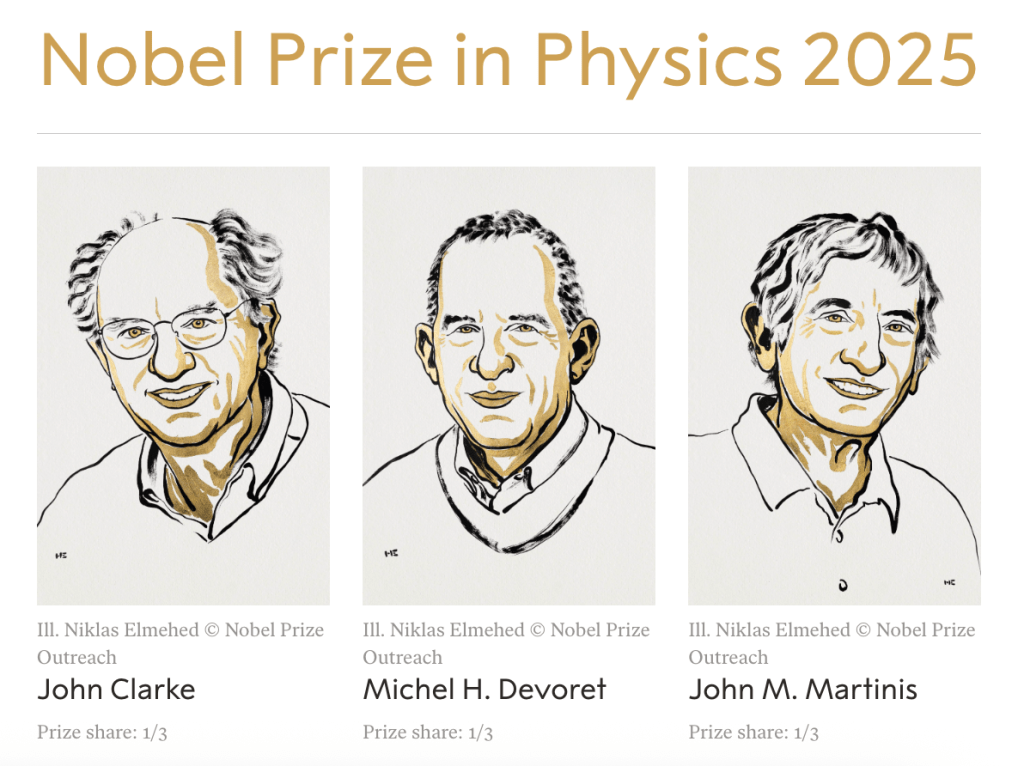
The 2025 Nobel Prize in physics has been awarded to John Clarke, Michel H. Devoret and John M. Martinis “for the discovery of macroscopic quantum mechanical tunnelling and energy quantisation in an electric circuit.“
The Nobel Prize webpage has an excellent summary of the work at popular and technical levels.
In this blog, I want to draw attention to an interesting review article from 1984 by Anthony Leggett that pre-empts the awarded work. Leggett himself was a Nobel laureate (2003), and his work on the theory of superconductors and superfluids forms one of the conceptual foundations for this year’s Nobel prize. Four of his papers have been cited by the Nobel committee as part of the scientific description of the award, and one of them is a review article I wish to emphasize.
The title of Leggett’s review is “Schrödinger’s cat and her laboratory cousins“. It discusses the detection and implication of macroscopic quantum mechanical entities, and has a description of the so-called Schrödinger’s cat, which is essentially a thought experiment describing quantum superposition and the bizarre consequence of such a formulation. Leggett utilizes this conceptual picture of the cat (in alive and dead states) and extends this to possible scenarios in which the macroscopic quantum superposition can be detected and verified under laboratory conditions. The text below from his review captures the essence of the concept and connects it to experimental verification :
“It is probably true to say that most physicists who are even conscious of the existence of the Cat paradox are inclined to dismiss it somewhat impatiently as a typical philosophers’ problem which no practising scientist need worry about. The reason why such an attitude can be maintained is that close examination of the paradox has seemed to lead to the conclusion that, worrying or not at the metaphysical level, it has at any rate no observable consequences: that is, the experimental consequences of the above apparently bizarre description are quite undetectable. Since physicists, by virtue of their profession, tend to be impatient of questions to which they know a priori no experiment can conceivably be relevant, they have tended to shrug off the paradox and leave the philosophers to worry about it.
Over the last few years, thanks to rapid advances in cryogenics, noise control and microfabrication technologies, it has become clear that the above conclusion may be over-optimistic (or pessimistic, depending on one’s point of view!). To be sure, it is unlikely that in the foreseeable future we will be able to exhibit the experimental consequences of a cat being in a linear superposition of states corresponding to life and death. However, at a more modest level it is possible to ask whether it would be possible to exhibit any macroscopic object in a superposition of states which by a reasonable common-sense criterion could be called macroscopically different. The answer which seems to be emerging is that it is almost certainly possible to obtain circumstantial evidence of such a state of affairs, and not out of the question that one might be able to set up a more spectacular, direct demonstration. This is the subject of this article.“
Cut to 2025, this is also the subject of the Nobel Prize in Physics today.
I have been amazed to explore the archives on Hideki Yukawa, which have been systematically categorized and meticulously maintained by Osaka University in Japan. My sincere thanks and acknowledgment to the Yukawa Memorial.
Below are a few gems from their public archives :
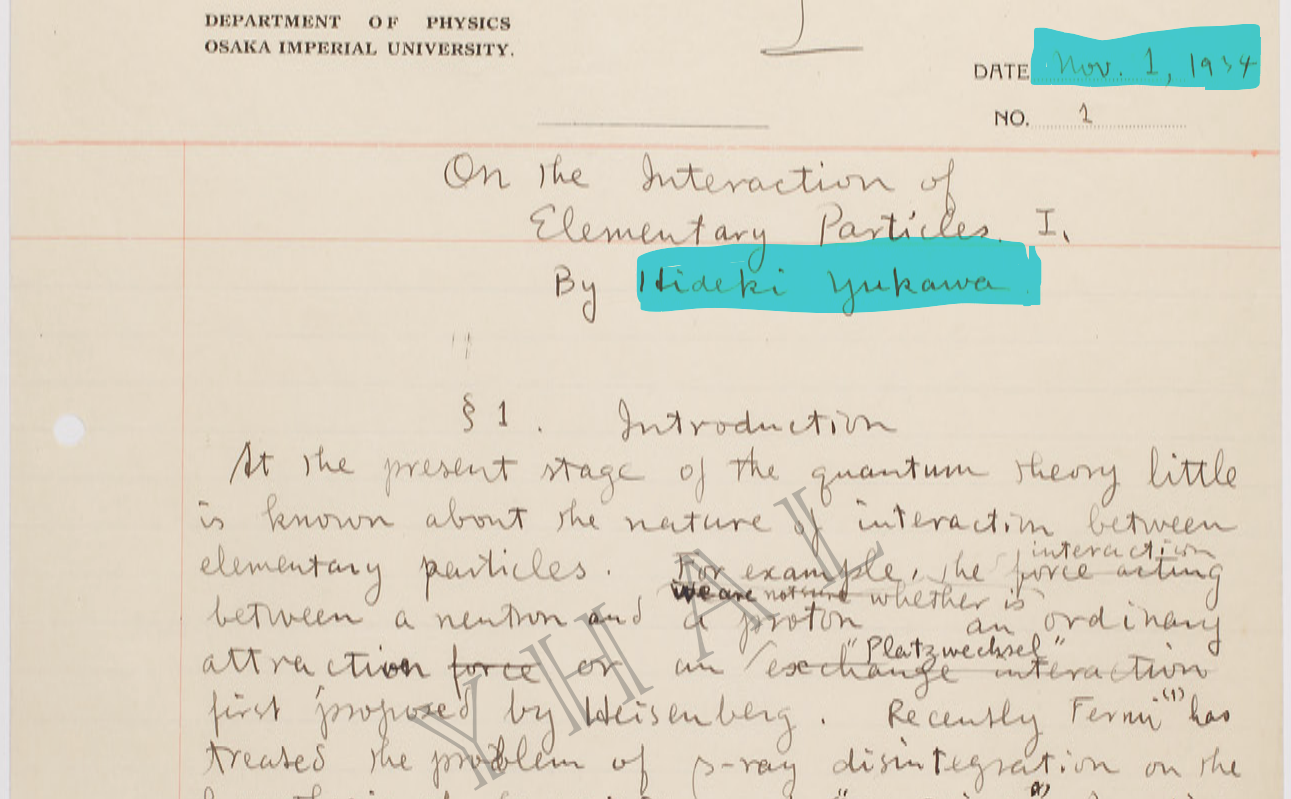
Draft of the paperwritten in 1934 – The making of the groundbreaking paper of Yukawa, which eventually led to his Nobel Prize in 1949.
The archive draft is accompanied by a note which reads:
Yukawa had not published any paper before then. In 1933, Yukawa began working at Osaka Imperial University and tackled the challenge of elucidating the mystery of nuclear forces while Seishi Kikuchi and other prominent researchers were producing achievements in nuclear physics and quantum physics. The idea of γ’ (gamma prime) that Yukawa came up with in early October led to the discovery of a new particle (meson) that mediates nuclear forces. The idea of introducing a new particle for the purpose of explaining the forces that act between particles was revolutionary at that time. Yukawa estimated the mass of the new particle and the degree of its force. No other physicists in the world had thought of this idea before.
2. Letters between Tomonaga and Yukawa
Sin-Itiro Tomonaga was a legendary theoretical physicist from Japan, who independently formulated the theory of quantum electrodynamics (apart from Feynman and Schwinger) and went on to win the Nobel Prize in physics in 1965.
Both these theoreticians were intensely working on interrelated problems and constantly exchanged ideas. The archival note related to the letter has to say the following:
During this period, Yukawa and Tomonaga concentrated on elucidating nuclear forces day in and day out, and communicated their thoughts to each other. In this letter, before starting the explanation, Tomonaga wrote “I am presently working on calculations and I believe that the ongoing process is not very interesting, so I omit details.” While analyzing the Heisenberg theory of interactions between neutrons and protons, Tomonaga attempted to explain the mass defects of deuterium by using the hypothesis that is now known as Yukawa potential. The determination of potential was arbitrary and the latest Pegrum’s experiment at that time was taken into consideration. Tomonaga also compared his results with Wigner’s theorem and Majorana’s theory.
3. Rejection letter from Physical Review
Which physicist can escape a rejection from the journal Physical Review?
Even Yukawa was not spared :-) Below is a snapshot of a rejection letter from 1936, and John Tate does the honours.
The influence of Yukawa and Tomonaga can be seen and felt at many of the physics departments across Japan. Specifically, their influence on nuclear and particle physics is deep and wide, and has inspired many in Japan to do physics. As the archive note says:
Yukawa and Tomonaga fostered the theory of elementary particles in Japan from each other’s standpoint. Younger researchers who were brought up by them, so to speak, must not forget that the establishment of Japan’s rich foundation for the research of the theory of elementary particles owes largely to Yukawa and Tomonaga.
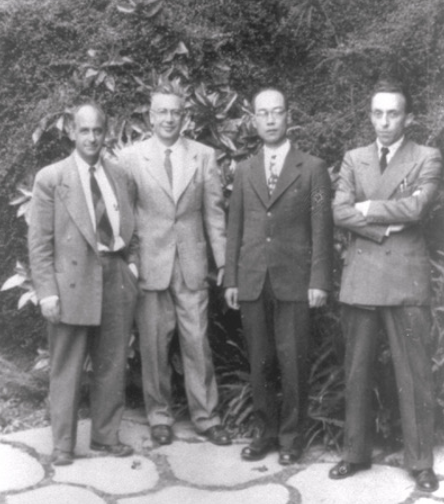
4. Lastly, below is a picture of the legends from the archive: Enrico Fermi, Emilio Segrè, Hideki Yukawa, and James Chadwick.
From the archive note on the picture from September 1948:
Yukawa met Prof. Fermi and other physicists of the University of Chicago who were staying in Berkeley for the summer lectures. From the left: Enrico Fermi, Emilio Segrè, Hideki Yukawa, and James Chadwick.
Tomorrow, I will conclude my third trip to Japan. I always take a lot of inspiration from this wonderful country. As usual, I have not only met and learnt a lot from contemporary Japanese researchers, but also have metaphorically visited the past masters who continue to inspire physicists like me across the world.
Writing in 1976, Weinberg made an interesting observation [1]:
A number of years ago, when I was an in- structor at Columbia University, I heard a rumor that Werner Heisenberg and Wolfgang Pauli, two of the great figures in physics in this century, had developed a new theory which would unify the physics of elementary particles. Thus, you can imagine my excitement when I received an invitation to attend what was de- scribed as a secret seminar to be conducted by Heisenberg and Pauli. On the appointed day, I was somewhat disconcerted to find some 500 distinguished theoretical physicists attempting to crowd into the room; however, my enthusiasm returned when I saw Niels Bohr seated in the front row. (I had been a graduate student at Copenhagen and had learned to look on Bohr as an oracle.) After Heisenberg and Pauli dis- cussed their theory, Bohr commented on it, con- cluding that he doubted the theory would be the great new revolution in physics because it was not sufficiently “crazy.”
He further adds :
This remark reflects an opinion, very common among physicists for the past forty years, that the next significant advance in theoretical physics would appear as another revolution – a break with the concepts of the past as radical as the great revo- lutions of the first third of the twentieth century: the theory of relativity and the development of quantum mechanics. That opinion may yet be proved true, but what has been developing in the last few years is, in fact, a different sort of synthesis. There is now a feeling that the pieces of physics are falling into place, not because of any single revolutionary idea or because of the efforts of any one physicist, but because of a flowering of many seeds of theory, most of them planted long ago
I like this way of thinking in terms of synthesis. It is closer to how science is done today than giving all the credit to an individual. Weinberg was a fine thinker who deeply thought about physics and its history. This is evident in his writing and talks.
Reference:
[1] S. Weinberg, “The Forces of Nature,” Bulletin of the American Academy of Arts and Sciences, vol. 29, no. 4, pp. 13–29, 1976, doi: 10.2307/3823787.
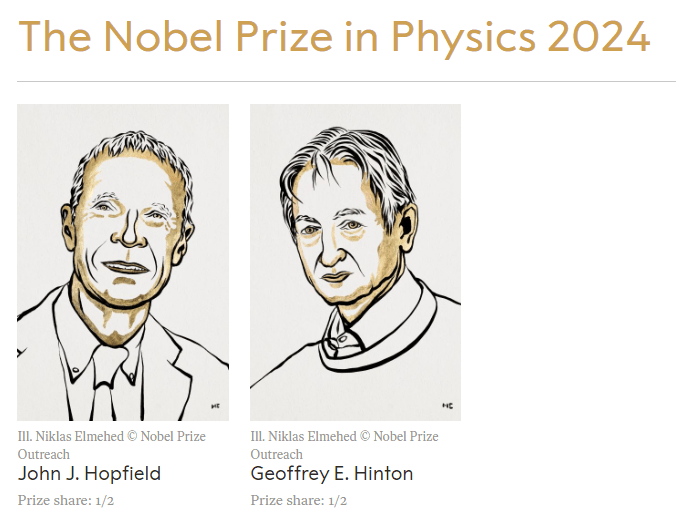
The Nobel Prize in Physics 2024 was awarded to John J. Hopfield and Geoffrey E. Hinton “for foundational discoveries and inventions that enable machine learning with artificial neural networks“. There has been much buzz surrounding this prize, especially in the context of whether these discoveries are indeed in the realm of mainstream physics. Many science commentators have questioned the choice and have provocatively dismissed it as ‘not part of mainstream physics’.
This has also brought into focus an important question: What is physics?
This question does not have a simple answer, given the rich history of the subject and its applicability over centuries. What we now call engineering is essentially an extrapolation of thinking in physics. New avenues have branched out from physics that cannot be readily identified as mainstream physics; a case in point is artificial intelligence and machine learning.
One of the aspects of mainstream physics is that the intellectual investment in the contemporary scenario is mainly driven by discoveries happening in the realm of quantum mechanics and general relativity. One of the mainstream problems in physics is to combine quantum mechanics and gravitation, which remains an unresolved task. Therefore, significant attention is paid to understanding these theories and verifying them through experimentation. Other areas and sub-disciplines in physics have become loosely connected to these two important theories.
There is another dimension to physics that is equally important and has vast applications: statistical physics. In statistical physics, the motivation comes from multi-particle systems and their applicability as models to understand our world, including biological systems. One utilizes knowledge from mathematics and statistics, combining them with physical laws to predict, invent and understand new forms and assemblies of matter. This thinking has been extrapolated to abstract assemblies and hence applied to a variety of situations. This approach has led to a revolution in how we can understand the realistic world because a statistical viewpoint is very useful for studying complex systems, such as many-body quantum mechanical aggregates (such as groups of electrons), dynamics of molecules inside a cell and the evolution of the stock market. Statistical physics plays a dominant role in all these situations. It has become a ubiquitous tool, making it difficult to directly connect it to basic principles of physics as taught in college textbooks and classrooms. It reminds me of a saying: if you are everywhere, then you are from nowhere.
This situation leads us back to the question: What is physics? John Hopfield himself offers an interesting definition related to this question, emphasizing that viewpoint is a crucial element. This perspective allows for greater freedom in using physics beyond conventional definitions. Among scientific disciplines, physics is always associated with its depth of understanding. This is a good opportunity to emphasize the breadth of physics, which is equally noteworthy.
In that light, the 2024 Nobel Prize in Physics should be welcomed as an expansion of the horizon of what constitutes physics. In a day and age where basic science has been questioned regarding its applicability to modern-day life and technology, this prize serves as a welcome change to showcase that basic science has played a fundamental role in establishing a contemporary tool of primary importance to society.
This point is particularly important because policymakers and politicians tend to focus on immediate issues and ask how they can influence them by using modern-day technology. Utility is central to this form of thinking. Given that basic sciences are often viewed as ‘not immediately useful’, this viewpoint diminishes the prominence of foundational disciplines: physics, chemistry, biology, and mathematics. In contrast, this prize reinforces the idea that building cutting-edge technology, which holds contemporary relevance and societal impact, has its roots in these foundational disciplines. In that sense, this prize is an important message because, like it or not, the Nobel Prize captures the attention not only of the scientific world but also of the public and, hence, of interest to politicians and policymakers.
Issac Asimov is attributed to have said: “There is a single light of science, and to brighten it anywhere is to brighten it everywhere.” The Nobel Prize in Physics 2024 fits that bill.




 VISMAYA - History & Philosophy of Physics