ShuX in IISER Pune

Yesterday evening (10th Jan 2026), Shubhanshu Shukla, the recent Indian astronaut, was at IISER Pune as part of the ‘India Science Festival’. There was a huge crowd gathered to see and listen to him. Within IISER, it is rare to see such a massive gathering for a science event, and it was heartening to witness this on a Saturday evening. Thanks to schools and colleges in Pune, science and science-related activities get traction from the people of Pune (especially younger people). They enthusiastically participate in many events related to science.

 Such a gathering is very important for at least three reasons:

  1. It connects a scientifically oriented person to the public and thereby connects them to science.
  2. It showcases that there is some science-related activity happening within the Indian scene.
  3. It sends out a message to people that icons can be created out of people who do science funded by the public.

I would want to emphasize four other points:

  1. Scientific icons are as good as the science they represent. A major part of the credit should go to the organizations that supported and trained him, and this includes ISRO, NASA and the Indian Air Force.
  2. To put an astronaut in space, it takes a lot of effort at various levels of society. Public support is vital for such an effort. Public icons such as Shubhanshu Shukla are a good representation of what investment in science can do to the morale of the public, especially for young people.
  3. The created momentum should not be lost, given that recognizable people, such as astronaut Shubhanshu Shukla, have made an imprint on young people. This should be followed up with measures to recruit them for science and technology.
  4. Space science and technology, astronomy and astrophysics have always been among the most fascinating domains to attract people into science. Many Indian scientists and a past astronaut, Rakesh Sharma, have played an important role in this pursuit. One should not forget them.

Let me conclude with a word of appreciation for Pune city. It is not a capital city, but its enthusiasm for intellectual pursuits is high, and it attracts a lot of enterprising people (recently, there was a public policy conference that had some amazing people). If it can get a lift in its public infrastructure, it can create its own path in the landscape of science and technology.

Conversation with Chaitra Redkar

Chaitra is a political scientist, Associate Professor & Chair of Humanities at IISER Pune – https://www.iiserpune.ac.in/research/department/humanities-and-social-sciences/people/faculty/regular-faculty/chaitra-redkar/326

She explores modern Indian political thought through the lens of philosophy and history.

In this episode, we discuss her intellectual journey in capturing an interesting trinity.

References:

  1. “Chaitra Redkar – IISER Pune.” Accessed November 8, 2024. https://www.iiserpune.ac.in/research/department/humanities-and-social-sciences/people/faculty/regular-faculty/chaitra-redkar/326.
  2. Redkar, Chaitra. Gandhian Engagement with Capital. First Edition. New Dehli: SAGE Publications India Pvt Ltd, 2019.
  3. X (formerly Twitter). “Chaitra Redkar (@R_Chaitra) / X,” April 9, 2023. https://x.com/r_chaitra.
  4. “Amazon.In.” Accessed November 8, 2024. https://www.amazon.in/Books-Chaitra-Redkar/s?rh=n%3A976389031%2Cp_27%3AChaitra+Redkar.
  5. “Chaitra (@my_historical_horizon) • Instagram Photos and Videos.” Accessed November 12, 2024. https://www.instagram.com/my_historical_horizon/.

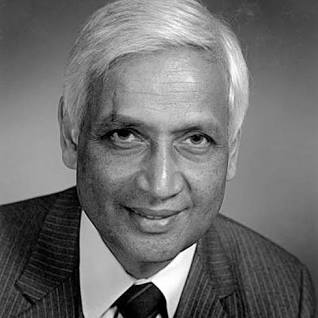
Kumar Patel and CO2 laser- Baramati-Pune to Bell Labs

Happy Deepavali: let’s celebrate (laser) light! Did you know there is a connection b/w Baramati, Pune city & the first-ever CO2 lasers? Kumar Patel, the inventor of one of the most powerful lasers, was born in Baramati & did his BE at the College of Engineering, Pune!

Chandra Kumar Naranbhai Patel had an illustrious career. From Pune, he moved to Stanford University for his PhD and then worked at Bell Labs, where he created his CO2 laser. See him describe the invention:

In Nov 1964 (around the time of the Diwali festival :)), he published his invention: https://journals.aps.org/pr/abstract/10.1103/PhysRev.136.A1187

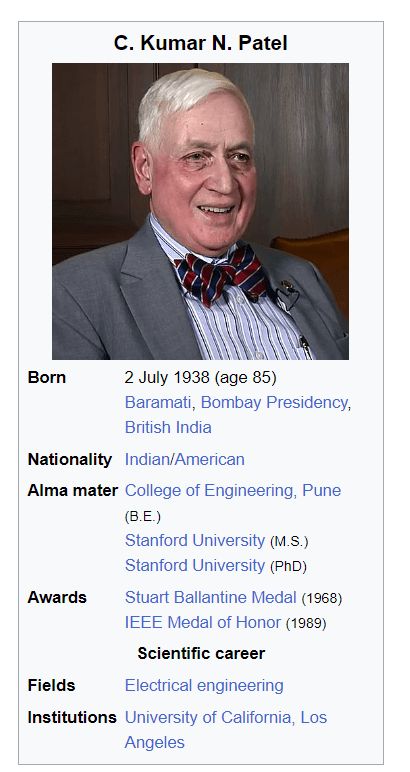
Wikipedia has a good profile of his work, including a video :

https://en.wikipedia.org/wiki/C._Kumar_N._Patel

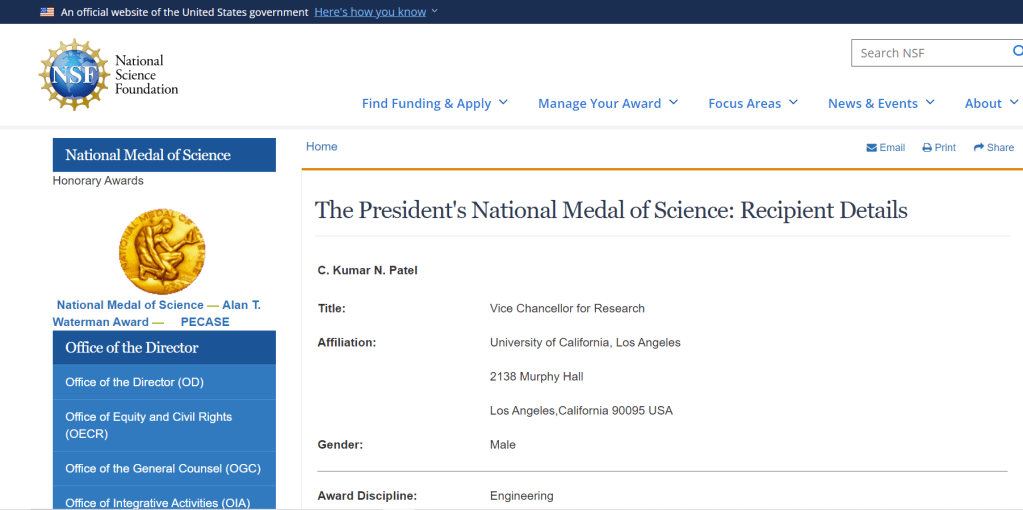
Kumar Patel went on to win many laurels, including US President’s National Medal of Science. https://www.nsf.gov/od/nms/recip_details.jsp?recip_id=270

Kumar was a rare engineering scientist who also served as the president of the American Physical Society in 1995.

https://www.aps.org/about/governance/presidents.cfm

One of the reasons to celebrate Diwali is the move from darkness(ignorance) to light(knowledge). I hope humanity moves toward peace, knowledge and harmony with nature guided by compassion and science. Baramati-born Kumar Patel has shown us one of the ways.

Kannada – ನಿಮಗೆಲ್ಲರಿಗೂ ದೀಪಾವಳಿಯ ಶುಭಾಶಯಗಳು

Marathi – तुम्हा सर्वांना दीपावलीच्या हार्दिक शुभेच्छा

Sanskrit – सर्वेभ्यः दीपावली शुभकामना

Hindi – आप सभी को दीपावली की शुभकामनाएँ

I wish you all a happy Deepavali.