Happy Independence Day & de Broglie’s birthday

Happy Independence Day to my fellow Indians !

15th Aug also happens to be birthday of Louis de Broglie, the famous French physicist who played a critical role in understanding wave-particle duality in quantum physics, and laid an important foundation through his formula

λ = h / p ;

where, λ is the wavelength of quantum particle with momentum p and h is the Planck constant.

See here for more details.

de Broglie studied and discovered the wave nature of electron, for which he received the Nobel prize in physics in the year 1929. In 1920s, understanding light from a quantum mechanical viewpoint was a challenge. Reconciling light, both as a particle and a wave, was counterintuitive and required a leap of thought that was provided by de Broglie. On 12th Dec 1928, delivered his Nobel lecture and mentions:

“I thus arrived at the following overall concept which guided my studies:
for both matter and radiations, light in particular, it is necessary to introduce
the corpuscle concept and the wave concept at the same time. In other words
the existence of corpuscles accompanied by waves has to be assumed in all
cases. However, since corpuscles and waves cannot be independent because,
according to Bohr’s expression, they constitute two complementary forces
of reality, it must be possible to establish a certain parallelism between the
motion of a corpuscle and the propagation of the associated wave.

This duality still remains, as we try understand the nature of light and harness it for information processing.

Interestingly, de Broglie was one of persons who nominated CV Raman for the Nobel prize in 1930 ! Below snapshot is from the Nobel prize nomination archives.

Light as EM wave – in Maxwell’s words

Every year, I teach an optics course to physics majors (including physics iPhD students and MS Quantum Tech students). In the process of introduction, I discuss how light was discovered to be an electromagnetic wave. One of the thrills of this topic is to quote Maxwell from his legendary 1865 paper1, in which he makes this monumental connection. Every time I teach this, I get an intellectual kick, even after doing this for almost 1.5 decades.

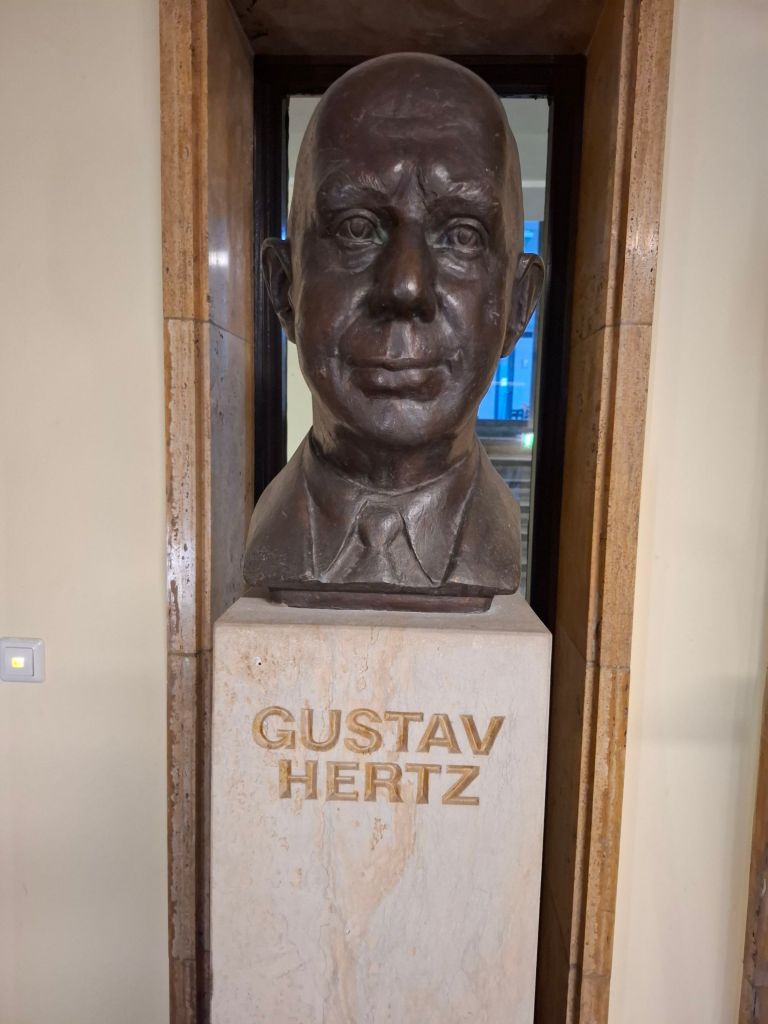
The highlighted text is the famous statement. Before that, Maxwell compares his result with two experimental results and confirms his prediction. I follow this up with Hertz’s experiment.

Note: Electric waves and telegraphy were already known before Maxwell’s paper. There were papers that discussed about velocity of light and its connection to electric waves. See this paper2, for example. However, these interpretations were not as comprehensive as Maxwell’s case, and importantly, the field theory viewpoint needed Faraday’s experiments and Maxwell’s interpretation.

  1. Maxwell, James Clerk. 1865. “VIII. A Dynamical Theory of the Electromagnetic Field.” Philosophical Transactions of the Royal Society of London 155 (January): 459–512. https://doi.org/10.1098/rstl.1865.0008.
    ↩︎
  2. https://www.ifi.unicamp.br/~assis/Weber-Kohlrausch(2003).pdf ↩︎

A quantum survery – 3 thoughts

One of the joys of studying quantum mechanics, at any stage of a career, is to be aware of the fact that there is more scope for interpretations and understanding. This notion has not changed for several decades. A recent survey reinforces this thought.

There are at least 3 interesting points that I infer from the situation:

1) The interpretation of reality at the quantum scale is probabilistic. This has served us well in experiments and has led to the founding of quantum technologies. We are in a situation in the history of science where the philosophical foundations are uncertain, but the technological implications are profound.

2) Having more data is always good, but for a new leap of thought, we may have to pay attention to new connections among the data. Can AI play a role in this?

3) There is more room for exploration in the foundations of quantum physics. Philosophy of physics has a role to play in this exploration. Physics students and researchers with (analytical) philosophical inclination have an opportunity to contribution. This needs a grounding in understanding mathematics and experiments related to quantum physics. I see this as a great opportunity for someone to enter the field.

Conclusion: Good time to explore the foundations of physics*

*subject to support from society

Conversation with Shivprasad Patil

Welcome to the podcast Pratidhavani – Humanizing Science

Shivprasad Patil is a Professor in the Department of Physics at the Indian Institute of Science Education and Research (IISER) Pune.

His main academic interests include nanotechnology, atomic force microscopy, and single-molecular interactions. His research centers on experimental nanomechanics and force spectroscopy, especially for probing phenomena at the single-molecule level.

In this conversation, we explore his intellectual journey from a small village in Maharashtra to a professor at IISER Pune

Spotify

References:

Force Spectroscopy Conference. n.d. “Conference on Force Spectroscopy and Microscopy, India.” Accessed July 25, 2025. https://forcespectroscopy.in/.

My Site. n.d. “Home.” Accessed July 25, 2025. https://nmlab220.wixsite.com/my-site-1.

“‪Shivprasad Patil‬ – ‪Google Scholar‬.” n.d. Accessed July 25, 2025. https://scholar.google.com/citations?user=rtuNcawAAAAJ&hl=en.

“Shivprasad Patil – IISER Pune.” n.d. Accessed July 25, 2025. https://www.iiserpune.ac.in/research/department/physics/people/faculty/regular-faculty/shivprasad-patil/313.

Philosophy of Science – ideas – cartoon

Ideas in philosophy of science, especially in the 1800s and early 1900s, had their origin in physics. Two philosophers who were deeply influenced by physics were Karl Popper and Thomas Kuhn. Below is a cartoon depiction of the same. Of course, the origins of ideas in philosophy of science have diversified in recent years, and biology and technology (especially AI) dominate the scene nowadays.

A note on experimental physics

Experimental physics is one of the crucial ingredients of physics. There are at least two major tasks within its realm. The first is to examine nature through observation. These observations can then be extrapolated into systematic measurements that can be quantified. The second aspect is that experimental physics serves as a platform to test hypotheses that are already formulated by theory. In this way, it acts as a conduit connecting theory to real-world situations. Additionally, it reveals the limitations of any theory, thereby serving as a valuable test bed.

These two tasks are essentially intertwined: an observation can lead to new hypotheses, and, conversely, a well-formulated hypothesis can lead to systematic measurements.

For example, while hunting for astronomical radio sources, an important discovery was made: the observation of the cosmic microwave background. This finding turned out to be one of the crucial ones in physics, providing vital insights into the Big Bang theory and becoming a foundational aspect of observational cosmology. Another example is the special theory of relativity, where the Michelson-Morley experiment ruled out ether, which enabled Einstein to formulate his theory with greater confidence.

These two examples offer a snapshot of the possibilities within experimental physics and highlight its essential role in the duality between theory and experiment in physics. In a way, experiments and theory complement each other, and are like two sides of a coin.

Tony Tyson and a giant CCD camera

Recently, I came across an interview with Tony Tyson, one of the main scientists related to the Rubin telescope. He says:

“We can do better than this. We can build a larger telescope by making larger mosaics of larger CCDs.”
— Tony Tyson

On a day when India lost a test match, the first sentence rings loud…anyway, the topic of this post is a fascinating development happening in observational cosmology.

Tony’s suggestion above is a great, ambitious way to explore the Universe….by building effective observational tools that can image and comprehend the observable…and perhaps unobservable too…

For students: Observational cosmology is a great place to explore cutting-edge science: physics (experiments + theory), maths, engineering & computation…all come together..

Check out the interview of Tony Tyson…one of the brains behind the cameras of Rubin Observatory…plenty to learn…

Just like test cricket, observational cosmology needs patience…perhaps a good lesson for life too…

Conversation with Shubashree Desikan

In this episode, we discuss Shubashree’s journey from earning a PhD in physics to building a career in science journalism. She talks about her experiences writing for The Hindu and her current role as Associate Editor at IIT Madras’ Shaastra magazine. As a national award-winning journalist, Shubashree shares insights into making scientific ideas accessible to a wider audience, the challenges she has faced in the field, and her advice for aspiring science writers. This conversation explores her career transition, the role of science communication, and the importance of clarity in sharing scientific knowledge.

REFERENCES:

“Star Stories | Science Is Perspective.” n.d. Accessed June 24, 2025. https://shubadesikan.wordpress.com/.

“(1) Shubashree Desikan | சுபா (@Shubawrite) / X.” 2025. X (Formerly Twitter). April 4, 2025. https://x.com/shubawrite.

“(5) Shubashree Desikan | LinkedIn.” n.d. Accessed June 24, 2025. https://www.linkedin.com/in/shubadesi/?originalSubdomain=in.

Shubashree. 2025. “When Entanglement Reaches for the Stars.” Star Stories (blog). April 3, 2025. https://shubadesikan.wordpress.com/2025/04/03/when-entanglement-reaches-for-the-stars/.

“Shubashree Desikan.” n.d. The Hindu. Accessed June 25, 2025. https://www.thehindu.com/thread/author/Shubashree-Desikan-336/.

ConForce 25 – highlights

From 15th to 18th June 2025, I attended a focused meeting called ConForce.

The location was at an interesting place: Casuarina Resort Park- Kurunji, which is about 70 km from Pune. It was a scenic and raw place, with an amazing landscape. The resort facilities were ok with limited facilities, but the landscape was just breathtaking. It rained almost all the time, but it created a wonderful visual across the horizon with lush green patches of mountains and grey clouds (see image).

The main theme of the meeting was related to force spectroscopy, with a greater tilt towards biophysical applications. I spoke in the optical tweezers section and enjoyed the discussion with various participants and speakers. Specifically, I presented some of our recent, unpublished work on optical binding and its optical perturbation.

More is Different – A Brief Overview

P.W. Anderson (image from wikipedia)

In 1972, P. W. Anderson wrote what is considered one of the most remarkable essays in the history of physics, and the title of that essay is “More is Different.” In the essay, Anderson was trying to make a case for emergence, where new, interesting physical properties can emerge by the combination of matter, which you would not anticipate if you had just kept it as an individual entity.

One of the aspects related to this essay is also the thought that reductionism has its limitations and that groups act very differently compared to individuals. The higher-level rules that can emerge from the combination of small entities are actually very different from the rules that are applicable to individual entities.

For example, if you consider electrons in a solid, you have the emergence of properties of electrons such as magnetism or superconductivity, or, for that matter, putting molecules inside a compartment and, lo and behold, life arises out of that. This has turned out to be one of the most influential ways of thinking in physics because it opened up a new avenue for understanding complex systems not as just combinations of simple systems but as the emergence of properties.

Very interestingly, this essay does not actually mention the word “emergence” at all, but the concept is so fascinating that it has turned out to be one of the most influential essays ever written in physics. The whole point about this particular essay is that the whole is more than the sum of its parts, and P. W. Anderson has to be remembered for this magnificent essay.