The accepted paper is online now. Thanks to the anonymous reviewer(s) for the encouraging feedback. It made my day :-)
The paper will be published as part of a special issue on optics in South Asia
Link to the online version here.
The accepted paper is online now. Thanks to the anonymous reviewer(s) for the encouraging feedback. It made my day :-)
The paper will be published as part of a special issue on optics in South Asia
Link to the online version here.
I have been studying quantum mechanics for almost 30 years now. Every time I go back to study and understand something, it reminds me of a quote by Nelson Mandela: “There is nothing like returning to a place that remains unchanged to find the ways in which you yourself have altered” ~ Long Walk to Freedom (1994)
On further contemplation, I find the same with other branches of physics and certain aspects of mathematics, too.
Perhaps this is what a ‘life of a student’ means?
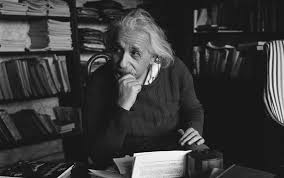
14th of March is Einstein’s birthday. There is so much written about Einstein, and every time you read about him or a text written by him, there is always something interesting to learn. Recently, I came across a wonderful paper by Shankland, who compiled his conversation with Einstein over a period of ten years and published it in 1962 in the American Journal of Physics. Below are three excerpts from the paper to give you a taste of the conversation. I would urge you to read the conversation in full, and it is a delight.
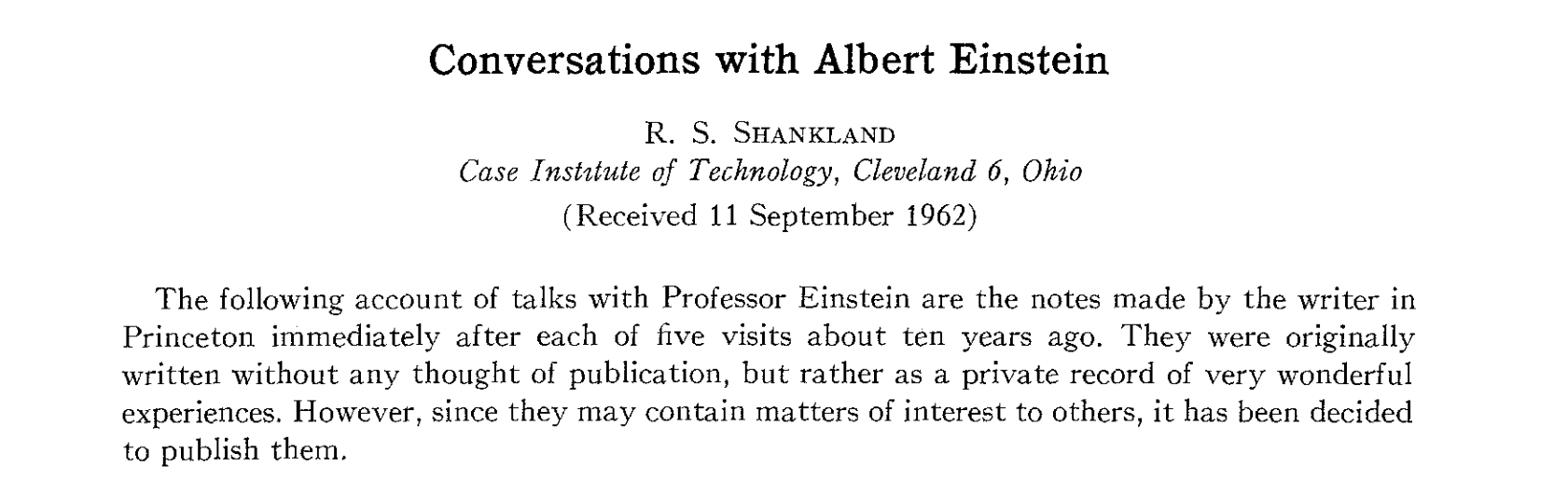
(Shankland 1963, 1)
“When I asked him how he had learned of the Michelson-Morley experiment, he told me that he had become aware of it through the writings of H. A. Lorentz, but only after 1905 had it come to his attention! “Otherwise,” he said, “I would have mentioned it in my paper.” He continued to say the experimental results which had influenced him most were the observations on stellar aberration and Fizeau’s measurements on the speed of light in moving water. “They were enough,” he said. I reminded him that Michelson and Morley had made a very accurate determination at Case in 1886 of the Fresnel dragging coefficient with greatly improved techniques and showed him their values as given in my paper. To this he nodded agreement, but when I added that it seemed to me that Fizeau’s original result was only qualitative, he shook his pipe and smiled, “Oh it was better than that!” He thought Zeeman’s later precise repetition of this experiment was very beautiful. He seemed really delighted when I mentioned to him how elegant I had found (as a student) his method of obtaining the Fresnel dragging coefficient from his composition of velocities law of special relativity.” (Shankland 1963, 2)
“I asked Professor Einstein how long he had worked on the Special Theory of Relativity before 1905. He told me that he had started at age 16 and worked for ten years; first as a student when, of course, he could only spend part-time on it, but the problem was always with him. He abandoned many fruitless attempts, “until at last it came to me that time was suspect!” Only then, after all his earlier efforts to obtain a theory consistent with the experimental facts had failed, was the development of the Special Theory of Relativity possible. This led him to comment at some length on the nature of mental processes in that they do not seem at all to move step by step to a solution, and he emphasized how devious a route our minds take through a problem. “It is only at the last that order seems at all possible in a problem.”” (Shankland 1963, 2)
“Our conversation then returned to the Michelson-Morley experiment and the Special Theory of Relativity. I could not help feeling that this elegant special theory, the product of his youthful efforts, held the place nearest to his heart. I asked him if he felt that writing out the history of the ;v[ichelson-Morley experiment would be worthwhile. He said, “Yes, by all means, but you must write it as Mach wrote his Science of Mechanics.” Then he gave me his ideas on historical writing of science. “Nearly all historians of science are philologists and do not comprehend what physicists were aiming at, how they thought and wrestled with their problems. Even most of the work on Galileo is poorly done.” A means of writing must be found which conveys the thought processes that lead to discoveries. Physicists have been of little help in this because most of them have no “historical sense.” Mach’s Science of Mechanics, however, he considered one of the truly great books and a model for scientific historical writing. He said, “Mach did not know the real facts of how the early workers considered their problems,” but Einstein felt that Mach had sufficient insight so that what he says is very likely correct anyway.” (Shankland 1963, 4)
There is a lot more to explore in the wonderful conversation paper. Link below.
Shankland, R. S. 1963. ‘Conversations with Albert Einstein’. American Journal of Physics 31 (1): 47–57. https://doi.org/10.1119/1.1969236.
Sudipta Sarkar is a Professor of Physics at IIT Gandhinagar, specializing in gravitation, black hole thermodynamics, gravitational waves, and quantum field theory in curved spacetime. He is also interested in the history of science, particular history of relativity and connected ideas.
In this conversation, we discussed his intellectual journey and the research questions that he has been interested in.
References:
‘IIT Gandhinagar | Sudipta Sarkar’. n.d. Accessed 9 March 2026. https://iitgn.ac.in/faculty/phy/fac-sudipta.
GEORGE GAMOV. n.d. ONE TWO THREE INFINITY. Accessed 13 March 2026. http://archive.org/details/OneTwoThreeInfinity_158.
IIT Gandhinagar. 2022a. Classical Black Hole | Prof Sudipta Sarkar | Lecture 01. 01:18:58. https://www.youtube.com/watch?v=1nKVYasNFh0.
IIT Gandhinagar. 2022b. Towards Relativity: Einstein and His Compass | Sudipta Sarkar | History of Ideas 2.0. 01:05:09. https://www.youtube.com/watch?v=-4gv-S7sLZ0.
Lightman, Alan. n.d. A Sense of the Mysterious: Science and the Human Spirit. Vintage Books.
Miller, Arthur I. 1981. Albert Einstein’s Special Theory of Relativity: Discovery. Addison Wesley Longman Publishing Co.
Pais, Abraham. 2005. Subtle Is the Lord: The Science And the Life of Albert Einstein. Oxford Univ Pr.
‘Sudipta Sarkar – Google Scholar’. n.d. Accessed 9 March 2026. https://scholar.google.com/citations?user=zXU9ZN4AAAAJ&hl=en.
‘Sudipta Sarkar – INSPIRE’. n.d. Accessed 9 March 2026. https://inspirehep.net/authors/1039819.
TIFR Quantum Space-Time Seminars. 2026. Sudipta Sarkar (IITGandhinagar): Rotating Black Holes Beyond General Relativity. 02:07:12. https://www.youtube.com/watch?v=cRJw9MXVgdc.

Anthony James Leggett (26 March 1938 – 8 March 2026)
pic credit: Britannica
I was informed that Anthony Leggett passed away…he made physics wonderful by asking profound questions, as below:
“……there is no good reason to accept this division of the world into a microscopic regime where QM reigns and a macroscopic one governed by classical physics; QM is a very ‘totalitarian’ theory, and if it applies to an individual and electrons, then it should prima facie equally apply to the macroscopic objects made up of them, including any devices which we have set up as measuring apparatus….” [1]
Leggett, A. J. ‘Realism and the Physical World’. Reports on Progress in Physics 71, no. 2 (2008): 022001. https://doi.org/10.1088/0034-4885/71/2/022001.
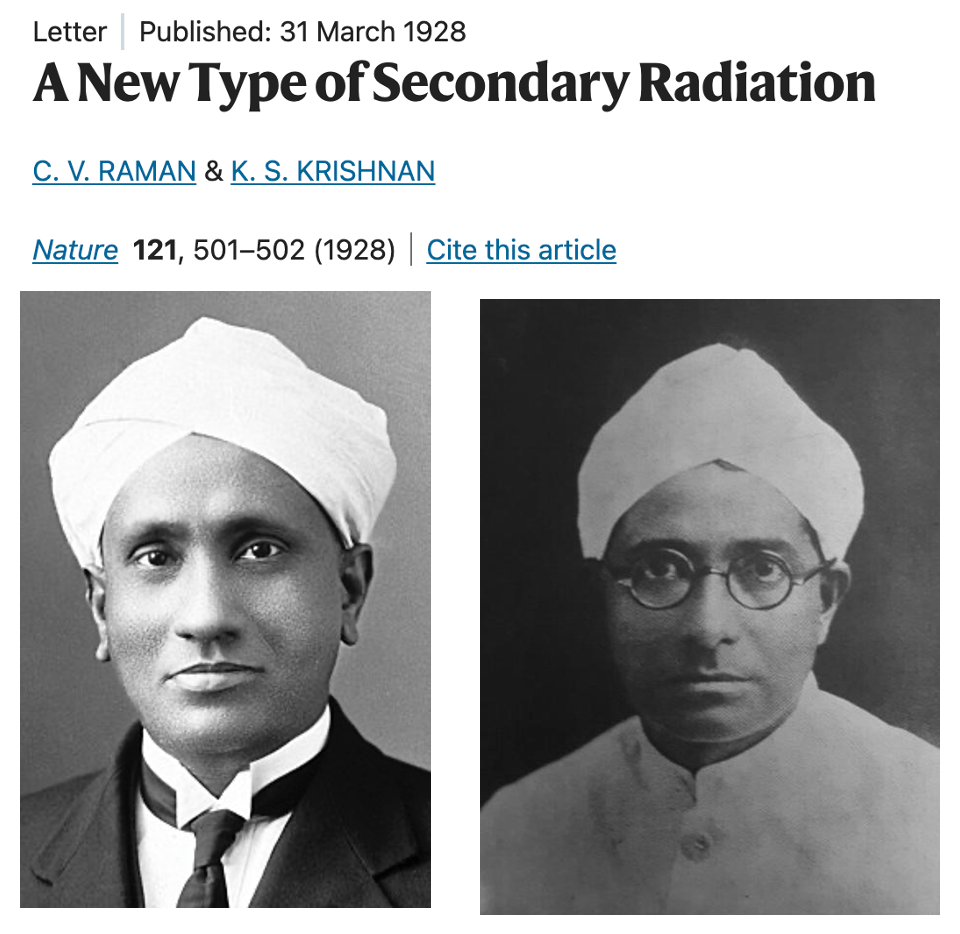
On 28th February, we commemorate the first confirmed observation of the Raman effect, dating back to 1928. Raman’s student, K. S. Krishnan (imaged on the right), had an important role in this observation, and the scientific paper associated with Raman scattering has both Raman and Krishnan as the authors (see picture above). Scientific discoveries and inventions happen with constant effort spread over a long duration. It also happens on a strong foundation of knowledge that has already been established.
Raman recognised this and, as he mentions in his talk on scientific outlook, “The happy discoverer in science is invariably a seeker after knowledge and truth working in a chosen field of his own and inspired in his labours by the hope of finding at least a little grain of something new. The commentators who like to consider discoveries as accidents forget that the most important part of a scientific discovery is the recognition of its true nature by the observer, and this is scarcely possible if he does not possess the requisite capacity or knowledge of the subject. Rarely indeed are any scientific discoveries made except as the result of a carefully thought-out programme of work. They come, if they do come, as the reward of months or years of systematic study and research in a particular branch of knowledge.” (Raman, 1951, p. 243)
This, I think, is generally good advice for researchers, especially the younger ones. One cannot over-emphasize the importance of systematic study.
On this commemorative day, it will be good for us, Indians, to commit ourselves to sincere, honest, hard work motivated by a scientific outlook. As Raman mentions, we need to be seekers of knowledge and truth. Not everything may lead to spectacular results, but it will give us a reason for having done something correct and hopefully useful to humanity. In doing so, we may live a meaningful and purposeful life. Science and scientific thinking can have a central role in realizing such a life.
Happy National Science Day to India…and to the world. After all, science is global.
Reference:
Raman, C. V. ‘The Scientific Outlook’. The New Physics – Talks on Aspects of Science by C V Raman, Philosophical Library, New York, 1951. https://doi.org/10.1007/BF02835148.
Journal of the Optical Society of America is coming up with a special issue on Optics in South Asia. I was invited to write a historical overview of Raman’s work on optics. Below is the snapshot of the pre-print. It should also appear in the axriv in the coming week. Meanwhile, you can access the preprint PDF below.
Also, look out for a research article from my group on multipolar optical binding submitted to the same issue. I will post a link when it appears as a pre-print.
Acknowledgements:
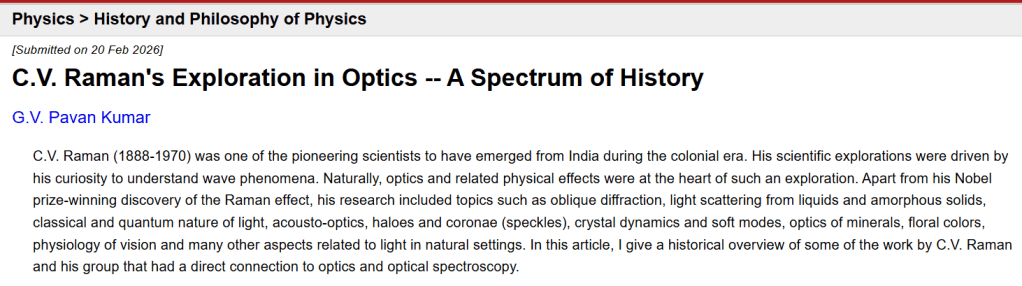
arXiv link here.
Debarati Chatterjee is a Professor of theoretical astrophysicist at IUCAA and the Chair of Education and Public Outreach for the LIGO-India project. An avid science communicator, she founded the Indian branch of the Pint of Science festival and regularly holds outreach events in multiple languages to make science accessible to all.
In this episode, we explore her intellectual journey so far.
References:
1.‘Debarati Chatterjee – Google Scholar’. Accessed 18 February 2026. https://scholar.google.com/citations?user=wL7lJoUAAAAJ&hl=en.
2.‘Debarati Chatterjee – IUCAA’. Accessed 18 February 2026. https://www.iucaa.in/en/faculty-research/debarati.
3.‘Facebook’. Accessed 18 February 2026. https://www.facebook.com/AstroRoamer.
4.India. ‘Pint of Science India’. Accessed 18 February 2026. https://www.pintofscience.in.
5.India. ‘The Team’. Accessed 18 February 2026. https://www.pintofscience.in/team.
6.‘iPortfolio Bootstrap Template – Index’. Accessed 18 February 2026. https://web.iucaa.in/~debarati/.
7.‘LIGO India (@ligoindia) • Instagram Photos and Videos’. Accessed 18 February 2026. https://www.instagram.com/ligoindia/.
8.Linktree. ‘Ligoindia | Twitter, Instagram, Facebook’. Accessed 18 February 2026. https://linktr.ee/ligoindia.
9.‘Pint of Science India (@pintofsciencein) • Instagram Photos and Videos’. Accessed 18 February 2026. https://www.instagram.com/pintofsciencein/.
10.‘Prof. Debarati Chatterjee | LinkedIn’. Accessed 18 February 2026. https://www.linkedin.com/in/prof-debarati-chatterjee-a6072a/.
11.‘Prof. Debi (@debi.Physix) • Instagram Photos and Videos’. Accessed 18 February 2026. https://www.instagram.com/debi.physix/.
12.Sharma, Kanika. ‘I Encourage Women to Claim Their Space in Astrophysics and Beyond’. Nature, ahead of print, 21 November 2025. https://doi.org/10.1038/d41586-025-03400-1.
13.X (Formerly Twitter). ‘Prof. Debarati Chatterjee (@astro_roamer) / X’. 9 February 2019. https://x.com/astro_roamer.
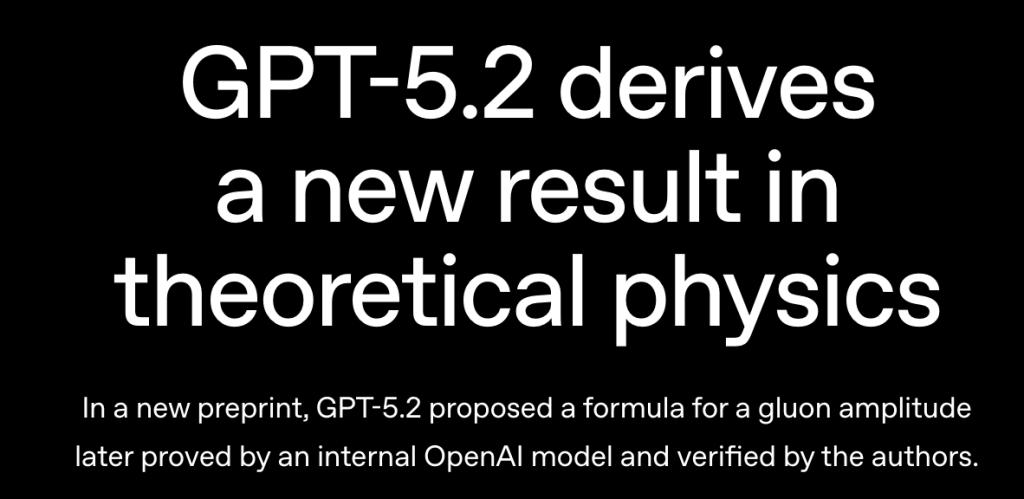
The above snapshot is from OpenAI, which has claimed to have derived a new result in theoretical physics. What is it about, and how good are the claims? Below, I discuss them.
Let me start with some background. Except for the hydrogen atom, the nucleus of all elements in the periodic table consists of neutrons and protons. Neutrons and protons are made of quarks. Quarks interact through gluons. How do these gluons interact? This is a contemporary question.
In this particular case, the authors of the study say: “We’ve published a new preprint showing that a type of particle interaction many physicists expected would not occur can, in fact, arise under specific conditions. The work focuses on gluons, the particles that carry the strong nuclear force.”[1]
The interaction can be computed in terms of probabilities[2], and these probabilities depend on quantum mechanical amplitudes (also called scattering amplitudes). Finding these amplitudes requires a deeper knowledge of strong nuclear forces. Computing such amplitudes is expensive and requires a lot of effort. Physicists, under physical constraints, take a guess on which interaction is more probable and which is not. This study shows that one of the interactions that physicists thought was not probable turns out to be probable, but under specific conditions. “The preprint studies a central concept in particle physics called a scattering amplitude. A scattering amplitude is the quantity physicists use to compute the probability that particles interact in a particular way. …….One case, however, has generally been treated as absent (having zero amplitude)……..As a result, this configuration has largely been set aside. The preprint shows that this conclusion is too strong.”[1]
Of course, this has been possible using the brute force computational capability of the GPT 5.2 model, and it has come up with a particular formula that shows the amplitude to be probable and has further validated it with a formal proof. It is a methodological breakthrough, and the authors claim, “An internal scaffolded version of GPT‑5.2 then spent roughly 12 hours reasoning through the problem, coming up with the same formula and producing a formal proof of its validity.” [1]
I think it is a good development in computational physics and helps in calculating parameters that have relevance in finding probabilities of interaction in particle physics. Overall, my hunch is that it is an important step in computational physics.
Notes:
[1] OpenAI has put out an excellent summary of this problem (without jargon), and it needs basic physics, and the flow of text is good.
[2] Also see Nirmalya Kajuri’s summary on X
One of the last letters written by Rutherford. This was to Raman dated 3rd Aug 1937.
Here, he is consoling Raman after he quit the Directorship of IISc. Rutherford is also discussing his possible travel plans to India.
Unfortunately, Rutherford died on 19th Oct 1937..
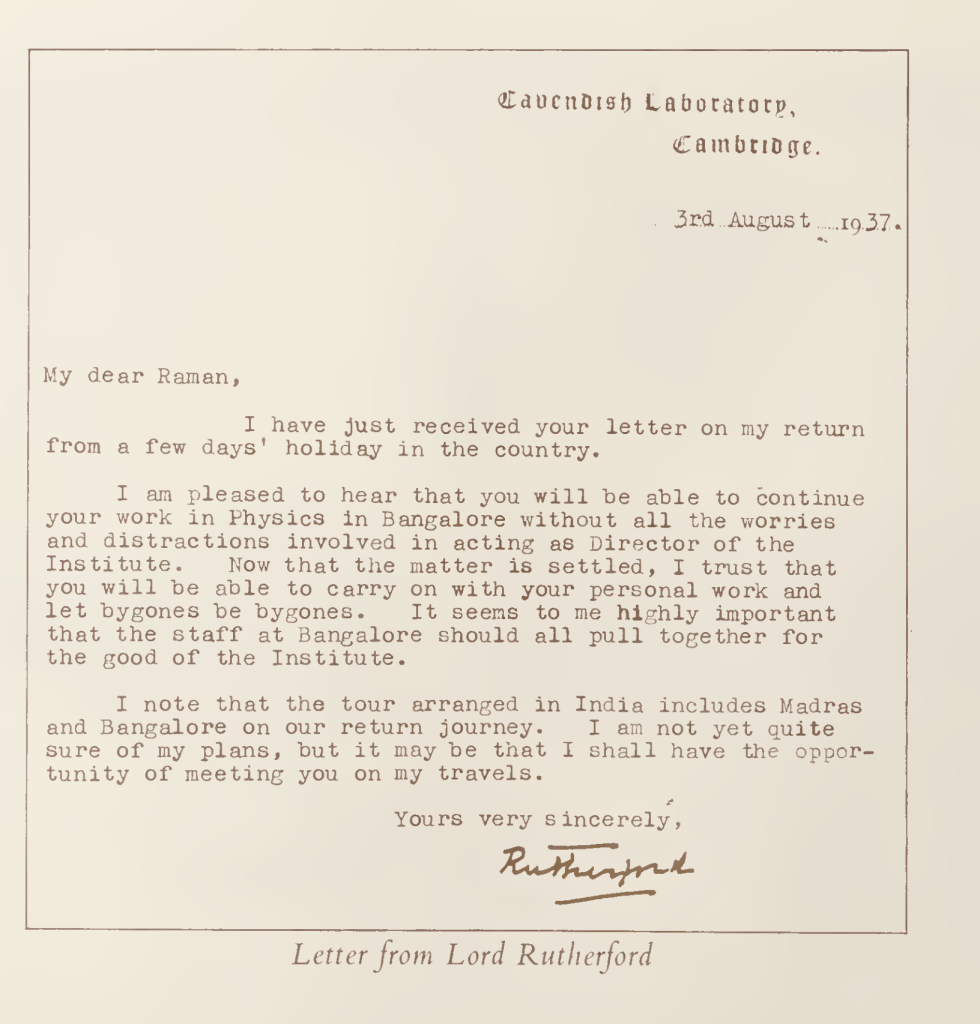
ref: S. Ramaseshan and C. Ramachandra Rao. C.V. Raman : A Pictorial Biography, p 108 (1988)
 VISMAYA - History & Philosophy of Physics