Sid Nagel has given an aura to an area of physics that was not considered fashionable even as late as the 2010s. Part of his elevation is because “Soft Matter Physics” has become so vital to understand our everyday world (including biological) that it is hard to ignore it anymore. Chemical Engineers, too, have played a major role in this elevation, and the James Frank Institute at Chicago has been an epicenter for this way of thinking.
A major shift in thinking, especially among physicists, is thanks to PW Anderson. His essay – ‘More is Different” did a great service to soft matter and complex systems by highlighting the importance of emergence (side note: the word emergence does not occur in his essay, even once !) It further got a major headway with a Nobel to de Gennes. Suddenly, condensed matter physicists had something to explore beyond electrons and their density functions. The French school had a major hand in this.
For me, soft matter physics, in a way, makes physics experiments democratic. One can still dare to do some ‘breakthrough science’ in a tiny kitchen 🙂
He specializes in integrated water management with a river basin perspective. His research focuses on adaptation, access, and use of water in agricultural and domestic sectors, often collaborating across disciplines. With extensive fieldwork in Southern India, he has led multidisciplinary projects on water resources management and adaptation. His work bridges environmental sustainability, development, and policy.
In this episode, we discuss his intellectual journey so far.
Bejoy K Thomas (ബിജോയ്) [@bejoykt]. 2024. “Traveling through Kuttanad/Vembanad Wetland, Where I Did My PhD Fieldwork Almost Two Decades Ago. Two and a Half Hours Boat Ride on Kerala State Water Transport Department (SWTD) from Alappuzha to Kottayam Costs Only 29 Rupees. Https://T.Co/nxCUVPMgfj.” Tweet. Twitter. https://x.com/bejoykt/status/1869608390504468810.
Even today, as a professor of physics, and importantly as a student of physics, I go back to his lecture series to learn AND derive inspiration from his thinking. He made physics more humane.
Many people across the globe have fallen in love with physics because of his books and the ‘way he did physics’
Feynman was a physics genius, but he had his flaws. It is important for us to note the limitations of human beings; celebrate what is good, and be aware and critical of what is not.
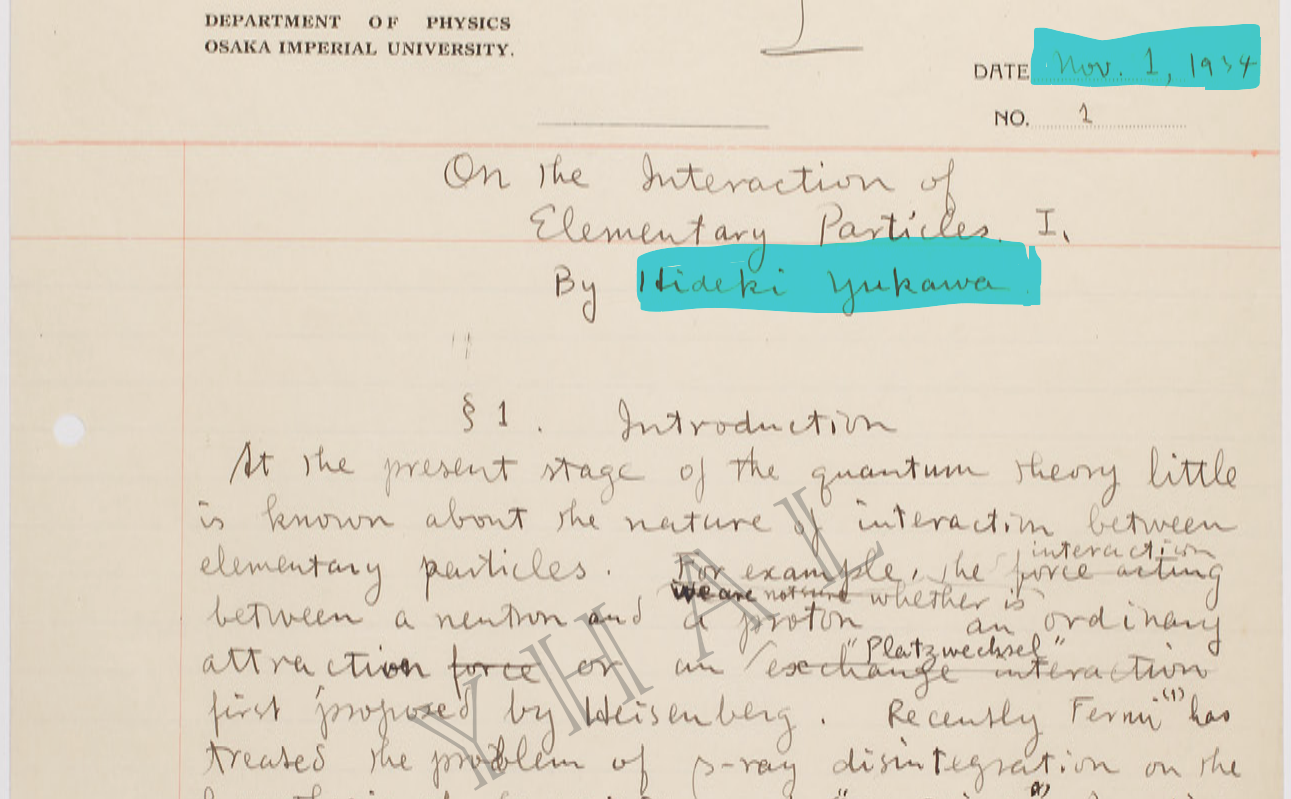
I have been amazed to explore the archives on Hideki Yukawa, which have been systematically categorized and meticulously maintained by Osaka University in Japan. My sincere thanks and acknowledgment to the Yukawa Memorial.
Below are a few gems from their public archives :
Draft of the paperwritten in 1934 – The making of the groundbreaking paper of Yukawa, which eventually led to his Nobel Prize in 1949.
The archive draft is accompanied by a note which reads:
Yukawa had not published any paper before then. In 1933, Yukawa began working at Osaka Imperial University and tackled the challenge of elucidating the mystery of nuclear forces while Seishi Kikuchi and other prominent researchers were producing achievements in nuclear physics and quantum physics. The idea of γ’ (gamma prime) that Yukawa came up with in early October led to the discovery of a new particle (meson) that mediates nuclear forces. The idea of introducing a new particle for the purpose of explaining the forces that act between particles was revolutionary at that time. Yukawa estimated the mass of the new particle and the degree of its force. No other physicists in the world had thought of this idea before.
2. Letters between Tomonaga and Yukawa
Sin-Itiro Tomonaga was a legendary theoretical physicist from Japan, who independently formulated the theory of quantum electrodynamics (apart from Feynman and Schwinger) and went on to win the Nobel Prize in physics in 1965.
Both these theoreticians were intensely working on interrelated problems and constantly exchanged ideas. The archival note related to the letter has to say the following:
During this period, Yukawa and Tomonaga concentrated on elucidating nuclear forces day in and day out, and communicated their thoughts to each other. In this letter, before starting the explanation, Tomonaga wrote “I am presently working on calculations and I believe that the ongoing process is not very interesting, so I omit details.” While analyzing the Heisenberg theory of interactions between neutrons and protons, Tomonaga attempted to explain the mass defects of deuterium by using the hypothesis that is now known as Yukawa potential. The determination of potential was arbitrary and the latest Pegrum’s experiment at that time was taken into consideration. Tomonaga also compared his results with Wigner’s theorem and Majorana’s theory.
3. Rejection letter from Physical Review
Which physicist can escape a rejection from the journal Physical Review?
Even Yukawa was not spared :-) Below is a snapshot of a rejection letter from 1936, and John Tate does the honours.
The influence of Yukawa and Tomonaga can be seen and felt at many of the physics departments across Japan. Specifically, their influence on nuclear and particle physics is deep and wide, and has inspired many in Japan to do physics. As the archive note says:
Yukawa and Tomonaga fostered the theory of elementary particles in Japan from each other’s standpoint. Younger researchers who were brought up by them, so to speak, must not forget that the establishment of Japan’s rich foundation for the research of the theory of elementary particles owes largely to Yukawa and Tomonaga.
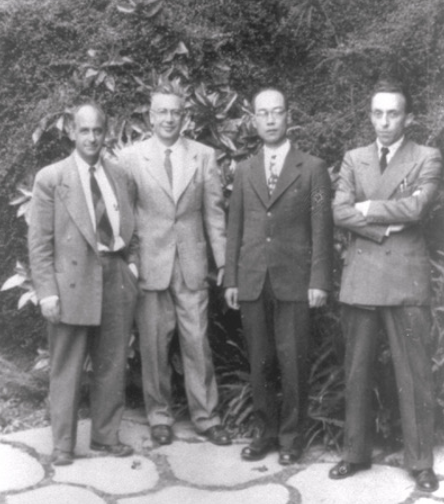
4. Lastly, below is a picture of the legends from the archive: Enrico Fermi, Emilio Segrè, Hideki Yukawa, and James Chadwick.
From the archive note on the picture from September 1948:
Yukawa met Prof. Fermi and other physicists of the University of Chicago who were staying in Berkeley for the summer lectures. From the left: Enrico Fermi, Emilio Segrè, Hideki Yukawa, and James Chadwick.
Tomorrow, I will conclude my third trip to Japan. I always take a lot of inspiration from this wonderful country. As usual, I have not only met and learnt a lot from contemporary Japanese researchers, but also have metaphorically visited the past masters who continue to inspire physicists like me across the world.
When we study the history of science, specifically physics, we find that a good idea simultaneously existed in various places. This suggests it may be better not to overemphasize a person for the origin of an idea. If we focus on the context, utility, and exchange of ideas, we get a broader picture of scientific ideas. This approach creates a spatio-temporal network, an interesting way to view the historical evolution of ideas across the humanities, space, and time. People, ideas, and technologies collectively progress the frontiers of science in various places at different times. In that sense, science, including physics, is a global human endeavor. This is evident when we look into the history of mechanics from ancient times until now. Mechanics is a fundamental sub-discipline of physics and has a strong connection to mathematics and engineering. It has evolved with logical reasoning and understanding of natural phenomena.
Engineering structures, which humanity has long been interested in, have played a significant role. Mechanics has been the playground of philosophers, scientists, and engineers. The questions it raised led to new thinking and new technologies. Mechanics offers a way to understand and engineer the universe. In this episode, we explore its links to mathematics, engineering, and key thinkers.
The importance of counting.
Counting has played a critical role in human life for a long time. In fact, we use fingers as a counting device, and this has been a very powerful tool for a significant period. So much so that it has been utilized to keep a tally of small numbers, which can be counted and analyzed in everyday life. Interestingly, as the numbers became larger, one had to externalize the counting process, and in ancient times, people had very creative methods to count objects. One of the fascinating aspects of counting was to use bones. Yes, bones were used as platforms on which marks were created, and these marks were utilized as the counts in a tally.
Images of Ishango bones with periodic marks on its surface.
One of the pieces of evidence for such behavior was found in the Congo Basin in a place called Ishango. The bones that were found are dated around 9000 BCE to 6500 BCE (although a big debate is going on regarding the dates, with some putting it beyond 20,000 BCE), on which marks have been identified that look like counts registered on the platform. Indeed, it is quite fascinating to see how people used various devices to enumerate objects. If you ask any child what is 1 plus 1, they will be able to say that it is 2. This may sound trivial, but the concept of addition itself was not in the historical context. To consider two numbers and add them together needs a certain degree of abstraction, which has been part of the evolution of mathematics since ancient times. A variety of counting methods have been devised in different civilizations, which have added a kind of flavour to the history of mathematics.
Importantly, language has played a critical role in facilitating a vocabulary for counting. Depending upon the syntax and the order of letters, numbers have been represented in a variety of ways across space and time of human history.
In this context, let me emphasize two important aspects of numbers and their representation. The first aspect is related to the positional notation. What is it? Let me give you an example. If you take numbers 24 and 42, the position of the number 4 is different. In 24, the number 4 is in the unit’s place, and in the number 42, it is in the tens place. So, the position of the number determines its value, and this is an important concept that civilizations have thought about and utilized in their counting systems. The second aspect is the concept of zero. Let me give an example. If you consider number 007 and compare it to 700, obviously, depending on the location of the zero, the value of the number drastically changes. But what is intriguing is that various civilizations used a variety of symbols, such as dots, circles, and empty spaces, to represent nothingness. What is not trivial is the recognition of zero as a number by itself. This needs a leap of thought because it must be an abstraction of a concept where the nothingness has to be associated with a number, and hence the association to zero. It was Brahmagupta around the year 628 CE in his Brahma Sputa Siddhanta that we first encountered the concept of zero as a number. This is indeed one of the great achievements because, without zero as a number, one cannot build mathematical concepts. It is both fundamental and profound. It has further played a critical role in laying the foundation of mathematics as we know it today.
02 Geometry
Now, let’s look at the connection between geometry and physics. Across various civilizations, the size and shapes of objects were curiosities, and understanding them was an important necessity for everyday life. Given that objects in the natural and artificial world come in various sizes and shapes, it was necessary to understand them for further utilization.
In ancient Greece, Thales of Miletus was one of the earliest to use a mathematical way of thinking and to formulate a framework to understand nature through logical analysis and not based on faith or myths. This thinking further percolated to all the subsequent philosophers, and that included a person named Pythagoras. Pythagoras’ life and times are not as well documented as those of other Greek philosophers, but by some estimates, he was supposed to have lived around 570 BCE to 495 BCE.
During that time, the Greeks had colonized various parts of Europe, and this included some parts of Italy. Pythagoras remained in that colonized part of Greece, where he had established a school, which was also interestingly a mythical cult. His school hardly shared any information with the outside world, and this is probably one of the reasons why there is very little known about Pythagoras’ life and times.
In fact, none of his writing has survived to date, and most of the information that we get is from indirect sources. However, the attribution of some scholars to Pythagoras’ work needs attention. Interestingly, Pythagoras did some experiments and tried to understand the production of sound.
He made an interesting connection to the strings and the pleasant sound that they produce. He hypothesized that there is a rational number of steps in strings that led to the pleasant sound. This thinking was further extrapolated to rational numbers, and that became an interesting connection. Pythagoras has also been attributed to have thought about astronomical objects.
Earth being spherical is one of the concepts that he had thought about and played a role in rationalizing the distances of objects such as the Sun, Moon, and planets. This kind of methodical thinking further influenced many Greek schools of thought, and this included the famous Plato’s Academy. Plato himself was a renowned philosopher, but he had a very strong inclination towards mathematics.
He also came up with the five solids and the four elements, which played a critical role in his interpreting of the natural world based on them. But it is in 300 BCE that we see an epoch in geometry in the form of Euclid’s Elements. Euclid of Alexandria was one of the great mathematicians whose work is still of significant relevance today.
Euclid, like many of his predecessors, had a life immersed in the ancient university system—in his case, the University of Alexandria. Again, not much is known about Euclid’s life and times, except for the fact that he wrote 13 volumes of his magnificent book titled Elements.
This book has turned out to be the foundation of mathematics and has played a critical role in creating a new worldview both for natural scientists and abstract mathematicians. Most of what we know today about Euclid is thanks to a Greek commentator, Theon of Alexandria, who lived roughly 700 years after Euclid. He played a critical role in interpreting and highlighting the works of Euclid, and going forward in time, Arabs took a keen interest in Euclid’s geometry and incorporated it into their education and research.
Euclid’s work on geometry is a masterpiece, which has 13 books in a series and contains 465 theorems. Each of them contains foundational knowledge about geometrical entities, including lines, angles, shapes, and solid geometries that past people had discussed. It is a tribute to his knowledge that Euclid’s Elements is still in print, and this shows how much the impact of Euclid has been over the centuries.
Importantly, the geometrical way of thinking has deeply influenced physics, along with the principle of counting and geometry. Physics, armed with mathematics, became an important way of looking at natural life in ancient times. This way of thinking further influenced another remarkable thinker named Archimedes of Syracuse.
If you want to think about a remarkable person who has deeply contributed to science and mathematics from ancient times, there is nobody better than Archimedes. Born in 287 BCE, Archimedes had a remarkable life because the number of things that are associated with him related to science, mathematics, and technology is probably unsurpassed compared to anybody else across the ages. Generally, when we talk about Archimedes, we associate him with the famous Eureka, where he probably ran naked in the excitement of discovering a specific concept related to buoyancy.
Of course, this might be altogether a myth, but the science that Archimedes did was indeed real and outstanding. He contributed to various areas in science, including mechanics, hydrodynamics, optics, engineering, and mathematics in both the pure and applied forms. We know about his achievements thanks to nine ancient Greek treatises, which give us a glimpse of his work.
An important aspect related to mechanics is the fact that in the ancient age, one can divide the contributions in terms of statics and dynamics. The dynamics aspect was mainly related to thinking driven by Aristotle and his school, which has turned out to be kind of incorrect from the modern viewpoint. But when it comes to statics, Archimedes had a very important role to play, and many of the discoveries he made have turned out to be correct and highly useful.
Related to statics, he wrote many interesting treatises, one of them being On the Equilibrium of Planes. In this book, he talks about the concept of the lever and utilizes the concept of the center of gravity. It is in this treatise where the concept of the center of gravity is used to understand various geometries, and he discusses the center of gravity of different geometrical objects.
Another important book related to Archimedes is On Floating Bodies. In this book, he discusses buoyancy and gives an important hypothesis to understand bodies immersed in a fluid. His discoveries were very critical in naval architecture.
Archimedes was not only an outstanding scientist but also an excellent engineer. He designed a water pump in which a hollow cylinder had a rotating helical shaft, which could pump water efficiently. This is usually called the Archimedes pump, and it has been used even to date.
Archimedes also contributed to the development of mathematics. He wrote On the Sphere and Cylinder and The Method, used for mechanical analysis.
One has to wonder whether he was one single person or many. Steven Strogatz’s book related to calculus, titled Infinite Powers: How Calculus Reveals the Secrets of the Universe, has a beautiful description of Archimedes’ contribution to understanding curves, including the circle and the determination of pi in an ingenious way. The logical process Archimedes used was unsurpassed for his time, and his contributions to science are among the most important from the ancient age.
There are also interesting stories related to his work, and one of them is called the Archimedes Palimpsest. A palimpsest is a technique in which one writes something, erases it, and rewrites on the same surface. In 1906, a Danish professor, Johan Heiberg, visited Constantinople to examine documents related to prayers, dated from the 13th century. To his surprise, it turned out that there was an underlying document beneath that prayer text, which was Archimedes’ writing.
It is truly outstanding that someone could discover such an important document after such a long time, and that’s another reason why one should do archival work—because you never know what kind of jewels one can discover. Archimedes contributed to various aspects of science, mathematics, and technology, but it is also vital to appreciate that he used a logical way of thinking. Such thinking had a deep influence on people who followed him, and even today, the process of his analysis stands up to scholarly scrutiny. It’s critical for us to realize that such people play a key role in spreading important ideas in science, in physics, and, in this case, mechanics.
Archimedes will surely be remembered as one of the greatest human beings who propelled human scientific thought. The legacy of Archimedes has been kept alive by introducing his figure on the Fields Medal, a major prize in mathematics. It’s considered the Nobel Prize equivalent in mathematics.
On the medal, there is an engraving with the quote: “Rise above oneself and grasp the world.” It is a great quotation to not only engrave on a medal but also to follow in letter and spirit.
With the same spirit to rise and grasp the world, we will explore the physics of mechanics going forward.
Padmanabhan, Thanu, and Vasanthi Padmanabhan. 2019. The Dawn of Science: Glimpses from History for the Curious Mind. Springer.
Stein, Sherman. 1999. Archimedes: What Did He Do Beside Cry Eureka?
Strogatz, Steven. 2019. Infinite Powers: How Calculus Reveals the Secrets of the Universe. Boston New York: Mariner Books.
Wu, Shiyue, and Francesco Perono Cacciafoco. 2024. “Understanding through the Numbers: Number Systems, Their Evolution, and Their Perception among Kula People from Alor Island, Southeastern Indonesia.” Humans 4 (1): 34–49. https://doi.org/10.3390/humans4010003.
K. Sridhar is a theoretical physicist and author currently at Azim Premji University, Bengaluru. Formerly at TIFR Mumbai, his research spans high-energy physics, including extra dimensions and supersymmetry. Sridhar also engages deeply with philosophy, literature, and education. He is the author of Particle Physics of Brane Worlds and Extra Dimensions (Cambridge University Press) and co-editor of Breaking the Silo: Integrated Science Education in India. In this conversation, we discuss his intellectual pursuits, including his recent novel Ajita.
In the 1960s, C. V. Raman wrote a series of papers on floral colors and the physiology of vision. In there, he was very interested in the origin of colors from various different flowers. This was also motivated by his fascination with optics and natural colors in vegetation. Specifically, during that era, he had a large garden at his institution and he was deeply immersed in understanding the origin of the colors from these wonderful living creatures.
By using his knowledge of spectroscopy and the chemistry of pigments, he was able to explore some of the spectral features of the floral colors. The diagrams that you are seeing are illustrations from his paper published in 1963.
As you can observe, these illustrations are beautifully created. I don’t know whether Raman himself drew these pictures, but one should really appreciate the artist who has created them.
In a broader sense, it also indicates two important aspects. The first is that Raman was deeply motivated by natural phenomena. His intuition of optics helped him to understand the origins of a variety of natural optical processes. Spectroscopy was a crucial element in all the things that he did. The second aspect is that, in a deeper sense, aesthetics is interwoven with the pursuit of science and Raman’s work, especially towards the later part of his life, showcased it.
There is a fascinating video conversation with Richard Feynman where he describes the appreciation of the beauty of flowers by a scientist. Raman’s appreciation of beauty is close to what Feynman is describing in the video.
C. V. Raman was a curious person. He had a deep inclination to explore natural phenomena, using the knowledge and tools he had accumulated over several decades. In that sense, he was a scientist driven by curiosity before and after his Nobel prize.
Next time when you see a flower, remember that it is a creature of beauty and science merged together.
In the previous essay, we discussed engineering civilizations. Specifically, we discussed how philosophy and technology have played a critical role in the betterment of civilization. In addition, the fact that thoughts and tools have direct implications on how human beings live cannot be overstated.
Over the centuries, there have been many people who have played a critical role in advancing philosophical thoughts and engineering tools that have directly or indirectly influenced the development of physics. Before we really get into the specifics of the science of mechanics and its historical developments, we need to investigate some of the ideas that were part of the discussion in ancient civilizations. Given that mechanical tools date back to the prehistoric era, it is not surprising that human beings took an interest in understanding how the world works within their proximity.
In such a development, a human being is always curious to understand and harness nature. To do this effectively, one will have to systematically think about how nature works. According to the existing literature from a history of science viewpoint, the Greek philosophers occupy a very special position.
Part of the reason is that their thoughts were recorded in some form or another, and these thoughts date back to a period as early as 300 to 400 BCE or even before. This also coincides with the time at which writing became an important tool to propagate ideas, and therefore, one can see the emergence of historical evidence from this era. The Greek philosophers have a great reputation in Western philosophy and have influenced the development of scientific thinking for a very long period.
This does not mean that people from other civilizations did not think about tools and philosophical ideas. Just that the availability of written records, either direct or indirect, has been one of the hallmarks of Greek civilization. Thanks to the accumulation of these texts, either in the primary or in the secondary source form, it has played a critical role in identifying a specific point in Western civilization(1).
Physics, as we know it in the 21st century, has a very different avatar compared to its origin. Among the many Greek philosophers who seriously thought about natural philosophy was Aristotle(2). Aristotle has had a long legacy of being the student of some great thinkers from the Hellenistic era.
Aristotle was a student of Plato, and Plato was a student of Socrates. So, these three gentlemen have contributed to Western philosophy in such a great way that one cannot discuss anything about philosophical discourse without bringing them into the picture. The origins of physics, too, have some connection to these gentlemen, specifically to Aristotle(3), who was guided by some processes of thinking developed by Socrates and his direct guru, Plato.
The Plato school of thinking deeply influenced Aristotle, and yet he paved his own way in Western philosophy. He was also one of the first writers among these philosophers to seriously think about natural philosophy in the form and shape that resembles the current day science. His questions were related to natural phenomena, and it is by studying them that we realize Aristotle’s contribution. As I always keep saying, it is not just the answers that make great thoughts; it is also the questions that elevate the answers and make them profound. In that way, Aristotle’s questions were profound.
Therefore, I need to emphasize the quality of the questions that Aristotle asked instead of just emphasizing the answers he gave in the process of this questioning. It also indicates that current-day physics, as we now know it is not in the form Aristotle thought about, but we can see a glimpse of some interesting ideas in Aristotle, which turned out to be extremely important. It became so critical that for the next thousand years from the time of Aristotle, the Western philosophy and the science that emerged out of it kept Aristotle as an important benchmark and developed its thought either in agreement or in rejection of Aristotle’s idea.
So much so that this thinking process in reference to Aristotle’s idea not only influenced Western civilization but also had a very deep implication for Islamic civilizations. Although Aristotle’s ideas became critical in ancient Europe and the ancient Islamic world, its ideas and categorizations of knowledge found relevance across various civilizations.
So, let’s try to get a glimpse of the man himself – Aristotle. Let us look at the biographical details of this remarkable individual and learn about his work.
########
The Life of Aristotle
Aristotle was born in Stagira, Macedonia, which is in the northern part of Greece, in 384 BCE. His father was a physician to one of the kings in Macedon, and Aristotle was probably influenced by his father’s way of thinking about nature and natural phenomena. Of course, this is all conjecture because nobody knows the exact nature of the interaction between Aristotle and his father. However, this reconstruction is generally accepted based on historical texts(4).
When Aristotle was around 17 years old, in 367 BCE, he was sent to Athens to join the remarkable institution known as Plato’s Academy. During that period, Plato’s Academy was one of the leading intellectual centers in Europe, playing a critical role in shaping the thinking of various philosophers, including Aristotle.
It was at this place that Aristotle honed his skills in philosophical argumentation and the observation of nature and natural phenomena. This foundation played a crucial role in shaping his later works. For approximately 20 years, Aristotle remained at Plato’s Academy.
After Plato died in 348 BCE, Aristotle moved elsewhere. Historical texts suggest two possible reasons for his departure. One possibility is that he had intellectual differences with Plato’s nephew, who took over the Academy. The second possible reason is that the political atmosphere in Athens had become increasingly hostile toward people from Macedonia. These reasons, of course, remain speculative, although they are mentioned in historical literature.
In 343 BCE, King Philip II of Macedon invited Aristotle to tutor his son, Alexander. This is the same Alexander whom history remembers as Alexander the Great, though we will refer to him simply as Alexander. Aristotle played a crucial role in educating Alexander for more than five to seven years, deeply influencing the future conqueror’s thought process.
After about seven to eight years, Aristotle returned to Athens and established the Lyceum, a school of philosophy that had a profound impact on Western thought. This school had a unique feature—philosophers often lectured while taking long walks. As a result, the school came to be known as the Peripatetic School, recognized for its tradition of philosophical discourse while on the move.
During this period, around 330 BCE, Aristotle produced some of his most significant works, particularly in the context of physics. Even before leaving Athens, he had made substantial contributions to topics related to biology. However, in this second phase of his career, his focus broadened to natural philosophy, logic, ethics, aesthetics, rhetoric, and even music. This vast intellectual repertoire is one of Aristotle’s most remarkable features(4).
Around 323 BCE, Aristotle left Athens again following the untimely death of Alexander. During that period, anti-Macedonian sentiment was widespread in Athens, which likely motivated his departure. Within a year of leaving, around 322 BCE, Aristotle passed away at the age of 62. The probable cause of his death appears to have been natural.
All this information, of course, is based on historical sources that have been passed down through the centuries(4). One should always be cautious when interpreting ancient texts, as most of these sources survive only in translation rather than their original form. There is always a possibility of inaccuracies, and one must approach these accounts with care.
Aristotle’s intellectual journey covered a vast spectrum of human inquiry, from the heavens, as in astronomy, to logic within the framework of mathematics and, of course, physics. His interests also overlapped with observational phenomena and the life around him, which is evident from the questions he explored. Among his many areas of interest, we will focus primarily on Aristotle and his contributions to physics.
Aristotle’s writings on natural philosophy cover a vast range of topics, from celestial bodies to the nature of matter and motion. His works, though sometimes speculative by modern standards, laid the foundation for centuries of philosophical and scientific thought(5). Much of what we know about Aristotle comes from the preserved writings of later scholars, as very few primary sources from Aristotle himself remain.
Before I discuss Aristotle’s book, a few words on the origin of the word Physics. The word physics is derived from a Greek word called phusikḗ, which means natural science. This word has its origin in another word, and it is called phúsis, which means nature in Greek. The modern definition of physics is essentially derived from the Latin word physikā, which essentially means the study of nature.
This word was adapted by the old French, which was further adapted by English to be transformed into the word physics, as in natural philosophy.
In the context of Aristotle, it is the Greek word phúsis, meaning nature, is central to this discussion.
##########
The Eight Books of Physics
Aristotle’s Physics is divided into eight books(6), each exploring different aspects of nature and motion. Specifically, he was interested in the principles and causes of change and motion of objects. Let me give you an overview of his books.
Book One introduces Aristotle’s fundamental concepts of matter and form. A key discussion in this book is the doctrine of the four causes: the material cause, which explains what something is made of; the formal cause, which defines its shape or essence; the efficient cause, which refers to the force or agent that brings about change; and the final cause, which represents the purpose or end goal of an object or process. These causes provide a framework for understanding physical interactions and transformations.
In Book Two, Aristotle argues for teleology—the idea that nature has inherent purposes. He defends the study of nature as a legitimate form of scientific inquiry and lays out a methodological foundation for observing and interpreting natural phenomena.
Book Three explores the nature of change. Aristotle distinguishes between actuality, the realized state of an object brought about by an external force, and potentiality, the inherent capability of an object to become something else. This distinction is significant in understanding motion and transformation.
In Book Four, Aristotle explores the nature of voids, rejecting the concept of a vacuum. He also presents an interesting perspective on time, defining it as a measure of change.
Book Five classifies different kinds of motion, an important step in distinguishing natural movement from forced motion.
In Book Six, Aristotle discusses the nature of continuity and the concept of infinity. He argues against the existence of actual infinity, emphasizing the finiteness of physical reality.
Book Seven introduces the concept of the Prime Mover—an external force that initiates movement. This idea becomes central to Aristotle’s broader cosmology.
Book Eight expands on the idea of the Prime Mover as the ultimate cause of cosmic motion. This notion of an external force influencing the universe had a lasting impact on Western thought, intertwining scientific and theological perspectives for centuries.
Related to these books was Aristotle’s book titled On the Heavens. In there, Aristotle discussed his celestial theories. This four-part work, On the Heavens, explores the nature of celestial bodies and their motion.
He proposes that heavenly bodies are made of ether, a perfect and unchanging substance.
Aristotle also argues that the Earth is spherical and that celestial objects move in circular orbits—a belief that persisted until Kepler’s elliptical model. He discusses why celestial objects move in circular paths, distinguishing their motion from that of objects on Earth.
Expanding on his theory of the five fundamental elements—earth, water, air, fire, and ether—Aristotle’s ideas parallel similar concepts in other ancient civilizations, such as those in India and Mesopotamia.
Aristotle also studied natural phenomena through observations, and a related 4 book series was titledMeteorology. These books addressed:
Weather phenomena (clouds, wind, rain, lightning)
Natural bodies (lakes, rivers, seas, and geological formations)
Dynamic processes such as volcanoes and the transformation of matter
Another interesting book that Aristotle wrote about was based on his views on matter. The title of the work is unconventional and reads: On Generation and Corruption. This work, consisting of two books, discusses:
The four elements and their combinations in forming matter
The processes of transformation, mixing, and decomposition of substances
One may wonder how we know so much about Aristotle, even though he lived around 350 BCE. This is one of the remarkable features of human beings. They carry forward ideas from one generation to another.
Of course, this transmission across ages may cause errors in translation, but at least we get a gist of the idea through percolation. The records that we obtain through transmission will depend on the preservation of the sources of ideas. This is where the written text becomes so important because a physical text can be preserved, transported and reproduced with relative ease compared to oral records from the past.
#######
Most of the information about Aristotle comes from Corpus Aristotelisium(4). This is a multinational project about preserving Aristotle’s work. Around 200 texts are associated with Aristotle, out of which 31 have survived as the ancient textual evidence. These texts are from later eras across different countries, but one can make a connection to the original source through educated guesses and cross-connections.
So, I hope you have got a glimpse of and range of topics Aristotle was interested in from a physics viewpoint. Aristotle’s broad approach to physics covered motion, change, matter, and the cosmos. While many of his explanations were later refuted, his method of questioning and systematic exploration laid the groundwork for future scientific inquiry(5). His emphasis on philosophical reasoning remains an essential part of the intellectual history of physics.
In this essay, we discussed the origins of physics from Aristotle’s philosophical viewpoint. We learnt about his life and remarkable scholarly output. Going forward, we will explore other ideas and thinkers from the ancient age whose work you will generally find in physics textbooks. Can you guess what ideas they are and whom I am referring to? Think about it for a while…
References:
1. Adamson P. Classical Philosophy: A history of philosophy without any gaps, Volume 1. Oxford, New York: Oxford University Press; 2014. 368 p. (A History of Philosophy).
2. Shields C. Aristotle. In: Zalta EN, Nodelman U, editors. The Stanford Encyclopedia of Philosophy [Internet]. Winter 2023. Metaphysics Research Lab, Stanford University; 2023 [cited 2025 Mar 27]. Available from: https://plato.stanford.edu/archives/win2023/entries/aristotle/
3. Bodnar I. Aristotle’s Natural Philosophy. In: Zalta EN, Nodelman U, editors. The Stanford Encyclopedia of Philosophy [Internet]. Spring 2025. Metaphysics Research Lab, Stanford University; 2025 [cited 2025 Mar 27]. Available from: https://plato.stanford.edu/archives/spr2025/entries/aristotle-natphil/
4. Winzenrieth J. The Textual Transmission of the Aristotelian Corpus. In: Zalta EN, Nodelman U, editors. The Stanford Encyclopedia of Philosophy [Internet]. Spring 2025. Metaphysics Research Lab, Stanford University; 2025 [cited 2025 Apr 2]. Available from: https://plato.stanford.edu/archives/spr2025/entries/aristotle-text/
Welcome to essays in A Global History of Physics, where I discuss people, ideas, philosophy and technology involved in the development of physics across the world
Some aspects of the essays are written as part of my podcast, and some are published as essays in journals and magazines. The intention is to eventually collate them into book(s). You are free to use it for educational and non-commercial purposes with attribution.
Welcome to essays in the global history of physics, where we discuss people, ideas and technology connected to physics in the historical context. Let me explain why the global history of physics is important. Physics, as you know, is one of the central disciplines of natural sciences from which various branches of science and technology have emanated.
Understanding the evolution of such an important output of human thought is imperative. It not only gives us a glimpse of how people over the ages have thought about ideas but also reveals how those ideas are connected to philosophical and technological questions that were of interest to people in the past. In fact, it is that dual connection of physics to philosophy and technology that makes it interesting, important and intellectually rich.
This series of essays aims to capture the historical evolution of physics by paying attention to the global evolution of the subject. In doing so, we will visit the people from the past and learn about their ideas and technologies that eventually led to the topics within physics.
Here, I need to emphasize the global aspect of history. Conventionally, the history of science as a discipline has been criticized for being Eurocentric in nature. In recent years, as highlighted by James Poskett’s excellent book Horizons (1), there has been an emerging scholarship in the history of science to reveal a decentralized evolution of science and that includes some developments in physics itself. In these essays, I will give credit to people, ideas and technology irrespective of their origin and emphasize curiosity as a basic human instinct prevalent across space and time.
This thought reinforces science, specifically physics, as a global intellectual pursuit over many ages and times. The way I will do this is to take on a particular branch of physics and discuss its evolution in chronological order. Of course, my aim is not to cover everything that is known but to highlight some interesting developments in that field with attention to some interesting people, ideas, tools and technologies at the relevant place and time.
Such an exercise cannot be done in one single essay. So, I intend to cover the chronological evolution with a series of essays spanning all the branches of physics. Yes, it will be a long journey, and I hope you will accompany me in this one endeavor.
2. How a physical phenomenon is explained.
One starts with a concrete situation of a particular problem. Associated with this situation is a general law. One applies the general law to the situation in a logical manner and utilizes mathematical descriptions where precision is needed. This logical and mathematical description leads to an explanation witha concrete prediction. Observations must test this prediction. The ability to predict a future observation is one of the remarkable traits of science in general and physics in particular (2). It is through this ability to predict that one can envisage the utility of a physical concept. That utility forms the seed of development towards technology.
As you may observe, there is a nice connection between scientific inquiry and the eventual realization of technology. This connection is what makes science and technology go hand in hand. Importantly, this is one of the outstanding features of physics and historical explanation, as we intend to do in these essays, which will justify the claim.
This connection between science and technology is not a one-way coupling. In fact, many interesting questions in physics have emerged out of technological development across various eras of human history. This recognition of jugalbandhi between science and technology is at the heart of the essay series.
Physics has played a critical role in engineering civilization over the centuries. This role has been explicit in recent times, say around the last 300 years or so. But what is interesting is that inquiries in physical sciences have implicitly influenced the growth of a civilization.
This growth is not only materialistic but also intellectual in nature. Therefore, understanding the evolution of physics gives us a glimpse of the evolution of humankind. Of course, it may not be the complete picture, but at least we learn about people, ideas and technology that gave rise to the world that we identify as a physical, real entity.
3. Engineering Civilizations
Let us start with some ancient civilizations. The oldest tools used by humans were stones. In fact, the ‘Stone Age’ gets its name from this. According to archeological explorations, the earliest stone tools found in Lomekwi, Kenya, date back to 3.3 million years ago (3). This is the Paleolithic age, in which hunting and gathering were the main occupations of human beings. The stone tools found within India at Attirampakkam, a village close to Chennai in Tamil Nadu, date back to around 300 thousand years ago (4). From such archeological evidence, humans were acquainted with toolmaking long ago. Towards the Neolithic age, we also have evidence of pottery in civilizations, indicating a gradual change to farming and agricultural occupations that were assisted by toolmaking based on clay and fire. I need to emphasize that knowledge of these tools was handed over from one generation to another without a formal writing process. The oldest written record dates to around 3500 BCE in the form of a cuneiform script from Mesopotamian civilization, which is somewhere around present-day Iraq (2). Such writing itself needs small tools, such as a stylus and a platform, such as clay, to imprint the written text. Well before any form of writing became part of any civilization, tools and structures had to be invented.
An interesting element of the Indus Valley Civilization was that they used measurement scales (5). In the Harappan museum, one can find a linear scale made of a shell that has nine divisions with a small circle engraved on it. A periodically divided scale indicates a quantitative measure of length and indicates the sophistication of thought, both from device and utility viewpoints.
A remarkable aspect of this scale is the utility of the shell as the material. Given that shells are robust and can sustain large temperature fluctuations, they make for an excellent choice as a material for scale. One must really marvel at how humans came to the point where such a design was implemented without modern tools, scientific knowledge or a written script.
To emphasize this fact, one of the earliest texts from the Indus Valley civilization dates to around 3000 BCE. Of course, in this case, the script is yet to be deciphered completely. What is interesting is that ancient civilizations achieved remarkable engineering feats even before any formalization of scientific disciplines, including physics, came into the picture.
This is because for civilization to survive, grow and sustain, they had to manage their natural resources and construct structures. These tasks would not have been feasible without an intricate understanding of how things work and how they can be used to construct physical structures. This can be achieved only through certain tools and techniques.
The civilizations would not have evolved without this engineering and, therefore, deserve credit as a human achievement. These tools and techniques have implicit physics in them. Of course, there was no formal discipline called physics until around 300 BCE, but the empirical knowledge about tools and techniques for construction was already present long before physics became a formal discipline of science.
4. The role of philosophy
As human beings cultivated crops, their mobility was confined to a smaller region compared to the hunter-gatherer era. This settlement at a place gave humans leisure to think and wonder about nature. As a consequence of this thinking, philosophical thoughts emerged (6).
Questions pertaining to philosophy, such as what life is and how humans live and interact with nature, occupied human minds. This exploratory era also gave rise to the need to understand the world, explore nature and harness it. Inquiries pertaining to the motion of celestial objects and that of common living and non-living things captured the attention.
To understand the intellectual foundations of physics, one needs to understand its connection to philosophy in general and philosophy of science in particular. The connection between reality and physical law is through an abstract formulation (2). Reality has its own complications, and a physical law retains only a small set of the complications that are evident in reality.
Although this connection between reality and a physical law looks to be straightforward, historically, there has been a large intellectual struggle to come to this point. It has not been an obvious task to connect reality to physical laws. And by studying the history of physics, it is evident that the route has been anything but smooth.
Another important aspect I need to emphasize is how reality becomes a raw material for scientific investigation. In essence, reality provides a kind of formless raw material on which physical laws can be formulated. These physical laws are drawn from a simplified structure of reality, and there is a process of encoding reality in a language that is amenable to scientific investigation.
This process of going from a multi-faceted reality to a slightly more precise physical law is done through assumptions, and these assumptions play a critical role. The pathway from reality to general laws has been through inductive methods, at least in the historical context. In the inductive method, there is an extrapolation from the finite to the general principles.
Based on certain observations in a concrete situation, one derives a general law. Now, the question is, how does one derive such a general law? This generalization is based on a logical process, and one of the best tools to implement logical analysis is mathematics. This is where the role of mathematics becomes so important in physics. If one needs to go from a concrete, realistic situation to an abstract principle, one will have to utilize mathematical tools such as geometry to convert the reality into an abstract formulation. An important aspect of physics and science, in general, is that once this abstract formulation has been postulated, the physical law can be tested going forward. The results can be checked by performing observations, and these observations can confirm or reject the induced hypothesis.
When it comes to the observation, there are two elements. The first is the observed object, and the second is the observer themselves. The demarcation between the observer and the observed object seems trivial; historically, it has not been the case. Because the observed object can interact with the observer, the physical laws that are derived from such observations must ensure that the observers themselves are not perturbing the physical reality.
Also, the judgment of objectivity itself is a complex process because the criteria of truth have a social connection. This means what we call a factor of truth is closely connected to the social realities in which the observation is performed. This social connection brings in another layer of complication, and one must understand the philosophy behind these processes.
As you can see, formulating science and, in our case, physics has not been a trivial task, given that these philosophical questions must be addressed to get a satisfactory answer. Understanding and discriminating science from other forms of human activity has not been a trivial exercise either, but it is with the help of philosophy that progress has been made.
This also highlights the intricate connection between philosophy, physics, experimental observation and technological developments as a network of events that interact with each other. Each part of this network plays a critical role and, many times, feeds back important information in the process. Therefore, to understand physics, we need to not only appreciate the philosophical questions but also be aware of technological developments.
Because many of the developments in the realm of scientific philosophy were motivated by technology and vice versa, this is also the reason why the history of physics is so interesting. It brings together all these epistemological components into one single platform and creates an intellectual magic that has played a critical role in understanding nature and the universe, that which can be observed and, in some cases, that which cannot be observed.
So, how did ancient people think about a subject called physics? What were the initiating thoughts of philosophers that led to physics? If we want to address these questions, we need to pay attention to some of the philosophers who thought and wrote about science. Among them, one of the earliest to do so was Aristotle. In the next essay, we will discuss his physics.
References:
[1] J. Poskett, Horizons: A Global History of Science. Penguin UK, 2022.
[2] K. Simonyi, A Cultural History of Physics, 1st edition. Boca Raton, Fla: A K Peters/CRC Press, 2012.
[4] S. Pappu, Y. Gunnell, M. Taieb, J. Brugal, and Y. Touchard, “Excavations at the Palaeolithic Site of Attirampakkam, South India: Preliminary Findings,” Curr. Anthropol., vol. 44, no. 4, pp. 591–598, 2003, doi: 10.1086/377652.
[5] S. Guha, A History of India through 75 Objects. Hachette UK, 2022.
[6] P. Adamson, Classical Philosophy: A history of philosophy without any gaps, Volume 1. in A History of Philosophy. Oxford, New York: Oxford University Press, 2014.






 VISMAYA - History & Philosophy of Physics