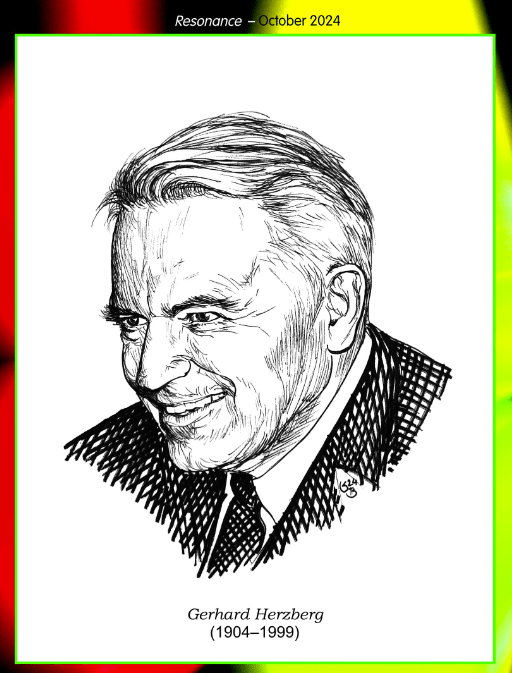
highlights the life and science of Gerhard Herzberg.
He was one of the greatest molecular spectroscopists who laid the foundation of atomic and molecular quantum mechanics and deeply impacted molecular astrophysics and astrochemistry.
He lived an extraordinary life, first in Europe learning quantum mechanics and then escaping 1930s Germany as his wife was of Jewish origin. Then, he settled in Canada to build and lead his lab, which was considered the ‘mecca of spectroscopy’ at NRC, Ottowa.
If you don’t know – Resonance is a pedagogical journal published by the Indian Academy of Sciences. It is a true open-access journal. Free to read and does not charge the authors to publish.
I think that knowledge, especially academic knowledge, should be openly accessible to fellow researchers and the public. Given that most of the academic research in India is public-funded, it is imperative that our work is made available for anyone interested in reading and utilizing the knowledge. This makes a strong case for making our work open to access. Unfortunately, the open-access publication venture has been hijacked by some commercial publishers, who have misused the enthusiasm of academic researchers by converting it into a money-making opportunity via so-called ‘gold’ open-access models, where authors pay exorbitant article processing charges (APCs) to publish their work in the journals.
I have been searching literature to understand the philosophy and economics of open-access publishing models, and recently, by chance, I came across a couple of books by Peter Suber.
First is an open-access book on Open Access. Peter Suber has been a philosopher & open-access advocate for a long time. In this book, he explains what it really means to have open access to knowledge & the related philosophy, including its economics. Link to the book.
Second is a collection of writings on open-access publication (link), and as the online blurb says :
Influential writings make the case for open access to research, explore its implications, and document the early struggles and successes of the open access movement.
The green open-access model is very interesting and pertinent to countries such as India, and as per wiki it is defined as :
Green OA, is the practice of placing a version of an author’s manuscript into a repository, making it freely accessible for the scientific community.
The primary motivation of Open Access was to provide Open Access to Knowledge to the READER of Publications and; to allow Open Access to AUTHORS Publication (unbiased publication of Knowledge)
Open access in the true sense, should neither have barriers to knowledge consumption nor to knowledge generation and dissemination. Therefore, APCs are a major hurdle to researchers and authors who do not have monetary support. This is most of the global south, and hence, a fair policy is needed to make it more democratic.


 VISMAYA - History & Philosophy of Physics