From my Substack conversation

From my Substack conversation
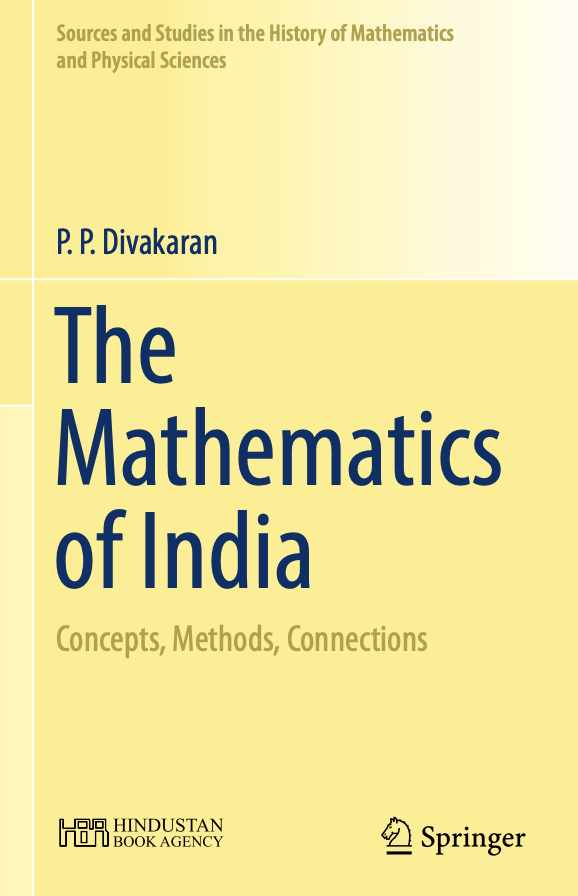
In recent years, this has been one of the best books on the history of mathematics in India. The late Prof. Divakaran was a theoretical physicist and a scholar.
This book is also an excellent example of how a scientist can present historical facts and analyse them with rigour and nuance. Particularly, it puts the Indian contribution in the global context and shows how ideas are exchanged across the geography. The writing is jargon-free and can be understood by anyone interested in mathematics.
Unfortunately, the cost of the book ranges from Rs 8800 to Rs 14,000 (depending on the version), which is a shame. Part of the reason why scholarly books, particularly in India, don’t get the traction is because of such high cost. This needs to change for the betterment and penetration of knowledge in a vast society such as India.
There is a nice video by numberphile on Prof. Divakaran and his book:
‘There is a story about two friends, who were classmates in high school,
talking about their jobs. One of them became a statistician and was working
on population trends. He showed a reprint to his former classmate, The
reprint started, as usual, with the Gaussian distribution and the statistician
explained to his former classmate the meaning of the symbols for the actual
population, for the average population, and so on. His classmate was a
bit incredulous and was not quite sure whether the statistician was pulling
his leg. “How can you know that?” was his query. “And what is this
symbol here?” “Oh,” said the statistician, “this is π.” “What is that?”
“The ratio of the circumference of the circle to its diameter.” “Well, now
you are pushing your joke too far,” said the classmate, “surely the population has nothing to do with the circumference of the circle.”’
These are the opening lines of Wigner’s famous essay titled: The Unreasonable Effectiveness of Mathematics in the Natural Sciences

This week in my optics class, I have been teaching Kramers-Kronig (KK) relations of electric susceptibility. It is fascinating to see the causality argument emerge from the relationship between the real and imaginary parts of the complex susceptibility. Whereas the time domain explanation is relatively easier to appreciate (that dissipation follows perturbation in time), for me, the frequency domain implication in KK relation is fascinating: the fact that information about the real part of the function at all frequencies can give you insight into the imaginary part at any given frequency (and vice versa) makes it such a powerful mathematical and physical tool. For example, by knowing the absorption spectrum of a medium, you can find out the refractive index of a medium at a particular frequency that is not easily accessible in experiments.
Two inferences I draw:
1) Complex analysis combined with differential calculus is one of the most beautiful and powerful mathematical tools invented, and exploring its application in experimental scenarios has made physics intriguing, useful, and profound.
2) The KK relationship shows how causality and the structure of matter are connected to each other, and by studying them, one will be able to extrapolate the idea beyond the problem at hand and apply it to a different context in physics. It just shows how ideas hop from one domain to another and how mathematics plays a critical role in intellectual arbitrage.
Real is imaginary and vice versa. Complex numbers zindabad!
Aninda Sinha is a theoretical physicist and a professor at Indian Institute of Science, Bengaluru: https://chep.iisc.ac.in/Personnel/asinha.html
He works at the interface of quantum field theory, superstrings and mathematical physics. In this episode, we explore his intellectual journey and discuss his recent work that led to a new series on pi, generalizing Madava’s series.
References:
 VISMAYA - History & Philosophy of Physics