From Yukawa Archives: a draft, a letter & a rejection

I have been amazed to explore the archives on Hideki Yukawa, which have been systematically categorized and meticulously maintained by Osaka University in Japan. My sincere thanks and acknowledgment to the Yukawa Memorial.

Below are a few gems from their public archives :

  1. Draft of the paper written in 1934 – The making of the groundbreaking paper of Yukawa, which eventually led to his Nobel Prize in 1949.
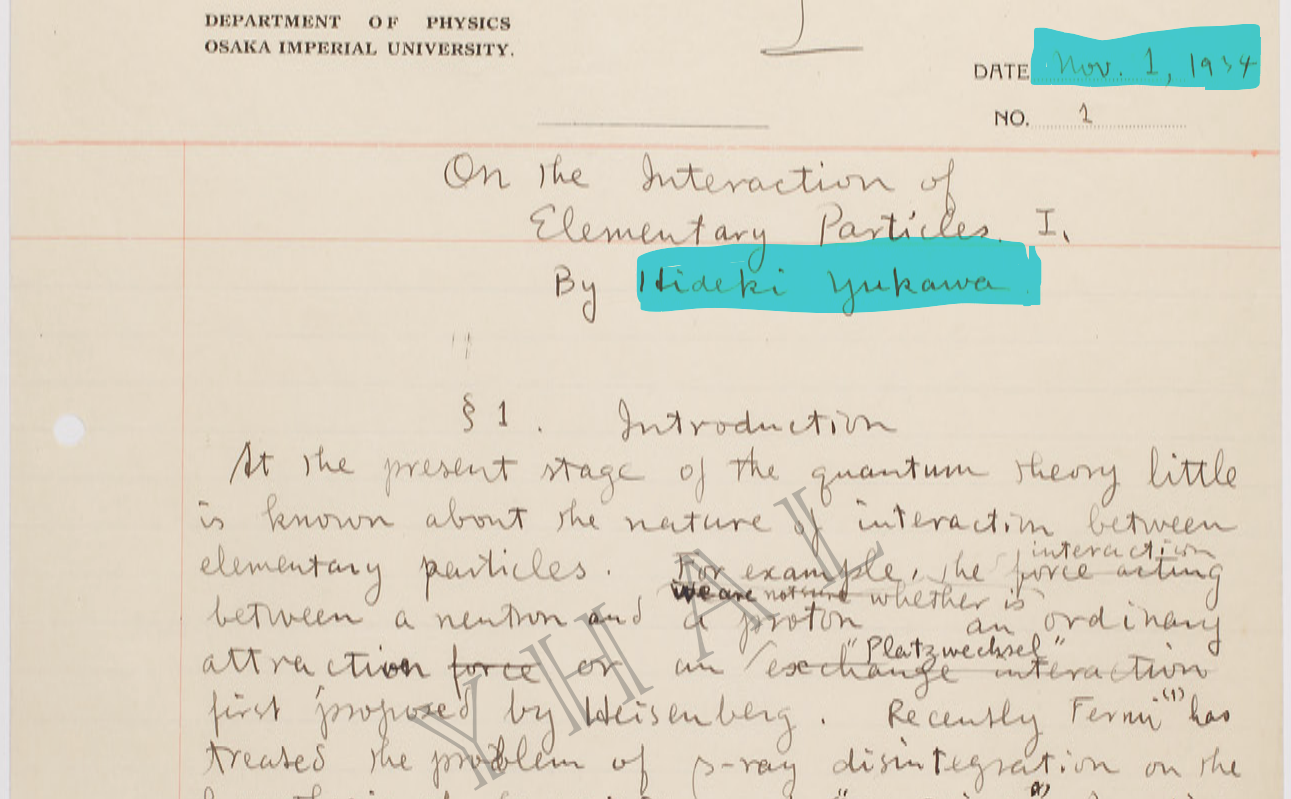
The archive draft is accompanied by a note which reads:

Yukawa had not published any paper before then. In 1933, Yukawa began working at Osaka Imperial University and tackled the challenge of elucidating the mystery of nuclear forces while Seishi Kikuchi and other prominent researchers were producing achievements in nuclear physics and quantum physics. The idea of γ’ (gamma prime) that Yukawa came up with in early October led to the discovery of a new particle (meson) that mediates nuclear forces. The idea of introducing a new particle for the purpose of explaining the forces that act between particles was revolutionary at that time. Yukawa estimated the mass of the new particle and the degree of its force. No other physicists in the world had thought of this idea before.

2. Letters between Tomonaga and Yukawa

Sin-Itiro Tomonaga was a legendary theoretical physicist from Japan, who independently formulated the theory of quantum electrodynamics (apart from Feynman and Schwinger) and went on to win the Nobel Prize in physics in 1965.

Tomonaga was a friend and classmate of Yukawa, and they inspired each other’s work. Below is a snapshot of the letter from 1933 written in Japanese.

Both these theoreticians were intensely working on interrelated problems and constantly exchanged ideas. The archival note related to the letter has to say the following:

During this period, Yukawa and Tomonaga concentrated on elucidating nuclear forces day in and day out, and communicated their thoughts to each other. In this letter, before starting the explanation, Tomonaga wrote “I am presently working on calculations and I believe that the ongoing process is not very interesting, so I omit details.” While analyzing the Heisenberg theory of interactions between neutrons and protons, Tomonaga attempted to explain the mass defects of deuterium by using the hypothesis that is now known as Yukawa potential. The determination of potential was arbitrary and the latest Pegrum’s experiment at that time was taken into consideration. Tomonaga also compared his results with Wigner’s theorem and Majorana’s theory.

3. Rejection letter from Physical Review

Which physicist can escape a rejection from the journal Physical Review?

Even Yukawa was not spared :-) Below is a snapshot of a rejection letter from 1936, and John Tate does the honours.

The influence of Yukawa and Tomonaga can be seen and felt at many of the physics departments across Japan. Specifically, their influence on nuclear and particle physics is deep and wide, and has inspired many in Japan to do physics. As the archive note says:

Yukawa and Tomonaga fostered the theory of elementary particles in Japan from each other’s standpoint. Younger researchers who were brought up by them, so to speak, must not forget that the establishment of Japan’s rich foundation for the research of the theory of elementary particles owes largely to Yukawa and Tomonaga.

4. Lastly, below is a picture of the legends from the archive: Enrico Fermi, Emilio Segrè, Hideki Yukawa, and James Chadwick.
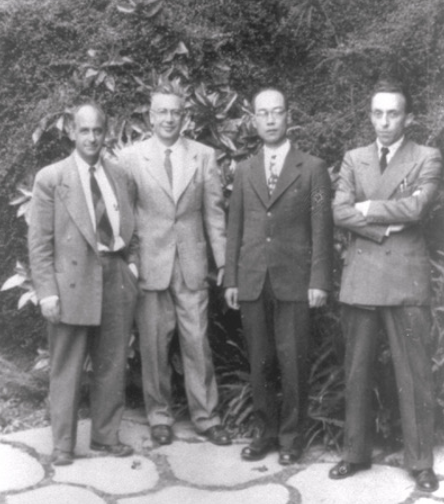
From the archive note on the picture from September 1948:

Yukawa met Prof. Fermi and other physicists of the University of Chicago who were staying in Berkeley for the summer lectures. From the left: Enrico Fermi, Emilio Segrè, Hideki Yukawa, and James Chadwick.

Tomorrow, I will conclude my third trip to Japan. I always take a lot of inspiration from this wonderful country. As usual, I have not only met and learnt a lot from contemporary Japanese researchers, but also have metaphorically visited the past masters who continue to inspire physicists like me across the world.

For this, I have to say: Dōmo arigatōgozaimasu !
Where Ideas Merge: A Visit to the Institute of Science Tokyo

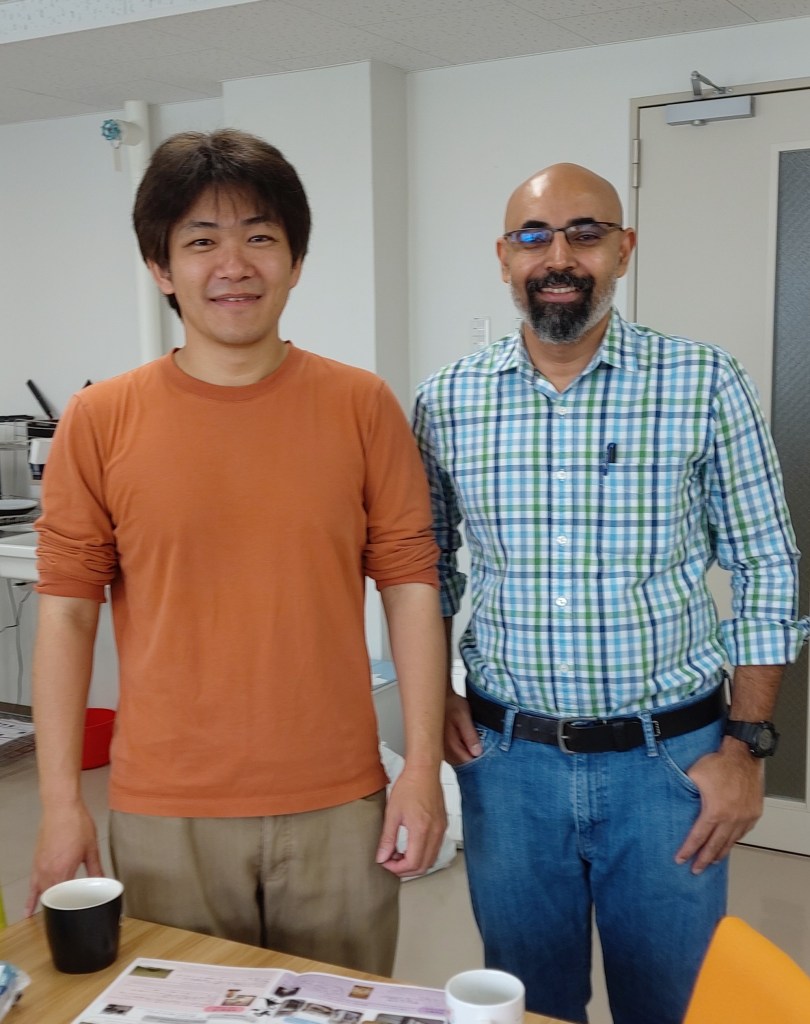
With Prof. Daiki Nishiguchi

New ideas are often created by the merging of two old ideas. How often is this true, and how often do we tend to forget this?

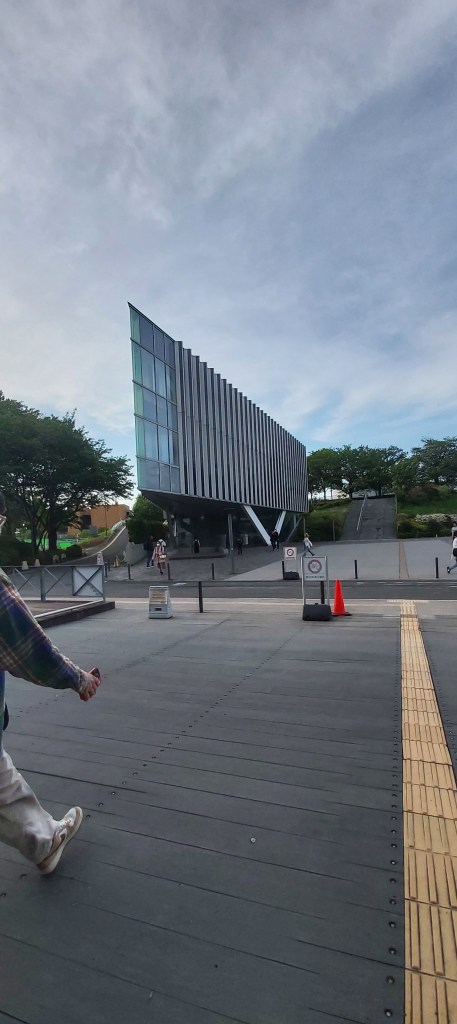
Today I visited the Institute of Science Tokyo, formerly known as Tokyo Tech. This is a new avatar of a very interesting institution funded by the government of Japan. By merging the Tokyo Institute of Technology with the Tokyo Medical and Dental University, a very interesting concept has emerged: the Institute of Science Tokyo. These two institutions have been important pillars of the research and educational landscape of Tokyo, and I had the privilege of visiting this new place, which is a result of a new merger.

Thanks to the invitation and fantastic hospitality of Prof. Daiki Nishiguchi, a faculty member in the Physics Department of the Institute of Science Tokyo, I had a memorable experience. I met Daiki a couple of years ago at the University of Tokyo, where he previously held a faculty position. Recently, he has moved to the Institute of Science Tokyo to establish his independent research group as an Associate Professor.

Daiki has done amazing work on topological soft matter, and his recent results include remarkable observations related to turbulence and vorticity in suspensions of bacteria under spatial confinement. He has also been setting up interesting experiments involving Janus particles, and I got a nice overview of his work. Thanks to him and his research group, I got a flavor of the research being carried out in their lab, and I was also treated to a wonderful lunch by Daiki.

I gave a physics seminar on some of our work on structured light and confinement of soft matter, especially thermally active colloidal matter in optothermal potentials. Since Daiki and his group (see image below) have expertise in topological soft matter, my seminar emphasized structured topological beams, including ring optical beams and optical vortices. I gave an overview of our experimental results and highlighted the prospect of utilizing the topology of light to interact with topological soft matter.

There is much to explore at this interface, and again, it brings me back to the point that new ideas often emerge from the merging of evolving old ideas, such as topological light and topological soft matter.

This is my third visit to Japan, and I always find their calm, focused, and deeply committed research environment inspiring. There is much to learn from their approach to science and technology, and my visit to the Institute of Science Tokyo reinforced this thought.

I thank Daiki and his research group for the wonderful time I had at their laboratory and offer my best wishes to him in his new explorations.

Talk at Kyoto University

Whereas Sunday was bright, sunny, and clear for outdoor activities, Monday started cloudy with a forecast of rain. I started from my living place to Kyoto University around 10 in the morning. I took the city bus, which shuttles people from the city centre to the university. Within half an hour, I was in a serene, green, and beautiful campus, typical of a Japanese university. Kyoto University has a rich blend of modern and ancient architecture, and I was not surprised to see a large maroon-coloured ark at the entrance of the university.

With Prof. Tetsuro, who hosted me at the Graduate School of Informatics at Kyoto University.

I met Tesuji Tetsuro upon arrival (our previous in-person meeting was in the 2023 Optics & Photonics Congress on optical manipulation at Yokohama). He had just arrived from his run (he is a regular marathon runner), and we had a brief chat. He had arranged an office for me to occupy for the day. We had a short discussion and thereafter went for lunch. Prof. Kazuo Aoki (Tetsuro’s erstwhile advisor at Kyoto University) accompanied us, and I was delighted to meet him. We had a delicious lunch at a small Italian restaurant.

Around 3 pm, we met at the seminar hall where I gave my talk titled Hot Brownian Dynamics Driven by Structured Light. One of the key points I emphasized in my talk was the relevance of structured light in driving Brownian dynamics of colloids. I spoke about various parts of the stochastic differential equation (see equation 1 below) that represent the dynamics of a colloidal system interacting with an external force.

A key element of my discussion was the generalized driving force on the right-hand side of the equation, where the conventional restoring force in an optical trap can be generalized to an external driving force due to structured light. This versatile force is a result of a large set of linear and angular momentum states of structured light. These states can drive soft matter, further resulting in unconventional assembly and dynamics. Furthermore, the generalized driving force can include not only the optical force but also the thermal and hydrodynamic effects initiated by optical illumination. The combination of these forces culminates in a resultant force, offering an unconventional driving mechanism to drive the structure, assembly, and dynamics of colloids and other kinds of soft matter systems, including droplets and fluids. I showed some of our experimental results related to the above-mentioned concepts with emphasis on rotational and orbital degrees of freedom. I also presented our recent results on synchronization in an optothermal trap.

We had a long discussion on how to measure fluid dynamic properties around such colloids, especially when there is an external perturbation force, such as a laser beam, which can itself influence the colloidal dynamics. Tetsuro also mentioned his protocols and certain simulation strategies utilized to study thermo-osmotic flows in such situations. I learned about interesting methods they have been developing to numerically simulate the interactions using differential temperatures. The strategy is interesting and deserves further attention by the community. He also showed his experimental setup and gave a tour of his laboratory facilities.

Overall, it was a long, thoughtful day with wonderful discussions on topics of common scientific interest. We ended with a delicious dinner at a Japanese izakaya, and I thank Tetsuro for his invitation and hospitality. Kyoto University has a wonderful atmosphere for research, and I hope to visit again.