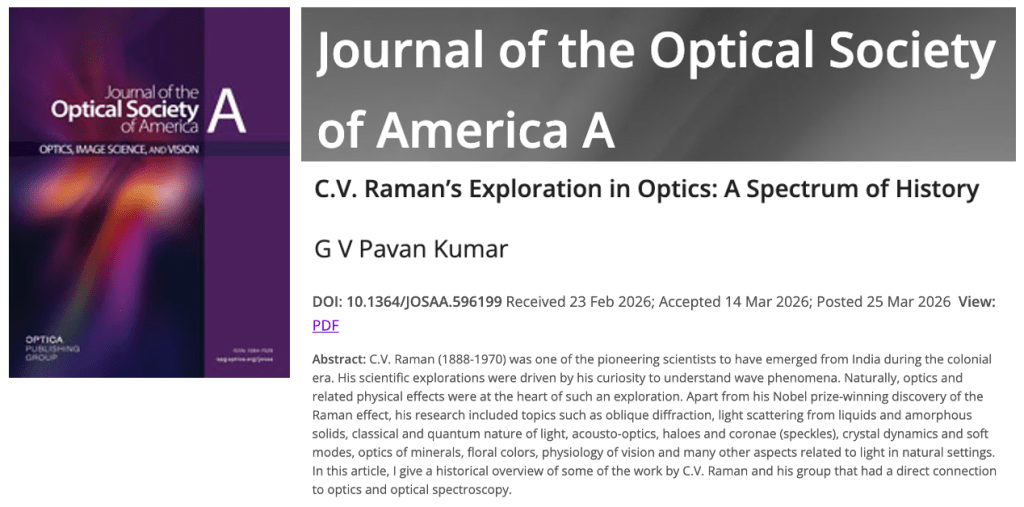
The accepted paper is online now. Thanks to the anonymous reviewer(s) for the encouraging feedback. It made my day :-)
The paper will be published as part of a special issue on optics in South Asia
Link to the online version here.
The accepted paper is online now. Thanks to the anonymous reviewer(s) for the encouraging feedback. It made my day :-)
The paper will be published as part of a special issue on optics in South Asia
Link to the online version here.
I have been studying quantum mechanics for almost 30 years now. Every time I go back to study and understand something, it reminds me of a quote by Nelson Mandela: “There is nothing like returning to a place that remains unchanged to find the ways in which you yourself have altered” ~ Long Walk to Freedom (1994)
On further contemplation, I find the same with other branches of physics and certain aspects of mathematics, too.
Perhaps this is what a ‘life of a student’ means?
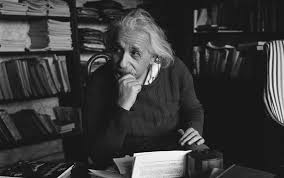
14th of March is Einstein’s birthday. There is so much written about Einstein, and every time you read about him or a text written by him, there is always something interesting to learn. Recently, I came across a wonderful paper by Shankland, who compiled his conversation with Einstein over a period of ten years and published it in 1962 in the American Journal of Physics. Below are three excerpts from the paper to give you a taste of the conversation. I would urge you to read the conversation in full, and it is a delight.
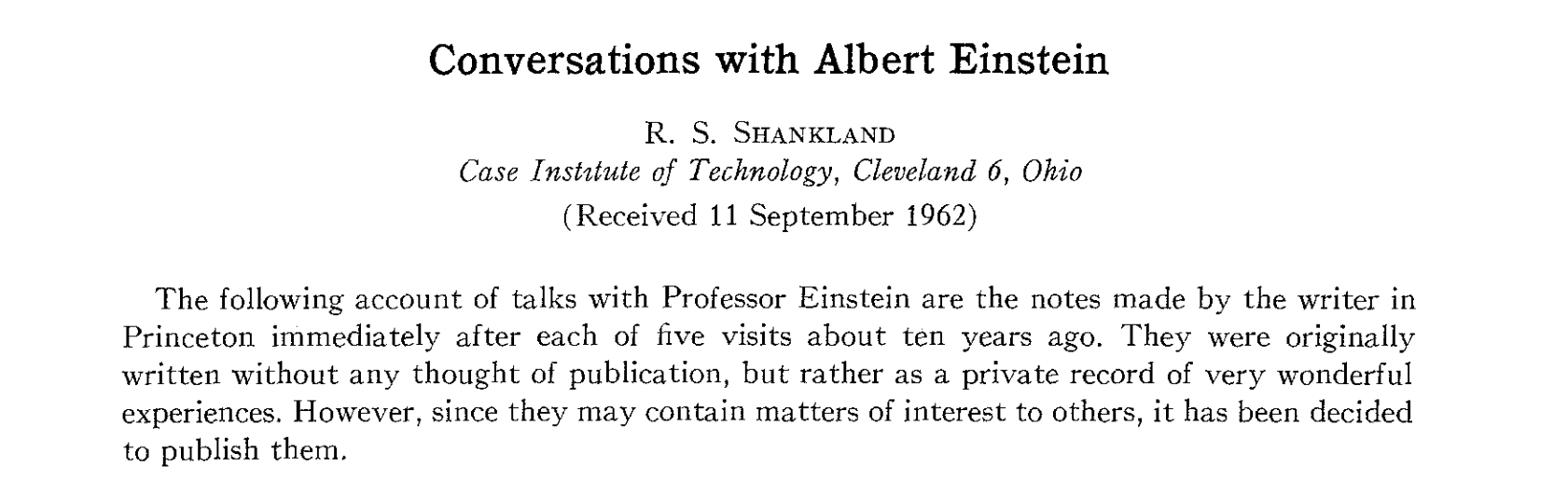
(Shankland 1963, 1)
“When I asked him how he had learned of the Michelson-Morley experiment, he told me that he had become aware of it through the writings of H. A. Lorentz, but only after 1905 had it come to his attention! “Otherwise,” he said, “I would have mentioned it in my paper.” He continued to say the experimental results which had influenced him most were the observations on stellar aberration and Fizeau’s measurements on the speed of light in moving water. “They were enough,” he said. I reminded him that Michelson and Morley had made a very accurate determination at Case in 1886 of the Fresnel dragging coefficient with greatly improved techniques and showed him their values as given in my paper. To this he nodded agreement, but when I added that it seemed to me that Fizeau’s original result was only qualitative, he shook his pipe and smiled, “Oh it was better than that!” He thought Zeeman’s later precise repetition of this experiment was very beautiful. He seemed really delighted when I mentioned to him how elegant I had found (as a student) his method of obtaining the Fresnel dragging coefficient from his composition of velocities law of special relativity.” (Shankland 1963, 2)
“I asked Professor Einstein how long he had worked on the Special Theory of Relativity before 1905. He told me that he had started at age 16 and worked for ten years; first as a student when, of course, he could only spend part-time on it, but the problem was always with him. He abandoned many fruitless attempts, “until at last it came to me that time was suspect!” Only then, after all his earlier efforts to obtain a theory consistent with the experimental facts had failed, was the development of the Special Theory of Relativity possible. This led him to comment at some length on the nature of mental processes in that they do not seem at all to move step by step to a solution, and he emphasized how devious a route our minds take through a problem. “It is only at the last that order seems at all possible in a problem.”” (Shankland 1963, 2)
“Our conversation then returned to the Michelson-Morley experiment and the Special Theory of Relativity. I could not help feeling that this elegant special theory, the product of his youthful efforts, held the place nearest to his heart. I asked him if he felt that writing out the history of the ;v[ichelson-Morley experiment would be worthwhile. He said, “Yes, by all means, but you must write it as Mach wrote his Science of Mechanics.” Then he gave me his ideas on historical writing of science. “Nearly all historians of science are philologists and do not comprehend what physicists were aiming at, how they thought and wrestled with their problems. Even most of the work on Galileo is poorly done.” A means of writing must be found which conveys the thought processes that lead to discoveries. Physicists have been of little help in this because most of them have no “historical sense.” Mach’s Science of Mechanics, however, he considered one of the truly great books and a model for scientific historical writing. He said, “Mach did not know the real facts of how the early workers considered their problems,” but Einstein felt that Mach had sufficient insight so that what he says is very likely correct anyway.” (Shankland 1963, 4)
There is a lot more to explore in the wonderful conversation paper. Link below.
Shankland, R. S. 1963. ‘Conversations with Albert Einstein’. American Journal of Physics 31 (1): 47–57. https://doi.org/10.1119/1.1969236.

Anthony James Leggett (26 March 1938 – 8 March 2026)
pic credit: Britannica
I was informed that Anthony Leggett passed away…he made physics wonderful by asking profound questions, as below:
“……there is no good reason to accept this division of the world into a microscopic regime where QM reigns and a macroscopic one governed by classical physics; QM is a very ‘totalitarian’ theory, and if it applies to an individual and electrons, then it should prima facie equally apply to the macroscopic objects made up of them, including any devices which we have set up as measuring apparatus….” [1]
Leggett, A. J. ‘Realism and the Physical World’. Reports on Progress in Physics 71, no. 2 (2008): 022001. https://doi.org/10.1088/0034-4885/71/2/022001.
There is a story going around on Facebook related to C.V. Raman and Nehru, and it makes a reference to Raman’s biography. It describes Raman and Nehru’s interaction in a darkened room at Raman Research Institute. Intrigued by the story, I went back and checked some of the biographies of C.V. Raman, and I could not find that story. If someone could find the exact reference, please let me know. (update on 4th March 2026: I dug up the sources further and found this anecdote in chapter 21 of C.V. Raman: A Biography, by Uma Parameswaran, Penguin Books India (2011). Unfortunately, there is no primary or secondary reference associated with the anecdote.)
Among the biographies, Venkatraman’s ‘Journey into the Light’ is comprehensive and mentions Nehru at least 70 times. It does discuss quite a bit about the interaction between these two powerful people and their differences of opinion. It also highlights their common commitment to science and technology. Raman publicly expressed his opinion on the state of science in India. His pronouncements did not go unnoticed, and the press highlighted them. Raman’s biographer, Venkatraman, addresses the issue of Raman’s criticism: “It should not be assumed that Raman was merely making a series of arbitrary and disconnected pronouncements. On the contrary, they were symptoms of a deep concern he had begun to feel about the way science was being promoted. It seemed to him that in the rush for development, scientific excellence and the objectives of science had begun to take a back seat. Sycophancy was on the rise, and ill-equipped people were being propelled into seats they were not ready to occupy. Everyone paid lip sympathy to the universities, but when it came to funding them, they were generally forgotten. What was worse, mediocrity was slowly allowed to become institutionalized. In retrospect, Raman’s utterances, though harsh, implicitly carried a warning that was unfortunately not heeded. And despite all the pious hopes of that period, the linkages between science and technology in India continue to be quite tenuous.” ([Venkataraman, 1989, p. 488])
Having said that, I should mention that almost all of his biographers mention Raman’s confrontation with a variety of people, starting from his Calcutta days till the end of his life. Subsequent scholarship in social sciences has also highlighted Raman’s issue with gender and caste. In contrast to people like Babha, Saha, and Dhawan, Raman was not an institution builder. He had his limitations, but his commitment to science and its role in society is unquestionable.
As I have written before, Raman was not an easy character to study and understand. He contained multitudes. For sure, he was an outstanding experimental physicist. His knowledge of mathematical physics, especially the classical aspect, was very good, and he utilized it extensively in his work. His scientific biographers, both Venkatraman and Ramaseshan, mention that although he had the aptitude to analyze theoretical frameworks, he was more driven by intuition and generally skimmed over the mathematical aspect of his work. This was also observed by Max Born. He also mentored some excellent scientists, such as K.S. Krishnan, Nagendra Nath, Bhagavatham, Pancharatnam, and G.N. Ramachandran, Anna Mani (one of the few women in his lab), to name a few. Probably the most important feature of Raman as an individual was his can-do spirit and his lifelong drive to do science irrespective of the situation.
My broad lesson from all this is to take the positives from the science and the scientific pursuit of a scientist, and yet, remain aware of the flaws in the character of the human being. After all, course correction is from the benefit of hindsight, and its application is in the present and the future.
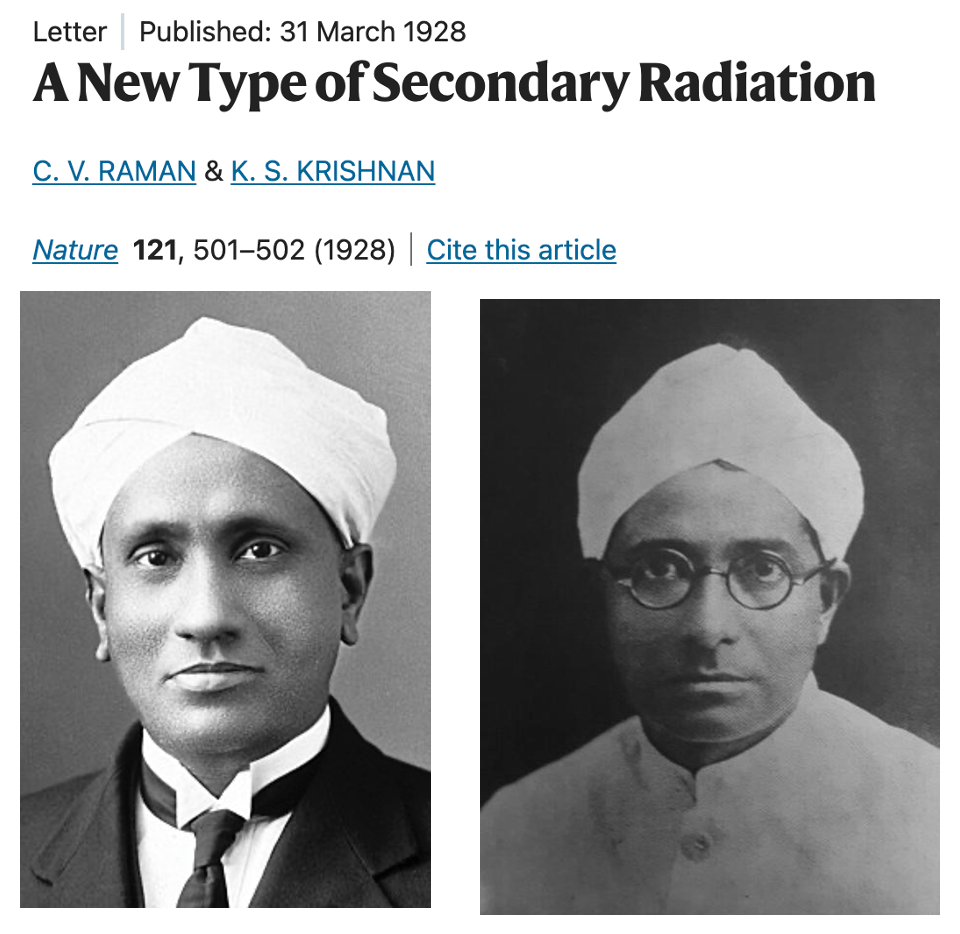
On 28th February, we commemorate the first confirmed observation of the Raman effect, dating back to 1928. Raman’s student, K. S. Krishnan (imaged on the right), had an important role in this observation, and the scientific paper associated with Raman scattering has both Raman and Krishnan as the authors (see picture above). Scientific discoveries and inventions happen with constant effort spread over a long duration. It also happens on a strong foundation of knowledge that has already been established.
Raman recognised this and, as he mentions in his talk on scientific outlook, “The happy discoverer in science is invariably a seeker after knowledge and truth working in a chosen field of his own and inspired in his labours by the hope of finding at least a little grain of something new. The commentators who like to consider discoveries as accidents forget that the most important part of a scientific discovery is the recognition of its true nature by the observer, and this is scarcely possible if he does not possess the requisite capacity or knowledge of the subject. Rarely indeed are any scientific discoveries made except as the result of a carefully thought-out programme of work. They come, if they do come, as the reward of months or years of systematic study and research in a particular branch of knowledge.” (Raman, 1951, p. 243)
This, I think, is generally good advice for researchers, especially the younger ones. One cannot over-emphasize the importance of systematic study.
On this commemorative day, it will be good for us, Indians, to commit ourselves to sincere, honest, hard work motivated by a scientific outlook. As Raman mentions, we need to be seekers of knowledge and truth. Not everything may lead to spectacular results, but it will give us a reason for having done something correct and hopefully useful to humanity. In doing so, we may live a meaningful and purposeful life. Science and scientific thinking can have a central role in realizing such a life.
Happy National Science Day to India…and to the world. After all, science is global.
Reference:
Raman, C. V. ‘The Scientific Outlook’. The New Physics – Talks on Aspects of Science by C V Raman, Philosophical Library, New York, 1951. https://doi.org/10.1007/BF02835148.
Journal of the Optical Society of America is coming up with a special issue on Optics in South Asia. I was invited to write a historical overview of Raman’s work on optics. Below is the snapshot of the pre-print. It should also appear in the axriv in the coming week. Meanwhile, you can access the preprint PDF below.
Also, look out for a research article from my group on multipolar optical binding submitted to the same issue. I will post a link when it appears as a pre-print.
Acknowledgements:
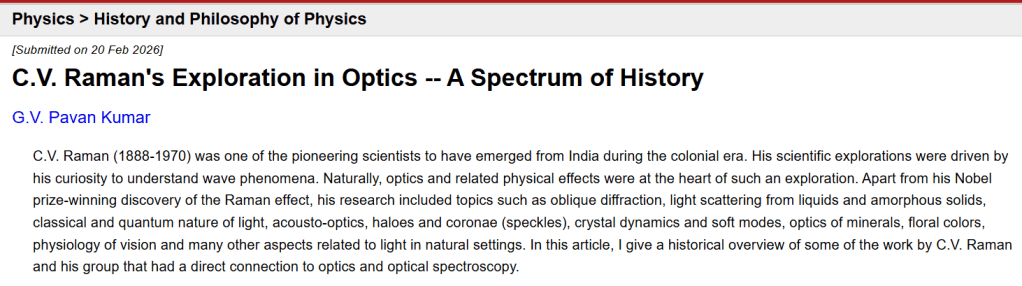
arXiv link here.
One of the last letters written by Rutherford. This was to Raman dated 3rd Aug 1937.
Here, he is consoling Raman after he quit the Directorship of IISc. Rutherford is also discussing his possible travel plans to India.
Unfortunately, Rutherford died on 19th Oct 1937..
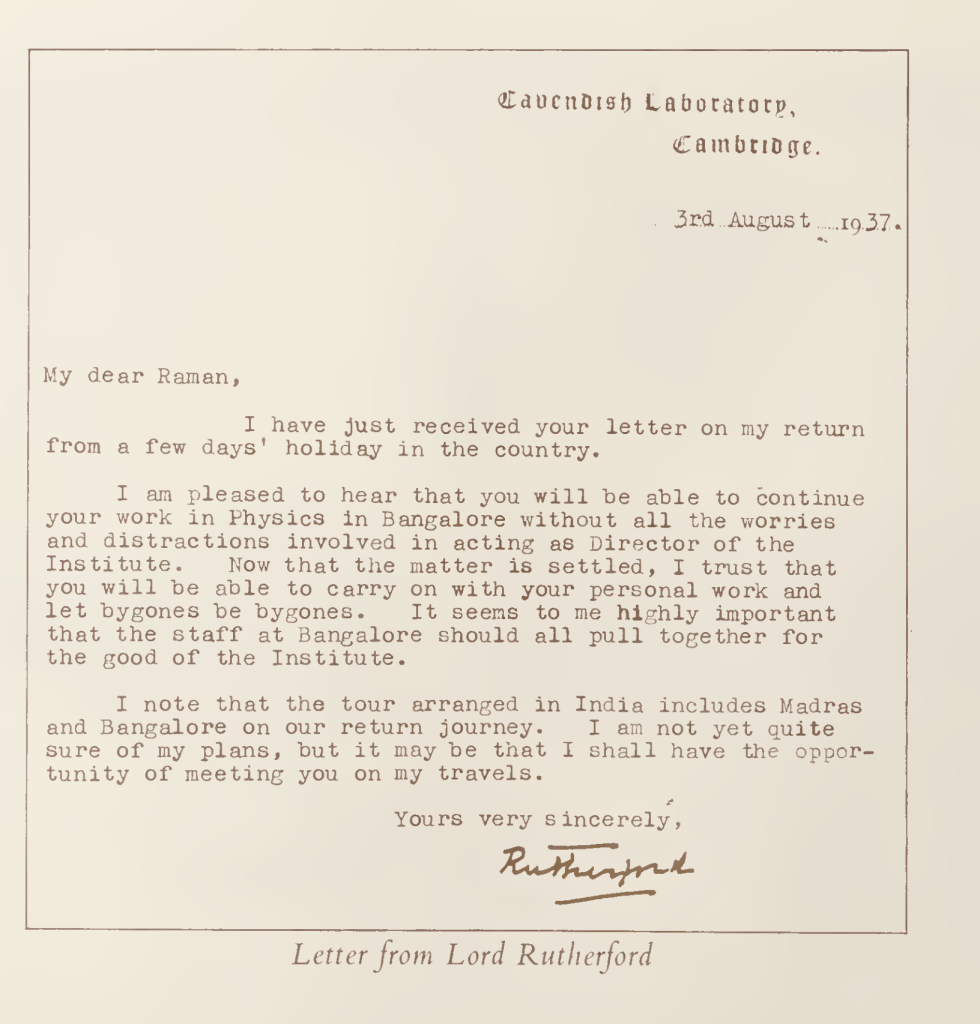
ref: S. Ramaseshan and C. Ramachandra Rao. C.V. Raman : A Pictorial Biography, p 108 (1988)
If you need to admire complex analysis for its elegance and visual utility, try quantum optics. Specifically, the description of quantum states. Thanks to creation and annihilation operators, the position and momentum states of a quantum optical field can be represented as quadratures. These entities can now be represented on the orthogonal axes of a complex plane. The representation of Argand diagrams starting with a classical electromagnetic field and then extrapolating them to quantum theory is a tribute to its geometrical representation. The fact that two axes can be utilized to represent real and imaginary parts of the defined state is itself an interesting thing. By certain operations within the plane, one can realize the vacuum state, the coherent state, and the squeezed state of quantum optics.
The Vacuum Spread – One of the major consequences of quantum theory, and especially the second quantization, is the realization of the vacuum states. Even when there are zero photons, there is a residual energy in the system that manifests as vacuum states. How to define the presence or absence of a photon is a different proposition because vacuum states are also associated with something called virtual photons. That needs a separate discussion. Anyway, in a complex plane of quadrature, a vacuum state is represented by a circular blob and not a point (see fig. 1). It is the spread of the blob that indicates the uncertainty. In a way, it is an elegant representation of the uncertainty principle itself because the spread in the plane indicates the error in its measurement. Importantly, it emphasizes the point that no matter how low the energy of the system is, there is an inherent uncertainty in the quadrature of the field. This also forms the fundamental difference between a classical and a quantum state. The measurement of the vacuum fluctuation is a challenging task, but one of the most prevalent consequences of vacuum fluctuation is the oblivious spontaneous emission. If one looks at the emission process in terms of stimulated and spontaneous pathways, then the logical consequence of the vacuum state becomes evident in some literature on quantum optics. Spontaneous emission is also defined as stimulated emission triggered by vacuum state fluctuations. It is an interesting viewpoint and helps us to create a picture of the emission process vis-à-vis the stimulated emission.
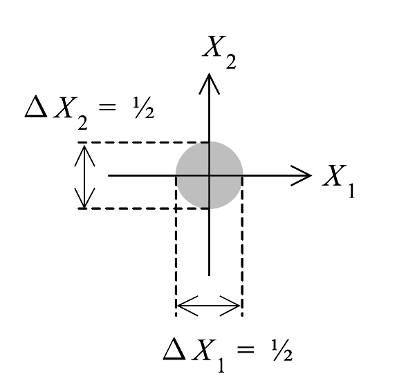
Figure 1. Vacuum state representation. Note that their centre is at the origin and has a finite spread across all the quadrants. Figure adapted from ref. 2.
Another manifestation of the vacuum state is the Casimir effect, where an attractive force is induced as you bring two parallel plates close to each other. The distance being of the order of the wavelength or below this triggers a fascinating phenomenon which has deep implications not only in understanding the fundamentals of quantum optics and electrodynamics, but also in the design and development of quantum nanomechanical devices.
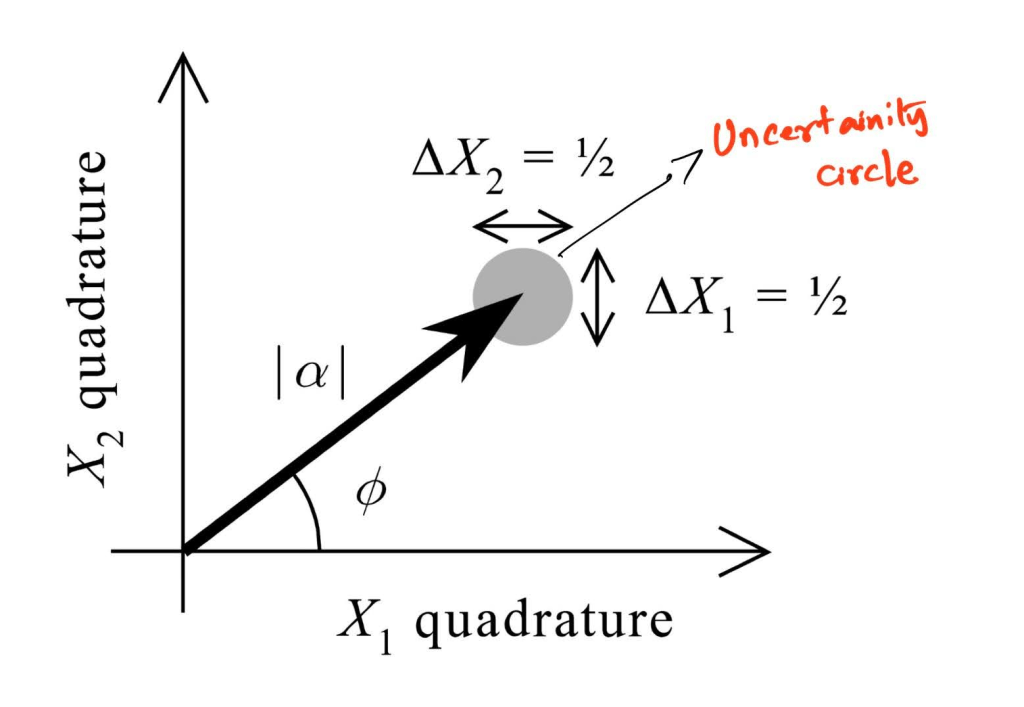
A shift in the plane – Coherent states are also described as displaced vacuum states, and this displacement is evident in the Argand diagrams. The quadrature can now help us visualize the uncertainty in the phase and the number of photons in the optical field. One of the logical consequences of the coherent state is the number-phase uncertainty. This gets clear if one observes the spread in the angle of the vector and the radius of the blob represented (see Fig. 2). Notice that the blob still exists. The only difference is that the location of the blob has shifted. The consequence of this spread has a deeper connection to the uncertainty in the average number of photons and the phase of the optical field. The connection to the number of photons is through the mod alpha, which essentially represents the square root of the average number of photons. Taken together, the blob in the Argand diagram represents the number-phase uncertainty.
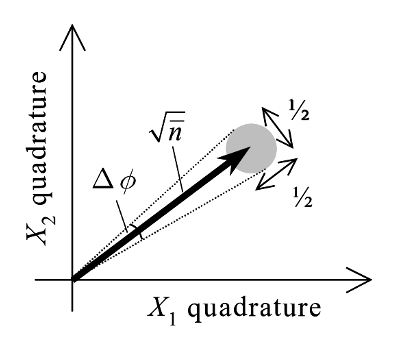
Figure 2. Coherent state representation. Note that their centre is displaced. Figure adapted from ref. 2.
Lasers are the prototypical examples of coherent states. The fact that they obey Poissonian statistics is the direct consequence of the variance in the photon number, which is equivalent to the square root of the average number of photons. This means one can use photon statistics to discriminate between sources that are sub-Poissonian, Poissonian, or super-Poissonian in nature. The super-Poissonian case is the thermal light, and the sub-Poissonian state represents photon states whose number can reach up to 1 or 0. The coherent states sit in the middle, obeying the Poissonian statistics.
Everything has a cost – Once you have a circle with a defined area, it will be interesting to ask: Can you ‘squeeze’ this circle without changing its area? The answer is yes, and that is what manifests as a squeezed state. In this special state, one can squeeze the blob along one of the axes at the cost of a spread in the orthogonal direction. This converts the circle into an ellipse (see Fig. 3).
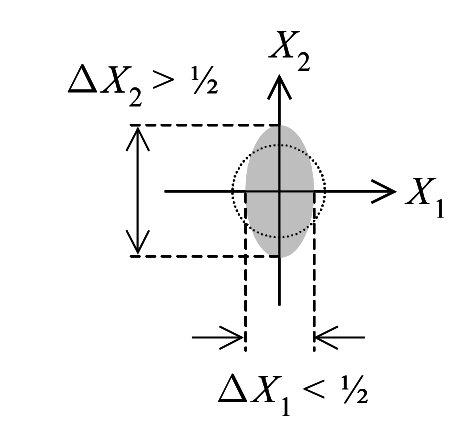
Figure 3. Squeezed State. Note the circle has been squeezed into an ellipse. Figure adapted from ref. 2.
Note that the area must be conserved, which means that the uncertainty principle still holds good; just that the reduction in the uncertainty along one axis is compensated by the increment in another. This geometrical trick has a deep connection to the behaviour of an optical field. If one squeezes the axis along the average number of photons, it means that you are able to create an amplitude-squeezed state. This means the uncertainty in the counting of photons in that state has reduced, albeit at the cost of the uncertainty in the measurement of phase. Similarly, if one squeezes the blob along the axis of the phase, then we end up with a lowering of the uncertainty for the optical phase. Of course, this comes at the cost of counting of number of photons. I should mention that the concept of optical phase itself is not clearly defined in quantum optics. This is because an ill-defined phase can have a value of 2π, which creates the problem. An interesting application of the phase-squeezed quantum states is in interferometric measurements. By reducing the uncertainty in the phase, one can create highly accurate measurements of phase shifts. So much so that this can have direct implications on high-precision measurements, including gravitational wave detection. The anticipation is also that such tiny shifts can be helpful in observing feeble fluctuations in macroscopic quantum systems.
Pictures can lead to more than 1,000 words. And if you add them to a quantum optical description, as in the case of the states that I have defined, they create a quantum tapestry. Perhaps this is the beauty of physics, where there is a coherence between mathematical language, geometrical representation, and physical reality. Feynman semi-jokingly may have said, “Nobody understands quantum mechanics,” but he forgot to add that there is great joy in the process of understanding through mathematical pictures. After all, he knew the power of diagrams.
Here I discuss the paper that announced the Raman effect to the world…
 VISMAYA - History & Philosophy of Physics