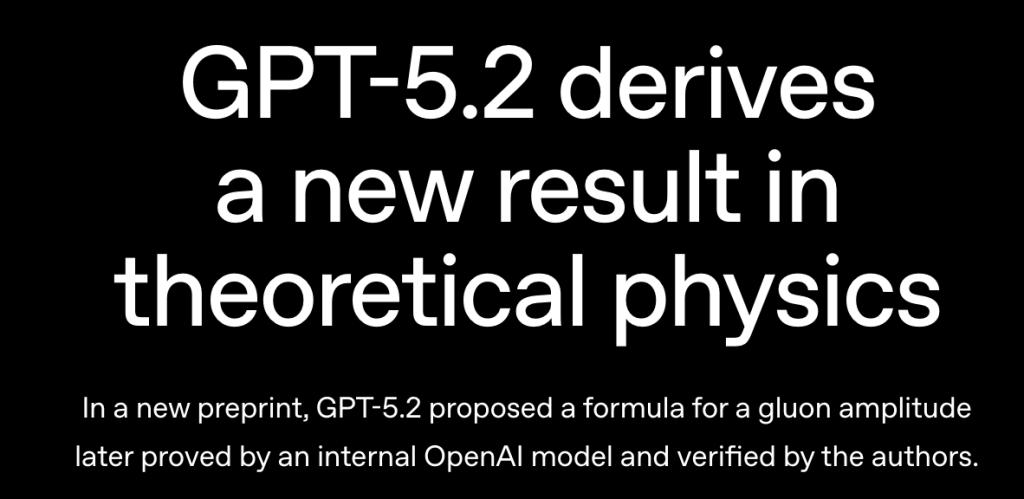
The above snapshot is from OpenAI, which has claimed to have derived a new result in theoretical physics. What is it about, and how good are the claims? Below, I discuss them.
Let me start with some background. Except for the hydrogen atom, the nucleus of all elements in the periodic table consists of neutrons and protons. Neutrons and protons are made of quarks. Quarks interact through gluons. How do these gluons interact? This is a contemporary question.
In this particular case, the authors of the study say: “We’ve published a new preprint showing that a type of particle interaction many physicists expected would not occur can, in fact, arise under specific conditions. The work focuses on gluons, the particles that carry the strong nuclear force.”[1]
The interaction can be computed in terms of probabilities[2], and these probabilities depend on quantum mechanical amplitudes (also called scattering amplitudes). Finding these amplitudes requires a deeper knowledge of strong nuclear forces. Computing such amplitudes is expensive and requires a lot of effort. Physicists, under physical constraints, take a guess on which interaction is more probable and which is not. This study shows that one of the interactions that physicists thought was not probable turns out to be probable, but under specific conditions. “The preprint studies a central concept in particle physics called a scattering amplitude. A scattering amplitude is the quantity physicists use to compute the probability that particles interact in a particular way. …….One case, however, has generally been treated as absent (having zero amplitude)……..As a result, this configuration has largely been set aside. The preprint shows that this conclusion is too strong.”[1]
Of course, this has been possible using the brute force computational capability of the GPT 5.2 model, and it has come up with a particular formula that shows the amplitude to be probable and has further validated it with a formal proof. It is a methodological breakthrough, and the authors claim, “An internal scaffolded version of GPT‑5.2 then spent roughly 12 hours reasoning through the problem, coming up with the same formula and producing a formal proof of its validity.” [1]
I think it is a good development in computational physics and helps in calculating parameters that have relevance in finding probabilities of interaction in particle physics. Overall, my hunch is that it is an important step in computational physics.
Notes:
[1] OpenAI has put out an excellent summary of this problem (without jargon), and it needs basic physics, and the flow of text is good.
[2] Also see Nirmalya Kajuri’s summary on X
 VISMAYA - History & Philosophy of Physics