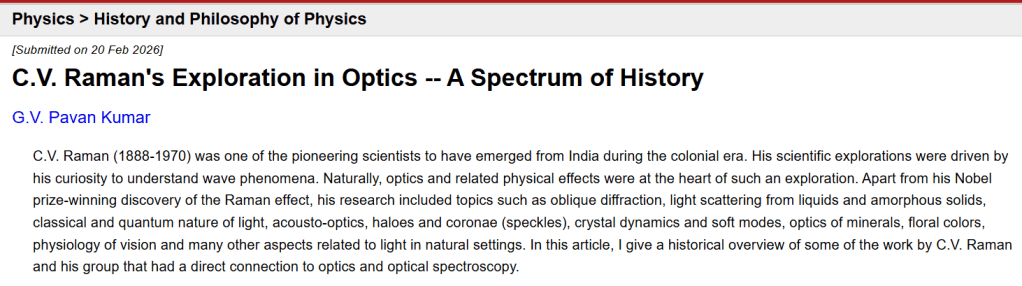
Journal of the Optical Society of America is coming up with a special issue on Optics in South Asia. I was invited to write a historical overview of Raman’s work on optics. Below is the snapshot of the pre-print. It should also appear in the axriv in the coming week. Meanwhile, you can access the preprint PDF below.
Also, look out for a research article from my group on multipolar optical binding submitted to the same issue. I will post a link when it appears as a pre-print.
Acknowledgements:
Professor Anurag Sharma, IIT, Delhi, for inviting me to write about Raman;
Other editors of this issue for taking the initiative.
Digital Archive Depository of Raman Research Institute
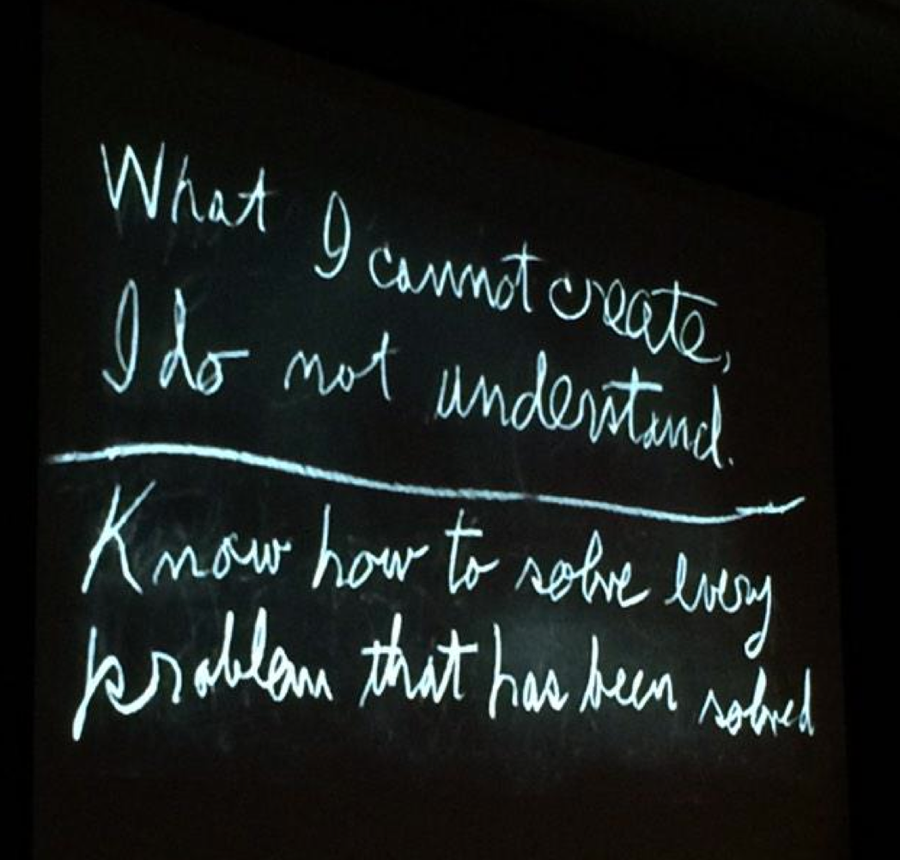
The first of these quotes by Feynman is a guiding principle for anyone who wants to learn. The second quote is an idealistic one, but a good approach to becoming a ‘problem-solving’ researcher. Feynman was a master of this approach.
From a philosophy of science perspective, researchers can be both ‘problem creators’ and ‘problem solvers’. The latter ones are usually famous.
Michael Nielsen, a pioneer of quantum computing and champion of open science movement, has an essay titled: Principles of Effective Research, in which he explicitly identifies these two categories of researchers, and mentions that “they’re not really disjoint or exclusive styles of working, but rather idealizations which are useful ways of thinking about how people go about creative work.”.
He defines problem solvers as those “who works intensively on well-posed technical problems, often problems known (and sometimes well-known) to the entire research community in which they work.” Interesting, he connects this to sociology of researchers, and mentions that they “often attach great social cache to the level of difficulty of the problem they solve.”
On the other hand, problem creators, as Nielsen indicates, “ask an interesting new question, or pose an old problem in a new way, or demonstrate a simple but fruitful connection that no-one previously realized existed.”
He acknowledges that such bifurcation of researchers is an idealization, but a good model to “clarify our thinking about the creative process.”
Central to both of these processes is the problem itself, and what is a good research problem depends both on the taste of an individual and the consensus of a research community. This is one of the main reasons why researchers emphasize defining a problem so much. A counterintuitive aspect of the definition of the problem is that one does not know how good the ‘question’ is until one tries to answer and communicate it to others. This means feedback plays an important role in pursuing the problem further, and this aptly circles back to Feynman’s quote: “What I cannot create, I do not understand”.
“…The example of great scientists is the light which guides all workers in science, but we must guard against being blinded by it. There has been too much talk about the flash of discovery and this has tended to obscure the fact that discoveries, however great, can only give effect to some intrinsic potentiality of the intellectual situation in which scientists find themselves…”
In 1972, P. W. Anderson wrote what is considered one of the most remarkable essays in the history of physics, and the title of that essay is “More is Different.” In the essay, Anderson was trying to make a case for emergence, where new, interesting physical properties can emerge by the combination of matter, which you would not anticipate if you had just kept it as an individual entity.
One of the aspects related to this essay is also the thought that reductionism has its limitations and that groups act very differently compared to individuals. The higher-level rules that can emerge from the combination of small entities are actually very different from the rules that are applicable to individual entities.
For example, if you consider electrons in a solid, you have the emergence of properties of electrons such as magnetism or superconductivity, or, for that matter, putting molecules inside a compartment and, lo and behold, life arises out of that. This has turned out to be one of the most influential ways of thinking in physics because it opened up a new avenue for understanding complex systems not as just combinations of simple systems but as the emergence of properties.
Very interestingly, this essay does not actually mention the word “emergence” at all, but the concept is so fascinating that it has turned out to be one of the most influential essays ever written in physics. The whole point about this particular essay is that the whole is more than the sum of its parts, and P. W. Anderson has to be remembered for this magnificent essay.

 VISMAYA - History & Philosophy of Physics