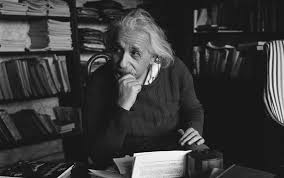
14th of March is Einstein’s birthday. There is so much written about Einstein, and every time you read about him or a text written by him, there is always something interesting to learn. Recently, I came across a wonderful paper by Shankland, who compiled his conversation with Einstein over a period of ten years and published it in 1962 in the American Journal of Physics. Below are three excerpts from the paper to give you a taste of the conversation. I would urge you to read the conversation in full, and it is a delight.
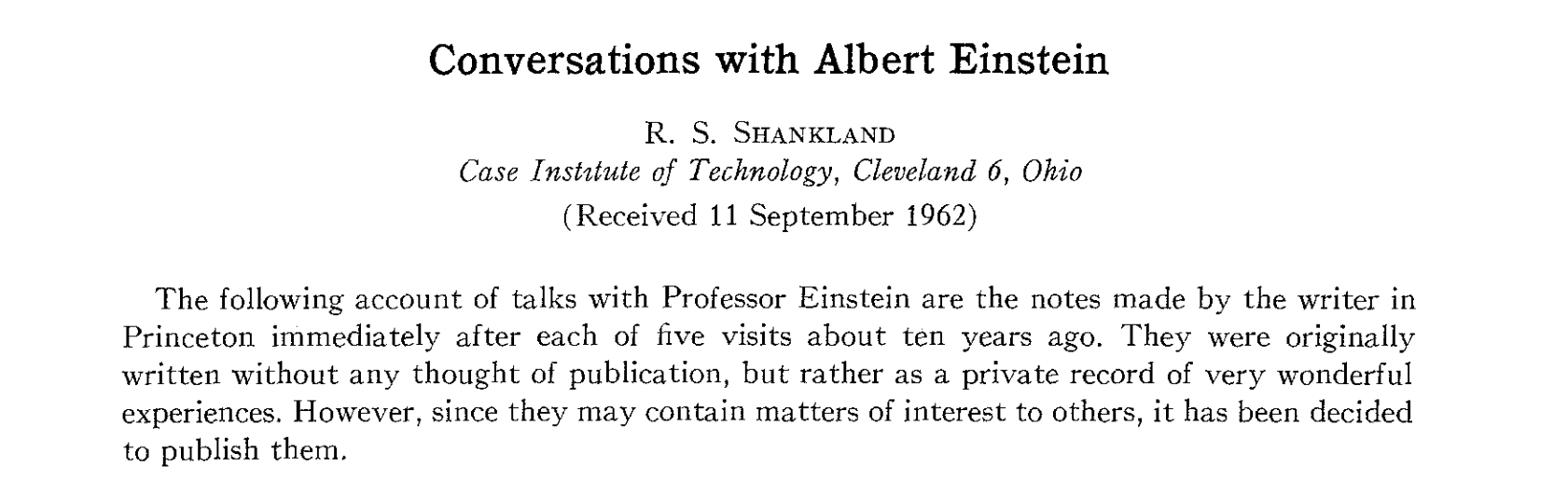
(Shankland 1963, 1)
“When I asked him how he had learned of the Michelson-Morley experiment, he told me that he had become aware of it through the writings of H. A. Lorentz, but only after 1905 had it come to his attention! “Otherwise,” he said, “I would have mentioned it in my paper.” He continued to say the experimental results which had influenced him most were the observations on stellar aberration and Fizeau’s measurements on the speed of light in moving water. “They were enough,” he said. I reminded him that Michelson and Morley had made a very accurate determination at Case in 1886 of the Fresnel dragging coefficient with greatly improved techniques and showed him their values as given in my paper. To this he nodded agreement, but when I added that it seemed to me that Fizeau’s original result was only qualitative, he shook his pipe and smiled, “Oh it was better than that!” He thought Zeeman’s later precise repetition of this experiment was very beautiful. He seemed really delighted when I mentioned to him how elegant I had found (as a student) his method of obtaining the Fresnel dragging coefficient from his composition of velocities law of special relativity.” (Shankland 1963, 2)
“I asked Professor Einstein how long he had worked on the Special Theory of Relativity before 1905. He told me that he had started at age 16 and worked for ten years; first as a student when, of course, he could only spend part-time on it, but the problem was always with him. He abandoned many fruitless attempts, “until at last it came to me that time was suspect!” Only then, after all his earlier efforts to obtain a theory consistent with the experimental facts had failed, was the development of the Special Theory of Relativity possible. This led him to comment at some length on the nature of mental processes in that they do not seem at all to move step by step to a solution, and he emphasized how devious a route our minds take through a problem. “It is only at the last that order seems at all possible in a problem.”” (Shankland 1963, 2)
“Our conversation then returned to the Michelson-Morley experiment and the Special Theory of Relativity. I could not help feeling that this elegant special theory, the product of his youthful efforts, held the place nearest to his heart. I asked him if he felt that writing out the history of the ;v[ichelson-Morley experiment would be worthwhile. He said, “Yes, by all means, but you must write it as Mach wrote his Science of Mechanics.” Then he gave me his ideas on historical writing of science. “Nearly all historians of science are philologists and do not comprehend what physicists were aiming at, how they thought and wrestled with their problems. Even most of the work on Galileo is poorly done.” A means of writing must be found which conveys the thought processes that lead to discoveries. Physicists have been of little help in this because most of them have no “historical sense.” Mach’s Science of Mechanics, however, he considered one of the truly great books and a model for scientific historical writing. He said, “Mach did not know the real facts of how the early workers considered their problems,” but Einstein felt that Mach had sufficient insight so that what he says is very likely correct anyway.” (Shankland 1963, 4)
There is a lot more to explore in the wonderful conversation paper. Link below.
Shankland, R. S. 1963. ‘Conversations with Albert Einstein’. American Journal of Physics 31 (1): 47–57. https://doi.org/10.1119/1.1969236.
 VISMAYA - History & Philosophy of Physics