FOLLOW THE MONEY – A useful model

Our world is a place with complex ideas superimposed on people with ever-changing attention. Complex ideas are complex because they depend on multiple parameters. If something changes in the world, then that change can occur due to multiple reasons.

Unlike a carefully designed physics experiment, there are too many ‘hidden variables’ in human life and behavior, especially when they act collectively. In such a situation, it is pertinent to search for models to understand the complex world. Models, by definition, capture the essence of a problem and do not represent the complete system. They are like maps, zoomed out, but very useful if you know their limitations. I keep searching for mental models that will help me understand the complex world in which I live, interact, and comprehend.

Among many models, one of them that I use extensively is the follow-the-money model. This model explains some complex processes in a world where one does not have complete information about a problem. 

Take, for example, the incentives to choose a research project. This is a task that as scientists, we need to do very often. In the process of choosing a project to work on, researchers have to factor in the possibility of that research being funded prior to the start of the project. This is critical for scientific research that is dependent on infrastructure, such as experimental sciences, including physics, chemistry, and biology. Inherently, as researchers, we tend to pick a topic that is at the interface of personal interest, competence, relevance, and financial viability.

The viability is an important element because sustained funding plays a critical role in our ability to address all the contours of a research project. Thus, as scientists, we need to follow the money and ask ourselves how our research can be adapted to the financial incentives that a society creates. A case in point is research areas such as AI, where many people are aware of its potential and, hence, support from society and an opportunity to utilize the available incentive.

It is important for the public to be aware of this aspect of research where the financial incentive to execute a project plays a role in the choice of the project itself. The downstream of this incentive is the opportunity to employ more people. This means large funding projects and programs attract more researchers. More people in the research area generate more data, and more data, hopefully, will result in more knowledge in the chosen research area. This shows how financial incentives play a critical role in propelling a research area. In that sense, the ‘follow the money’ model has a direct correlation with more researchers flocking towards a research area.

The downside of this way of functioning is that it skews people towards certain areas of research at the cost of another research area which may not find financial support from the society. This is a topic that is generally not discussed in science classes, especially at the undergraduate and research level but I think we should discuss with students about this asymmetry as their futures are dependent on financial support that they can garner.

Broadening the scope further, the ‘follow the money’ model is useful to understand why a certain global trend rises or falls. A contemporary global upheaval is the situation of war in Ukraine and Gaza. At first sight, it looks like these wars are based on ideologies, but a closer look reveals that these wars cannot be fought without financial support. Such underpinning of the money running the war reveals patterns in geopolitics that are otherwise not easy to grasp.

Ideologies have the power to act as vehicles of human change, but these vehicles cannot be propelled without the metaphorical fuel – that is, money. The ‘follow-the-money’ model can show some implicit motivation and showcase how ideologies can be used as trojan horses to gain financial superiority either through captured resources or through showcasing the ability to capture that resource. Following money is also a very powerful and useful model for understanding many cultural, sociological and political evolution, even in a complex country like India and other South Asian countries. I leave it as an intellectual assignment for people who want to explore it 😊. You will be surprised how effective it can be in explaining many complex issues, provided we know the limitations of the model. 

As I mentioned earlier, a model is like a map. It is limited by resolution, the dimension and the viewpoint. But they are useful for navigating a complex world.

Conversation with Ayan Banerjee

Ayan is an experimental optical physicist and a Professor at IISER Kolkata: https://www.iiserkol.ac.in/~ayan/group_leader.html.

He is also a playwriter, theatre actor and a mentor to many science and arts enthusiasts.

What drives him to do all these things? We discuss this and many other things in this episode.

References:

  1. “Group Leader | Light-Matter Lab.” Accessed December 2, 2024. https://www.iiserkol.ac.in/~ayan/group_leader.html.
  2. “IISER Kolkata – Ayan.” Accessed December 2, 2024. https://www.iiserkol.ac.in/web/en/people/faculty/dps/ayan/.
  3. “Ayan Banerjee – Professor – Indian Institute of Science Education & Research (IISER), Kolkata | LinkedIn.” Accessed December 2, 2024. https://in.linkedin.com/in/ayan-banerjee-3034208.
  4. Department of Physical Sciences (DPS), IISER Kolkata, 2022. https://www.youtube.com/watch?v=vgv7iODxYTY.
  5. “Department of Physical Sciences : Home.” Accessed December 2, 2024. https://physics.iiserkol.ac.in/.
  6. Ayan Banerjee. Accessed December 2, 2024. https://www.facebook.com/ayan.banerjee.5895.
  7. “‪Ayan Banerjee – ‪Google Scholar.” Accessed December 2, 2024. https://scholar.google.co.in/citations?user=GQo7yG4AAAAJ&hl=en.
  8. Gupta, Subhasish Dutta, Nirmalya Ghosh, and Ayan Banerjee. Wave Optics: Basic Concepts and Contemporary Trends. CRC Press, 2015.
  9. Haldar, Arijit, Sambit Bikas Pal, Basudev Roy, S. Dutta Gupta, and Ayan Banerjee. “Self-Assembly of Microparticles in Stable Ring Structures in an Optical Trap.” Physical Review A 85, no. 3 (March 27, 2012): 033832. https://doi.org/10.1103/PhysRevA.85.033832.
  10. “Indian Institute of Science.” Accessed December 2, 2024. https://iisc.ac.in/events/remembering-prof-vasant-natarajan-1965-2021/.
  11. “LML.” Accessed December 2, 2024. https://sites.google.com/iiserkol.ac.in/light-matter-lab-iiserk/.
  12. “LML – Physics of Micro-Bubbles.” Accessed December 2, 2024. https://sites.google.com/iiserkol.ac.in/light-matter-lab-iiserk/research/physics-of-micro-bubbles.
  13. Network, N. F. N. “Theatre At IISER-K Against Misinterpretation of Science And Superstition,” January 17, 2019. https://newsfromnadia.in/theatre-at-iiser-k-against-misinterpretation-of-science-and-superstition/.
  14. “Self-Assembly of Mesoscopic Materials To Form Controlled and Continuous Patterns by Thermo-Optically Manipulated Laser Induced Microbubbles | Langmuir.” Accessed December 2, 2024. https://pubs.acs.org/doi/full/10.1021/la402777e.
  15. X (formerly Twitter). “Ayan Banerjee (@ayanban7) / X,” November 26, 2024. https://x.com/ayanban7.

Conversation with Bhaskaran Muralidharan

Bhaskaran is an Electrical Engineer & a Professor at the Indian Institute of Technology Bombay: https://cnqt-group.org/?page_id=25

He is a quantum transport theorist, musician and long-distance runner.

We explore his intellectual, musical and running journey.

Also, don’t miss a segment on Bhaskaran playing the piano.

References:

  1. “Bhaskaran Muralidharan [Department of Electrical Engineering IIT Bombay].” Accessed November 26, 2024. https://www.ee.iitb.ac.in/wiki/faculty/bm.
  2. “‪Bhaskaran Muralidharan – ‪Google Scholar.” Accessed November 26, 2024. https://scholar.google.co.in/citations?user=PWFVEKIAAAAJ&hl=en.
  3. “Group Members – CNQT @ IIT Bombay.” Accessed November 26, 2024. https://cnqt-group.org/?page_id=25.
  4. Muralidharan, B., A. W. Ghosh, and S. Datta. “Probing Electronic Excitations in Molecular Conduction.” Physical Review B 73, no. 15 (April 10, 2006): 155410. https://doi.org/10.1103/PhysRevB.73.155410.
  5. Prof. Bhaskaran Muralidharan || Electrical Engineering || EESA IIT Bombay, 2021. https://www.youtube.com/watch?v=O8fFdb3-NRQ.

Conversation with Chaitra Redkar

Chaitra is a political scientist, Associate Professor & Chair of Humanities at IISER Pune – https://www.iiserpune.ac.in/research/department/humanities-and-social-sciences/people/faculty/regular-faculty/chaitra-redkar/326

She explores modern Indian political thought through the lens of philosophy and history.

In this episode, we discuss her intellectual journey in capturing an interesting trinity.

References:

  1. “Chaitra Redkar – IISER Pune.” Accessed November 8, 2024. https://www.iiserpune.ac.in/research/department/humanities-and-social-sciences/people/faculty/regular-faculty/chaitra-redkar/326.
  2. Redkar, Chaitra. Gandhian Engagement with Capital. First Edition. New Dehli: SAGE Publications India Pvt Ltd, 2019.
  3. X (formerly Twitter). “Chaitra Redkar (@R_Chaitra) / X,” April 9, 2023. https://x.com/r_chaitra.
  4. “Amazon.In.” Accessed November 8, 2024. https://www.amazon.in/Books-Chaitra-Redkar/s?rh=n%3A976389031%2Cp_27%3AChaitra+Redkar.
  5. “Chaitra (@my_historical_horizon) • Instagram Photos and Videos.” Accessed November 12, 2024. https://www.instagram.com/my_historical_horizon/.

Gerhard Herzberg – scientific life


References:

Pavan Kumar, G. V. “Gerhard Herzberg (1904–1999): A Pioneer in Molecular Spectroscopy.” Resonance 29 (2024): 1339. https://www.ias.ac.in/describe/article/reso/029/10/1339-1345.

Stoicheff, Boris. Gerhard Herzberg: An Illustrious Life in Science. Ottawa : Montréal ; Ithaca N.Y.: Canadian Forest Service,Canada, 2002.

Stoicheff, Boris P. “Gerhard Herzberg PC CC. 25 December 1904 – 3 March 1999.” Biographical Memoirs of Fellows of the Royal Society 49 (December 2003): 179–95. https://doi.org/10.1098/rsbm.2003.0011.

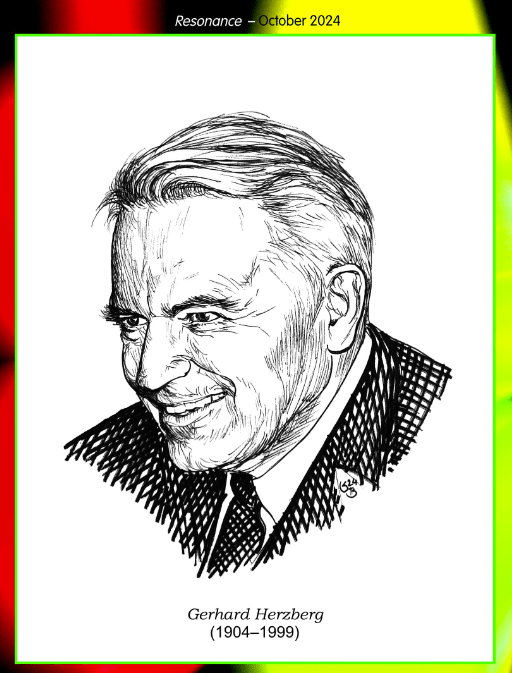
Article on Gerhard Herzberg

The October 2024 issue of Resonance, Journal of Science Education

highlights the life and science of Gerhard Herzberg.

He was one of the greatest molecular spectroscopists who laid the foundation of atomic and molecular quantum mechanics and deeply impacted molecular astrophysics and astrochemistry.

He lived an extraordinary life, first in Europe learning quantum mechanics and then escaping 1930s Germany as his wife was of Jewish origin. Then, he settled in Canada to build and lead his lab, which was considered the ‘mecca of spectroscopy’ at NRC, Ottowa.

I wrote a sci-biography article about him in this issue

Link to full edition: https://www.ias.ac.in/listing/articles/reso/029/10

If you don’t know – Resonance is a pedagogical journal published by the Indian Academy of Sciences. It is a true open-access journal. Free to read and does not charge the authors to publish.

Do explore the past editions. There are some absolute gems. https://www.ias.ac.in/listing/issues/reso

Open access : a few thoughts and books

I think that knowledge, especially academic knowledge, should be openly accessible to fellow researchers and the public. Given that most of the academic research in India is public-funded, it is imperative that our work is made available for anyone interested in reading and utilizing the knowledge. This makes a strong case for making our work open to access. Unfortunately, the open-access publication venture has been hijacked by some commercial publishers, who have misused the enthusiasm of academic researchers by converting it into a money-making opportunity via so-called ‘gold’ open-access models, where authors pay exorbitant article processing charges (APCs) to publish their work in the journals.

I have been searching literature to understand the philosophy and economics of open-access publishing models, and recently, by chance, I came across a couple of books by Peter Suber.

First is an open-access book on Open Access. Peter Suber has been a philosopher & open-access advocate for a long time. In this book, he explains what it really means to have open access to knowledge & the related philosophy, including its economics. Link to the book.

Second is a collection of writings on open-access publication (link), and as the online blurb says :

Influential writings make the case for open access to research, explore its implications, and document the early struggles and successes of the open access movement.

The green open-access model is very interesting and pertinent to countries such as India, and as per wiki it is defined as :

Green OA, is the practice of placing a version of an author’s manuscript into a repository, making it freely accessible for the scientific community.

The primary motivation of Open Access was
to provide Open Access to Knowledge to the READER of Publications and; to allow Open Access to AUTHORS Publication (unbiased publication of Knowledge)

Open access in the true sense, should neither have barriers to knowledge consumption nor to knowledge generation and dissemination. Therefore, APCs are a major hurdle to researchers and authors who do not have monetary support. This is most of the global south, and hence, a fair policy is needed to make it more democratic.