A bit of random thinking on critical thinking..a slide show..
Tag: education
C V Raman and long term thinking

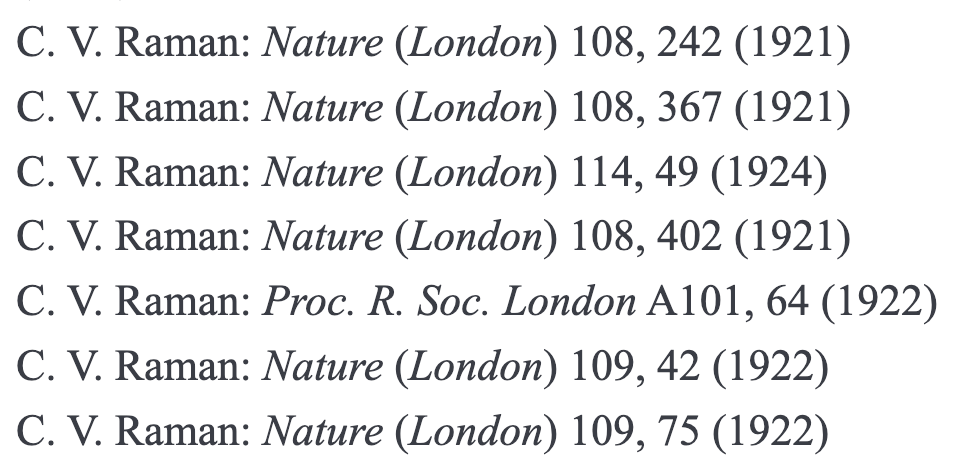
A small sampling of Raman’s publication. These papers are related to light scattering and form the foundation on which he made his famous discovery. Raman wrote more than 400 research papers in his lifetime (apart from monographs, lectures and public talks). Writing such a series of papers on a particular topic can be observed throughout his career.
A note to young scholars: intellectual monuments are built this way: thought after thought, day after day, paper after paper. Never underestimate what can be achieved with consistent, honest effort.
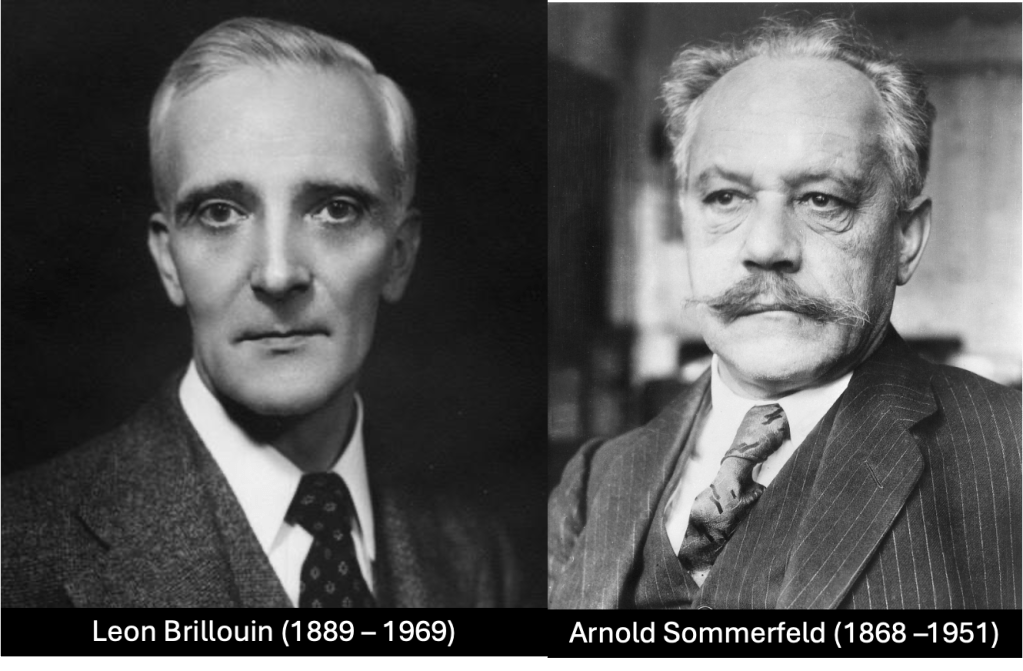
Brillouin on Sommerfeld

“Everybody wondered (and still wonders) why the Stockholm committee systematically ignored Sommerfeld’s pioneer work in modern physics. Such an omission is actually impossible to understand.”
Leon Brillouin, in the foreword of his book WAVE PROPAGATION AND GROUP VELOCITY (1959)
Brillouin further mentions the teachers who taught him, and rates Sommerfeld among the best:
“I had the great privilege of attending, as a student, lectures given by some prominent physicists, such as H. A. Lorentz, H. Poincaré, and P. Langevin. But I was especially impressed by Sommerfeld’s mastery as a teacher.“
Icons of Science in India – some thoughts
based on my blog.
ShuX in IISER Pune
Yesterday evening (10th Jan 2026), Shubhanshu Shukla, the recent Indian astronaut, was at IISER Pune as part of the ‘India Science Festival’. There was a huge crowd gathered to see and listen to him. Within IISER, it is rare to see such a massive gathering for a science event, and it was heartening to witness this on a Saturday evening. Thanks to schools and colleges in Pune, science and science-related activities get traction from the people of Pune (especially younger people). They enthusiastically participate in many events related to science.
Such a gathering is very important for at least three reasons:
- It connects a scientifically oriented person to the public and thereby connects them to science.
- It showcases that there is some science-related activity happening within the Indian scene.
- It sends out a message to people that icons can be created out of people who do science funded by the public.
I would want to emphasize four other points:
- Scientific icons are as good as the science they represent. A major part of the credit should go to the organizations that supported and trained him, and this includes ISRO, NASA and the Indian Air Force.
- To put an astronaut in space, it takes a lot of effort at various levels of society. Public support is vital for such an effort. Public icons such as Shubhanshu Shukla are a good representation of what investment in science can do to the morale of the public, especially for young people.
- The created momentum should not be lost, given that recognizable people, such as astronaut Shubhanshu Shukla, have made an imprint on young people. This should be followed up with measures to recruit them for science and technology.
- Space science and technology, astronomy and astrophysics have always been among the most fascinating domains to attract people into science. Many Indian scientists and a past astronaut, Rakesh Sharma, have played an important role in this pursuit. One should not forget them.
Let me conclude with a word of appreciation for Pune city. It is not a capital city, but its enthusiasm for intellectual pursuits is high, and it attracts a lot of enterprising people (recently, there was a public policy conference that had some amazing people). If it can get a lift in its public infrastructure, it can create its own path in the landscape of science and technology.
On Criticism
How to criticize somebody’s work? This is a question we often ask in academia, especially while writing referee reports for articles in journals and theses submitted by students. It is important to learn constructive criticism of academic work, which makes criticism a tool that can lead to positive feedback. When we talk about positive feedback, it does not mean that you will have to applaud the work. It means that anybody who is receiving the feedback should be able to build on it and improve their work.

In this regard, the philosopher Daniel Dennett has come up with some thoughts on critical commentary of somebody’s work. One of the key points he notes: ‘You should attempt to re-express your target’s position so clearly, vividly, and fairly that your target says, “Thanks, I wish I’d thought of putting it that way”’.
This way of changing the perspective on a piece of work is one of the crucial aspects of constructive criticism. It helps you to understand the role as a reviewer in not only correcting somebody’s mistake but also helping them to build on their own thoughts. Many times, criticism is looked down on as a negative thing. But done this way, it is probably one of the most enriching processes, not only for the person who is receiving the feedback, but also for the person who is criticizing the work. The correct way to criticize is to think with different perspectives and add to the body of knowledge that the author has already presented. In that way, knowledge is progressed and corrected for mistakes, if any.
How to Build Atomic LEGOs?
In ~8min, I try to explain how and why to build atomic Legos and their potential applications.
The video is for non-experts.
Reference for further reading:
Geim, A. K., and I. V. Grigorieva. ‘Van Der Waals Heterostructures’. Nature 499, no. 7459 (2013): 419–25. https://doi.org/10.1038/nature12385.
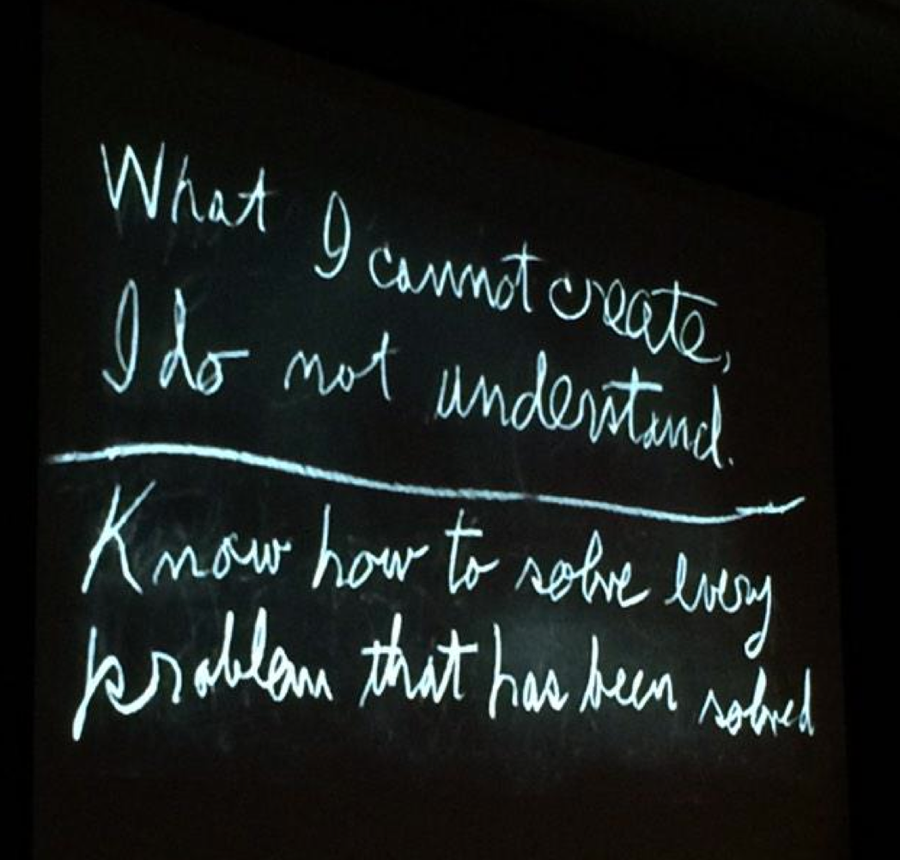
Create to Understand
Below are two quotes on the blackboard of Feynman’s office in Caltech which were found just after his death.
Raman essay and Open-Access
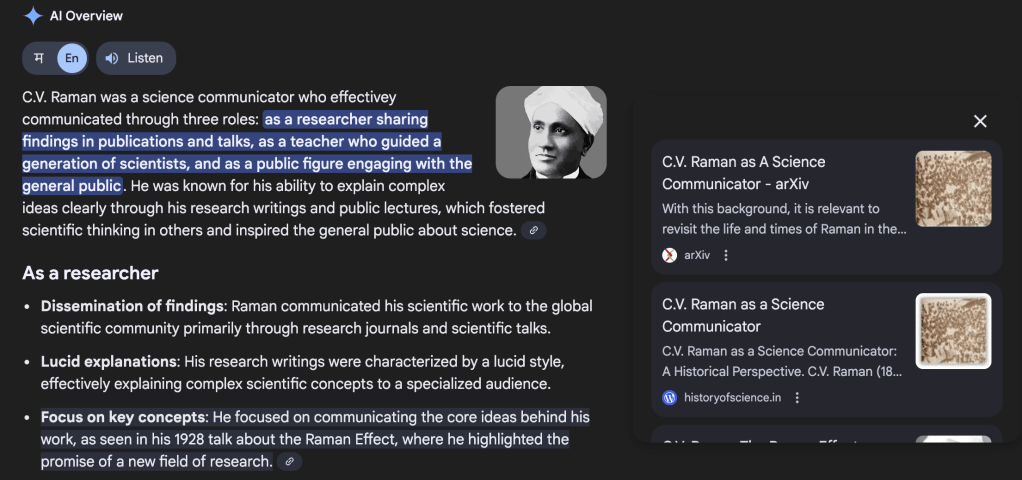
I see that the essay I wrote on CV Raman and made open access (thanks to Resonance, which published it) has been used by several educators on YouTube, including some in Indian languages. Also, the Google AI overview shows the published essay as the main reference for a search related to Raman’s science communication (see slideshow below).
I am glad to see that making one’s writing open to all has positive effects. Open-access, not just for readers, but also for authors, is beneficial. Especially in India, paywalls for science are a detriment.
My worry is that open-access publishing has been mainly driven by commercial publishers that extract huge funds from the publishing authors. This defeats the purpose of open science, especially when the research of an author is publicly funded. Added to that, Indian researchers and writers cannot afford to pay huge sums for publishing articles and books.
The publication landscape (including journals and books) across the world needs an introspection. Open-access model is effective only when the readers and authors have access to that model. Otherwise, the model becomes a paywall for authors.
Humanizing Science – A Conversation with a Student
Recently, I was talking to a college student who had read some of my blogs. He was interested in knowing what it means to humanize science. I told him that there are at least three aspects to it.
First is to bring out the wonder and curiosity in a human being in the pursuit of science. The second was to emphasize human qualities such as compassion, effort, mistakes, wrong directions, greed, competition and humour in the pursuit of science. The third thing was to bring out the utilitarian perspective.
The student was able to understand the first two points but wondered why utility was important in the pursuit of humanizing science. I mentioned that the origins of curiosity and various human tendencies can also be intertwined with the ability to use ideas. Some of the great discoveries and inventions, including those in the so-called “pure science” categories, have happened in the process of addressing a question that had its origin in some form of an application.
Some of the remarkable ideas in science have emerged in the process of applying another idea. Two great examples came into my mind: the invention of LASERs, and pasteurization.
I mentioned that economics has had a major role in influencing human ideas – directly or indirectly. As we conversed, I told the student that there is sometimes a tendency among young people who are motivated to do science to look down upon ideas that may have application and utility. I said that this needs a change in the mindset, and one way to do so is to study the history, philosophy and economics of science. I said that there are umpteen examples in history where applications have led to great ideas, both experimental and theoretical in nature, including mathematics.
Further, the student asked me for a few references, and I suggested a few sources. Specifically, I quoted to him what Einstein had said:
“….So many people today—and even professional scientists—seem to me like someone who has seen thousands of trees but has never seen a forest. A knowledge of the historic and philosophical background gives that kind of independence from prejudices of his generation from which most scientists are suffering. This independence created by philosophical insight is—in my opinion—the mark of distinction between a mere artisan or specialist and a real seeker after truth..”
The student was pleasantly surprised and asked me how this is connected to economics. I mentioned that physicists like Marie Curie, Einstein and Feynman did think of applications and referred to the famous lecture by Feynman titled “There is Plenty of Room at the Bottom” (1959).
To give a gist of his thinking, I showed what Feynman had to say on miniaturization:
“There may even be an economic point to this business of making things very small. Let me remind you of some of the problems of computing machines. In computers we have to store an enormous amount of information. The kind of writing that I was mentioning before, in which I had everything down as a distribution of metal, is permanent. Much more interesting to a computer is a way of writing, erasing, and writing something else. (This is usually because we don’t want to waste the material on which we have just written. Yet if we could write it in a very small space, it wouldn’t make any difference; it could just be thrown away after it was read. It doesn’t cost very much for the material).”
I mentioned that this line of thinking on minaturization is now a major area of physics and has reached the quantum limit. The student was excited and left after noting the references.
On reflecting on the conversation, now I think that there is plenty of room to humanize science.