In scientific research, comparative analysis is an excellent way to objectively quantify two measurable entities. The recent Google quantum chip (named Willow) does that efficiently as it compares its capability with today’s fastest supercomputers. The comparison note on Google’s blog is worth reading.
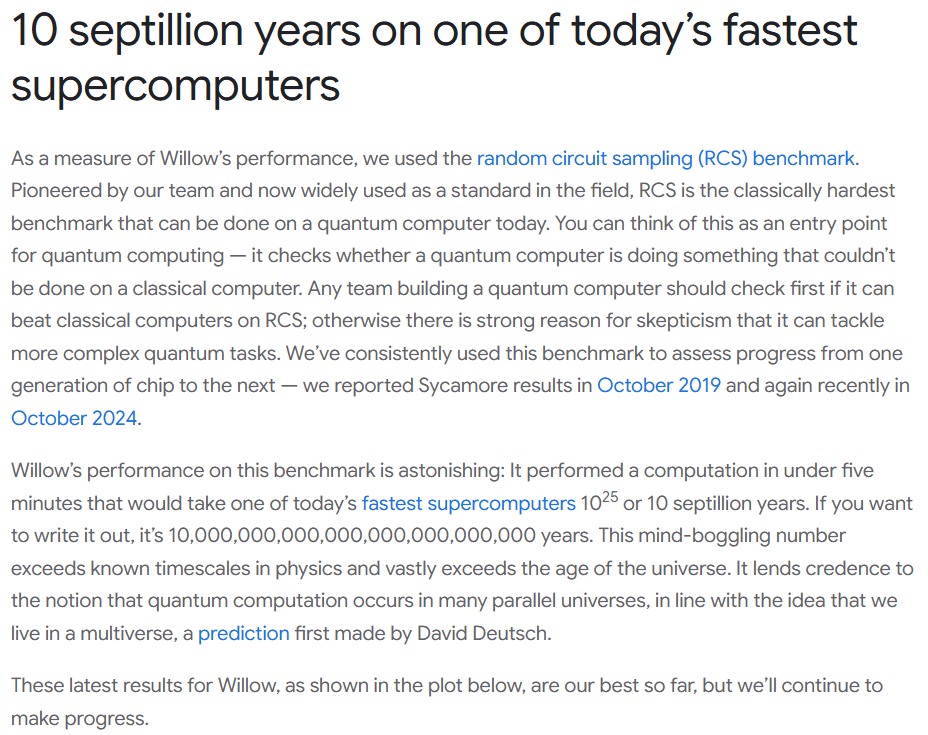
In scientific analysis, such comparison teaches us three things:
a) how a scientific boundary is claimed to be pushed?
b) how a benchmark problem is used to achieve comparison?
c) what is the current state-of-the-art in that research area?
Some further observations on the work:
- The theme of the Nature paper reporting this breakthrough is mainly on error correction. Technically, it shows how error tolerance is measured for a quantum device. This device is based on superconducting circuits, which were tested first on a 72-qubit processor and then on a 105-qubit processor.
- Interestingly, as the authors mention in the paper, the origins of the errors are not understood well.
- The paper is quite technical to read, and, to my limited understanding as an outsider, it makes a good case for the claim. The introduction and the outlook of the paper are written well, and give more technical information that can be appreciated by a general scientific audience.
- There is more to come ! It looks like Google has further plans to expand on this work, and it will be interesting to see in which direction they will take the capability. The Google blog shows a roadmap and mentions their ambition as follows: “The next challenge for the field is to demonstrate a first “useful, beyond-classical” computation on today’s quantum chips that is relevant to a real-world application. We’re optimistic that the Willow generation of chips can help us achieve this goal.”
- In the past 12 months or so, there has been a lot of buzz related to AI tools (thanks to GPTs, Nobels and perplexities :-), which are mainly in the realm of software theoretical development. This breakthrough in the realm of ‘hardware’ tells us how the physical world is still important!
More to learn and explore…interesting times ahead..
 VISMAYA - History & Philosophy of Physics